zenpundit.com » Perception

Archive for the ‘Perception’ Category

Obama’s Foreign Policy Gamble on the Moderate Islamists

Wednesday, September 12th, 2012

As you probably already know, the US Embassy in Cairo Egypt was stormed today by Islamists supposedly angry about a video on Youtube supposedly made or endorsed by anti-Muslim Quran-burner and bigot Rev. Terry Jones. The embassy, deliberately left without sufficient protection by the Egyptian government of Islamist President  Mohamed Morsi, was overrun, Islamists tore down the US flag and hoisted the black flag of al Qaida while a senior Muslim Brotherhood official has called on the US to “apologize”. All on the anniversary of 9/11.

The US Consulate in Benghazi, Libya was attacked by an Islamist militia with RPGs and small arms, sacked and burned, killing at least one American.

The Obama administration has gambled heavily upon a Mideast policy of engagement verging into appeasement and sponsorship of Sunni Islamist groups’ political and even revolutionary aspirations in the hopes of  co-opting “moderate” or “pragmatic” Islamists into a durable partnership with the United States. The new regime of American-educated Mohammed Morsi, represents the cornerstone of this policy, alongside the Libyan Revolution that toppled Gaddafi. This initiative has been delicately balanced, Nixon-style, with a very tough campaign of unapologetic targeted drone strikes on hard-core al Qaida terrorists in Afghanistan, Pakistan, Yemen and Somalia.

If you have a sense of deja vu, you are harkening back to 1979, when another Democratic administration and an arrogantly uninformed group of senior State Department officials severely misread another, that time Shia, Islamist revolution. We lost several embassies then as well and endured a national humiliation of the Iranian hostage crisis.

But give the Carter administration, it’s due: when the embassy in Teheran was seized or the one in Islamabad burned by military-sponsored Islamist mobs, no State Department official at the time responded with quite this level of truckling moral cowardice and incompetence:

@Mbaha2

@USEmbassyCairo you say all humans are equal but the truth is you hate Muslims and describe us as terrorists when u are the real terrorists

@USEmbassyCairo

@mbaha2 No, that’s not true. We consistently stand up for Muslims around the world and talk abt how Islam is a wonderful religion

Perhaps the time for anxiously politically correct FSOs describing Islam as “a wonderful religion” to an online Salafist hater could wait a few days, at least until Egypt restored the American embassy to it’s sovereign status with an apology and the body of the slain American diplomat is returned to their family from Libya for a decent burial?

The administration’s policy teeters on a knife’s edge. Their so far craven and confused response today to two of our diplomatic missions being attacked by the forces they themselves have engaged could potentially cause a snowball effect across the region. Their would-be “allies” are  currently calculating the costs of biting the hand that fed them vice the dangers of their own swarming fanatics in the streets. The administration’s officials as of today seem to have little awareness of the effects of their bizarrely conciliatory words and a stubborn determination to double-down rather than correct their course  have begun to reevaluate at least their rhetoric. The policy is another question.
.
Perhaps for our next hostage crisis, we will see an American ambassador beheaded live on al Jazeera……
.
UPDATE:
.
Events in Libya were worse than news reports yesterday indicated. Ambassador Stevens and three other diplomatic personnel were killed and the security situation in Libya remains dicey.
.
When this terrible incident is examined by Congressional committees, one focus will be on the security provided to the embassy and Ambassador Stevens by the State Department and the government of Libya, whose security minister reported that the government safe house sheltering American diplomatic personnel had been discovered by the attackers. “Where were the Marine guards?” is a question already being asked privately by national security and defense professionals which will soon be put forward in public.
.
UPDATE II:
.
Now policy may be changing sharply in the direction of realism. Good

Bassford’s Dynamic Trinitarianism Part I.

Monday, September 10th, 2012


“Clausewitz wants us to accept the practical reality that these dynamic forces are ever-present and constantly interacting in the everyday world….”

I just finished reading a working paper by Professor Christopher Bassford he has posted at Clausewitz.com that I am strongly recommending to the readership (with a hat tip to Peter at SWJ Blog).

Tiptoe Through the Trinity, or, The Strange Persistence of Trinitarian Warfare

At 31 pages of analytic prose, diagrams and footnotes regarding the nature of  Carl von Clausewitz’s “fascinating” trinity; how Bassford thinks Michael Howard and Peter Paret got some important points in their translation of On War wrong ; the real meaning of Politik and on the perfidy of non-trinitarians – Bassford’s paper is not a quick read but a worthwhile one. I learned some important things about On War from reading this paper and had some uncertain speculations strengthened by Bassford’s expertise on Clausewitz and Clausewitzians.  I am not going to attempt a summary of so long and abstruse an argument, but I would instead like to highlight some of Bassford’s more valuable insights. There were also a couple of points where, in stretching to make analogies with other fields, I think Bassford may be going astray, as well as some commentary I might make regarding “non-state war”.

This paper will be more digestible if we blog the topics one at a time, in succession.

The most important part in the paper and I think most helpful to people who have not read On War many times was Bassford’s emphasis on the extremely dynamic nature of Clausewitz’s “fascinating” (his translation) trinity:

….in fact, the Trinity is the central concept in On War. I don’t mean “central” in the sense that, say, Jon Sumida applied in his conference paper*7 to Clausewitz’s concept of the inherent superiority of the defensive form of war. That is, I do not argue that the Trinity is Clausewitz’s “most important” concept, that the desire to convey it was his primary motivation in writing, or that all of his other insights flowed from this one. Rather, I mean simply that the Trinity is the concept that ties all of Clausewitz’s many ideas together and binds them into a meaningful whole.

….In any case, the role of the Trinity within the narrow confines of Book One, Chapter One ofOn War, which reflects Clausewitz’s most mature thinking, is crucial. That chapter must be read in terms of Clausewitz’s dialectical examination of the nature of war. That discussion is very carefully structured but (purposefully, I suspect) largely unmarked by clear dialectical road markers labeling thesis, antithesis, and synthesis,*8 or even by sections clearly devoted to one stage of the dialectic or another. The Trinity itself represents the synthesis of this dialectical process.

….The H/P translation then gives the impression that the Trinity is being offered simply as an alternative metaphor. In truth, Clausewitz has already ceased riffing on the chameleon imagery. He is actually switching to a whole new metaphor, with a new structure, new entailments, and new purposes. The chameleon metaphor pointed to changes in war’s appearance from case to case; the Trinity addresses the underlying forces that drive those changes.

….The second problem here is the choice of modifying adjective. It seems that no modern translator is prepared to render wunderliche in the military context as “wonderful,” “wondrous,” or “marvelous” (much less “queer,” “quaint,” or “eccentric,” all good dictionary definitions). H/P 1976 gives “remarkable,” a throw-away word of no particular significance. This was changed to “paradoxical” in the 1984 edition, but this word seems to have no relationship to wunderliche and carries inappropriately negative connotations. Clausewitz wants us to accept the practical reality that these dynamic forces are ever-present and constantly interacting in the everyday world. But he clearly found this shifting interaction really, really interesting—to the point of being mesmerized by it.

…..Clausewitz, in contrast, was skeptical (to put it mildly) of any positive doctrine that was not highly context-specific. The pursuit of such a doctrine was entirely alien to his approach to theory. His Trinity was descriptive, not prescriptive, and foretold the very opposite of balance. (Schwebe carries the connotation of dynamism, not equilibrium.) The message of this Trinity was that the relationships among his three elements were inherently unstable and shifting. What he actually said was that “the task … is to keep our theory [of war] floating among these three tendencies,” and not to try to set, or to count on, any fixed relationship among them.

….it is the infinite variability among the trinity’s factors and in their interaction that underlies Clausewitz’s insistence on the inherent unpredictability of war. It is a classic model of Chaos, in the modern scientific sense.

….In short, this last element of the Trinity represents concrete reality, i.e., everything outside of our own skull and its emotions and calculations.

…. Clausewitz’s Trinity is all-inclusive and universal, comprising the subjective and the objective; the unilateral and multilateral; the intellectual, the emotional, and the physical components that comprise the phenomenon of war in any human construct. Indeed, through the subtraction of a few adjectives that narrow its scope to war, it is easily expanded to encompass all of human experience. It is thus a profoundly realistic concept.  

What came across to me from Bassford’s essay is that the Clausewitzian trinity makes the most sense understood as a true trinity – three separate coexistent forces in unity – and not a mere triad, which would be a simple grouping of three forces. So while Bassford is probably right that Clausewitz had no mystical intentions whatsoever here, his contemporary readership, aristocratic, educated, army officers versed in Christian doctrine of the Holy Trinity, would have grasped the difference and that primordial violence and hatred, probability and chance and the pure reason of policy were in fusion and tension and not three entirely separated forces.

I particularly like Bassford’s analysis that the trinity was unstable and shifting which wars frequently do, sliding from disciplined and limited use of military force to unconstrained barbarism or “total war” and back again.

On Psychopaths and Society

Wednesday, August 22nd, 2012

Earlier this year, milblogs had much discussion regardingtoxic leaders” – so-called “leaders” who in command epitomized a bullying, negative, destructive, egocentric, “boss from hell” that compromised missions, institutional values, morality and sometimes the law with their behaviors. This a phenomena plaguing more than just in the US military; a best-selling business book, The No Asshole Rule by Stanford professor Robert I. Sutton , even attempted to quantify the negative economic impact of psychopathic or antisocial personalities on their organizations and concluded the best strategy was to systematically not hire these people in the first place (Steve Jobs, incidentally, was identified by Sutton as the extremely rare asshole who created significantly more value for an organization than he destroyed in the damage he did to the people around him).

I came across an intriguing discussion of pyschopathology on TED that takes a number of surprising twists that puts “toxic” personalities in a different perspective than fixed categories.

An Unquiet Riot

Monday, August 20th, 2012

The Master and the Minion

The Russian girl-punk rock band Pussy Riot has done something with their protest at  Christ the Savior Cathedral that prior cases of oppression, election-fraud, corruption and murder of Putin’s critics by agents of the siloviki regime failed to do – put a defiant human face on political persecution in Russia. Something we have not seen since the days of Sakharov and Solzhenitsyn.


Photo credit: The Guardian 

A reminder that when men are not free, mocking insolence is a form of bravery.

In a thoughtful post, Charles Cameron suggests that their performance was not a “political protest”. I disagree, though I think Charles’ examination of the tradition of “Holy Fools” in Russia is useful and culturally relevant as to how this event was intended to register with a Russian audience. Pussy Riot was being audaciously offensive in their selection of performance sites, as TM Lutas explains:

Orthodoxy is not a religion that is widely understood in the West. So it’s actually the rare pundit that catches how offensive what this punk riot group was doing actually was. There’s a subtitled version of the video that helps. The video misses the positional problems. The picture screen, called an iconostasis is something like the old altar rails of Catholicism but with fairly elaborate rituals surrounding the structure. There are three doors, the center one is called the holy doors. As a lay person you’re not even supposed to walk in front of that door. It’s viewed as disrespectful, even sacrilegious. So the people in charge of order and discipline were a bit stuck because these girls were dancing in the sanctuary, in front of the iconostasis and extracting them actually meant that they had to break the rules too. Several times a Pussy Riot girl bowed and did a full prostration. One does these things towards the altar in Orthodoxy. Reversing this as the protesters did is viewed as idolatry. Who, exactly, are they bowing to? That’s the genesis of the “devil dancing” talk in their trial.

Putin may have been a target but he certainly wasn’t the target. Their attack had a much wider range of victims. This was an attack on Orthodoxy, an attack on symphonia, the concept of church and state in complementary roles and mutual respect, and also an attack on Putin. 

In 4GW thinking, the strong lose when they are forced to fight the weak on terms that favor the weak. Pussy Riot – a group of young women – engineered a protest at a location whose significance meant that the authorities could not easily ignore or suppress it quietly with brutal thuggery in the shadows. By making Vladimir Putin the lyrical center of gravity, local officials were  made to look sycophantic and toadying, national officials petty and foolish. The Russian authorities, burly and oafish like their Soviet counterparts, have been reduced to fighting young girls while the rigged legal system that passes for justice in Russia is showcased in the unsparing glare of the global media.

By daring the authorities to make them political prisoners, Maria Vladimirovna Alyokhina, Yekaterina Stanislavovna Samutsevich and Nadezhda Andreyevna Tolokonnikova have made the regime look weak.

Moreover, their actions are a not so subtle reminder to Russians that the Orthodox Church is a corrupt vessel, a propaganda arm of the regime with a long tradition of KGB agents as Patriarchs and squalid informers as clergymen. The Church in Russia has not been free of the tentacles of state security since the day Lenin ordered the arrest of St. Tikhon. President Putin and Patriarch Kyrill are not peers temporal and spiritual, but fellow alumni of the same organs as the Big Lubyanka’s gaolers and policemen.

I would like to close this post by letting Yekaterina Samutsevich speak for herself:

In the closing statement, the defendant is expected to repent, express regret for her deeds, or enumerate attenuating circumstances. In my case, as in the case of my colleagues in the group, this is completely unnecessary. Instead, I want to voice some thoughts about what has happened to us.
That Christ the Savior Cathedral had become a significant symbol in the political strategy of the authorities was clear to many thinking people when Vladimir Putin’s former [KGB] colleague Kirill Gundyayev took over as leader of the Russian Orthodox Church. After this happened, Christ the Savior Cathedral began to be openly used as a flashy backdrop for the politics of the security forces, which are the main source of political power in Russia.
Why did Putin feel the need to exploit the Orthodox religion and its aesthetic? After all, he could have employed his own, far more secular tools of power—for example, the state-controlled corporations, or his menacing police system, or his obedient judicial system. It may be that the harsh, failed policies of Putin’s government, the incident with the submarine Kursk, the bombings of civilians in broad daylight, and other unpleasant moments in his political career forced him to ponder the fact that it was high time to resign; that otherwise, the citizens of Russia would help him do this. Apparently, it was then that he felt the need for more persuasive, transcendent guarantees of his long tenure at the pinnacle of power. It was then that it became necessary to make use of the aesthetic of the Orthodox religion, which is historically associated with the heyday of Imperial Russia, where power came not from earthly manifestations such as democratic elections and civil society, but from God Himself.
How did Putin succeed in this? After all, we still have a secular state, and any intersection of the religious and political spheres should be dealt with severely by our vigilant and critically minded society. Right? Here, apparently, the authorities took advantage of a certain deficit of the Orthodox aesthetic in Soviet times, when the Orthodox religion had an aura of lost history, of something that had been crushed and damaged by the Soviet totalitarian regime, and was thus an opposition culture. The authorities decided to appropriate this historical effect of loss and present a new political project to restore Russia’s lost spiritual values, a project that has little to do with a genuine concern for the preservation of Russian Orthodoxy’s history and culture.
It was also fairly logical that the Russian Orthodox Church, given its long mystical ties to power, emerged as the project’s principal exponent in the media. It was decided that, unlike in the Soviet era, when the church opposed, above all, the brutality of the authorities toward history itself, the Russian Orthodox Church should now confront all pernicious manifestations of contemporary mass culture with its concept of diversity and tolerance.
Implementing this thoroughly interesting political project has required considerable quantities of professional lighting and video equipment, air time on national television for hours-long live broadcasts, and numerous background shoots for morally and ethically edifying news stories, where the Patriarch’s well-constructed speeches would in fact be presented, thus helping the faithful make the correct political choice during a difficult time for Putin preceding the election. Moreover, the filming must be continuous; the necessary images must be burned into the memory and constantly updated; they must create the impression of something natural, constant, and compulsory.
Our sudden musical appearance in the Cathedral of Christ the Savior with the song “Mother of God, Drive Putin Out” violated the integrity of the media image that the authorities had spent such a long time generating and maintaining, and revealed its falsity. In our performance we dared, without the Patriarch’s blessing, to unite the visual imagery of Orthodox culture with that of protest culture, thus suggesting that Orthodox culture belongs not only to the Russian Orthodox Church, the Patriarch, and Putin, but that it could also ally itself with civic rebellion and the spirit of protest in Russia.
Perhaps the unpleasant, far-reaching effect of our media intrusion into the cathedral was a surprise to the authorities themselves. At first, they tried to present our performance as a prank pulled by heartless, militant atheists. This was a serious blunder on their part, because by then we were already known as an anti-Putin feminist punk band that carried out its media assaults on the country’s major political symbols.
In the end, considering all the irreversible political and symbolic losses caused by our innocent creativity, the authorities decided to protect the public from us and our nonconformist thinking. Thus ended our complicated punk adventure in the Cathedral of Christ the Savior.
I now have mixed feelings about this trial. On the one hand, we expect a guilty verdict. Compared to the judicial machine, we are nobodies, and we have lost. On the other hand, we have won. The whole world now sees that the criminal case against us has been fabricated. The system cannot conceal the repressive nature of this trial. Once again, the world sees Russia differently than the way Putin tries to present it at his daily international meetings. Clearly, none of the steps Putin promised to take toward instituting the rule of law has been taken. And his statement that this court will be objective and hand down a fair verdict is yet another deception of the entire country and the international community. That is all. Thank you.

Pakistan’s Strategic Mummery

Saturday, August 18th, 2012

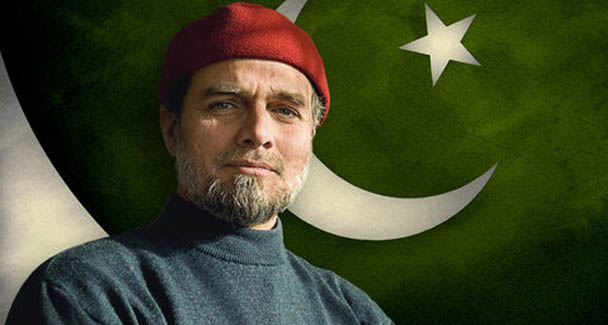
A while back, Charles Cameron had a post on the Ghazwa E Hind that served as my introduction to an oddball Pakistani agitator named  Zaid Hamid The colorful Mr. Hamid seems to be Pakistan’s fully militarized version of Glenn Beck fused with an Islamist George Friedman, with perhaps an astrologer and Rip Taylor thrown in for good measure. In discussing this figure, ZP commenter Omar offered:

….But this clown has serious backers. The deep state systematically uses these clowns to prepare the “information space” for their plans. ..and they are not kidding around. 

Zaid Hamid made a recent appearance in another post by Charles, so I felt inspired to look at him more closely and discovered that Hamid, who has a fondness for 4GW verbiage, has his own think tank, Brasstacks which publishes “geostrategic analysis”, largely about alleged “Hindu Zionist” (?) conspiracies to destroy Pakistan. These papers are fascinating, in a car-crash sort of way, much like a political intelligence letter from the LaRouchies. There is also a blog by Hamid, where his latest post remarkably declares Pakistan’s late dictator, the ruthless General Zia ul-Haq, a “shaheed”.

My question, since Hamid appears to stir controversy and criticism within Pakistan, is what is his real level of influence in Paskistani society? Comments welcome.


Switch to our mobile site