zenpundit.com » Republic

Archive for the ‘Republic’ Category

The Era of the Creepy-State is Here

Tuesday, March 6th, 2012

George Orwell was more right than he knew….

Congress passed a law – by unanimous consent in the Senate and by a suspension of rules in the House – to permit the Federal government to arbitrarily arrest and imprison for up to ten years members of the serf class (formerly known as “American citizens”) whose presence annoys or offends specally designated members of the elite and foreign dignitaries. A list that will no doubt expand greatly in future legislation to include very “special” private citizens.

Think about that, future “Joe the Plumbers” or Cindy Sheehans, before you ask an impertinent question of your betters or wave your handmade cardboard sign. Is ten seconds of glory on your local ABC affiliate news at 5 o’clock worth that felony arrest record and federally funded anal exam?

No? Then kindly shut your mouth, sir. Learn your place.

Two nebbish Representatives, one Republican and one Democrat, distinguished only by their lack of legislative or political importance, sponsored the bill on behalf of the big boys who fast-tracked it under the radar (they learned from the SOPA debacle). Forget ideology or boasts about carrying a copy of the Constitution in the breast pocket of their suit, whether you are in an archconservative Congressional district or an ultraliberal one, almost every member of Congress voted “aye” to trash multiple amendments in the Bill of Rights.

Almost every one.

This is an accelerating trend in recent years and in particular, a bipartisan theme of the 112th Congress, which views Constitutional rights of nobodies as an anachronistic hindrance to the interests (or convenience) of their powerful and wealthy political supporters. Our elected officials and their backers increasingly share an oligarchic class interest that in important matters, trumps the Kabuki partisanship of  FOXnews and MSNBC and inculcates a technocratic admiration for the “efficiency” of select police states.

It is from this demographic-cultural root of incestuous corruption that our creeping – and increasingly creepy – manifestations of authoritarianism in American life springs. The SOPA/PIPA internet censorship bills, naked scanners at airports, Stasi-like expansion of expensively wasteful TSA security theater, proposed 24/7 monitoring of  every American’s online activities, migration of police powers to unaccountable private firms, replacement of elected municipal governments with “emergency managers” (favoring financiers over taxpayers), Federal agencies monitoring political critics , the Department of Justice retro-legalizing corporate racketeering, fraud, perjury and conspiracy on a national scale, plus other infringements of liberty or gross corruption that I could list, ad nauseum.

We have reached the point where we as Americans need to stop, step back from moment by moment fixation on nonsensical, “white noise” fake political issues like “contraception” ginned up to keep the partisans distracted and become seriously involved in determining the direction in which our nation is headed. Our elite are telegraphing their strong preference for a “soft dictatorship” but we still have time to check their ambitions and rein in their looting.

It is almost quaint these days to pick up Friedrich von Hayek’s classic,  The Road to Serfdom and thumb through it. The libertarian antistatists of the 20th century were so focused on the clear and present dangers of totalitarianism that the idea of a weak state that endangered liberty through a mixture of corruption and regulatory capture eluded them. The Westphalian state at it’s apex was so overweening that the enemy of free societies, after foreign monsters like Hitler and Stalin, could be ambitious intellectual pygmies like Harold Laski or Tom Hayden. The state was so omnipotent that even it’s efforts at benevolence, to build a “Great Society” of the Welfare State were injurious to individual freedom because the expanse of statism crowded and weakened civil society , the market and private life. The argument gained political traction because, to varying degrees, it was true and looked prophetic when the Welfare-state began to crash economically in the 1970’s on stagflation.

Give the Welfare-state liberals and Social Democrats of the past their due though, their intentions by their own lights were benign. They wanted to make a safer, more secure, more equal, more just life through a more powerful state (whether that was a good idea or a realistic endeavor was the central political question between right and left). The current elite in comparison is so inferior in moral character and overconfident in their abilities that they may soon make us yearn for the former’s return.

What have now in our ruling class,  are the  builders of a Creepy-state and their intentions are not benign, except toward themselves, for as long as the looting of the American economy can last.

Unlike the Welfare-state, the Creepy-state, shot through with corruption, is  not omnipotent  because it is to be the servant and gendarme of the emerging oligarchy and not their master – but it is to be omniscient and omnipresent, constantly watching, monitoring, investigating, recording, interrogating, coercing, sorting, muzzling, gatekeeping and shearing the sheep on behalf of the shepherds.

Or the wolves.

The Creepy-state is not there to protect you or give you a higher standard of living or ensure justice or democracy, but to maintain a hierarchical public order from “disruption” (formerly known as “politics” or “democracy”). If the classical liberal ideal was the night watchman state, this state is the shadowy and ill-disposed watcher in the night.

The American political elite, Democrat and Republican, Conservative and Liberal, are in are largely in consensus that the government should, in regard to the American people:

Read your email
Listen to your phone calls
Track your movements on GPS
Track your online activity
Track your spending
Track your political activity
Read your medical records
Read your financial records
Scan your body
Scan your house
Scan your DNA
Keep you under video surveillance in public
Detain you at random in public places for security checks
Close off public spaces for private use
Seize private property for private use
Censor your speech
Block your access to judicial relief
Determine your educational and career path
Regulate your diet, place of residence, lifestyle and living standards (ever downwards)
Charge you with secret crimes for breaking secret regulations
Share or leak information about you at will

Is this the America we wish for our children or grandchildren? One that epitomizes the values of our Constitution or Declaration of Independence, or is it some kind of tawdry and shameful dime store fascism of a small Latin American country? Perhaps life is finally imitating fiction?

Fortunately, it is not too late. Irrevocable changes in the constitutional order have yet to be engineered. Our politicians are followers, not leaders here. They are a small and cowardly lot for the most part and will recoil in fear from this authoritarian ethos if a sufficiently large number of elected officials are thrown out of office at once. We can still roll this back – at least the most egregiously anti-American aspects – if we get sufficiently angry come November.

Self-interest is their only lodestone.

Wishcraft as Statecraft a.k.a The “And a Pony!” Doctrine

Wednesday, January 11th, 2012

A short and cranky diatribe.

Adam Elkus and his amigo Dan Trombly of Slouching Towards Colombia have been busy  poking holes into the ill-considered and/or poorly reasoned strategic conceptions of victory-free but credible influence. Dan gets very close to something important, something worth contemplating for the welfare of our Republic:

…..Rather than a world where normal victory and political decision through force of arms give way to a world of credible influence, I see this concept ushering in a world where America’s objectives remain expansive – seeking to create social and political change – but where “twentieth century” warfare continues as usual, obscured by multilateral efforts and prosecuted as much as possible by local forces. Because the objectives are essentially unchanged – overthrow of criminal regimes, integration of societies into a dynamic liberal international order, protection of civilians – one of my real fears about the Defense Strategic Guidance is that, confronted with conflicts and challenges to our interests, and with a paradigm of military aims just as expansive as before, we will slouch inevitably towards unsustainable ways of war. Already, the new objectives of civilian protection are blurring into the old objectives of democracy promotion and liberalization – just look at the title of the new State Department Office of Civilian Security, Democracy, and Human Rights.

When a statesman selects Ends that have no rational relationship to available Ways and Means we might take that as a sign of possible incompetence as a strategist.

While that’s not good it is at least normal – most politicians in a democratic society are on average, poor strategists but pretty good intuitive tacticians. After all, acquiring and keeping political power for long periods of time requires more than luck and a large checkbook. While there are always some buffoons decorating the halls of Congress, as individuals, Members of Congress are usually pretty shrewd and a minority are exceptional people.

If the Ends selected are fantastically broad open-ended, undefined or, worse, undefinable, convoluted and insensible in their context, we are left with two even less savory conclusions:

First, that the statesman has a fundamental political immaturity and narcissism the leads them to articulate their emotively generated whims as policy objectives without regard to empirical reality. Sort of a wishcraft of state that substitutes rhetorical expressions and sloganeering for thought and analysis. We see this effect on a much larger scale in the ideological atmosphere of totalitarian regimes where 2+2= 5 and only Right-deviationist mathematician, counterrevolutionary wreckers would dare suggest the answer is 4. Geopolitical goals that are created by political fantasists – like the creation of a modern, liberal democratic state in Afghanistan in a few years time – can be appended with “And a Pony!” and still be just as likely to come to pass.

American statesmen seem to be particularly predisposed to this condition in foreign affairs (and arguably, in fiscal affairs as well). Perhaps this is an intellectual legacy of Wilsonian excess but the problem was not acute until the past decade and a half, which indicates that the driving force may be, in part, generational. Men and women born into a time of record-breaking standards of living have reached the apex of power and they are no more inclined to act with restraint, responsibility or realism now than they did in ’68.

The second conclusion is that the Ends are purposefully incoherent and recklessly broad because the real strategic objective is not in our relations with country X, but for the statesman to wrest for their faction as large a grant of unaccountable power as possible.

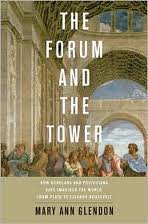
The Forum and The Tower, a review

Sunday, November 20th, 2011

[by J. Scott Shipman]

the-forum-and-the-tower.jpeg

The Forum and The Tower by Mary Ann Glendon

“The relationship between politics and the academy has been marked by mutual fascination and wariness since the time of Plato.”

The first sentence on the flap of the dust jacket of this very good and informative small book. Professor Glendon, who is the Learned Hand Professor of Law at Harvard Law school, set out to write a book for her students that would answer ageless questions such as:

“Is politics such a dirty business, or are conditions so unfavorable, that couldn’t make a difference? What kinds of compromises can one make for the sake of getting and keeping a position from which one might be able to have influence on the course of events? What kinds of compromises can one make for the sake of achieving a higher political goal? When does prudent accommodation become pandering? When should one speak truth to power no matter what the risk, and when is it acceptable, as Burke put it, to speak the truth with measure that one may speak it longer? When does one reach the point at which one concludes, as Plato finally did, that circumstances are so unfavorable that only the reasonable course of action is to “keep quiet and offer up prayers for one’s own welfare and for that of one’s country”?”

Professor Glendon answers these questions and more through brief examinations of the lives and works of some of history’s most important figures:

Plato

Cicero

Justinian, Tribonian, and Irnerius

Machiavelli

Thomas Hobbs and Edward Coke

John Locke

Jean-Jacques Rousseau

Edmund Burke

Tocqueville

Max Weber

Oliver Wendell Holmes

Eleanor Roosevelt and Charles Malik

All in all, I believe Professor Glendon has provided a uniquely valuable book to help her students and other readers to answers those questions. In short but focused chapters of about 20 pages each, she provides mini-biographies of the subjects above and how they answered the some of the questions both in their lives and in their philosophy. Some of her subjects were thinkers lacking the abilities for the public square, Plato, for instance, but were enormously influential just the same. Rare were those like Cicero and Burke who were equally comfortable in the political arena or the academy.

My favorite chapters were on Plato, Cicero, Machiavelli, and Burke—mostly because I’ve read a respectable amount of their work. That said, I have not read Plato’s The Laws—and Professor Glendon suggests it is much better than The Republic—which I have read and did not much enjoy. Not surprisingly, The Laws will be on my list for this winter.

The inclusion of Eleanor Roosevelt and Charles Malik was something of a surprise, but Professor Glendon is weaving a sub-story through each chapter and illustrating how Roosevelt and Malik’s work on the Universal Declaration of Human Rights was something of culmination and extension of over 2,000 years of thinking and political action—not in the context of human progress towards a utopia of sorts, which she wisely rejects,  but rather a reflection the common threads of political thought throughout history.

While this is not criticism, I would have liked to have seen a chapter on John Adams and Thomas Jefferson, and a chapter on Karl Marx, whom she frequently mentions.

This is a book that is approachable and readable, and in our tumultuous domestic and global political climate, important.

She closes with this illuminating sentence:

“If one message emerges from the stories collected here, it is that just because one does not see the results of one’s best efforts in one’s own lifetime does not mean those efforts were in vain.”

Professor Glendon is to be commended for a job “well done!”

The book comes with my highest recommendation and may be the best book I’ve read this calendar year. Add this book to your must read list.

.
Referenced works you may find of interest (some of these works are out of print and expensive—for simplicity I’ve used Amazon links): 

The Laws of Plato, translated by Thomas Pangle

Cicero: The Life and Times of Rome’s Greatest Politician, by Anthony Everitt

Cicero, A Portrait, by Elizabeth Rawson (Glendon praised this book.)

A Panorama of the World’s Legal Systems, John Henry Wigmore

The Life of Nicolo Machiavelli, Roberto Ridolfi

The Prince, translated by Harvy Mansfield

Machiavelli, by Quentin Skinner

The Lion and the Throne, Catherine Drinker Bowen

The Spirit of Modern Republicanism, by Thomas Pangle

Statesmanship and Party Government, by Harvy Mansfield

The Great Melody, A Thematic biography of Edmund Burke, by Conor Cruise O’Brien (I read this wonderful book in 1992 when it was released: highly recommended.)

Kesler on R2P Hypocrisy

Saturday, October 8th, 2011

Nice catch by Bruce Kesler who goes en fuego on the weirdly discordant note Anne-Marie Slaughter strikes in her latest New York Times op-ed:

Majority Rule Over Minorities: Ironic R2P Hypocrisy

The extremism of R2P’s leading proponent is exhibited in Anne-Marie Slaughter’s op-ed in today’s New York Times. Slaughter likens the Wall Street protesters to those demonstrating against oppressive regimes in the Middle East and recommends removal of the US system of checks and balances that protect minority views and avoid poorly developed political stampedes. (Slaughter doesn’t mention or give credence to the more numerous, mature citizenry participating in or supporting the Tea Parties more peaceful protests for more limited government intrusions into Americans’ private lives and earnings.)

R2P’s leading proponent, Anne-Marie Slaughter of Harvard, believes that US foreign policies and military interventions should prioritize the Right To Protect severely repressed peoples through US obeisance to liberal internationalist elites’ sentiments in favor of some they like regardless of the US Constitution or laws or national or security interests.

In today’s New York Times, Slaughter takes her R2P home to the US, advocating that majorities rule regardless of the formal and informal checks and balances of our political system and overriding the rights of political minorities. Again, it is the majorities that liberals like who should be given more powers.

Without any sense of proportionality or of core differences between the US and Middle East satrapies, Slaughter says, “Indeed, the twin drivers of America’s nascent protest movement against the financial sector are injustice and invisibility, the very grievances that drove the Arab Spring.” Slaughter then concludes, “The only effective response is a political response, of a nature and magnitude that convinces protesters on the streets that they can in fact secure the change they seek within, rather than outside, the system.”

Slaughter’s system, however, would reduce the ability of permanent or transitory political minorities to protect their interests. They would, also, further factionalize the US and make compromises more difficult as the power of centrists is reduced….

Read the rest here.

Good grief. Anne Marie Slaughter opining on the need for greater democracy and accountability to the people is somewhat akin to Ayn Rand calling for more welfare programs.

My suspicion here, since this rhetoric runs counter to Slaughter’s most influential ideas, is that Slaughter is just carrying water as part of the current Democratic political strategy of trying to co-opt the Occupy Wall Street movement. Perhaps the Axelrods and Podestas see that open-source protest movement to potentially be “their tea party”. Whatever. I will take her op-ed more seriously when she is marching against the Hedge fundies and Wall Streeters who are top donors to her Party, her administration and her university.

You can put a three corned hat on a Princeton theorist of global governance by transnational “governmental networks” but even if you adjust the hat at a suitably jaunty angle for maximum populist effect, the agenda underneath is still neither democratic nor popular.

Fouche on Potential and Probable Uses of Power

Friday, October 7th, 2011

My sometime Chicago Boyz colleague, Joseph Fouche, had an interesting if somewhat meandering post on how power is used, not used and possibly abused.

The Chains of the Improbable vs. The Chains of the Impossible

An old Vulcan proverb advises us that only Sulla could march on Rome. This proverb may contradict another ancient proverb that claims that all roads lead to Rome. This seeming contradiction is resolved when you include little used roads, off the beaten track, the roads not taken. Sherlock Holmes once chided John A. Watson, M.D., saying, “How often have I said to you that when you have eliminated the impossible, whatever remains, however improbable, must be the truth?” Some roads to Rome are impossible, leading to the insurmountable. Lucius Cornelius Sulla Felix took a road that, while thought impossible, proved to be merely improbable.

Sulla, consul of Rome for the year 88 B.C., was in camp preparing to take his army east to fight King Mithridates VI of Pontus. Two envoys arrived to tell him that his command had been taken away by the vote of one of the people’s assemblies in Rome. These envoys of the Roman people expected that Sulla would do the only thing possible: lie down there, obedient to their commands, as every Roman army commander before him had done. Unfortunately, what they thought was impossible was only improbable.

Sulla gathered his men, announced what the will of the Roman people was, and asked them what the will of the army was. Sulla’s soldiers answered by stoning the envoys of the Roman people to death, much to the surprise of the envoys of the people. Sulla’s soldiers then petitioned Sulla to take an impossible road, a road never taken, and lead them to Rome to reclaim his Mithridatic command. Sulla, much to the surprise of his own officers, who thought such a course impossible, decided to heed his men and march on Rome. His officers resigned en masse except a happy few. But the poor bloody legionaries of Sulla’s army eagerly began the march on Rome.

Envoys from Rome streamed towards Sulla’s army as it marched north.These envoys were shocked and grew increasingly shocked as they protested to Sulla that surely, surely it was impossible that he wanted to march a Roman army through the city limits and into Rome itself. The law forbade it. The unwritten constitution forbade it. The Republic forbade it. The gods forbade it.

Sulla responded to the effect of, “Go tell the Romans that I don’t lie here obedient to their commands. I’m coming to Rome and hell’s coming with me.” The tone of these envoys’ entreaties and the mood of the people of Rome grew increasingly hysterical as the improbable dawned on them: not only could a Roman army commander march an army on Rome, it was increasingly probable that Sulla would march armed Roman legionaries right into the heart of Rome itself to deal with his political enemies. Indeed, Sulla led his men across the sacred pomerium that divided the “public thing” (res publica) of sacred Roma herself from land that was merely the property of Rome. Sulla’s veteran legionaries easily dispatched the hastily gathered mob of gladiators and other ruffians that his political opponents had thrown together at the last moment in a futile attempt to stop them.

Sulla had revealed that the impossible was merely the improbable.

Sulla spent the rest of his life trying to disguise this state of improbability as a mere state of impossibility.

He failed.

That was merely Fouche’s introduction. The post is well worth reading in full.

The post caught my eye because of Sulla, a Roman who did a monstrous thing but who was himself no monster. Much like a surgeon whose patient’s body is riddled with cancer, Sulla attempted to buy the old Roman Republic time and restore a semblance of political health by ruthlessly cutting out a tumorous faction and ratcheting back a host of constitutional gimmickery that had been welded onto Roman government over the years by ambitious politicians. Older, original rules of the game, or new ones in their spirit, were restored after blood shed in the proscriptions was scrubbed from the forum. Sulla even formally stepped down from the supreme power he held, like Cincinnatus, to further drive home the point to his fellow Romans regarding the sanctity of their traditions – though reportedly Sulla remained, even in a debaucherous retirement, a terrifying figure and stringpuller.

Fouche is correct that Sulla’s extreme measures failed. The underlying structural problems of the Republic were rooted in an increasing concentration of wealth, primarily in land ownership by Patricians and politically favored trading opportunities in “the East”, held mostly by the elite of Rome’s Italian “allied” city states, that left many Roman citizens too impoverished to perform military service or to be active in politics, except as dependent members of a clientela. The Republic’s legions and it’s political virtue had been based on an economically independent smallholding class who were being despoiled by politically powerful Patricians. Sulla’s reforms may have tempred political conflict within the ruling class for a time, but they also aggravated the social grievances that provided the Populares with political support from ordinary Romans and tilted the delicate political balance in the Republic toward extreme oligarchy.

In his retirement, observing the young Julius Caesar, whom Sulla had reluctantly spared, his toga fashionably loosely belted, long sleeved and wearing boots, like the ancient kings of Alba Longa, Sulla remarked “ He contains many Mariuses“. Caesar did. And unlike Marius but like Sulla, Julius Caesar was successful, Sulla having shown him the way to cross a Rubicon.

Power is power but power coupled with legitimacy endures. Sulla to Caesar to Augustus is the continuum.


Switch to our mobile site