zenpundit.com » visualization

Archive for the ‘visualization’ Category

WYSIWYG

Friday, January 18th, 2013

[ by Charles Cameron — what you see is what you get: WYSIWYG — and possibly also TEOTWAWKI ]
.

See buildings, walls, handrails, reflections, rows of windows, and people he’s walking past vanish and reappear as a man dressed for mountain climbing sets out into a blizzard of snow, video snow and special effects…

Hat-tip — Shlok Vaidya.

**

We knew that Iran could photoshop extra rockets into a widely distributed news image –
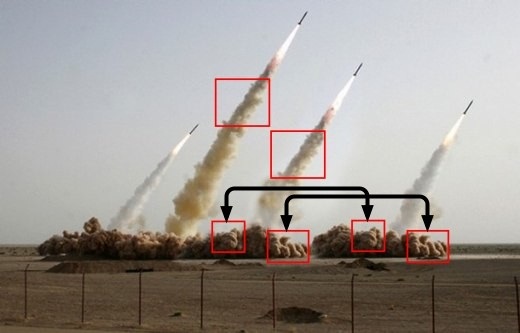
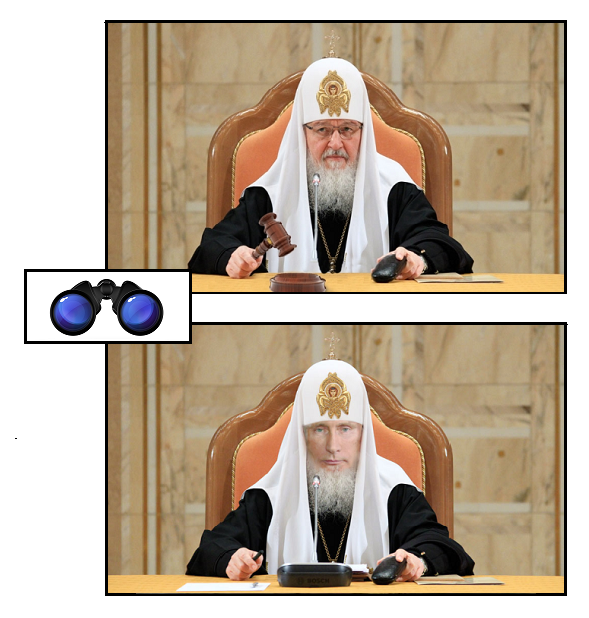
and that Russian dissidents could makeover Kirill as his friend Putin

But the video above, with it’s vanishing and reappearing everythings? Simple — it’s a stunning portrayal of just what patience and skill can manage with video tampering using Photoshop CS5 or the like. Hence — this may also be the time to announce TEOTWAWKI. The end of the world as we know it. As we believe we know it.

You only need one of those effects, remember, to fake out a geopolitical tipping point…

Watcher, beware.

**

But then there’s my friend Howard Rheingold, who points out that our whole world is a constructed reality:

We habitually think of the world we see as “out there,” but what we are seeing is really a mental model, a perceptual simulation that exists only in our brains. …

Cognitive simulation — mental model-making — is what humans do best. We do it so well that we tend to become locked into our own models of the world by a seamless web of unconscious beliefs and subtly molded perceptions. And computers are model-making tools par excellence, although they are only beginning to approach the point where people might confuse simulations with reality.

That’s a quote from his piece in Brenda Laurel‘s 1990 classic Art of Human-Computer Interface Design — and it seems to grow more prescient by the day!

**

Three topics, at least somewhat related, we can maybe talk about later:

  • Who it was that spread the word about the Innocence of Muslims trainer.
  • The disputed Muhammad al-Durrah incident at the Netzarim junction. And
  • Zero Dark Thirty.
  • New Book: The Violent Image by Neville Bolt

    Friday, December 14th, 2012

    The Violent Image by Neville Bolt 

    Columbia University Press just sent me a review copy of The Violent Image, by Dr. Neville Bolt of King’s College vaunted War Studies Department.  Initially, I was amused by the colorful book jacket, but flipping through, it belies a very weighty, heavily footnoted, academic exploration of the iterative relationship between propagandistic imagery and insurgency. Even a casual perusal indicates that The Violent Image is a book many readers of ZP will  like to  get their hands on.

    From the jacket:

    ….Neville Bolt investigates how today’s revolutionaries have rejuvenated the nineteenth century “ptopaganda of the deed” so that terrorism no longer simply goads states into overreacting, thereby losing legitimacy. Instead the deed has become a tool to highlight the underlying grievances of communities

    A small sampling of some of the section titles:

    Strategic Communications:the State
    Strategic Communications: the Insurgent
    Networks in Real and Virtual Worlds
    Images as Weapons
    POTD as Insurgent Concept of Operations
    Anonymity and Leaderless Revolutions
    The Arab Uprisings and Liberation Technology
    POTD as Metaphor

    Endnotes run slightly over 90 pages and the bibliography tips the scales at 50, for those interested in such things.

    Looking forward to reading this and seeing how Bolt presents his case.

    Sensitive dependence on initial conditions — & more

    Saturday, November 3rd, 2012

    [ by Charles Cameron — on human impact, with a quick glance at Pundita’s wide-angle thinking ]
    .

    The “butterfly effect” identified by meteorologist Edward Lorenz suggests that when you are dealing with highly complex systems such as weather patterns, what eventually happens may be “sensitively dependent on initial conditions”. Very small differences at one moment in such systems may result in very large differences later on. As Lorenz explains in the upper quote above, however, we’re dealing with a myriad of influences simultaneously, and it’s entirely possible that our own meteorological impact exceeds and outweighs that of the butterfly species…

    I’ve chosen to post this particular pair of quotes, in fact, because both examples point to severely deleterious effects of human impact on our home environment in the larger sense — “the world we live in” — at a level where human individuals may not feel they have much of an individual impact, but where the cumulative effect is much greater: global warming? devastating storms? loss of rain forest? — narcarchy?

    Narcarchy: hereby defined as rule by cartel — see this fascinating news piece, and note in particular the presence of a significant religious thread in the midst of the drug / crime / warfare picture.

    **

    On the question of sensitive dependence on initial conditions, this graphic paints the picture nicely and with nuance, for those who “think in pictures”:

    I found it attached to the Wikipedia entry on Lorenz’s Butterfly Effect which may also help if like me you’re a lay reader, mathematically speaking.

    **

    I also wanted to juxtapose the two quotes above because they give me a chance to talk about “wide angle views” and their virtues, and to point you to a recent Pundita post that set me thinking along those lines. The post is Then and Now: Instructive parallels between 9/11/01-Benghazi and Katrina-Sandy storms, and part of my comment read as follows:

    …you have an amazing breadth of thought going on here – especially in your paragraph:

    It’s as if a new era arrived, with its vast changes in weather patterns and attack patterns, and nobody is yet fully processing the nature of the threats. I guess such an observation is actually old news. But Sandy coming on the heels of Benghazi struck me as a kind of exclamation mark to the fact that civilizations start to fall at the point where they’re no longer able to process the cumulative effects of their past.

    Seeing parallels between Benghazi and 9/11, or between Sandy and Katrina, would be one thing – but managing to see parallel changes in both “weather patterns and attack patterns” is quite another — and even though people may want to question and qualify some of the details, the overall scope and view is breathtaking.

    We need this kind of wide-angle thinking, it seems to me, and I offer my two quotes here in much the same spirit.

    So if “sensitive dependence on initial conditions” is one analytic thought pattern I’m promoting here, “wide-angle thinking” and the capacity to zoom from significant detail to global context is surely another.

    Graphic matches?

    Thursday, September 27th, 2012

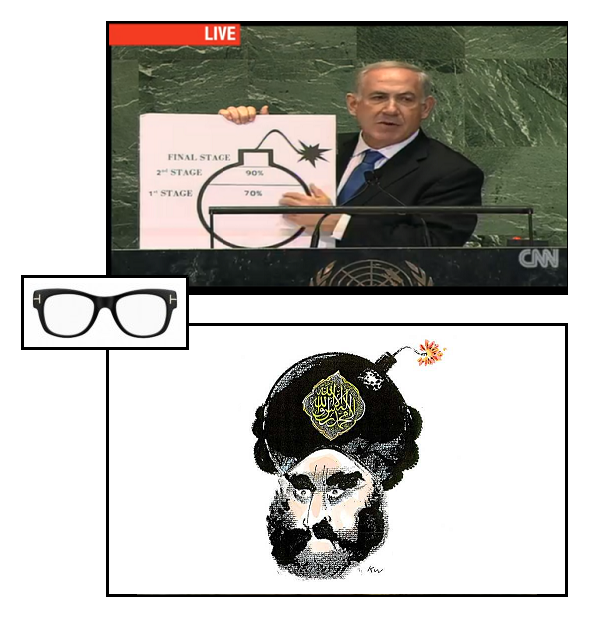
    [ by Charles Cameron — Netanyahu’s UN speech, Jyllands-Posten cartoon, a nifty film technique, and is there an echo there? ]
    .

    **

    A fair number of people have commented on Israeli PM Netanyahu‘s displaying a cartoonish bomb graphic in the course of his UN address today, and some have complained, fairly IMO, at the choice of photo used to depict Netanyahu during his speech by eg Fox News:

    I think it’s important to read graphic messages closely for the cues they contain.

    **

    Sometimes, as with images of the Virgin Mary seen in grilled cheese sandwiches or oil slicks, the correspondences don’t really mean much more than that the brain is designed for pattern recognition, and a little “imagination” without critical appraisal can get things wrong: the terms commonly used for this are apophenia, patternicity and pareidola.

    My own favorite example of this phenomenon is of the wall-stain in a school in the East Bay that was recognized as the Virgin Mary by Catholics and the bodhisattva Kuan-Yin by Buddhists

    Nonetheless, I’m reluctant to ridicule such modes of perception without also recognizing the utility of Rorschach blots in psychology and the even more creative uses to which Leonardo put them.

    **

    Perceived visual similarities, in short, can be the result of creative or merely overheated imagination, but in the visually sophisticated they become much more.

    Film-makers, in particular, have several names for the kind of skillful editing by which one scene segues into another via a well-chosen visual similarity: match cut and graphic match.

    My personal favorite example is that of Apocalypse Now, where the rotors of the fan in that claustrophobic hotel room in Saigon morph into the rotors of the helicopter coming to take Captain Willard out and away on his mission up river…

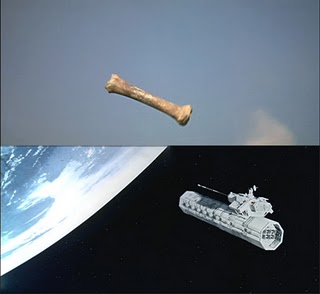
    Perhaps even more celebrated, though, is Kubrick’s match between the bone tumbling through the air and the space station tumbling through space, in 2001: A Space Odyssey:

    **

    To get back to Netanyahu, then — is his hand held out a little above vertical, palm down, really a Hitler salute? I think not.

    And does his image of a bomb carry any resonance from the Jyllands-Posten cartoon? I have to admit I’m almost undecided on that one.

    And if there’s just a hint of a correspondence, would it be conscious or unconscious?

    **

    The thing is, politicians have to be extremely careful about tossing graphic matches onto dry kindling.

    To my own way of thinking, both Netanyahu’s “cartoonish bomb” graphic and his “mid-heil” salute are potential fodder for incautious speculation — but neither one is even remotely as far-fetched as Jerome Corsi‘s claim in a recent WND that a recent Obama campaign use of the Stars and Stripes (above, upper panel) — in admittedly terrible taste — suggests that Obama in any way favored the decease of Ambassador Christopher Stevens in Benghazi (lower panel).

    **

    My point here, as so often, lies not in any political content or conclusion, so much as in a general purpose invitation to persons of intelligence (and a fortiori, intel) to watch out for possible graphic matches, to make close and cautious readings of visual as well as textual data — in short, to take a closer look

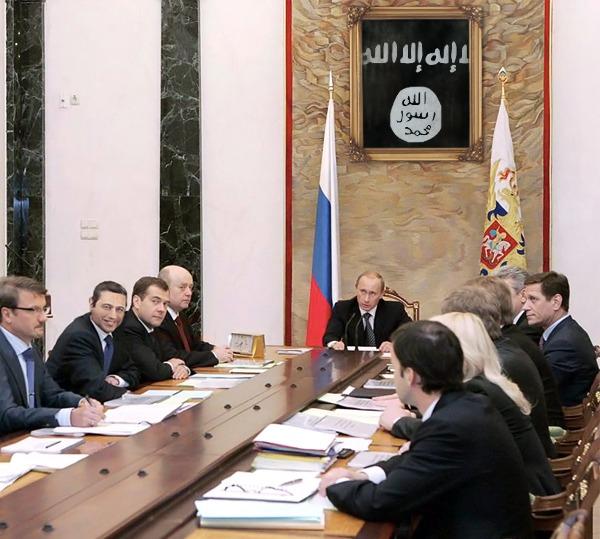
    A slight change of ideology at the Kremlin?

    Monday, September 10th, 2012

    [ by Charles Cameron — with irony, skepticism, and just a dash of dry humor ]
    .

    image from the Ansar forum, h/t to Aaron Zelin

    **

    You’re probably familiar with the idea of a jihadist flag flying over the White House. Anjem Choudry, the British radical Islamist preacher told Christiane Amanpour on ABC This Week a while back:

    Indeed, we believe that one day the flag of Islam will fly over the White House. Indeed, there’s even a narration of the prophet where he said that ‘the Judgment will not come until a group of my Ummah conquered the White House’.

    I’ve dealt with this hadith before as it happens, and pointed out that in one telling the Prophet is asked which “white palace” he’s referring to and replies that he’s referring to the palace of Khosrau (Chosroes) I of Persia:

    Jabir b. Samura said:

    I heard the Messenger of Allah (may peace be upon him) say on Friday evening, the day on which Ma’ez al-Aslami was stoned to death (for committing adultery): A small force of the Muslims will capture the white house. I said: Kisra? he replied Kisra.

    **

    Never mind, Choudary thinks the jihadist flag will fly over the White House on Pennsylvania Avenue — and like-minded protesters in New York even carried a photoshopped image of the concept (below) as a placard at a 2006 rally in New York.

    **

    Hey! Put those two ideas together — a little “more of the same” photoshopping should do the trick — and you’d have a magnificent end to the Cold War, eh?

    Maybe that’s what Choudary meant when he said, earlier in the same conversation with Amanpour:

    Well, just let me say that Islam has a solution for all of the problems that mankind faces.

    I suppose that’s one way to avoid a clash of civilizations — have just one guy holding both cymbals, right?


    Switch to our mobile site