zenpundit.com » Hipbone Games

Archive for the ‘Hipbone Games’ Category

DoubleQuote as Match Cut

Monday, October 12th, 2015

[ by Charles Cameron — further passing notes in the virtual music of ideas, including meditations for glass bead game players ]
.

From the agile algorithmic eyes at Archillect:

A match cut or graphic match in cinema is, in Wikipedia’s words,

a cut in film editing between either two different objects, two different spaces, or two different compositions in which objects in the two shots graphically match, often helping to establish a strong continuity of action and linking the two shots metaphorically.

**

Perhaps it’s time to post my Meditations for Glass Bead Game Players:

i

First, I ask you to consider the rhyme of “womb” with “tomb” — which has the delicious property that these two words describe, if you will, the two chambers from which we enter this life and through which we leave it. Not only do the two words rhyme on the ear, in other words, they can also be said to rhyme in meaning. Meditation: if you were wearing headphones, and these two words were spoken, what would the stereophony of their meanings be?

ii

Next, I would invite you to consider visual rhymes — known as “graphic matches” in film studies. Take, for instance, lipstick and bullet. To rephrase the opening of a book I am still working on:

The conjunction comes from a Yardley’s cosmetic advertisement of a few years back: a woman model wearing a leather bandolier with a variety of lipsticks in place of bullets. It is a powerful image partly because it plays on the visual similarity of bullets and lipsticks, each in their own metal jacket. Indeed, the visual match between them is astonishing — and the lurking Freudian visual pun only adds to our delight.

The juxtaposition of lipstick and bullet I take to be an example of a certain kind of visual logic, a visual kinship. Transposing their relationship from visual to verbal terms, one might say that lipstick and bullet “rhyme.”

But there is more than the purely visual here too… There is also a meaning rhyme that echoes in Freud’s pairing of Eros and Thanatos, in Wagner’s Liebestod, in Woody Allen, and in the opening sentence of Bedier’s Tristan and Iseult:

My Lords, if you would hear a high tale of love and death…

Meditation: what is the stereophany (by analogy with epiphany, theophany — neologism intended) of the meanings of lipstick and bullet?

iii

Consider next musical rhymes — fugal treatment of a theme — and if you have the means, play yourself Bach’s Chromatic Fantasia and Fugue, BWV 903, or Passacaglia and Fugue, BWV 582…

iv

Next I would ask you to consider — briefly — rhymes between ideas themselves… Ponder, for instance, the twin themes of the myth of Narcissus, and the rhyme that exists between the idea of “echo” and that of “reflection”…

v

Consider rhymes between things, between names and the things they name (onomatopoeia), and between ideas and names and things and musical themes and images:

Seen together, aerial maps of river estuaries and road systems, feathers, fern leaves, branching blood vessels, nerve ganglia, electron micrographs of crystals and the tree-like patterns of electrical discharge-figures are connected, although they are vastly different in place, origin, and scale. Their similarity of form is by no means accidental.

G Kepes, New Landscapes of Art & Science

When the surf echoes and crashes out to the horizon, its whorls repeat in similar ratios inside our fleshåWe are extremely complicated, but our bloods and hormones are fundamentally seawater and volcanic ash, congealed and refined. Our skin shares its chemistry with the maple leaf and moth wing. The currents our bodies regulate share a molecular flow with raw sun. Nerves and flashes of lightning are related events woven into nature at different levels.

Grossinger, Planet Medicine

The links of association that are possible between one thing and another are extraordinary, and rhymes of the sort we have been discussing are just the beginning… On being asked:

What is the intersection of fish and flames?

my list-colleague Barbara Weitbrecht responded:

Fish being cooked … flame-colored fish … fish flickering through sunlit water like flames … things to do with water: one in it, one antagonistic to it … fish and flames both images of sleep, of subconscious ideas surfacing, of revelation … fish and flames both images of the Deity ….

vi

Consider all things as the calligraphy of a god or gods…

vii

Consider, finally, the stereophany between these two elegant paragraphs, one written by the contemporary American poet and naturalist, Annie Dillard, and the other by her compatriot Haniel Long:

My friend Jens Jensen, who is an ornithologist, tells me that when he was a boy in Denmark he caught a big carp embedded in which, across the spinal vertebrae, were the talons of an osprey. Apparently years before, the fish hawk had dived for its prey, but had misjudged its size. The carp was too heavy for it to lift up out of the water, and so after a struggle the bird of prey was pulled under and drowned. The fish then lived as best it could with the great bird clamped to it, till time disintegrated the carcass, and freed it, all but the bony structure of the talon.

Haniel Long, Letter to Saint Augustine

And:

And once, says Ernest Seton Thompson–once, a man shot an eagle out of the sky. He examined the eagle and found the dry skull of a weasel fixed by the jaws to his throat. The supposition is that the eagle had pounced on the weasel and the weasel swiveled and bit as instinct taught him, tooth to neck, and nearly won. I would like to have seen that eagle from the air a few weeks or months before he was shot: was the whole weasel still attached to his feathered throat, a fur pendant? Or did the eagle eat what he could reach, gutting the living weasel with his talons before his breast, bending his beak, cleaning the beautiful airborne bones?

Annie Dillard, Teaching a Stone to Talk

These are the rhymings of the ten thousand things. It is with such meditations as these that we may build the “hundred-gated cathedral of Mind” to which Hesse refers…

And that “brings us by a commodius vicus of recirculation back” to my post, DoubleQuotes — origins, of just a few days ago.
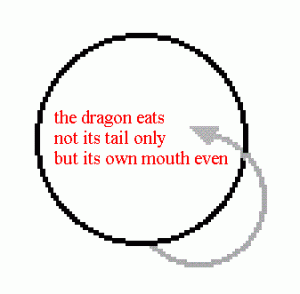
.. bites fish bites snake bites fish bites ..

Saturday, September 26th, 2015

[ by Charles Cameron — for whom death-matches between species have special Platonic significance ]
.

You may remember my earlier post, Bobcat jumps shark, one in which I showed a video illustrating “ring form” — the ourobouros or serpent which bites its own tail.

Here’s another:

**

It was these two quotes from to books by Haniel Long and Annie Dillard that set me firmly on the path of DoubleQuotes. I’ve quoted them before, but they bear repetition.

From Haniel Long’s Letter to Saint Augustine:

My friend Jens Jensen, who is an ornithologist, tells me that when he was a boy in Denmark he caught a big carp embedded in which, across the spinal vertebrae, were the talons of an osprey. Apparently years before, the fish hawk had dived for its prey, but had misjudged its size. The carp was too heavy for it to lift up out of the water, and so after a struggle the bird of prey was pulled under and drowned. The fish then lived as best it could with the great bird clamped to it, till time disintegrated the carcass, and freed it, all but the bony structure of the talon.

And from Annie Dillard‘s Teaching a Stone to Talk:

And once, says Ernest Seton Thompson–once, a man shot an eagle out of the sky. He examined the eagle and found the dry skull of a weasel fixed by the jaws to his throat. The supposition is that the eagle had pounced on the weasel and the weasel swiveled and bit as instinct taught him, tooth to neck, and nearly won. I would like to have seen that eagle from the air a few weeks or months before he was shot: was the whole weasel still attached to his feathered throat, a fur pendant? Or did the eagle eat what he could reach, gutting the living weasel with his talons before his breast, bending his beak, cleaning the beautiful airborne bones?

**

My haiku-esque poem, my one-move recursive HipBone Game:

On the felicities of graph-based game-board design: four

Tuesday, September 8th, 2015

[ by Charles Cameron — cross-posted from Sembl — following parts 1, 2 and 3 with a fourth ]
.

Back in my student days, I used to have a three dimensional tic-tac-toe board, 4 x 4 x 4, made of plexiglas sheets with holes drilled in them, and using colored golf-tees for markers. I could play pretty well on that board, but these ones would drive me nuts — whether for tic-tac-toe or for HipBone / Sembl.

with a chaser:

And that’s what I call a DoubleTweet.

On the felicities of graph-based game-board design: three

Monday, August 24th, 2015

[ by Charles Cameron — cross-posted from Sembl ]
Following up on two previous posts on graph-based design: Preliminaries and Two dazzlers

**

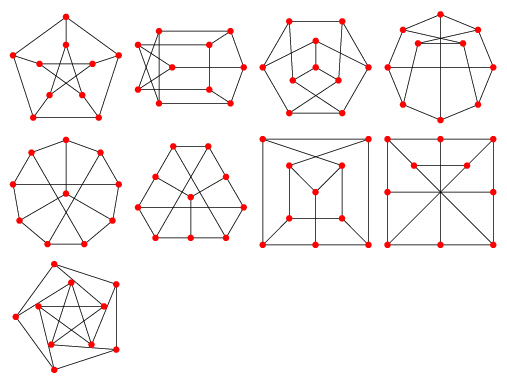
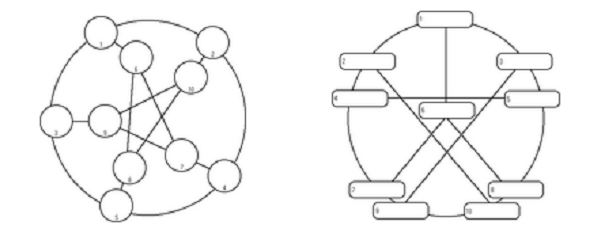
Here are two old HipBone boards that have the curious property of looking very different while being, in fact, topologically identical. Moves played on either board will feature the same set of links — although, given the visual impac ts of proximity and distance, they may “feel” very different to the players themselves:

Petersen graph boards

I call them the Pentagram and Mercedes boards, for what I trust are obvious reasons. They are both based on versions of the Petersen graph, and I’m grateful to Walter Logeman and Miles Thompson for introducing me to them.

**

One of the vivid differences between my childhood memories and present experience has to do woth the time when the table, the place where food or whatever was, was above my head.

Of course, the table was flat — but it was flat above my head, and I had to reach up into that unknown flatland to grab what I could. Unless of course there was a tablecloth trailing over the edge of the flat, down towards eye-level, in which case.. voila!

Hence my ongoing notion that something tasty might be literally above my head, and my associated excitement. Hence, too, my excitement at the prospect that tasty ideas might also be above my head, and that I might reach up into unknown intellectual flatlands — or pull them down to my own level with a tug of the intellectual tablecloth.

**

That may sound foolish, but it’s entirely in line with Eric Drexler’s advice — and Drexler published the first scientific paper on molecular nanotechnology [.pdf] in 1981.

Here’s what Drexler has to say about reading scientific journals:

Read and skim journals and textbooks that (at the moment) you only half understand. Include Science and Nature.

Don’t avoid a subject because it seems beyond you – instead, read other half-understandable journals and textbooks to absorb more vocabulary, perspective, and context, then circle back.

**

Okay, I’m in over my head as they say.

Here’s an artist’s rendering of something called, I guess, an amplituhedron, a (relatively) newly discovered mathematical object that has the world of physics all excited:

amplutihedron_span

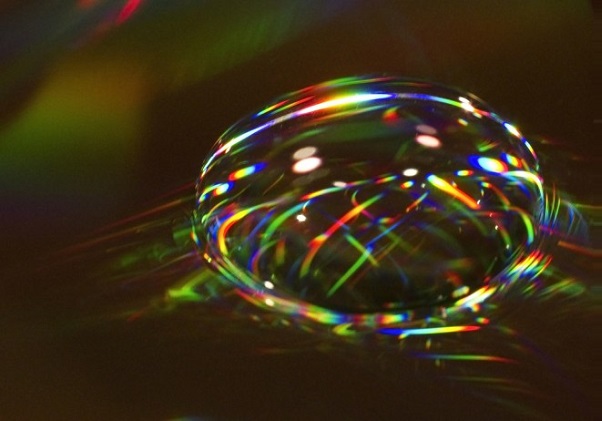
Here’s another, titled for some reason “droplet”:

droplet

Neither of those is anything I could conceivably use to come up with a HipBone or Sembl board, is it?

But get this:

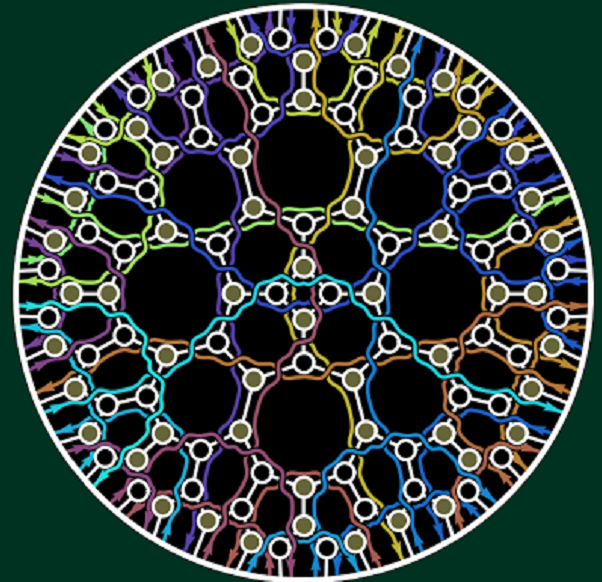
nima-permutation-grassmannian-final-picture

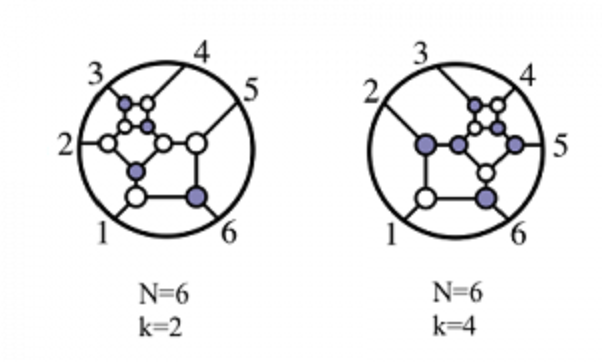
This is another way of looking at the same corner of mathematical physics — one of over a hundred diagrams in the same paper— and here are the two “lesser” diagrams that caught my attention and made me think back to the Petersen graph boards earlier on today:

twistor-diagrams- scientists discover a jewel

Now my itch is to figure out what use the “filled” and “open” nodes in these two graphs might serve in game-playing terms, and how on earth to interpret in game terms the complex weavings of the colored lines in the larger image / board.

**

And hey, while we’re at it, Here are the Wolfram variants on the Petersen graph — striking, aren’t they?

PetersenGraphEmbeddings wolfram

Food for thought is food for play.

**

Sources:

  • N. Arkani-Hameda et al, Scattering Amplitudes and the Positive Grassmannian
  • Nima Arkani-Hameda and Jaroslav Trnkab, The Amplituhedron
  • Check out the stunning physics — deeper than time and space? — if you don’t already know it, and explain it if you do!

  • Natalie Wolchover, A Jewel at the Heart of Quantum Physics
  • And for Wolfram on the Petersen Graph:

  • Eric W. Weisstein, Petersen Graph
  • Gaming the Islamic State three ways from Sunday

    Thursday, July 16th, 2015

    [ by Charles Cameron — what hipbone thinking / gaming could and should bring to the natsec table ]
    .

    I have just been browsing the Institute for the Study of War‘s report on its ISIS wargame, and thought I’d wargame ISIS a bit myself, using my DoubleQuotes game.

    **

    The ISW report, in its 32 pages, barely mentions religious drivers, features one use of the word “apocalyptic” in a pretty non-specific sentence that implies nothing about what that word implies in terms of religious instensity — “ISIS intends to expand its Caliphate and eventually incite a global apocalyptic war” — and generally focuses on everything but “knowing” the enemy..

    If they’d invited me and added a round or three of DoubleQuotes during a coffee break, I’d have been grateful for the coffee and the visit to DC, and very quickly played these two double-moves:

    For wide context:

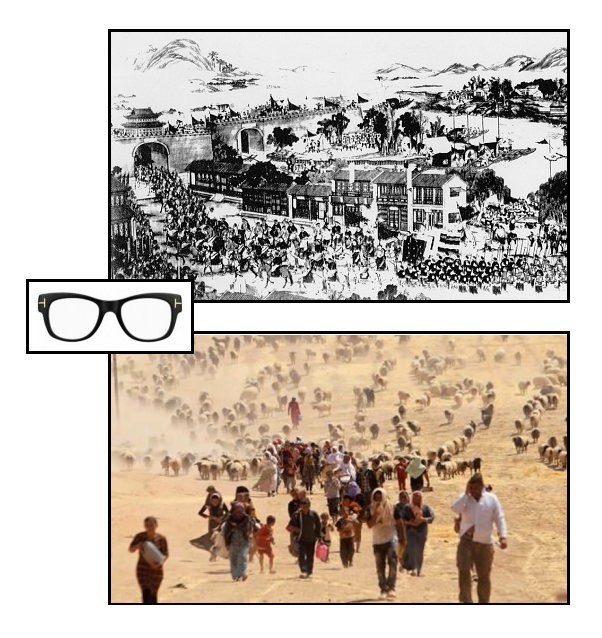
    SPEC DQ Taiping IS

    Upper panel: the Taiping Rebellion, an apocalyptic (in the true sense) movement in China, 1850 to 1864, with between 20 million and 30 million dead — as a reminder that apocalyptic movements can have, ahem, far-reaching consequences.

    Lower panel: Refugees fleeing the Islamic State, a movement whose apocalyptic (in the true sense) strategy includes a focus on great end-times battle to be fought at Dabiq in Syria, Dabiq being the name of their English lnaguage magazine.

    Read into the record in support of these two visuals:

  • Jonathan Spence, God’s Chinese Son: The Taiping Heavenly Kingdom of Hong Xiuquan
  • William McCants, The ISIS Apocalypse: The History, Strategy, and Doomsday Vision of the Islamic State
  • And with narrower focus:

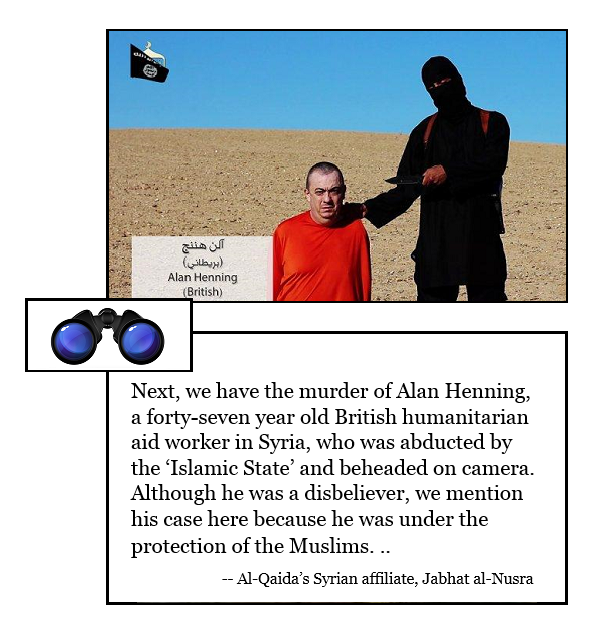
    here, on the brutality levels permitted in two rival jihadist groups in Syria:

    SPEC DQ IS vs Jabhat

    Upper panel: the Islamic State brutally executes British aid worker Alan Hemming

    Lower panel: AQ affiliate Jabhat al-Nusra points out that he was under an offer of protection binding on all Muslims.

    There would be background reading to explore and expand that DoubleQuote too. But the main point is: the contest of ideas, not simply that of troop movements and materiel, would have been part of the picture.

    **

    The Atlantic Council has also held two wargaming sessions on IS [1, 2], but again the insights to be gained into the Islamic State’s end-times motivations and their implications are almost nonexistent:

    ISIS carries the seeds of its own destruction primarily because it has an extremely small constituency within Islamist populations around the world, an apocalyptic vision, an unsustainable strategy of us-against-theworld, and a failed governance project.

    And that’s about it.

    **

    McCants’ presentation at the Boston conference, and his forthcoming book (above), both make it clear that the apocalyptic stress of today’s “caliphate” has morphed significantly from the more immediate apocaypticism in IS’ Zarqawi-era predecessor, Al Qaeda in Iraq.

    And for a nuanced understanding of time-urgency in apocalyptic rhetoric, Stephen O’Leary‘s Arguing the Apocalypse: A Theory of Millennial Rhetoric is the definitive work.

    So when do we start introducing ideational war (and/or peace) games alongside our games of brute force?

    And how do you factor esprit, morale, and “angels, rank on rank” (Quran 8.9, 89.22) into troop movements and so forth?

    Hint: they’re force-multipliers.


    Switch to our mobile site