zenpundit.com » Patterns

Archive for the ‘Patterns’ Category

Of railroad tracks and polyphonic thinking

Thursday, February 23rd, 2012

[ by Charles Cameron — more on the graphical mapping of heresy, radicalization, decision points, multiple ideas and complex issues, and some illustrations from railroad land ]

.
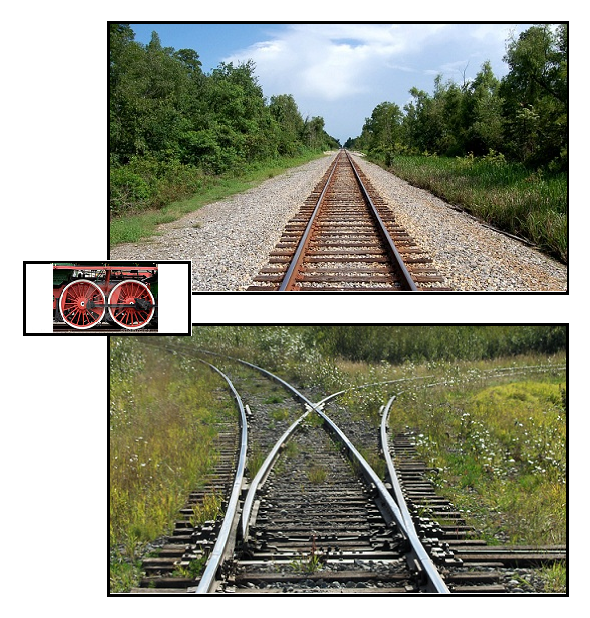
Here’s a railway track illustration of, say, the difference between true Islam (the straight track) and bida (the introduction of new ideas into the religion, deviation, heresy).

This graphic could equally represent the radicalization process, with the “point switching” occurring when the decision is made to switch from sympathizing to active participation, or from participation in the virtual dimension (say by posting on the forums) to the preparation and execution of acts of violence.

Locating the “switching points” would then be a significant part of a successful de-radicalization program, and I’d suggest that the concept of jihad as a matter of obligation (fard ‘ayn) would be one such.

*

What follows is essentially a quick-and-dirty pattern language of train tracks, switching points, marshaling yards, etc — I’ve even included one water-slide — to stir creative insights about linear thinking, multiple voices, multiple lines of thought, elegance and the polyphony of ideas

I’m posting this because any strategic and / or creative thinking that includes the perspectives and voices of multiple stakeholders will require polyphony, as will any approach to the complex dynamics in play in wicked problems…

And much else besides.

*

First, we have linear thinking — and a dilemma:

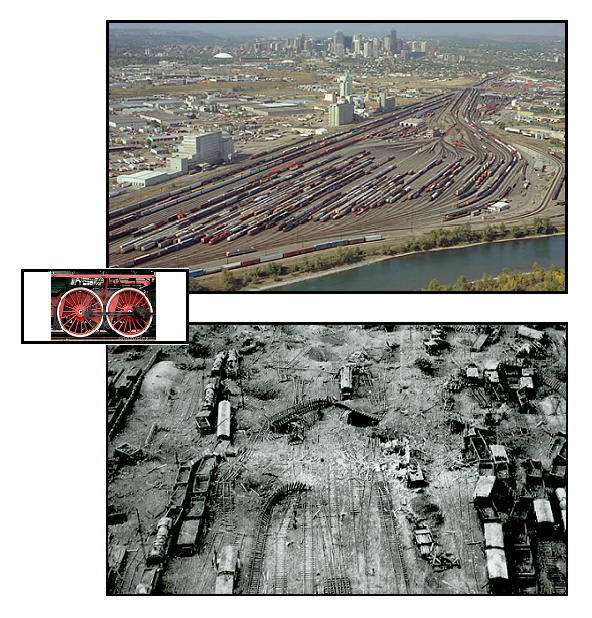
Then, there’s complication — not the same as complexity, and not nearly so hard to figure out —

— and a wicked problem, where the issues are indeed complex, and the problem itself may shift unexpectedly if, for instance, there’s another bombing run just as you are fixing things up after the last one…

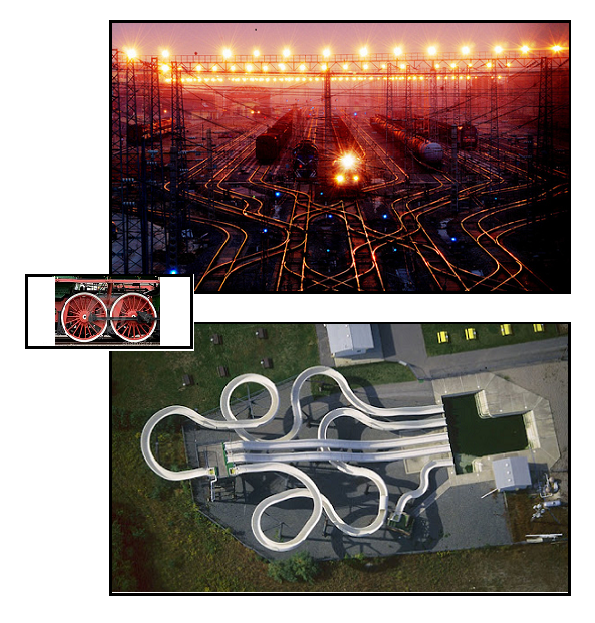
And finally, by way of inspiration, there is always the possibility of elegance —

— and (here’s where I switch to the water-slide) — there’s always the possibility of playfulness…

*

Finding ways to think graphically, elegantly and a bit playfully about wicked problems is what I’m after here…
.

*******************************************************************************

Addendum

Friend JM Berger aka @intelwire sent me a link to this image:

and commented, “I think it’s more like this, no single point of departure, no single destination, loopbacks, dead ends” — nice one, JM!

Ruminating on Strategic Thinking II. : Social Conditions

Tuesday, January 3rd, 2012

A follow up to Part I.

How does a society, as opposed to individuals, develop a capacity for “strategic thinking” ?

While war is an obvious answer, it is not an advisable first resort. First of all, although war teaches hard lessons about strategy, the costs of losing a war are high. Secondly, the costs of winning a war can be high. Thirdly, few people, relatively speaking to the number involved, have any direct input into genuinely strategic decisions during wartime; most will either gain tactical experience or be relegated to support functions. At best, wars seem to create a cohort of excellent tactical leaders with the potential to, someday, mature into strategic leaders or strategists. At worst, from a war, the wrong lessons may be drawn and institutionalized to create a future disaster.

What conditions produce strategic thinkers for a state? A brief example from American history:

Here are some of the US leadership of WWII, the postwar “Wise Men” and their Cold War successors, collaborators, thinkers and military chiefs:

Franklin Roosevelt, Henry Stimson, Joseph Grew, Dean Acheson, Douglas MacArthur, Charles E. Bohlen, George F. Kennan, Paul Nitze, George C. Marshall , Harry S. Truman, Robert A. Lovett, Dwight D. Eisenhower  , John J. McCloy , W. Averell Harriman, William Donovan, James F. ByrnesChester Nimitz,  John Foster Dulles,  James Forrestal, Vannevar Bush,  Allen Dulles, Ernest King, Albert Wohlstetter, Dean Rusk, Hyman RickoverHerman Kahn, Robert McNamara,  Bernard Brodie, Fritz G. A. KraemerMcGeorge BundyRichard Nixon, Thomas Schelling, Henry Kissinger

Some commonalities that these individuals shared, sometimes in pluralities and others in large majorities:

Above average to very high IQ
Middle class to high socioeconomic status
Eastern Establishment
Fraternal organizations
Male
Protestant
Episcopalian
Ivy League education
Law 
Politics
Military service
Diplomacy
Wall St.
Harvard
Yale
Princeton
Columbia
Harvard Law
Military Academy
University of Chicago
Berkeley
Skull & Bones
Scroll & Key
WWI
WWII
RAND
Executive Branch
Nuclear weapons/arms control/power

This list could be expanded or reduced on a number of grounds. For example, the list is composed of men primarily because almost no women, with very few exceptions, even from elite backgrounds, had an opportunity during the first 2/3 of the 20th century to contribute to strategic decisions or policy making. We could also include other characteristics, but what we have is sufficient for some broad generalizations.

  • First, these men generally engaged in careers that featured complex activities that stressed and rewarded incisive analysis of factual scenarios, assessment of risk and potential benefits, intuitive judgment and organizational abilities – law, politics, the stock market, diplomacy and corporate leadership. A minority of the list had formal training in advanced mathematics.

  • Secondly, the men all had the social wherewithal and ambition to gain entry into educational and social institutions that were by definition, highly exclusive on more than a strictly meritocratic basis. For many from higher SES families, this presented no significant barrier but for the “outsiders” like Kennan, Nixon or Rickover, it was a formidable obstacle to overcome. In either case, there were social mores or even commonly held prejudices to which they had to adapt in order to “fit in”. Despite this demonstration of social intelligence, most members of our list were not  professional politicians (but those that were made an impact on American history much greater than that of an “average” president).

  • Thirdly, the presence of such overlapping experiential commonalities, while not creating a formal “strategic community” was probably sufficient to impart a strategic mentalité as to how the world really worked, red in tooth in claw, as well as implicit ideological assumptions as how the world ought to work, if perfected. This meant that strategic debates about American national security could take place within the framework of commonly held assumptions and reference points. While certain individuals might be disliked (MacArthur, Truman, Nixon) or regarded warily, with little trust (Nixon, FDR, Kahn) their strategic arguments were nevertheless widely understood within the elite and could be assessed on their merits – an excellent environment for building an elite consensus and continuity on matters of policy and strategy. This condition may be a political prerequisite for a democratic state’s formulation and adoption of a successful grand strategy.

If we wonder why the United States has been so ineffective at strategy in recent years, maybe we should look at how our current (and most importantly, future) elite’s formative experiences have sharply diverged from their strategically gifted WWII-Cold War predecessors.

A poignant week or so in DoubleQuotes

Friday, December 30th, 2011

[ by Charles Cameron — fictitious peoples (Israelis, Palestinians), approved and disapproved scriptures (Hindu, Falun Gong), religious violence (Afghanistan, Nigeria, Bethlehem) ]
.

So, is there some sort of contest going on between Iranian and American ex-Speakers? Perhaps Elliott Abrams‘s response to Gingrich, quoted in the Washington Post piece, applies equally well to Haddad-Adel?

There was no Jordan or Syria or Iraq, either, so perhaps he would say they are all invented people as well and also have no right to statehood.

Next up…

And okay, what’s the point here? Is it that the Russians want to please both the Chinese and Indian governments — or that they don’t like new scriptures but are okay with old ones? Or is the problem that they haven’t decided yet on a “one size fits all” approach to unOrthodox religions?

Sigh. Next…

This is brutal — and apparently intercontinental.

You might think it’s obvious what the wrong answer is, and who’s doing the killing, in Nigeria. But these things can cut both ways:

Even here, it’s not clear who threw the bomb into the madrasa, although one could hazard a guess…

And even the site of the Nativity is infected. The Guardian’s account of events there this Christmas season is harsh in tone — but consider whose Nativity is supposedly being celebrated…

I’d say the Qur’an offers a better image of Christian monks than that experienced by those Palestinian riot police… who, in the event, although they themselves were also assailed with broom-sticks, declined to arrest anyone because, as Palestinian police lieutenant-colonel Khaled al-Tamimi put it:

Everything is all right and things have returned to normal. No one was arrested because all those involved were men of God.

Still, things could be worse. It was a squabble along similar lines in which nine several Orthodox monks were killed that triggered the Crimean War: details in Raymond Cohen, Conflict and Neglect: Between Ruin and Preservation at the Church of the Nativity — h/t Juan Cole, who also has video of this year’s brouhaha.

*

Et in terra pax hominibus bonae voluntatis.

Iconic: compare and contrast III

Saturday, December 24th, 2011

[ by Charles Cameron – Iraq war, beginning and ending, analytic power of similarity ]

.

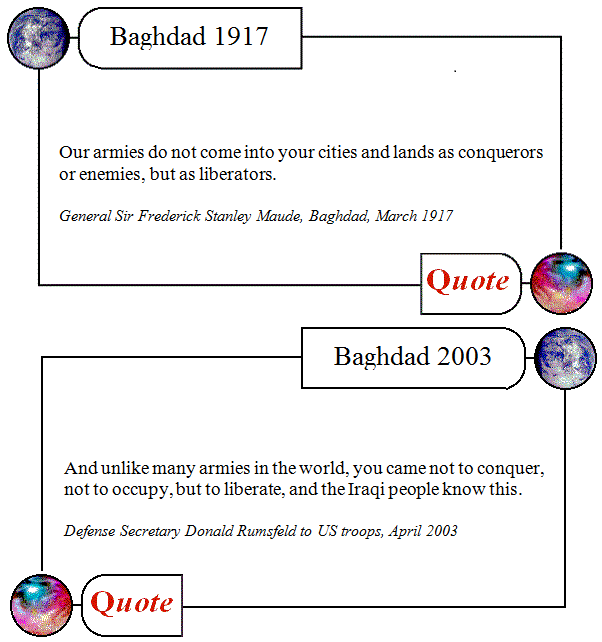
I’ve thanked Zen for his Iconic Compare and Contrast post already, but I’d like to run with his juxtaposition of images from the end of the Iraq war, and book-end it with an early DoubleQuote of mine from the beginning, thus:

That’s the beginning of the war, as I saw it “binocularly” — and here’s its ending, as Zen captured it:

Different though they are — one verbal, one visual — I think they go well together. I think they belong together.

But that’s essentially an aesthetic intuition.

*

And — apart from thanking Zen — that’s the thing I want to talk about.

The two quotes, eighty-six years apart, about an (anglophone) army in Baghdad coming there to liberate, not to conquer, are similar enough that they should give us pause for thought. They challenge us to think long and hard about the similarities between the two situations — and they challenge us to think no less hard and long about their differences.

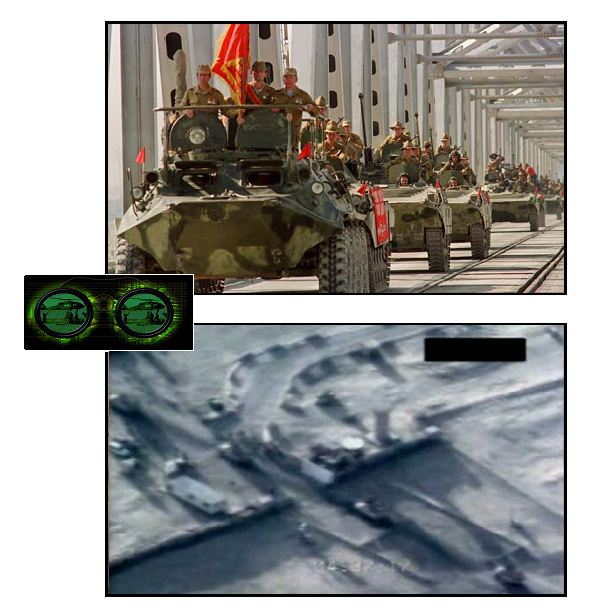
Likewise, it’s the similarities between the two images Zen chose — of the Soviet withdrawal from Afghanistan and the US exit from Iraq — that give that juxtaposition its power.  And Zen has chosen very carefully:

Not only are there two lines of vehicles stretching back from the foreground away into the distance in each image, but the angle from which the two columns are seen is about the same — and there are even two “tracks” in each photo reinforcing the vanishing point — two tracks to the right of the vehicles in the Afghan photo, the edge of the road and a what looks like the shadow of an overhead cable in the photo from Iraq.

*

But let’s take this a bit further. The following juxtaposition is every bit as much a juxtaposition of the Soviet and American withdrawals as the pair of images Zen picked, but this time we have an aerial view of the US convoy — so the visual “rhyme” between the two images is no longer there — and even though the aerial shot is an intriguing one, what a difference that makes!

There’s nothing in that juxtaposition to make you go, yes!

On the level of what’s being referred to, the troop withdrawals from Afghanistan and Iraq,  this pair of images has the same properties as the two images that Zen selected.  But it doesn’t capture our attention in nearly the same way.

And the same would have been true if I’d picked a different sentence from Rumsfeld‘s speech to juxtapose with General Maude‘s “not as conquerors or enemies but as liberators” — such as, “You’ve unleashed events that will unquestionably shape the course of this country, the fate of the people, and very likely affect the future of this entire region.” I’d still be comparing and contrasting two speeches from the beginnings of two occupations of Baghdad.  But there’d be no oomph to the comparison.

*

Because — and this is what I am trying to get at, the basic principle of HipBone analysis and what distinguishes it from otherwise similar modes of brainstorming and mind-mapping — the recognition of pattern, of salient sameness, of close parallelism or opposition is the criterion for success or failure in a HipBone-style juxtaposition.

Zen’s graphic example has that closeness — even down to those two parallel tracks beside and to the right of the vehicles.  My two quotes from Maude and Rumsfeld have that.  And it’s that closeness of match that makes a juxtaposition powerful.

Analogy works this way, rhyme works this way, fugue works this way, graphic match (in cinematography) works this way — it’s basic to the arts, basic to rhetoric, and basic to the way our analogically-disposed minds think.

It is not a method for arriving at conclusions, it’s a method for posing questions. And it sits right at the juncture where analysis admits it is not a science but an art.

Iconic: compare and contrast

Thursday, December 22nd, 2011

[ by Charles Cameron — iconic images, riot police, compare and contrast, repetition with variation ]
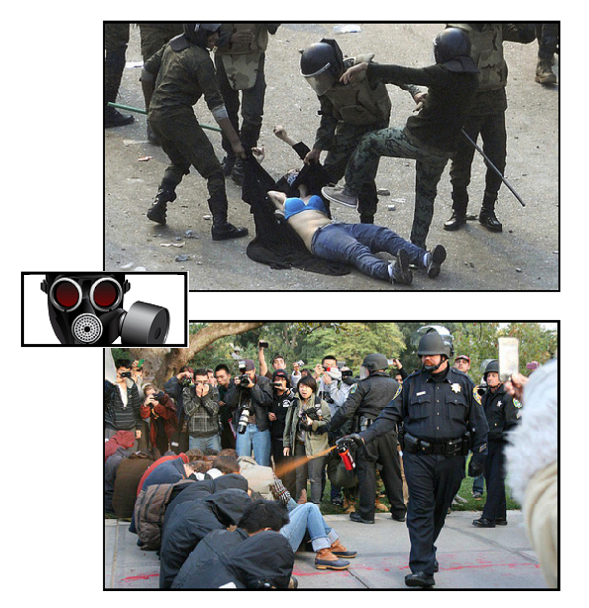
First, let’s be clear that both these images have been widely considered iconic.

Thus NPR reported of the first photo:

There have been countless accounts of violence recorded during the uprisings in Egypt but the image that perhaps has captured the most attention is the most recent. The image has been widely referred to as the “girl in the blue bra.”

While Real Clear Politics quotes Michael Moore on the second:

“The images have resonated around the world in the same way that the lone man standing in front of the tanks at Tiananmen Square resonated. It is an iconic movement in Occupy Wall Street history,” Michael Moore declared on MSNBC’s “Last Word” program.

Moore was referring to police pepper spraying students at an “Occupy” protest at UC Davis.

So we have two similarities between the two images: they both show police in riot gear taking action against demonstrators, and they have both caught the public eye as somehow being representations that can “stand in” for the events they seek to portray.

Beyond that, it’s all compare and contrast territory — or variations on a theme, perhaps — and different people will find different reasons to attack or defend the demonstrators or the police in one, the other, or both cases.

1.

These are, for many of us, “home” and “away” incidents, to borrow from sports terminology, and some of our reactions may reflect our opinions in general of what’s going on in Egypt, or in the United States.

We may or may not know the rules of engagement in effect in either case, on either side.

In a way, then, what the photos tell us about those two events, in Tahrir Square and on the UC Davis campus, may tell us much about ourselves and our inclinations, too.

2.

As I’ve indicated before, I am very interested in the process of comparison and contrast that the juxtaposition of two images — or two quotes — seems to generate. And I’ve quoted my friend Cath Styles, too:

A general principle can be distilled from this. Perhaps: In the very moment we identify a similarity between two objects, we recognise their difference. In other words, the process of drawing two things together creates an equal opposite force that draws attention to their natural distance. So the act of seeking resemblance – consistency, or patterns – simultaneously renders visible the inconsistencies, the structures and textures of our social world. And the greater the conceptual distance between the two likened objects, the more interesting the likening – and the greater the understanding to be found.

I’d like to examine these two particular photographs, then, not as images of behaviors we approve or disapprove of, but as examples of juxtaposition, of similarity and difference — and see what we might learn from reading them in a “neutral” light.

3.

What I am really trying to see is whether we can use analogy — a very powerful mental tool — with something of the same rigor we customarily apply to questions of causality and proof, and thus turn it into a method of insight that draws on our aha! pattern recognition and analogy-finding intuitions, rather than the application of inductive and deductive reason.

And that requires that we should know more about how the mind perceives likenesses — a topic that is often obscured by our strong emotional responses — you’re making a false moral equivalence there! or look, one’s as bad as the oither, and it’s sheer hypocrisy to suggest otherwise!

So among other things, we’re up against the phenomenon I call “sibling pea rivalry” — where two things, places, institutions, whatever, that are about as similar as two peas in a pod, have intense antagonism between them, real or playful — Oxford and Cambridge, say, and I’m thinking here of the Boat Race, or West Point and Annapolis in the US, and the Army-Navy game.

Oxford is far more “like” Cambridge than it is “like” a mechanic’s wrench, more like Cambridge than it is a Volkswagen or even a high school, more like it even than Harvard, Yale, Princeton or Stanford — more like it than any of the so-called “redbrick universities” in the UK — so like it, in fact, that the term “Oxbridge” has been coined to refer to the two of them together, in contrast to any other schools or colleges.

And yet on the day of the Boat Race, feelings run high — and the two places couldn’t seem more different. Or let me put that another way — an individual might be ill-advised to walk into a pub overflowing with partisans of the “dark blue” of Oxford wearing the “light blue” of Cambridge, or vice versa.  Not quite at the level of the Zetas and the Gulf Cartel, perhaps, but getting there…

4.

So one of the things I’ve thought a bunch about is the kind of analogy that says a : A :: b : B.

As in: Egyptian cop is to Egyptian protester as UC Davis cop is to UC Davis protester.

Which you may think is absolutely right — or cause for impeachment — or just plain old kufr!

And I’ve figured out that the reason people often have different “takes” on that kind of analogy — takes so different that they can get extremely steamed about it, and whistle like kettles and bubble over like pots — has to do with the perceptual phenomenon of parallax, whereby some distances get foreshortened in a way that others don’t.

5.

So my thought experiment sets up a sunken garden — always a pleasure, with two video cameras observing it, as in this diagram:
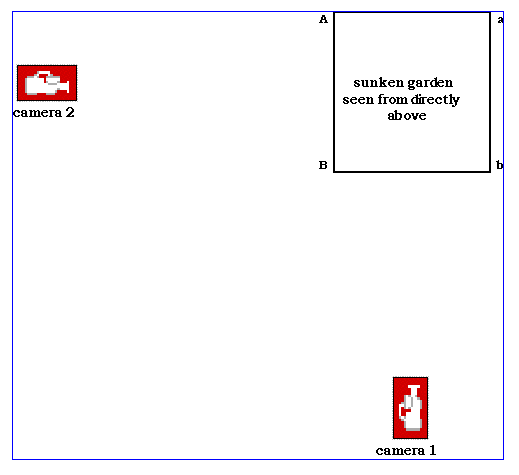
And from the two cameras, the respective views look like this:
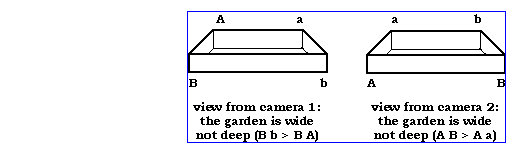
In this scheme of things, Aa (Oxford) seems very close to Bb (Cambridge) seen from the viewpoint of camera 1 — but from camera 2’s standpoint, Aa (Oxford) and Bb (Cambridge) are at opposite ends of the garden, and simply couldn’t be father apart.

6.

Now, my thinking here is either so obvious and simple as to be a platitude verging on tautology — or one of those subtle places where the closer examination of what looks tautological and obvious leads to the emergence of a new insight, a new “difference that makes a difference” in Bateson’s classic phrase.

And clearly, I hope that the latter will prove to be the case here.

7.

What can we learn from juxtapositions? What can we learn from our agreements about specific juxtapositions — and what can we learn from our specific disagreements?

Because it’s my sense that samenesses and differences both jump out at us, as Cath Styles suggested — and that both have a part to play in understanding a given juxtaposition or proposed likeness.

Each juxtaposition will, in my view, suggest both a “sameness” and a “difference” — in much the same way that an arithmetic division of integers, a = qd + r, gives both quotient and dividend.

And then we have two or more observers of the juxtaposition, who may bring their own parallax to the situation, and have their own differences.

8.

Tahrir is to Tienanmen as Qutb is to Mao?

Or is pepper spray just a food additive?

And how do icons become iconic anyway? Are they always juxtapositions, cops against college kids, girl vs napalm, man against line of tanks?  Even in the iconic photo of Kennedy from the Zapruder film, the sudden eruption of violence into the stateliness of a presidential parade is there — a morality play in miniature.

Any thoughts?


Switch to our mobile site