zenpundit.com » Buddhist

Archive for the ‘Buddhist’ Category

Form is Insight: the project

Monday, October 22nd, 2012

[ by Charles Cameron — about the (not yet titled) book (or post-book project) i seem to be writing, which offers a grand slam intro to an array of box-free contemplative and artistic approaches to creative thinking, and hence opens fresh angles on intelligence ]
.

One thing I can promise: whatever this project turns out to be, it won’t be predictable.

credit for this incredible image: Roger Dean

.

This project won’t take you over familiar territory, congratulating you on holding the same opinions as the author and adding in enough choice details to keep you interested. I’m not aiming to teach you the same thing you already know, only better, more interestingly, more precisely, or in greater detail. I’m aiming to question you, challenge you, and give you a whole new range of optics through which to view the world.

**

So, here we go.

I think I am finally at the point where the book (or whatever it is) I’ve been gathering inside me all these years is ready to be written. Some of it has already emerged in earlier posts here on Zenpundit — you don’t known and couldn’t count how many thanks, Mark — and this is certainly where I’ve been developing the style of integrated visuals and verbals that gives the project its flavor — so I’d also like to use my posts here to discuss the thing with you as I go along.

The project is about intelligence in the widest sense, including heart and mind, and with particular focus on creativity. I’m addressing this from two standpoints that mesh together well, and I’m addressing it to two audiences that I believe also mesh together well.

The standpoints are (i) meditation and (ii) the arts, and the audiences are (i) the “intelligence community” and (ii) bright people in general.

I believe that meditation cultivates a spacious mind-set in which we can hold multiple concerns in mind at the same time – the opposing needs of different people, stakeholders, sections of society, the environment, etc – thus seeing things from multiple angles and in balancing & thus balanced ways. And I think the arts serve as the primary means for expressing these balances with all their nuances and shadings, and that techniques from within the arts such as polyphony, chiaroscuro, formal constraint and pattern can teach us to shape multi-faceted insights like these into rich and complex understandings – complex patterns that respond to complex situations. I’ll go into all this in detail as we move along, with examples.

I also believe that this kind of creatively patterned insight — embodying artistic methodology in the context of complex problems with a “fresh” and open mind – will be of interest beyond the intelligence agencies and policy-makers, to business people, artists, and also — importantly — the bright general public, which I take to be a far larger subset of the population than we commonly think, and always eager for reading that doesn’t talk down to them but appreciates their own intelligence and good will.

For now let me just say that I’m very excited, because this seems (at last) to be a project that ties together my game-work with Sembl, the think-tank side of me which has been monitoring religious violence, jihad and terror and working towards nuance, understanding and peace these last dozen years — and my sense of creativity as a writer and poet.

Ripeness is all: I suspect the time for this venture has arrived.

**

Here’s the single page overview I’ve written, with a working title:

Intelligence is Zen: understanding our complex world with koans in mind

Just a few days ago, the Director of National Intelligence, James Clapper, referenced Pirsig‘s book, Zen and the Art of Motorcycle Maintenance, as key to the Intelligence Community’s work in understanding and adapting to the many, varied, intersecting problems we face in the world today. As I noted, Clapper was focused a bit more on the biker wisdom than the Zen to be found in Pirsig’s book, but he does raise a question I’ve been addressing for some years now:

What does the contemplative mind have to offer in terms of understanding a complex world?

To my mind, the creativity which is all the buzz of the business world, aimed at solving what are called “wicked problems” — problems that feature multiple stakeholders with multiple aims and objectives, aims and objectives which themselves shift over time so the problems are “never the same river twice” – requires a major mental and emotional shift. Reverie and meditation free us up to make the shift: the shift itself is poorly understood.

Our present, mostly linear way of thinking favors either/or side-taking, dubious cause-and-effect expectations which fail to take complex feedback loops into account, followed all too often by a rush to judgment. We need a whole new – old, even ancient – way of thinking.

Our problems are complex because they overlap, they ripple through one another. In Buddhist terms, they are “interdependently arising.” Not surprisingly, the way of thinking that is required to gain a deeper insight into “interdependently arising” problems can be found in explicit form in such contemplative traditions as Madhyamika & Zen, Taoism, Sufism, and their Abrahamic contemplative analogs. At the heart of these systems is fresh thinking – thought refreshed by quiet.

Furthermore, the shaping of insights in an open field of thought is something the world’s artistic traditions have long dealt with, and there are schools of insight not just available but recorded in exquisite detail in the world’s traditions of poetry, music, painting, theater, film… in patterns that are found in nature, in culture, and in the very turbulence we now must learn to flow with.

The project therefore takes a meditation-influenced approach to intelligence, both in the sense in which Clapper would use the word, relating to the intelligence analysis which develops and influences our decision-makers’ understanding of what’s needed, and in the more general sense of those capable folk with bright minds, keen insights, sharp instincts, warm hearts.

I’ll propose a series of ways of looking differently – with application for anyone, whether artist, intel analyst, businessman, policy-maker, or lover – that cut to the essence of creativity: lateral, analogical, holistic thinking, witnessing pattern beneath the surface of things. My examples will be mainly drawn from terrorism, which I have been monitoring for a dozen years: my style is that of a poet and an eccentric Englishman.

My subtext, my subliminal message, will be contemplation and artistry as profound common sense.
Graphic matches?

Thursday, September 27th, 2012

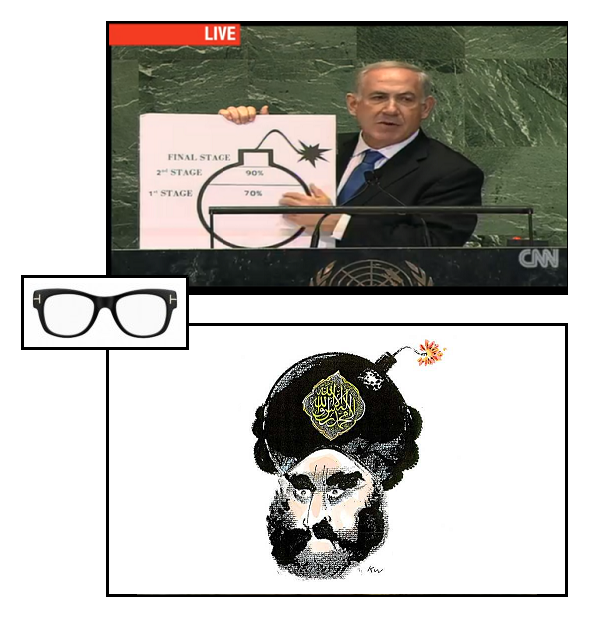
[ by Charles Cameron — Netanyahu’s UN speech, Jyllands-Posten cartoon, a nifty film technique, and is there an echo there? ]
.

**

A fair number of people have commented on Israeli PM Netanyahu‘s displaying a cartoonish bomb graphic in the course of his UN address today, and some have complained, fairly IMO, at the choice of photo used to depict Netanyahu during his speech by eg Fox News:

I think it’s important to read graphic messages closely for the cues they contain.

**

Sometimes, as with images of the Virgin Mary seen in grilled cheese sandwiches or oil slicks, the correspondences don’t really mean much more than that the brain is designed for pattern recognition, and a little “imagination” without critical appraisal can get things wrong: the terms commonly used for this are apophenia, patternicity and pareidola.

My own favorite example of this phenomenon is of the wall-stain in a school in the East Bay that was recognized as the Virgin Mary by Catholics and the bodhisattva Kuan-Yin by Buddhists

Nonetheless, I’m reluctant to ridicule such modes of perception without also recognizing the utility of Rorschach blots in psychology and the even more creative uses to which Leonardo put them.

**

Perceived visual similarities, in short, can be the result of creative or merely overheated imagination, but in the visually sophisticated they become much more.

Film-makers, in particular, have several names for the kind of skillful editing by which one scene segues into another via a well-chosen visual similarity: match cut and graphic match.

My personal favorite example is that of Apocalypse Now, where the rotors of the fan in that claustrophobic hotel room in Saigon morph into the rotors of the helicopter coming to take Captain Willard out and away on his mission up river…

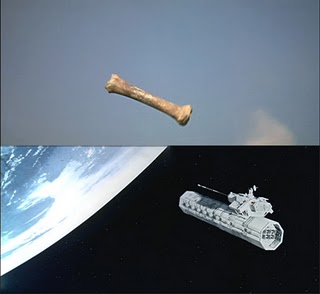
Perhaps even more celebrated, though, is Kubrick’s match between the bone tumbling through the air and the space station tumbling through space, in 2001: A Space Odyssey:

**

To get back to Netanyahu, then — is his hand held out a little above vertical, palm down, really a Hitler salute? I think not.

And does his image of a bomb carry any resonance from the Jyllands-Posten cartoon? I have to admit I’m almost undecided on that one.

And if there’s just a hint of a correspondence, would it be conscious or unconscious?

**

The thing is, politicians have to be extremely careful about tossing graphic matches onto dry kindling.

To my own way of thinking, both Netanyahu’s “cartoonish bomb” graphic and his “mid-heil” salute are potential fodder for incautious speculation — but neither one is even remotely as far-fetched as Jerome Corsi‘s claim in a recent WND that a recent Obama campaign use of the Stars and Stripes (above, upper panel) — in admittedly terrible taste — suggests that Obama in any way favored the decease of Ambassador Christopher Stevens in Benghazi (lower panel).

**

My point here, as so often, lies not in any political content or conclusion, so much as in a general purpose invitation to persons of intelligence (and a fortiori, intel) to watch out for possible graphic matches, to make close and cautious readings of visual as well as textual data — in short, to take a closer look

Book review: Kay Larson on the zen of Cage

Friday, August 10th, 2012

[ by Charles Cameron ]
.

Kay Larson, Where the Heart Beats: John Cage, Zen Buddhism, and the Inner Life of Artists, Penguin, $29.95

.

Dropping silence into a concert turns things upside down: it brings the solo performer or group of performers into the position of audience, makes listeners of them – and makes keener listeners of the audience — perhaps with a touch of unease or self-consciousness, but with an unusual attentiveness, too.

Dropping John Cage‘s piece of silent music into a book right around the beginning… well, it has a similar impact. And that’s what Kay Larson‘s book Where the Heart Beats does, on the page numbered xiii so you’ll know the book hasn’t even started properly yet. Larsen points you, without giving you the URL, to YouTube, where you can find Cage’s most shocking, and thus his most famous piece, 4’33”, performed by the London Symphony at the Barbican, in three movements, all silent as demanded by the composer’s score – with breaks in between the movements for the usual coughing and fidgeting.

And how to say this? During the silence, you could have heard a pin drop? Or you could hear, as Tom Service said on the BBC, the “very distinct high hum” of the Barbican’s electrical system, and the occasional cough too – “you could cut the atmosphere with a knife, and every cough, every tiny noise was absolutely amplified, made into a massive musical event”.

Listen:

You can tell the audience was delighted – self-satisfied perhaps, too? – from the hearty applause, and they had listened, had presumably taken onboard the idea that pauses – silences – are as much a part of music as sounds.

But what if I said that wine was just as much a part of drinking as glasses, and poured wine for my guests with no glasses to contain it?

The thing about John Cage’s 4’33” is that it straddles the line between the emperor having and not having clothes, between group assent and dissent, between “either” and “or” -– if it turns us from self-obsessed self-expressives into attentive listeners, it has reached into us musicically and carried us beyond the limits of music. And if it’s a bunch of boring minutes while an orchestra gets paid to SFU, it’s plain idiotic.

Which means that John Cage composed it right at the tipping point between the stupid and the profound.

I want to express it that way, and not tell you that Cage composes where the mind is fresh and inspiration flows, because it is stupid as well as fresh and profound.

As Hitler might have said, if he’d been asked…

And we haven’t really begun the book yet.

**

There are three stories here:

There’s the rigorous thread of western classical music, from its origins in the mist via Jewish cantillation and Gregorian chant into Polyphony and the Baroque, Classicism proper, Romanticism and the Modern. The music of Cage is the culmination, here, of this theme.

There’s the circling yet nonexistent circle, drawn as it were on glass with an ink brush dipped in water, of Zen, a “rebirth with neither beginning nor end”…

And there’s the world of the contemporary arts, centering in New York, with Cage a leading light.

They comes together when various characters have what Larson calls “life altering moments” — Larson herself, John Cage, Gary Snyder, Allen Ginsberg, Jack Kerouac in the first few pages alone, with the two Suzukis, DT Suzuki and Shunryu Suzuki Roshi and their experiences hovering in the background.

Zen is the pond, the emptiness, the silence, the stillness waiting into which like so many varied pebbles, the themes are character off the book will drop, in which their ripples will intersect…

Or to put that another way: silence, the stillness, is the pond into which Cage’s life and influence is dipped, and music and the arts the shingle on the beach from which the pebbles are dropped.

**

And Cage played in that shingle, sent notes from “prepared piano” and other instruments… formal and informal… skipping across the silence.

Cage not only invited silence into the concert hall, he also theorized it at length. I’d like to quote here a celebrated passage from his book, aptly named Silence: Lectures and Writings:

What happens to a piece of music when it is purposelessly made? What happens, for instance to silence? That is, how does the mind’s perception of it change?… Silence becomes something else — not silence at all, but sounds, the ambient sounds… Where ears are in connection with a mind that has nothing to do, that mind is free to enter into the act of listening, hearing each sound as it is, not as a phenomenon more or less approximating a preconception.

**

Zen is the simplest thing, it’s human nature. It is also the most difficult — it’s what we instinctively shy away from. And it can take all our resources, as those who “sit while going round in circles” well know — to break from the “boredom” of silence into listening, to dip into the sound stream, to hear the stillness.

Somehow, I’m hoping to nudge you into that kind of awareness, so that you can understand from within the taste of silence, the importance of Cage’s life, and of Kay Larson’s book.

Here’s another nudge, from a different angle — the Scottish poet Edwin Morgan‘s poem in homage to one of John Cage’s sayings:

Opening the Cage: 14 Variations on 14 Words
“I have nothing to say and I am saying it and that is poetry.” — John Cage

I have to say poetry and is that nothing and am I saying it
I am and I have poetry to say and is that nothing saying it
I am nothing and I have poetry to say and that is saying it
I that am saying poetry have nothing and it is I and to say
And I say that I am to have poetry and saying it is nothing
I am poetry and nothing and saying it is to say that I have
To have nothing is poetry and I am saying that and I say it
Poetry is saying I have nothing and I am to say that and it
Saying nothing I am poetry and I have to say that and it is
It is and I am and I have poetry saying say that to nothing
It is saying poetry to nothing and I say I have and am that
Poetry is saying I have it and I am nothing and to say that
And that nothing is poetry I am saying and I have to say it
Saying poetry is nothing and to that I say I am and have it

Edwin Morgan, The Second Life
Edinburgh University Press, 1968

**

In a follow up post on Monday or Tuesday, I shall describe Larson’s book in more conventional terms, and offer you some details from Cage’s intricate life and extraordinary network of friends..

For now, I just want to give you again that taste of silence from which this whole endeavor springs. Here is the pianist David Tudor, for whom the piece was written, playing 4’33”:

Myanmar: the Rohingya and the Buddhists

Tuesday, July 24th, 2012

[ by Charles Cameron — one person’s shrine is another person’s ex-shrine ]
.

I was struck by this sentence in a blog post on Myanmar today:

As for the Muslims, they have been force-converted, their places of worship, as in the case of mosques, transformed into Buddhist temples, and they have been attacked during their religious festivities.

Buddhists? Just like the rest of us? Okay…

**


.

You know how some Muslims must feel when they see a Christian cathedral sprouting right out of the heart of their beautiful Mezquita mosque in Cordoba (above)? Or some Christians, when they see the huge Islamic decals hanging in what was once the great cathedral of Istanbul, Hagia Sophia (below) — now a museum?

.

**

I believe we’re all pretty happy that Aung San Suu Kyi is no longer under house arrest, but even she hasn’t felt at easy commenting on the Rohingya / Muslims in her native Myanmar:

The issue of the Rohingya is so delicate that even Myanmar’s leading defender of human rights and democracy, Daw Aung San Suu Kyi, has been oblique and evasive about the situation. Asked at a news conference on Thursday whether the estimated 800,000 Rohingyas in Myanmar should be given citizenship, Ms. Aung San Suu Kyi was equivocal. “We have to be very clear about what the laws of citizenship are and who are entitled to them,” she said in Geneva, which she was visiting as part of a European tour. “All those who are entitled to citizenship should be treated as full citizens deserving all the rights that must be given to them.”

Since I doubt I could ever be as brave as she has been already, I can’t complain… but maybe, all the same, wish?

**

To backtrack a little, here’s the full paragraph from which that first quote was taken. It’s a two-fisted paragraph, a mind-blower:

To provide another case of discrimination and persecution of minorities and non-Buddhists, probably even less known than the Rohingya, I can mention the Christians amongst the Karen, Karenni, Chin and Kachin ethnic groups. As for the Muslims, they have been force-converted, their places of worship, as in the case of mosques, transformed into Buddhist temples, and they have been attacked during their religious festivities.

Unless, of course, your mind is already blown. Which, given the complexities of the world around us, it probably should be by now.

Lex Talionis I: the matter of Subramaniam Swamy and Harvard

Friday, December 9th, 2011

[ by Charles Cameron — Harvard controversy, free speech vs hate speech, Hindutva, moral high ground & sanctions for and against violence ]

.

I am grateful to various members of the New Religious Movements list for pointing me to the recent events in Harvard, where a group of scholars led by the formidable Diana Eck (her book on Banaras is a masterpiece and greatly treasured) have persuaded the Faculty of Arts and Sciences to omit two courses in economics usually taught by Subramaniam Swamy from their Summer School offerings next year, on the ground that an op-ed he published in Daily News and Analysis titled “How to Wipe Out Islamic Terror” fell under the category of hate-speech (as opposed to free speech).

The article in question is no longer available on the DNA site, but can be found on Pamela Geller‘s Atlas Shrugged blog.  An account of the controversy can be found on Inside Higher Ed, and Harvard Faculty’s debate was reported in the Harvard Magazine.

Subramaniam Swamy is President of what remains of the once powerful Janata Party and former Union Cabinet Minister.

With that as background, I would like to address the issue of the varying principles and rule-sets invoked as offering a moral high ground – or a necessary safeguard – in various religious and other traditions.

*

I have read Dr Subramaniam Swamy’s article, and while the various quotes in it recommending specific actions — such as “Remove the masjid in Kashi Vishwanath temple complex, and 300 others in other sites as a tit-for-tat” and “Enact a national law prohibiting conversion from Hindu religion to any other religion” – give western readers a sense of Swamy’s overall mindset and intentions, it was another quote that held my attention:

This is Kaliyug, and hence there is no room for sattvic responses to evil people. Hindu religion has a concept of apat dharma and we should invoke it. This is the moment of truth for us.

I suspect the reason this quote has not been featured in the reports I’ve read of the debate have to do with the number of words in it that are unfamiliar to the western reader.

I’m acquainted with Kaliyug (the Age of Darkness) and with the concept of the sattvic (“Sattva is a state of mind in which the mind is steady, calm and peaceful” to quote the sacred Wiki), but had to dig a bit to discover that apat dharma is essentially “righteousness in emergencies”:

There are special Dharmas during critical and dangerous circumstances. They are called Apat-Dharma.

Swami Sivananda

Apat Dharma: They are duties that come to one under extraordinary circumstances, in crisis or in emergencies (apatmulakah). In such circumstances, even that which under normal circumstance is deemed wrong becomes dharma (tatra adharmo’pi dharmah). Here the righteous motives guide our actions (bhava-suddhimattvat). Normally a doctor gives anaesthesia before operating the patient but an emergency operation performed on the battlefield to save the life or limb of a soldier on the battlefield may be done without anaesthesia and with the instruments available, be they sterilized or not. When emergency is declared in the country, the elected parliament can be dismissed, the Constitution suspended and the ruler assumes extra-ordinary powers to deal with the situation. When peace prevails, the youth of a country should get education and work, but during war, the country may call upon its youth to sacrifice their education and fight in defence of the country, sometimes with hardly any training.

Sanjeev Nayyar

So that quote – “This is Kaliyug, and hence there is no room for sattvic responses to evil people. Hindu religion has a concept of apat dharma and we should invoke it. This is the moment of truth for us” – is essentially the abstract principle on which Swamy’s various proposals are based, and thus corresponds to the principles articulated by PM Netanyahu in his recent opening of the Knesset as underlying his government’s policies with regard to national security:

Our policy is guided by two main principles: the first is “if someone comes to kill you, rise up and kill him first,” and the second is “if anyone harms us, his blood is on his own hands.”

If you want a sense of how important that quote about apat dharma is to a Hindu (and a fortiori, a Hindutva) reader, see the way it is singled out and quoted with an illustration of Krishna driving Arjuna‘s chariot into battle by “Sanchithere (I’ve used the same illustration at the head of this post):

*

What am I after here?

It seems to me that we could use a brief yet definitive scholarly account of what the guiding principles of the various religions and secular worldviews allow their adherents, in terms of justice, forgiveness, pre-emption, retribution and retaliation.

This would need to include, compare and contrast such principles as:

  • The Judaic notions of pre-emptive killing (Netanyahu’s first principle, found in the Talmud and commonly quoted as ‘ha’Ba Lehorgecha, Hashkem Lehorgo, If someone tries to kill you, rise up and kill him first) and the injunction, in fighting the Amalekites, “Now go and smite Amalek, and utterly destroy all that they have, and spare them not; but slay both man and woman, infant and suckling, ox and sheep, camel and ass” (1 Samuel 15:3).
  • Christ’s “But I say unto you which hear, Love your enemies, do good to them which hate you.” (Luke 6.27)
  • Christian “just war” theology.
  • The western / UN “norm” that some actions are simply beyond the pale, unacceptable under any circumstances (essentially the basis for war crimes tribunals)
  • Game theory’s “tit for tat” strategy in an iterated Prisoners’ Dilemma as proposed by Anatol Rapaport and articulated by Robert Axelrod in his book, The Evolution of Cooperation.
  • The Islamic tradition’s notion of response in kind (Qur’an: 2.194, “and so for all things prohibited, — there is the Law of Equality. If then anyone transgresses the prohibition against you, transgress ye likewise against him but fear Allah, and know that Allah is with those who restrain themselves”) – which would appear to imply that actions that would not normally be acceptable may be appropriate in response to an enemy that has already “transgressed” in that specific manner
  • Gandhi’s ahimsa, together with his corollaries, “An eye for an eye makes the whole world blind” (attributed) and “It is better to be violent, if there is violence in our hearts, than to put on the cloak of nonviolence to cover impotence.”
  • Swamy’s own “This is Kaliyug, and hence there is no room for sattvic responses to evil people” and “the nation must retaliate — not by measured and ‘sober’ responses but by massive retaliation.”
  • Buddha’s “Victory breeds hatred. The defeated live in pain. Happily the peaceful live giving up victory and defeat” (Dhammapada15,5)…

… and so forth.

*

I am grateful for further pointers and comments you may care to offer.

I hope to follow this post up with another, Lex Talionis II, which will address the use of private rewards for revenge killings in the Israeli / Palestinian matter.


Switch to our mobile site