zenpundit.com » literature

Archive for the ‘literature’ Category

Hoover on Charles Hill and Hill on Grand Strategy

Tuesday, November 8th, 2011

Lexington Green sent this extended profile/interview with Charles Hill by Emily Esfahani Smith. The tone of the article is somewhat hagiographic because Hill is a fellow at the Hoover Institution and….well…. this is in Hoover’s journal 😉  If you can get past that, it is a worthwhile read about a deep thinker and scholar of grand strategy.

Profile in Strategy: Charles Hill

….In diplomacy, literature is relied upon because, as he writes in “Grand Strategies,” “The international world of states and their modern system is a literary realm; it is where the greatest issues of the human condition are played out.” That is why Alexander the Great carried the Iliad with him on his conquests, and why Queen Elizabeth studied Cicero in the evenings. It is why Abraham Lincoln read, and was profoundly influenced by, Walt Whitman’s “Leaves of Grass,” and why Paul Nitze paged through Shakespeare on his flights to Moscow as America’s chief arms negotiator.

Hill, for his part, has always kept the “History of the Peloponnesian War” in his mind as the “manual of statecraft.”

Why Thucydides? He explains: “When you read the Peloponnesian War, you realize that Thucydides is moving from one set of problems to another, and you have to deal with them all-rhetorical problems, material problems, and moral problems. That’s the closest literary work related to statecraft that I can imagine.”

To understand world order-and those who manipulate it for their own aims-requires a literary education, the kind students were once able to find at such places as Yale, where Hill now teaches the humanities to freshman undergraduates.

This is a departure from his days at the State Department, where he helped orchestrate monumental events in the grand strategy of the Cold War. One of his first memories as a diplomat was of being seated behind Adlai Stevenson at the UN during the Cuban missile crisis, characteristically scribbling notes-in grand strategy, no detail can be lost. Later, Hill was a “China watcher” during that country’s Cultural Revolution. And when the Iran-Contra scandal nearly brought down the Reagan administration, Hill’s meticulous notes played an influential role in the Congressional investigations by shedding light on the chronology of then-Secretary of State George Shultz’s knowledge of the arms sale. Over the years, Hill has also served as confidante to Secretaries of State. For Henry Kissinger, Hill was speechwriter and policy analyst. For Shultz, Hill was an executive aide and trusted ally.

These days, Hill embodies grand strategy in a different way. After a long and distinguished career as a diplomat, Hill is now a heralded figure in academia. Beyond his appointment as a research fellow at the Hoover Institution, he is the Brady-Johnson Distinguished Fellow in Grand Strategy, a Senior Lecturer in Humanities, and a Senior Lecturer in International Studies at Yale. Alongside historians John Gaddis and John Kennedy [ sic] , he teaches one of Yale’s most legendary courses to a select group of elite students-future statesmen-the Grand Strategies course.

And yet, Hill tells me stoically, “There is no grand strategy in our time.” Turning his attention to the turmoil in the Middle East, Hill provides an example. “America’s lack of strategic outlook responding to the Arab Spring is really distressing.”

Hill retains the diplomat’s gift for understatement.

Read the rest here.

ADDENDUM:
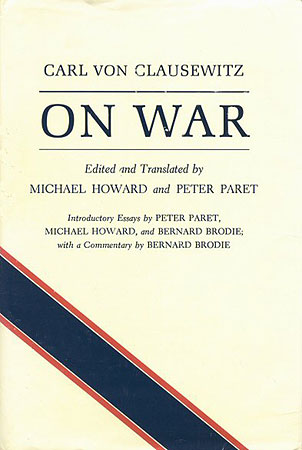
Book Review: Grand Strategies by Charles Hill 

Trial of a Thousand Years, by Charles Hill-a review

On War as an Unfinished Symphony

Thursday, November 3rd, 2011

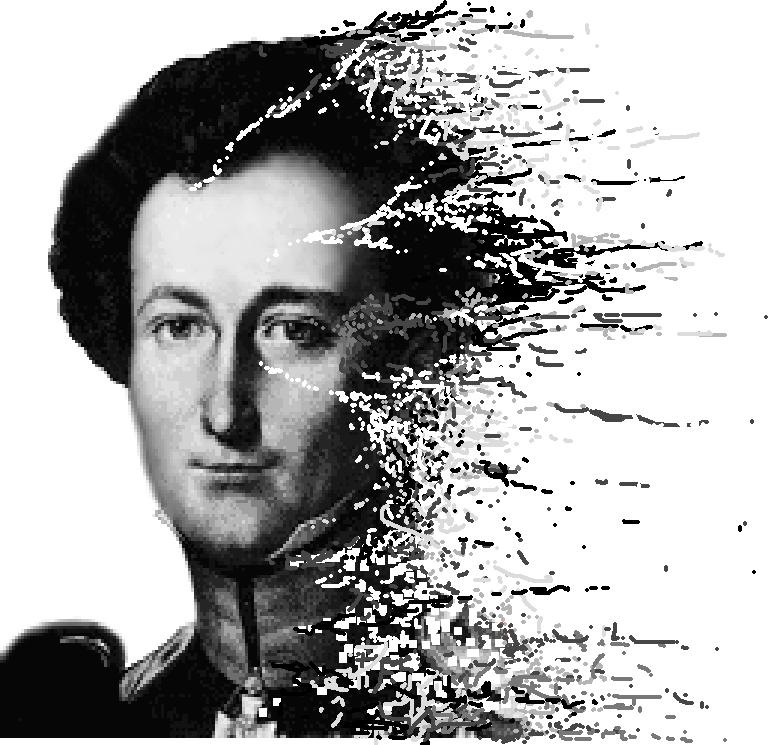
cvcforming.jpg

On War by Carl von Clausewitz has been the most influential book on strategy and war of all time.

We can say this because On War is the standard by which all other works of strategy are measured and only a few compared – notably Sun Tzu’s Art of War and The Peloponnesian War by Thucydides. The odd thing is that we can say this despite the fact that On War is more frequently shelved, cited or understood secondhand rather than read, even by military professionals. And furthermore, within the narrow demographic that reads Clausewitz seriously and critically, there can be heated dispute over what he meant, due to the difficulty of the text. Then there are the secondary effects, historical and military, of Clausewitz having been misunderstood, forgotten, ignored or at times, his strategic philosphy consciously rejected.

The shadow cast by On War is all the more remarkable given it’s circumstances of publication. Clausewitz died in 1831, at fifty-one, of cholera, having finally risen to a military post his talents merited. He had been writing On War since 1816 and it was far from completed or refined to his satisfaction and it is highly unlikely, in my view, that Clausewitz would have consented to it’s publication in the condition in which he left it. His determined and intellectually formidible widow, Marie von Clausewitz, further shaped the manuscript of On War, guided by her intimate knowledge of her husband’s ideas and was likely the best editor Clausewitz could have posthumously had.
Nevertheless, to my mind On War remains a magnificent unfinished symphony.

What would On War have looked like if Clausewitz had lived another twenty-five or thirty some years? Assuming continued good health, Clausewitz would have seen, perhaps commanded in, the First Schleswig War and at least studied the Crimean War from afar. He would have had another quarter-century of reading and mature reflection on his subject. Clausewitz, who had a keen understanding of history, would have also witnessed the grand European upheaval of liberal revolution in 1848 that rocked the Hohenzollern monarchy to it’s core. What new insights might Clausewitz have gleaned or expanded upon? Would his later chapters On War have evolved to equal the first?

Having outlived Marie (who died in 1836), would Clausewitz have become a deeply changed man?

What I find it difficult to believe is that Clausewitz, with his creatively driven and philosophically exacting mind,  would have been content to let the manuscript of On War rest where it stood in 1831. Or that we read today what Carl von Clausewitz ultimately intended.

Rivalrous and non-rivalrous goods and the OWS library

Friday, October 28th, 2011

[ by Charles Cameron — Jefferson, economics of possession and ideas, Occupy COG, library ]
.

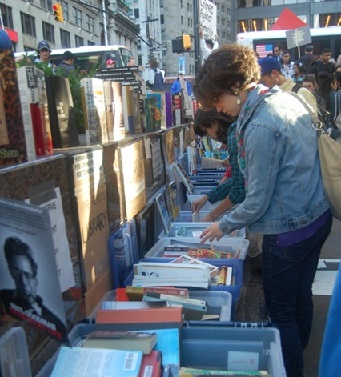
library-long.jpg

photo credit: Monique Zamir for Untapped Cities

.

1.

Let’s start with Thomas Jefferson. I don’t know if he was the first to mention this curious distinction on record, but he makes the point nicely:

If nature has made any one thing less susceptible than all others of exclusive property, it is the action of the thinking power called an idea, which an individual may exclusively possess as long as he keeps it to himself; but the moment it is divulged, it forces itself into the possession of everyone, and the receiver cannot dispossess himself of it. Its peculiar character, too, is that no one possesses the less, because every other possesses the whole of it. He who receives an idea from me, receives instruction himself without lessening mine; as he who lights his taper at mine, receives light without darkening me. That ideas should freely spread from one to another over the globe, for the moral and mutual instruction of man, and improvement of his condition, seems to have been peculiarly and benevolently designed by nature, when she made them, like fire, expansible over all space, without lessening their density at any point, and like the air in which we breathe, move, and have our physical being, incapable of confinement or exclusive appropriation. Inventions then cannot, in nature, be a subject of property.

John Perry Barlow quotes that gobbit of Jefferson as the epigraph to his essay, The Economy of Ideas.

2.

Here’s Lawrence Lessig, in his essay Against perpetual copyright:

Tangible goods are rivalrous goods

For one person to gain some tangible item, another person must lose it. For one person to gain the ownership of some piece of land, the previous owner must surrender ownership. T his is the ordinary state of physical property, and the laws around physical property are designed around this fact. Property taxes, zoning laws, and similar legal constructs are examples of how the law relates to physical property.

Intellectual works are non-rivalrous

Intellectual works are ordinarily non-rivalrous. It is possible for someone to teach a work of the mind to another without unlearning it himself. For example, one, or two, or a hundred people can memorize the same poem at the same time. Here the term “work of the mind” refers not to physical items such books or compact discs or DVD’s, but rather to the intangible content those physical objects contain.

3.

As someone whose work falls almost entirely in the “non-rivalrous” category, I am naturally very interested by this distinction, both for my own sake, and because (if the coming economy is an “information” or “imagination” economy) it may be the hinge on which the future of that economy turns…

4.

Which brings me to the Occupy movement, and to this curious fact which I found in an article I didn’t otherwise read. It’s from David Graeber, On Playing By The Rules – The Strange Success Of #OccupyWallStreet :

It’s no coincidence that the epicenter of the Wall Street Occupation, and so many others, is an impromptu library: a library being not only a model of an alternative economy, where lending is from a communal pool, at 0% interest, and the currency being lent is knowledge, and the means to understanding.

In quoting this, I mean neither to endorse nor to condemn the movement, but simply to note that its center of gravity as described here (although technically, books are rivalrous goods) falls clearly within the non-rivalrous category: it is a market-place of ideas.

5.

As a one-time tank-thinker, I was trained to spot early indicators.

I don’t know what this one means, but I suspect it’s an indicator.  Give me another to pair it with, and I may be able to foresee a trend.

What do you see?

6.

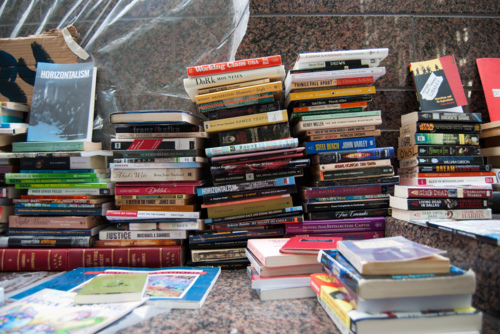
I spotted a copy of Mikhail Bulgakov‘s  The Master and Margarita in one of the photos.

tumblr_lsdaiufma61qzpfhxo1_500.jpg

photo credit: Blaine O’Neill under a CC BY-NC 2.0 license

and DH Lawrence, Sons and Lovers and Christopher Isherwood, The Berlin Stories; Strindberg, The Plays and Beckett, Krapp’s Last Tape; Dr Who, yeah and Star Wars too; William Gibson‘s Neuromancer and his Mona Lisa Overdrive; Max Marwick‘s Witchcraft and Sorcery; Orson Scott Card‘s Ender’s Game and Lewis Carroll‘s Alice in Wonderland — and for the politics of it all, Marina Sitrin, Horizontalism: Voices of Popular Power in Argentina and Erica Chenoweth and Maria J. Stephan, Why Civil Resistance Works: The Strategic Logic of Nonviolent Conflict… which I’ve linked for your convenience.

7.

For what it’s worth…

Nathan Schneider‘s article, What ‘diversity of tactics’ really means for Occupy Wall Street, cites blog-friend David Ronfeldt‘s study (with John Arqilla) Swarming & the Future of Conflict — along with (among others) Gene Sharp, whose work I discussed here a few months back.

[Reposting] Talking the audible talk

Wednesday, October 26th, 2011

[ previous version deleted for tech reasons, now reposted — pls comment if you were unable to do so before ]

[ by Charles Cameron — importance of suiting language to intended audience, importance of graphics, Tajikistan, Yemen, importance of poetry in conflict and conflict resolution ]

.

talking-the-talk.jpg

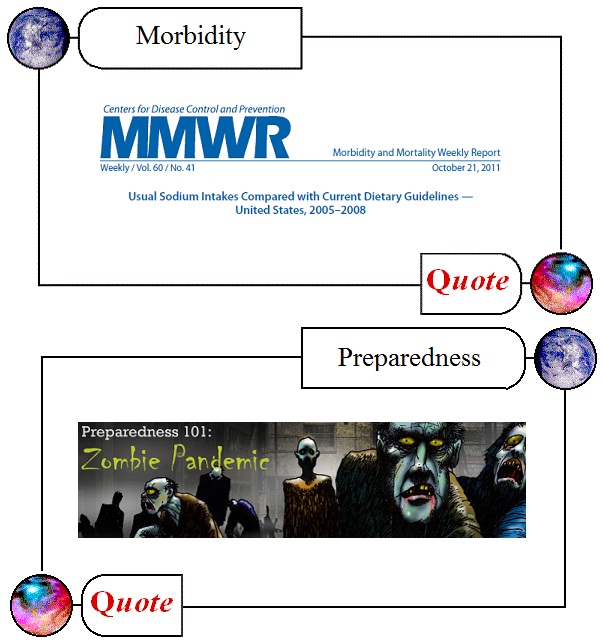
Et voila! Two publications issued this month by the Centers for Disease Control.

I’ve already stated the two lessons that I think we can draw from these, in the parenthetical header where I try to warn ZP readers of the approximate through-line and likely detours of each of my posts:

  • graphics, graphics, graphics!
  • talk the talk your intended audience can hear!

But why?

Of course I’m mildly amused at the CDC using zombies — just like Daniel Drezner — to get a serious point across. And I like the play between the seriousness of the Morbidity Report and the morbid fascination of the undead…

But I am going somewhere with all this, and on this occasion the CDC’s sense of presentation is the detour, and my through-line leads to the importance of poetry in conflict resolution.

*

I want to borrow a story from the keynote speech delivered by John Paul Lederach at the Association for Conflict Resolution’s 2004 Conference, as told to him by a Tajik professor named Abdul:

“I was tasked by the government to approach and convince one of warlords, a key Mullah-Commander located in the mountains to enter negotiations,” Abdul begins. “This was difficult if not impossible, because this Commander was considered a notorious criminal, and worse, he had killed one of my close friends.” Abdul stops while the translation conveys the personal side of his challenge.

When I first got to his camp the Commander said I had arrived late and it was time for prayers. So we went together and prayed. When we had finished, he said to me, How can a communist pray?

I am not a communist, my father was, I responded.

Then he asked what I taught in the University. We soon discovered we were both interested in Philosophy and Sufism. We started talking Sufi poetry. Our meeting went from twenty minutes to two and half hours. In this part of the world you have to circle into Truth through stories.” In the hallway Abdul’s gold capped teeth sparkle with a smile as he relays his message: “You see in Sufism there is an idea that discussion has no end.”

His point well conveyed, the Professor picks up the story again.

“I kept going to visit him. We mostly talked poetry and philosophy. Little by little I asked him about ending the war. I wanted to persuade him to take the chance on putting down his weapons. After months of visits we finally had enough trust to speak truths and it all boiled down to one concern.”

“The Commander said to me, ‘If I put down my weapons and go to Dushanbe with you, can you guarantee my safety and life?'” The Tajik storyteller pauses with the full sense of the moment. “My difficulty was that I could not guarantee his safety.”

He waits for the translator to finish making sure I have understood the weight of his peacemaking dilemma and then concludes.

“So I told my philosopher warlord friend the truth, ‘I cannot guarantee your safety.'” In the hallway Professor Abdul swings his arm under mine and comes to stand fully by my side to emphasize the answer he then gave the Commander.

“But I can guarantee this. I will go with you, side by side. And if you die I will die.’ The hallway is totally quiet.

“That day the Commander agreed to meet the Government. Some weeks later we came down together from the mountains. When he first met with the Commission he told them, ‘I have not come because of your Government. I have come for honor and respect of this Professor.’ “You see, my young American friend,” Abdul taps my arm lightly, “this is Tajik mediation.”

Think about it. Think about the Yemen.

Consider that Steven C. Caton of the Center for Middle Eastern Studies at Harvard suggests:

Every day in the Middle Eastern country of Yemen, battles are being waged that don’t involve bombs, guns or even a raised fist. Rather in Yemen, where physical violence is considered an inferior form of honor-conflict, poetry is one of the preferred weapons of choice.

If Yemen is important to you — or conflict resolution — I have a question for you:

Are you fluent in poetry?

*

Your copy of the Zombie Pandemic awaits you here. For those more interested in Morbidity and Mortality Weekly, here’s the report.

Hat-tip to Tony Judge for his paper, Poetic Engagement with Afghanistan, Caucasus and Iran: an unexplored strategic opportunity?

WikiLeaks (and a kiss stolen in the 13th century)

Wednesday, October 19th, 2011

[ by Charles Cameron — Assange, WikiLeaks, Google Ngrams, impact assessment — and a digression ]

.


Charles, duc d’Orleans

1.

Let’s start with Julian Assange; we’ll get to Charles d’Orleans later.

In the movie Julian Assange: a Modern Day Hero? Assange claims for WikiLeaks‘ massive Afghan / ISAF leak

It’s the most detailed history of any war that has been made, ever. It’s significant.

I don’t think there’s much doubt that WikiLeaks has had some impact in many areas of our complex world — but as I was watching the film the other day, I found myself wondering just how small its cumulative impact is, in comparison to that immense complexity.

2.

Assange makes various claims for WikiLeaks in the movie, but perhaps the most instructive one comes at the tail end of his statement describing the WL project as a whole:

WikiLeaks is a project of Sunshine Press; Sunshine Press is a collaboration between journalists, technical people, cyberpunks, some anti-corruption people, and some fairly famous civil rights activists, to try and get as many documents as possible out onto the internet that have never been released before that will produce positive political reform.

Let’s take Assange’s expressed hope that WL will “produce positive political reform” as the benchmark here.

Has it done that? Are there any signs that it will? What positive political reform, precisely?

Have, for instance, the Afghan WikiLeaks influenced the outcome of the war in Afghanistan?

3.

Or – to put the same question slightly differently – is or was WikiLeaks all a bit of a nine-days-wonder?

Google’s Ngram Viewer allows users to search for the frequency of uses of specific terms across a large volume of books over a specific time frame. It cannot have escaped the attention of folks at Google (or no such agency) that an Ngram-style timeline of mentions of names and terms of one sort or another in news articles from the leading news sources would be of similar interest.

A promo page on the movie notes that “WikiLeaks and Assange have been one of THE news stories of 2010” and suggests “There is a new WikiLeaks story in the media every week and the next wave involves the big banks in 2011” – not to mention “Julian Assange will remain in the news all year as his controversial sex crime charges come to a head later in 2011” – no doubt a popular selling point…

Is there a new WikiLeaks story in the media every week? I’m wondering what a Ngram of news mentions of WikiLeaks across the last two or three years would show.

4.

What’s a “nine days wonder”?

I had to use Google myself to verify that “a nine days wonder” (as opposed to “a seven days wonder”) was the phrase I should be using.

I was delighted to find that an old hero of mine – the poet Charles d’Orleans – was among the first to use it:

For this a wondir last but dayes nyne, An oold proverbe is seid.

I have always liked d’Orleans since I first ran across his poetic “confession” to God and his priest:

My ghostly father! I me confess,
First to God, and then to you,
That at a window, wot you how,
I stole a kiss of great sweetness!

To steal is sinful, to be sure, and kisses carry their own moral burden – but confession and penitence purifies the soul.

The thing is, reparation must also be made — and so it is that d’Orleans continues by vowing to God:

But I restore it shall, doubtless…

— the stolen kiss, that is.

He’s willing to give it back — always assuming that particular “window of opportunity” is still open…

5.

But I digress.  Which raises the question: is there a purpose to digression, do you suppose?


Switch to our mobile site