zenpundit.com » Zen

Archive for the ‘Zen’ Category

Of diversity in Islam

Wednesday, March 7th, 2012

[ by Charles Cameron — against either / or thinking — a graphic reminder? ]
.
Islam is “a mosaic, not a monolith”.

Vartan Gregorian, president of the Carnegie Corporation, offered us a 177-page exposition of that theme in a book of that title published by the Brookings Institution (2003), expanding on an earlier and shorter essay of the same title. Of the book-length version, he writes:

Presenting such a wide-angle view in a relatively small space requires the free use of generalizations, summaries, and categorizations that must leave out many nuances of history.

1.

There’s no doubt that some currents within Islam preach a continuing war against “Crusaders and Zionists” — and make no mistake about it, this is a religious movement, claiming its sanction in scripture and its path as submission to the will of God, as indicated by David Martin Jones and MLR Smith in Whose Hearts and Whose Minds? The Curious Case of Global Counter-Insurgency [see Zen’s comments here]:

The process of radicalisation is obviously a complex one. Certainly, the passage to the act of terrorism cannot be reduced solely to religion. Nevertheless, it is somewhat naive, if not perverse, to dismiss it completely. The bombings of the Madrid and London transport systems in March 2004 and July 2005 respectively, and even the 9/11 assaults, are, whatever else, Islamist acts in a Western setting. The view that religion is at best a secondary motive defies the evidence. All the groups that have undertaken high-profile terrorist acts dating from 9/11 and stretching from Bali to Madrid, London and Mumbai have acted in the name of a militant understanding of Islam. Such a pattern of worldwide attacks, exhibiting a profound devotion to a politically religious cause intimates, if nothing else, a religious dimension to jihadism. In fact, to reduce jihadism to individual social pathology attempts to explain away political religion as a social fact. Rather worryingly, it assumes that when a highly motivated jihadist claims to undertake an operation to advance a doctrine, he does not really mean it.

This might seem so obvious as to require no comment — yet Jones and Smith follow this paragraph with a question:

we need to resolve this paradox: why do counterinsurgency theorists exhibit this reluctance to confront the ideological or politically religious dimension of modern insurgency?

— and there are no doubt other segments of the media, intelligence and policy communities of which the same question might be asked.

One aspect of the answer, I believe, lies in the general tendency of post-enlightenment thinkers to “push religion into the background of their story” (Richard Landes‘ words, which I quoted here in a different context a week ago).

2.

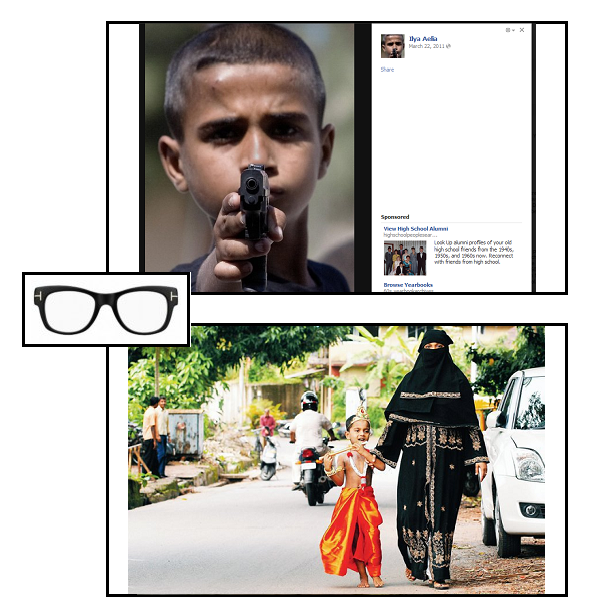
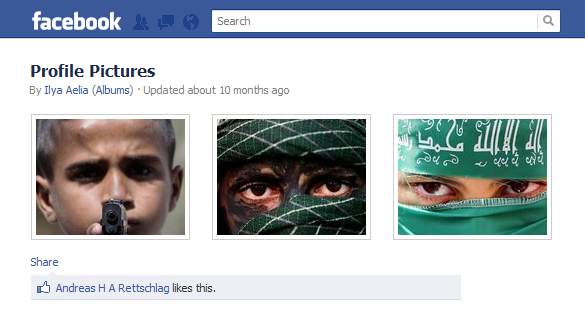
The young man pointing a gun at the viewer on a Facebook page (h/t Internet Hagganah) is the avatar of a net-salafi in Germany whose sequence of avatars looks like this:
Quintan Wiktorowicz defines a salafi thus:

The term “salafi” is used to denote those who follow the example of the companions (salaf) of the Prophet Mohammed. Salafis believe that because the companions learned about Islam directly from the Prophet, they commanded a pure understanding of the faith.

As he notes in another article:

The Salafi movement (often referred to as the Wahhabis)1 represents a diverse community. All Salafis share a puritanical approach to the religion intended to eschew religious innovation by strictly replicating the model of the Prophet Muhammad. Yet the community is broad enough to include such diverse figures as Osama bin Laden and the Mufti of Saudi Arabia. Individuals and groups within the community reflect varied positions on such important topics as jihad, apostasy, and the priorities of activism. In many cases, scholars claiming the Salafi mantel formulate antipodal juristic positions, leading one to question whether they can even be considered part of the same religious tradition.

The avatar-salafi depicted above sums up his own existence and “aim in life” by pointing a gun at you.

3.

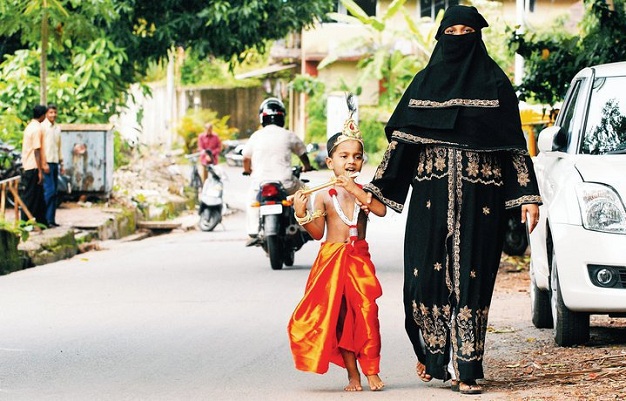
Not so the lady leading a child by the hand in the lower of the two images, from a photo taken in India.

She offers us, in fact, a vividly contrasting picture of Islam to that of the salafi. She, a woman who is clearly observant of the demure dress code given in Qur’an 33.59 and wearing a niqab, is leading by the hand a joyful child arrayed in the finery of Krishna — beloved flute-playing avatar of Vishnu (avatar in its original sense) among her Hindu neighbors.
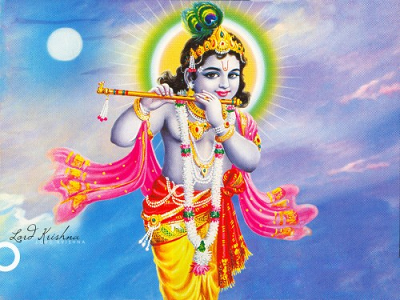
You might consider the pair of them together as monotheism hand-in-hand with polytheism. But then again, you might see them as peace and delight together, walking hand-in-hand.

You might see them as expressive of the Quranic proclamation (49.13 ):

O people, We have created you from a male and a female and made you into races and tribes so that you may know each other. Surely the most honored of you in the sight of God is the one who is the most righteous of you.

4.

To bring this back to contemporary politics, we may have our views about Islamist politics, and in the context of the changing scene across the Arab world it is worth pondering this recent quote from Rachid Ghannouchi, founder of the Ennahda Party in Tunisia, indicating another significant aspect of the contemporary evolution of Islamist thought:

Freedom is a fundamental principle in Islam, religion can not be forced on believers … Religion is not meant to give us guidance in all areas of industrial management, agricultural innovation, and governance, those subjects require human reason. Religion, however, gives us a code of values and principles.

Islam is not merely diverse, it is self-renewing.

5.

In light of all this, we need a far richer awareness of the mosaic that is Islam that our tendency towards black and white, war or peace, either / or thinking easily allows.

Consider these Quranic verses (35.27-28):

See you not that Allah sends down rain from the sky? With it We then bring out produce of various colors. And in the mountains are tracts white and red, of various shades of color, and black intense in hue. And so amongst men and crawling creatures and cattle, are they of various colors.

Again, the delight in diversity!

Now take another, closer look at those two folks from India:
Beautiful.
On fire: issues in theology and politics – i

Sunday, February 26th, 2012

[ by Charles Cameron — suicide, protest, martyrdom, the self-immolation of Buddhist monastics ]
.

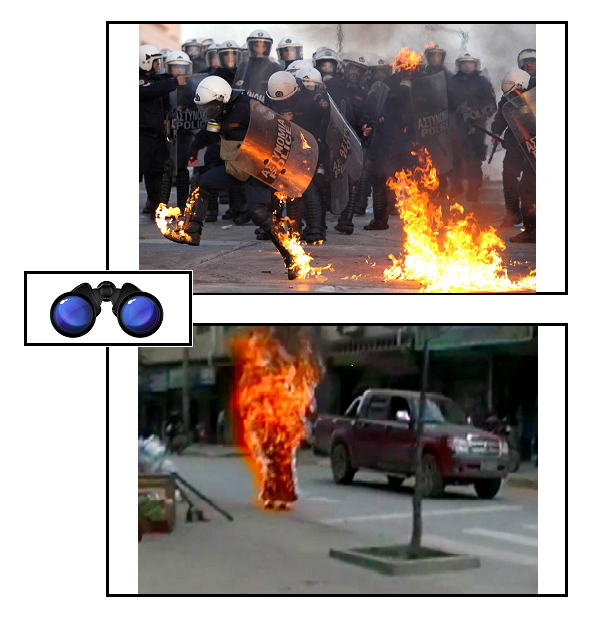
You can set your enemies on fire, you can set yourself on fire, you can blow yourself and your enemies up…

Protest, mayhem, suicide, martyrdom?

*

As usual, my interest is in the theological sanctions and constraints involved — in this case, by Buddhist self-immolation — so this excerpt from a Q&A with Lobsang Sangay, the prime minister of the Tibetan government-in-exile caught my eye:

Q: Does Buddhism allow self-immolation?

A: It’s a complex issue. One could refer to Jataka tales, which concern the previous births of the Buddha. In one story, the Buddha, in a previous incarnation, gives up his body to feed a starving tigress and her four cubs. Some other stories also talk about self-sacrifice by the Buddha.

Although suicide is violent and prohibited in Buddhism, some Buddhists believe it depends on the motivation. If you do it out of hatred and anger, then it is negative. But if you do it for a pure cause … it’s such a complex theological issue. You can’t go either way or have a definitive answer. But the action is tragic, so painful.

That’s a start: it’s a theologically complex issue…

The young Karmapa Lama, second in influence only to the Dalai Lama himself, is quoted in a Guardian report as discouraging this form of protest:

These desperate acts … are a cry against the injustice and repression under which they live. But I request the people of Tibet to preserve their lives and find other, constructive ways to work for the cause of Tibet.

In Buddhist teaching life is precious. To achieve anything worthwhile we need to preserve our lives.

It should be noted, however, that a number of monks in exile from China are depicted in the same article, bearing posters that call the self-immolators “burning martyrs”.

Robert Thurman, Je Tsongkhapa Professor of Indo-Tibetan Buddhist Studies at Columbia and president of New York’s Tibet House, provides his own justification for such acts:

When you destroy your body, you violate your own life, the lives of what Buddhists call “the 84,000 cells” that constitute it. This does seem violent. Yet in this case, the individual sacrifices herself to appeal to her enemy, to convey the perhaps all-too-subliminal message that they have nothing to fear from her, that she will resist their relationship of fear and harm by removing herself from being the target of their ultimately self-destructive, evil behavior. That is true non-harming—perfect resistance by complete surrender. If your victim prevents you from harming her by harming herself and taking herself out of your reach, then why were you afraid of her and wanting to harm her in the first place? Since she won’t harm you, she must love you. She wants you to stop fearing and hating; she wants you to be happy! Indeed, she cries out to you with her very life to wake up and behold the power of love—how it does not fear death, how it gives itself away to reality, how it overwhelms hatred.

And we should remember that even within Buddhism, self-immolation is not an exclusively Tibetan phenomenon. Here’s the celebrated Vietnamese zen monk and poet Thich Nhat Nanh, hearkening back to the days of the Vietnam War in his open letter “In Search of the Enemy of Man” (addressed to Martin Luther King):

The self-burning of Vietnamese Buddhist monks in 1963 is somehow difficult for the Western Christian conscience to understand. The Press spoke then of suicide, but in the essence, it is not. It is not even a protest. What the monks said in the letters they left before burning themselves aimed only at alarming, at moving the hearts of the oppressors and at calling the attention of the world to the suffering endured then by the Vietnamese. To burn oneself by fire is to prove that what one is saying is of the utmost importance. There is nothing more painful than burning oneself. To say something while experiencing this kind of pain is to say it with the utmost of courage, frankness, determination and sincerity. During the ceremony of ordination, as practiced in the Mahayana tradition, the monk-candidate is required to burn one, or more, small spots on his body in taking the vow to observe the 250 rules of a bhikshu, to live the life of a monk, to attain enlightenment and to devote his life to the salvation of all beings. One can, of course, say these things while sitting in a comfortable armchair; but when the words are uttered while kneeling before the community of sangha and experiencing this kind of pain, they will express all the seriousness of one’s heart and mind, and carry much greater weight.

The Vietnamese monk, by burning himself, says with all his strength and determination that he can endure the greatest of suffering to protect his people. What he really aims at is the expression of his will and determination, not death. To express will by burning oneself, therefore, is not to commit an act of destruction but to perform an act of construction, that is to suffer and to die for the sake of one’s people.

In a later post, I’ll return to Nhat Hanh‘s comment about monastic ordination, comparing it with the symbolism of the “red” given to cardinals on their elevation to that dignity.

*

Someone who is neither a monk or nun, nor a Tibetan, nor even a Buddhist — a Tunisian street vendor named Mohamed Bouazizi — set himself on fire in Sidi Bouzid not so long ago, and the rippling wave of events triggered by that act have included the toppling of long-entrenched dictators — is it so remarkable that an 18 year old nun, Tenzin Choedon, and other Tibetans too might hope that an act of self-immolation would galvanize the population around them and the world, resulting in the toppling of the hated Han regime in their part of the world?

I am not sure whether Prof. Thurman’s attempt to tie the Buddhist monastics’ mode of self-sacrifice to the notion, “see, we’re no threat” really works, but it is surely worth considering when it comes from a man who often speaks as a western mouthpiece for the Dalai Lama…

There are of course differences between monastics and laypeople.

Bouazizi’s self immolation was an act of despair, Tenzin Choedon’s an act of courage — as the photos of her standing there, ablaze and unflinching, while another woman offers a silk scarf into the flames in the traditional gesture of respect clearly show.

And when Prof. Thurman declares that the nun wanted her people to be happy, he surely doesn’t mean that she wanted them to be pleased at the sight of her standing there in the middle of the street ablaze — but that she wanted her people to be liberated from the repressive yoke they were and are under, and to feel the joy that comes with liberation from dictatorship.

But Bouzazi’s act, too, must have required considerable courage, while Tenzin Choedon’s act was surely also born of desperation. We humans, as individuals, are by our very nature blended beings.

***

As an Addendum:

Khenpo Karthar Rinpoche in his book, Dharma Paths, tells the Jataka tale of the Buddha giving his body to feed some tiger cubs as follows:

In one of his previous lives, the Buddha was born as the youngest of three princes. When he was only five years old, the three princes were in a forest playing together at hide-and-seek and other games. As they were walking in the forest, they came to a cave where they saw a wounded female tiger with five cubs. The mother tiger was very weak and was unable to provide food for the baby tigers. The Buddha’s older brothers went to search for some food, and they asked the young prince to stay near the cave to take care of the mother tiger and the five cubs.

While the Buddha was taking care of the wounded tiger and her five cubs, he began to think that it was not proper to kill other beings and give their flesh to the tiger. He found some large thorns and pressed them into neck, and as the blood came out, he let the cubs and their mother suck the blood. In fact, he gave his whole body to the five cubs and their mother as an act of generosity. As he did this, the Buddha prayed, “Right now I am only able to give temporary help to these starving beings, just removing their hunger. May these tigers who are enjoying my flesh, blood, and bones be reborn to a higher realm, and may I be able to teach them and lead them out of cyclic existence.”

We are naturally entitled to take the Jataka tales as scriptures, morality tales, or legends, fairy-tales — but the Rinpoche makes it clear in his telling that the bodhisattva who would later become Gautama Buddha “gave his whole body”.

In the Chod ritual of Tibetan Buddhism, practitioners symbolically give their own flesh to sate the hungry demons…

The speeds of thought, complexities of problems

Wednesday, February 1st, 2012

[ by Charles Cameron — instinct, rationality, creativity, complexity and intelligence ]
.

Guy Claxton, Hare Brain, Tortoise Mind
Daniel Kahneman, Thinking, Fast and Slow

You might think, taking a quick glance at their titles, that these two books would be in substantial agreement with one another about the speeds of thought. But consider these two comments, in one of which the deliberative, logical mind is “slower” than the intuitive and emotional — while in the other, it is the rational mind that is “faster” and the intuitive mind which is “slower”. Brought together, the two quotes are amazing — it would seem that either one or the other must be wrong:

\

Happily, I don’t believe either one is wrong — I think it’s more a matter of there being three speeds of thought, and the two books in question using different terminologies to emphasize different distinctions between them.

Here’s a more extended version of Guy Claxton’s position:

Roughly speaking, the mind possesses three different processing speeds. The first is faster than thought. Some situations demand an unselfconscious, instantaneous reaction. … Neither a concert pianist nor an Olympic fencer has time to figure out what to do next. There is a kind of ‘intelligence’ that works more rapidly than thinking. This mode of fast, physical intelligence could be called our ‘wits’. (The five senses were originally known as ‘the five wits’.)

Then there is thought itself — the sort of intelligence which does involve figuring matters out, weighing up the pros and cons, constructing arguments and solving problems. A mechanic working out why an engine will not fire, a family arguing over the brochures about where to go for next summer’s holiday, a scientist trying to interpret an intriguing experimental result, a student wrestling with an examination question: all are employing a way of knowing that relies on reason and logic, on deliberate conscious thinking. … Someone who is good at solving these sorts of problems we call ‘bright’ or ‘clever’.

But below this, there is another mental register that proceeds more slowly still. It is often less purposeful and clear-cut, more playful, leisurely or dreamy. In this mode we are ruminating or mulling things over, being contemplative or meditative. We may be pondering a problem, rather than earnestly trying to solve it, or just idly watching the world go by. What is going on in the mind may be quite fragmentary. What we are dunking may not make sense. We may even not be aware of much at all. As the English yokel is reported to have said: ‘sometimes I sits and thinks, but mostly I just sits’. […]

That third mode of thinking is the one Claxton identifies with “wisdom” — which is interesting enough. Just as interesting, though, is his identification of this slowest mode of thought with “wicked problems”:

Recent scientific evidence shows convincingly that the more patient, less deliberate modes of mind are particularly suited to making sense of situations that are intricate, shadowy or ill defined. Deliberate thinking, d-mode, works well when the problem it is facing is easily conceptualised. When we are trying to decide where to spend our holidays, it may well be perfectly obvious what the parameters are: how much we can afford, when we can get away, what kinds of things we enjoy doing, and so on. But when we are not sure what needs to be taken into account, or even which questions to pose — or when the issue is too subtle to be captured by the familiar categories of conscious thought — we need recourse to the tortoise mind.

I haven’t read either book, and I’d hope that Kahneman as well as Claxton actually addresses all three speeds of thought. But my immediate point is that the slowest of the three forms of thought is the one that’s best suited to understanding complex, wicked and emergent problems.

And that’s the one that can’t be hurried — the one where the Medici Effect takes effect — and the one which provides Claxton with one of his finest lines, with which he opens his book, a western koan if ever I saw one:

There is an old Polish saying, ‘Sleep faster; we need the pillows’, which reminds us that there are some activities which just will not be rushed. They take the time that they take.

More on that front shortly, insha’Allah and the creek don’t rise.

Buddhist monks in Geopolitics this week…

Monday, January 16th, 2012

[ by Charles Cameron — Burma, Tibet, impermanence ]
.

Sources:

Hozan Alan Senauke, Burma’s Opening Door, Shambhala Sun, Jan 16, 2012
Robert Saiget, China’s Tibetan Buddhists ‘in vicious cycle’, AFP, January 16, 2012

China cracks down, Myanmar lightens up… the Buddhists call it all “impermanence”.

Two Great Early Cyberneticists

Wednesday, December 21st, 2011

[ by Charles Cameron — Ashby, the Law of Requisite Variety, Bateson, the arts and sciences ]

Mapping from complexity to complexity. Access to a set of relationships … that we are not usually conscious of in ourselves.  The depth and riches of imagination, of the arts and sciences, of the listening heart / mind, of the world around us, of the models we need to make to navigate that world successfully… of the wisdom our steersmen need, and all too often lack.

Zen‘s post Ruminating on Strategic thinking had me thinking a bit, and I guess I felt some of his bullet points,

  • Assessment of the relationships among the variables
  • Assessment of the relationship between the variables and their strategic environment
  • Assessment of current “trajectory” or trend lines of variables
  • Assessment of costs to effect a change in the position or nature of each variable
  • Assessment of the strengths and weaknesses of the variables as a functioning system

and particularly

  • Recognition of systemic “choke points”, “tipping points” and feedback loops.

are separable as components one might learn, but need to fuse into a single intuition if the result is to be fully system-responsive.

And I think the two comments above by Ashby and Bateson are in their own ways both “about” that — about the need for a gestalt understanding rather than a list of separate and disparate parts…

*

And of course, those two quotes can also be used to pitch for cybernetics, or for poetry, or both… much to my delight!


Switch to our mobile site