[ by Charles Cameron — on a mostly overlooked possible asymmetry ]
Michael Peck posted a piece at the game site Kotaku yesterday, titled The Immense Pleasure of Huge War Games, and his opening quote startled me – it’s not one I’d heard before. Here’s Peck’s first para:
“Quantity has a quality all its own,” said Josef Stalin, as he relentlessly flung waves of Soviet tanks and troops against Hitler’s elite but outnumbered panzers. Comrade Stalin might not have believed in a deity, but even a Communist warlord would surely have agreed with Napoleon’s dictum that God is on the side of the bigger battalions.
And so to Napoleon’s dictum that God is on the side of the bigger battalions — I imagine he means real, flesh and blood battalions — which “even a Communist warlord would surely have agreed with”.
Not so the Qur’an, which reminded the Prophet of the battle of Badr (Quran 8.9-10):
Remember ye implored the assistance of your Lord, and He answered you: “I will assist you with a thousand of the angels, ranks on ranks.” Allah made it but a message of hope, and an assurance to your hearts: (in any case) there is no help except from Allah: and Allah is Exalted in Power, Wise.
Durer‘s angels of the Apocalypse, likewise, are militant angels, though like ourselves (Ephesians 6.12) they:
wrestle not against flesh and blood, but against principalities, against powers, against the rulers of the darkness of this world, against spiritual wickedness in high (celestial) places.
*
And so I would ask you: is there even the possibility of a higher asymmetry at work here — or are we speaking only of a matter of brute force versus high morale?
[ by Charles Cameron — bin Laden, Abu Bakr, Bernard of Clairvaux, Qur’an burning, Tora Bora, David Ignatius, Emptywheel, and impassioned belief ]
.
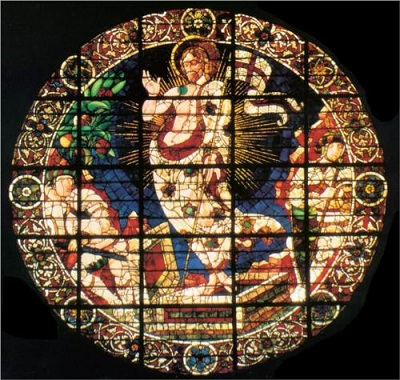
image: Paulo Uccello (1443) depicts the Resurrection — life after the grave, seen through a glass, darkly
We keep on stumbling over this one.
To the western mind, mostly, this world is axiomatically more vivid than the next. But there are those for whom the next life is axiomatically the more vivid – even if their day to day practices are geared to success and continuity in this life.
And this has consequences for our own lives, in the world around us — and for security.
1.
Some who are of this mind – bin Laden in this video among them — may quote or paraphrase Abu Bakr‘s message to Khosru:
I have come to you with an army of men that love death, as you love life.
That particular quote is from the rich tapestry of Islam – but Jewish history speaks also of Kiddush ha-Shem, martyrdom for the glory of God, which became in the time of the crusades “the exemplary answer of Jews threatened in their life and faith” when offered the options of conversion to Christianity or death.
And in Christendom, there is St Bernard of Clairvaux, who is quoted as writing in his letter to the Templars at the time of the Second Crusade:
The Christian who slays the unbeliever in the Holy War is sure of his reward, the more sure if he himself is slain.
Christian warriors, He who gave His life for you, to-day demands yours in return. These are combats worthy of you, combats in which it is glorious to conquer and advantageous to die.
2.
It is with this difference in axiomatic understanding in mind, that we should approach such issues as the relative importance – in our own minds, and in those of many Afghans – of the loss of human life in a night raid, as compared with the burning of copies of the Qur’an [In Reactions to Two Incidents, a U.S.-Afghan Disconnect]:
The mullah was astounded and a little angered to be asked why the accidental burning of Korans last month could provoke violence nationwide, while an intentional mass murder that included nine children last Sunday did not.
“How can you compare the dishonoring of the Holy Koran with the martyrdom of innocent civilians?” said an incredulous Mullah Khaliq Dad, a member of the council of religious leaders who investigated the Koran burnings. “The whole goal of our life is religion.”
The same understanding also explains bin Laden’s retreat to the Tora Bora caves. As I said in an early guest post here on ZP, with a hat-tip to Lawrence Wright and his book The Looming Tower:
When bin Laden, at the lowest point of his jihadist efforts, leaves the Yemen for Afghanistan and betakes himself to the Tora Bora caves, he will inevitably remind some Muslims of the Prophet himself, who at the lowest point of his prophetic vocation left Mecca for Medina and sought sanctuary in a cave — where by the grace of his God, a spider’s web covered the entrance in such a way that his enemies could not see him.
Our natural tendency in the west is to see Tora Bora in terms of military topography, as a highly defensible, almost impregnable warren of caves deep within some of the world’s most difficult mountain territory. What we miss may be precisely what Muslim piety will in some cases see — that bin Laden’s retreat there is symbolically aligned with the “sunna” or life of the Prophet, and thus with the life of Islam itself — in much the same way that Christians, in the words of Thomas a Kempis, may practice “the Imitation of Christ”.
4.
It was in fact Emptywheel‘s piece about bin Laden’s comment re killing President Obama (and thus promoting Joe Biden) that caught my attention today and prompted this post.
“The reason for concentrating on them,” the al-Qaeda leader explained to his top lieutenant, “is that Obama is the head of infidelity and killing him automatically will make [Vice President] Biden take over the presidency… “
— and commented:
OBL was going to kill Obama not for the sake of killing the US President, but because Biden, who served in the Senate for 36 years, almost 12 of which he served as one or another powerful committee Chair, “is totally unprepared for that post, which will lead the U.S. into a crisis.”
I just don’t think that’s right. I think it’s wrong, in fact, but [and here’s the important part] subtly wrong.
I believe that OBL lived at the confluence of worlds — one that we might call mythic or spiritual, and one that’s the one we call the “real” world. I believe that it was his myth, archetype, spirit based reality that was the more vivid to him, the one to which he was entrained, and that he found means in the practical world of strategies and tactics to adhere to the demands of that other world.
A world that was both invisible to us, and to him axiomatically victorious – at least as much so in death as in life.
Discussing strategy, the very canny LTG (USMC, Ret’d.) Paul Van Riper had this to say:
What we tend to do is look toward the enemy. We’re only looking one way: from us to them. But the good commanders take two other views. They mentally move forward and look back to themselves. They look from the enemy back to the friendly, and they try to imagine how the enemy might attack them. The third is to get a bird’s-eye view, a top-down view, where you take the whole scene in. The amateur looks one way; the professional looks at least three different ways.
A bird’s-eye view, a hawk’s eye view, a top-down view, an overview, a view from 30,000 feet, a God’s eye view, a view from above, a zoom…
If move 18 and its cadenza gave us a view of the depth of vision or insight that is necessary for a full and rich understanding of the world we live in — its qualitative or spiritual scope, if you like — this next move, with its picnic and drone-sight, addresses its breadth in space and time — materially and quantitatively speaking.
The classic expression of the sheer material scope of the universe was put together by Charles and Ray Eames in their justly celebrated film, Powers of Ten, from which the lower of these two images is drawn:
Here are some other relevant scans of the scope of things, in terms of time and space:
These are impressive videos to be sure, but as an aside I’ll invite you to ask yourselves how well they compare with this zoom in words, a poem by the zennist, ecologist, essayist and poet Gary Snyder, from his book, Axe Handles: Poems:
Such breadth of vision, such craft.
*
If this “material scope of things” too has a cadenza, it would be that all of this is shot through with some primary oppositions, dappled as the poet Gerard Manley Hopkins would have it, with swift, slow; sweet, sour; adazzle, dim — as indicated in the drone-sight and picnic double image at the head of this move.
This dappling, this constant flux of opposites, takes many forms — day and night lead to the more abstract light and dark, which can then be interpreted morally as good and evil, to which we respond with repulsion and attraction as the case may be, building our worldviews from love or fear…
At different scales the opposites that matter most to us may have different names and shadings, but here I’d just like to draw attention to the dappling of our world with:
competition and cooperation Darwin‘s natural selection and Kropotkin‘s mutual aid
duel and duet (ah! — a favorite phrasing of mine)
war and peace
Provocatively, we find this dappling in scriptures, too, wherein the ripples of such verses as “The LORD is a man of war: the LORD is his name” (Exodus 15.3) dropped like a stone into the pond of the human mind, meet with the ripples of other verses such as “God is love; and he that dwelleth in love dwelleth in God, and God in him” (I John 4.16).
There are times when we take such oppositions literally, perhaps too literally, and times when we begin to see oppositions as abstract and theoretical end-points to what is in fact a yin-yang process continually unfolding…
Which brings me by a commodius vicus of recirculation to this image of the great opposition between war and peace, its dappling, its unfolding:
Links claimed:
To the Lamb, move 18: this move presents the material scope of the universe in counterpoint to its visionary scope as laid out in move 18 with its cadenza.
To Revelation, move 17 — the word revelation means unveiling, as we have seen, and our sciences and technologies, with their spectra of telescopes, microscopes, cameras and zooms, are unveiling and revealing to us much about the physicality of the world we live in — much that was accounted for in other times and places through intuition, vision and poetry.
This scientific and technical revelation of material existence, for many of us moderns, has largely eclipsed the mode of visionary revelation of move 17 — yet it cannot eradicate it. Implicit in this move, then, is the sense that we carry with us both subjective and objective, inner and outer, qualitative and quantitative understandings — though the data that “sight” and “insight” provide us with may be different in kind, and resolving them may be something of a koan to us, the deep problem in consciousness as philosophers of science have named it — and that we can discount neither one if we are to have and maintain a rich sense of our situation.
Comment:
If the two previous moves have shown us the scope of the universe we co-inhabit, perhaps we should now make our own zoom in, much as James Joyce did when he had the schoolboy Stephen inscribe his name and address in his geography book as Stephen Dedalus, Class of Elements, Clongowes Wood College, Sallins, County Kildare, Ireland, Europe, The World, Universe – an address that Stephen then read both forwards and backwards, finding himself in one direction, and finding in the other that he had no means of knowing what might lie beyond the universe…
Imagine then, skipping rapidly from (unimaginable) cosmos via such things as the intriguingly named End of Greatness to galaxy or nebula…
…solar system and planet — whence we can slow down and zero gently in on the Middle (or as my friend Ralph Birnbaum would call it, the Muddle) East, Israel / Palestine, Jerusalem / Al Quds / the Temple Mount / Noble Sanctuary – and to such matters of contemplative vision and tribal passion as the first, second and projected third Temples, the al-Aqsa mosque.
Our increasing focus will bring us, then, to that the rock which Jews believe marks the place where Abraham bound his son Isaac (the Akedah), and which Muslims believe to be the place of ascent of the Prophet to the celestial realms (the Mi’raj) on his Night Journey (Qur’an, Al-Isra).
Here again myth and history collide, and both visionary and material considerations merge in the heart of the what my friend the Israeli journalist Gershom Gorenberg has justly called “the most contested piece of real estate on earth”.
As a movement Khudi stands against all forms of extremism, including those that use religion to justify a certain agenda. But simply saying ‘no’ to extremism isn’t good enough – it’s essential to challenge and undermine the arguments used by extremists and to refute the religious justifications they put forward.
However, challenging extremism in this way doesn’t mean that Khudi is eligible to comment on religious matters or issue fatwas about the length of the beard or the hijaab. At Khudi we believe religious beliefs are a personal matter that each individual may take guidance on from their respective religious authorities. Thus, our volunteers and friends belong to a variety of faiths and sects and span the religious spectrum, from conservative to liberal. The important thing is that we stand firmly by the principle of respecting each other’s difference.
2.
I’m intersted in Khudi, not least because it seems to be a brainchild of Maajid Nawaz, one of the ex-jihadists who founded the Qulliam Foundation in London:
Quilliam is the world’s first counter-extremism think tank set up to address the unique challenges of citizenship, identity and belonging in a globalised world. Quilliam stands for religious freedom, equality, human rights and democracy.
Khudi appears to be Quilliam’s Pakistan equivalent, more or less.
3.
Here’s the deal. The Khudi blog website header illustrated above cites Bukhari 9.582 as saying:
Beware of extremism in religion, for extremism destroyed those who went before you.
I would like to be able to point to that hadith with confidence in my own writings, and I’d be happy to give appropriate attribution to the Khudi blog. but first I need help in clearing up some questions I have about it.
Specifically, when I went to verify the hadith for scholarly accuracy before quoting it — not being a reader of Arabic, and thus being dependent on what resources in English I can muster — I found to my surprise that the hadith-search function for MulsimOnline gave the following result for Bukhari 9.582:
Narrated Ibn `Abbas:
(regarding the Verse):– ‘Neither say your prayer aloud, nor say it in a low tone.’ (17.110) This Verse was revealed while Allah’s Apostle was hiding himself in Mecca, and when he raised his voice while reciting the Qur’an, the pagans would hear him and abuse the Qur’an and its Revealer and to the one who brought it. So Allah said:– ‘Neither say your prayer aloud, nor say it in a low tone.’ (17.110) That is, ‘Do not say your prayer so loudly that the pagans can hear you, nor say it in such a low tone that your companions do not hear you.’ But seek a middle course between those (extremes), i.e., let your companions hear, but do not relate the Qur’an loudly, so that they may learn it from you.
“Not too soft, not too loud” bears a kind of family resemblance to “nothing in excess” — but it’s not the same thing, and I rather doubt that the words in Bukhari rendered by one translator as “Neither say your prayer aloud, nor say it in a low tone” would be rendered by another as “Beware of extremism in religion” — and I don’t see anything there that would correspond with the phrase “for extremism destroyed those who went before you”.
4.
Okay, all this set me digging a little further, and I next found a hadith reported at the ProphetEducation site, which reads as follows:
On the authority of Ibn Abbas (May Allah be pleased with him):
“Very early in the morning on the day of ‘Aqabah, the messenger of Allah (blessings and peace of Allah be upon him) while riding on his camel said to me: ‘pick some pebbles for me’. I then picked seven hurling pebbles for him. While dusting them of his hands he said: thou shall not cast except with such pebbles. Then he said: O mankind! Beware of extremism in religion for those before you were destroyed as a result of extremism in religion”
Related by Ibn Majah, Hadith no.(3029).
5.
So.
Did the folks putting the Khudi site together just get the hadith citation wrong — or is there more here than meets my eye? I would very much appreciate any help in explaining what at present seems to me a somewhat confusing picture.
If the hadith is authentic and can be found as stated in Sahih Bukhari, the pre-eminent source for hadith, and can be referenced from the English translation of Bukhari on the USC site, that would itself be a help. If so, it would also be of interest to know what kind of hermeneutic AQ deploys to get around it.
And if it is always found in the original sources, Bukhari or otherwise, in association with the comments about small “hurling pebbles” — why, that raises yet other questions.
6.
TIA — in this case meaning thanks in advance, not transient ischemic attack!
[ by Charles Cameron — addendum to an earlier post ]
.
Blog-friend Michael Robinson pointed me towards some interesting materials today that are relevant to my earlier post Of dust and breath, and I’m drawing here on his various emails to present them to you.
Each of these stories has more details than can be mentioned here: in each case, the link will take you to further riches.
1.
As Michael points out, “The ‘celebrity memorabilia,’ ‘sports memorabilia’ market — and also the ‘film memorabilia’ stuff is completely analogous to relics” featuring “individual players ‘worn’ unwashed game shirts or ‘Gone With The Wind Dresses’ and the like”.
His reference here for further reading is to Tim Munby‘s Cult of the Autograph Letter in England (1962), which “traces the rise of these sentimental phenomena in what after all was a Protestant Culture”. Michael notes, “if memory serves I think it simultaneous to the beginnings of Methodism, though from memory Munby draws no parallels”.
2.
Moving on to religious collectibles (assuming for a moment that sports memorabilia don’t qualify, not a necessary assumption), he points us to an article in the Toledo Blade today titled Ex-Toledoan sleuths out biblical relics for collectors, which discusses Scott Carroll‘s work in putting together the Green Collection, selections from which are currently on display at the Vatican:
Former Toledoan Scott Carroll doesn’t break into dusty tombs or dodge poisoned arrows, but the charismatic professor’s globe-trotting adventures in amassing the world’s largest private collection of rare biblical texts and artifacts have earned him the reputation of “the Indiana Jones of biblical archaeology.”
Mr. Carroll … has purchased nearly 50,000 ancient biblical papyri, texts, and artifacts since November, 2009, for the Green Collection, funded by Steve Green and the Green family. The Oklahoma City-based owners of 499 Hobby Lobby retail stores in 41 states, the Greens have been bankrolling Mr. Carroll’s collecting with the ultimate goal of having the items displayed in a nonsectarian Bible museum.
“I tell the Greens that I trust them to know where to put a store, and they need to trust me to stock the shelves,” Mr. Carroll said in a telephone interview he gave The Blade from Rome, where the Green Collection this month opened an exhibit at the Vatican called Verbum Domini, or Word of the Lord. The exhibit, which is free and open to the public, features 152 artifacts displayed contextually in settings ranging from re-creations of the Qumran caves where the Dead Sea Scrolls were discovered to a monastic scriptorium and an excavation of a Roman garbage city in Egypt.
I liked this passage, too…
Mr. Carroll said he has to laugh at opening an exhibit in Vatican City, seat of the global Roman Catholic Church, when he thinks of his childhood run-ins with the church.
“It’s kind of ironic because I was suspended and expelled from several Toledo Catholic schools in my upbringing,” he said. One of the expulsions, he added, was for setting fire to a church when he was in grade school.
“I chuckled at length talking to cardinals about my expulsions,” he said. “I was an athlete and rather rambunctious as a child — and that is putting it mildly. I was too active, not very self-disciplined, and ran into trouble.”
Reminiscing about one’s setting a church on fire as a youth sounds like an intriguing was of breaking the ice with their Eminences.
3.
Michael also drew my attention to this account of Rabbi Menachem Youlus [depicted above], “a self-described ‘Jewish Indiana Jones'” according to the New York Times – Indiana lookalikes seem to be cropping up all over! – who for years “told stories of traveling to Eastern Europe and beyond to search for historic Torahs that were lost or hidden during the Holocaust” but recently admitted he had lied (NYT, Rabbi Admits Torah Tales Were a Fraud, February 2):
“Between 2004 and 2010, I falsely represented that I had personally obtained vintage Torah scrolls — in particular ways, in particular locations — in Europe and Israel,” he told Judge Colleen McMahon of Federal District Court. “I know what I did was wrong, and I deeply regret my conduct.”
4.
Finally, from the world of Islamic art, Michael brings us another tale of collectors and their sometimes disreputable practices — this time from The Economist and having to do with the 16th-century illuminated version of Ferdowsi‘s epic Shahnameh, with its “lyrical calligraphy on gold-spattered pages” and “258 painted miniatures”, purchased at auction and “broken up” [as also depicted] – to the horror of collectors and bibliophiles – by Arthur Houghton :
In 1976 Houghton auctioned seven of its paintings at Christie’s for £863,500 ($1.6m): nearly four times more than the $450,000 he had paid for the whole book. He gave 78 pages to the Metropolitan where he was chairman of the trustees. When he died in 1990, 120 pages remained in the manuscript. These went back to Iran in 1994 in a swap for “Woman III” by Willem de Kooning, an abstract expressionist painter. Each side of the swap was valued at $20m.
5.
Hypothesis: all collectibles are talismans, all talismans are sacred.
****
Further addendum:
I’d intended to post this as a comment, but the comment function seems to be off — will try to fix that — but Michael’s most recent post to me included a pointer to a still current offer of a highly-collectible Americana twosome:
Zen here – dealing with an internal server error as it relates to comments and pings on Charles’ post. Unable to turn comments back on at the present time – only this post seems to be encountering problems. Trying to fix.
Zenpundit is a blog dedicated to exploring the intersections of foreign policy, history, military theory, national security,strategic thinking, futurism, cognition and a number of other esoteric pursuits.