zenpundit.com » Sembl

Archive for the ‘Sembl’ Category

The White House, Games, and HipBone/Sembl — today

Thursday, January 2nd, 2014

[ by Charles Cameron — a project of keen interest to me, and a request for your support ]
.

Something is going on in one corner of the White House that has me agog in a pleasant way.


.

Mark DeLoura, Senior Advisor for Digital Media at the WH Office of Science and Technology Policy is soliciting ideas about Games that Can Change the World. I’ve jumped in, and so have some old friends, one auld acquaintance and one new…

**

The home page for this project is hosted on its own Games for Impact site, and I’d invite you to take a look, and note in particular…

  • Games where ideas collide (& create new ideas)
  • This is my own page, for the HipBone / Sembl games and DoubleQuotes — and if you have found my style of analysis valuable, you may want to go there, (take the trouble to) log in, and upvote my idea — making a comment too, should you so wish.

  • Positive Impact and Game Evangelism
  • Similarly, you can log in and upvote the whole idea by supporting this proposal, the current “leading” concept…

    Part of what makes this entry so interesting is the fact that Chris Crawford, game designer and thinker non pareil, is discussing his own long-hoped-for paradigm shift in game design in this thread. Chris is the “auld acquaintance” I mentioned, and I met him via the good services of my old friend Mike Sellers late in the last century. It is good to read him again in the new millennium.

  • Games to increase understanding about emergent social systems
  • Mike’s own offering is this one, which I also highly recommend. Mike is one of the founding fathers of multiplayer games with graphical architecture, and has more recently been working to bring human psychology into gameplay with increasing subtlety. By all means give him a vote up if that sounds good.

  • Knecht/Connect – a playable version of the Glass Bead Game
  • As you know, my own games attempt to bring the game concept embedded in Hermann Hesse’s great novel, The Glass Bead Game / Magister Ludi into playable form, and my friend Paul Pilkington has been doing the same in a series of books [1, 2, 3] and a Twitter stream. Let’s help him get some recognition, too…

  • Try the Poietic Generator
  • This one’s a game concept I like, too — it’s based on Conway‘s Game of Life… and brings it alive!

    It was submitted by Olivier Auber, whom I hadn’t previously met — so he’s my new acquaintance, and I’m hoping his game ideas will flourish and that acquaintance will grow into friendship in as things unfold…

    **

    So that’s the overall project, along with a sampling of specific ideas that I admire and would invite you to support. I hope you’ll find (and support) some other game concepts of interest, too.

    In a follow up post honoring Chris Crawford — which may still take a while to write and post — I’ll be looking at some of the historical background of “serious games” — and of the HipBone / Sembl style of thinking in particular.

    Geometry aka logic as an analytic tool

    Friday, June 28th, 2013

    [ by Charles Cameron — reflections on cognitive empowerment by selective noticing ]
    .


    .

    I just realized that I take notice of details at the level of “geometry aka logic” which I would miss if I were more focused on content. In effect, I treat idiosyncracies and hiccups of expression — such as paradoxes — as indicative of condensed or distilled meaning.

    What triggered this realization was the way my interest was aroused by this phrase:

    The parallel universes may soon become perpendicular.

    I found that today in an FP piece, Will June 30 be midnight for Morsi’s Cinderella story?

    **

    Paradox? Geometry? Contradiction? Figure of speech?

    It’s the irregularity in the pattern used to describe the events in question that catches my eye here, however you care to name it. And something very similar is going on when I flag the weird juxtapositions of imagery and music in Taylor Swift, Sara Mingardo, JS Bach and a quiet WTF, or the koan-like tensions and reconciliations inherent in such inseparable pairs as war-and-peace in Of dualities, contradictions and the nonduality.

    Here’s the full paragraph, discussing the increasing polarization of the Egyptian public, and some ways in which “the current situation differs more in degree than in kind from the recent past”:

    Second, violence is on the table. The parallel universes may soon become perpendicular. Of course, Egyptian politics has had its victims over the past two and a half years, but violence has seemed episodic and almost self-limiting since those who have deployed it have paid a heavy political price. Nobody advocates violence now, but many expect it and it is not uncommon to hear from both sides that they will not shrink from self-defense. And the line between self-defense and offensive action can become thin for each camp for opposite reasons. The opposition is hardly centrally controlled and rogue elements have already been involved in attacks on Brotherhood offices as well as those of its political party. For the Brotherhood, its discipline has led it to prepare for what it sees as defensive action in a manner that understandably appears threatening to outsiders (especially after the events of December 2012 when Brotherhood cadres constituted themselves as a vigilante force to confront those demonstrating at the presidential palace).

    Okay, so I’m already reading the article, ergo I must already have been interested enough in what’s going on in Egypt to click through to it. So why the fuss about paradox and geometry in what is, after all, only one turn of phrase in a piece whpose subject already interests me?

    **

    I’m still feeling my way towards and understanding of how my mind works, how I pick up on things, how I populate my mind with rich and interesting memories, how I make my small and large creative “leaps” — my means of collecting and connecting dots, if you will. Because there’s a cognitive skill there that I haven’t seen taught, and I believe it offers an “outside the box” alternative mode of monitoring topics of interest.

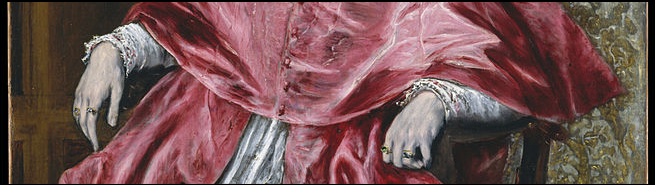
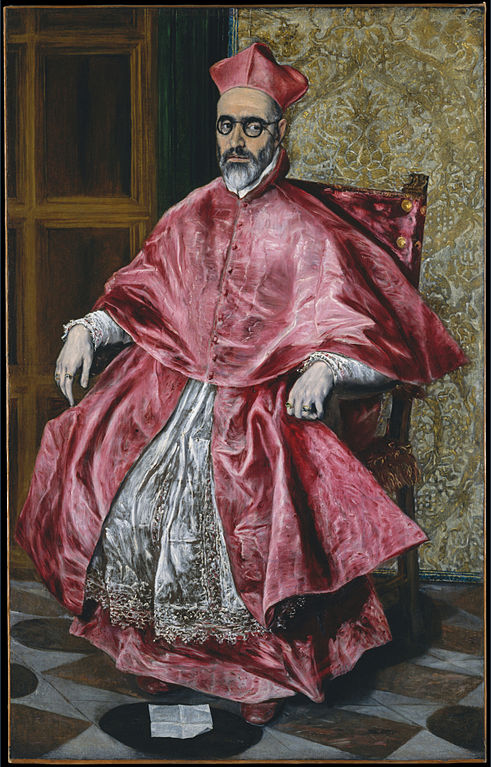
    You know, of course, that most every time you read the words you know, of course, that it’s a dead giveaway that the speaker or writer is skimming quickly past a cherished assumption that he or she wouldn’t want you to examine too carefully? Of course you do. It’s one of those psychological “tells” that should alert you, like a facial tick, a hesitation, or that curious (and paradoxical) tight grip on one arm of the chair with one hand while the other rests almost disdainfully relaxed and gracious on the other, in El Greco’s masterful portrait of a Cardinal, now in the Metropolitan in New York:

    How very telling that sort of detail can be!

    **

    And intersections.

    I talk quite a bit about juxtapositions and parallelisms, because they’re the elements of “creative leaps” (and Sembl / Hipbone moves) and I “practice” noting them for my DoubleQuotes. But one way to clear the xlutter from mind is to concentrate on places where two fields intersect. I’m interested in apocalyptic, for instance, so I take particular note when someone from a Christian apocalyptic POV (Joel Richardson, Joel Rosenberg, eg) writes about Islamic eschatology, or when someone from an Islamic apocalyptic POV (Sh. Safar al-Hawali, eg) writes about Christian eschatology. Reading wherever I notice this kind of overlap means that I learn in two contexts — effectively doubling my knowledge value — where most reading that’s not “targeted” this way only allows me to learn in one…

    Again: parallelisms, overlaps, paradoxes, perpendiculars, contradictions — these are all “formal properties” of a given text rather than “contents” — that’s the level of abstraction at which you can make the details sing.

    **

    Hey, I’m not alone. As I was cleaning this post up, Adam Elkus tweeted a link to a post about the CTO of Intel, Intel Labs: Assuring Corporate Immortality by Rob Enderle, which contains this phrase:

    This is very orthogonal thinking

    There we go! The word orthogonal is so important to me, and is so often on the tip of my tongue but out of reach of immediate memory, that I have a file on my computer consisting solely of the words “opposite oblique orthogonal congruent incongruous antithetical obtuse parallel asymptotic perpendicular right angles” — so if I can remember any one of them, I can easily find “orthogonal”.

    Very orthogonal thinking — terrific!

    Apocalyptic Fire in Azan #2

    Wednesday, June 5th, 2013

    [ by Charles Cameron — on end-times rhetoric and having no need of sun or moon ]
    .

    Detail from a Commentary on the Apocalypse by Beatus of Liebana

    **

    On the whole, the “signs of the end times” described in the installment of Maulana Asim Umar‘s Third World War and Dajjal, pp. 23-31, and now posted in the second issue of Azan on pp 83-89 are standard fare of the “wars and rumors of wars” type that could fit pretty much any time n history, including our own — “When the most despicable person of a nation would be its leader” would fit an astounding number of rulers across recorded history, depending on your point of view, including Nero and Diocletian, George III and Abe Lincoln, and a slew of Saddams, Mubaraks and Assads

    There was one section, however, that struck me as a powerful piece of visionary apocalyptic, and I wanted to bring it to the attention of those interested in such things.

    The Maulana writes [I’ve omitted the Arabic honorifics since I lack Arabic, and corrected one typo in Enlish]:

    “Hazrat Abu Hurayrah narrates that the Prophet of Allah said that the Day of Judgment would not occur before a fire erupts from Hijaz and lights up the necks of the camels of Basra.” [Bukhari, Muslim]

    The incident mentioned in this Hadith has already occurred according to Hafiz Ibn Kathir (RA) and other historians. This fire appeared in 650 H on the Day of Jumu’ah in some valleys of Madinah Munawwarah and remained for about a month. The narrators have said that the fire suddenly erupted from the direction of Hijaz. The scene looked like a whole city of fire – containing a whole castle, tower or battlement etc. Its height was 4 “farsakh” (around 12 miles) and its width was 4 miles. The fire would melt any mountain it reached as if the mountain was made out of wax or glass. Its flames had the sound of thunder and the energy of river waves. Blue and red-colored rivers looked to be coming out of the fire. In such a (horrible) state, the fire reached Madinah Munawwarah. But the curious thing was that the wind that was emanating from the direction of the flames felt cool in Madinah. The scholars have written that the fire had encompassed all the jungles of Madinah such that in the Haram-e-Nabwi and in Madinah, all the houses were lit up as if from the sun. The people would do all their work in the night from the light (of the fire); in fact, the light of the sun and the moon would became faded because of the light of the fire.

    Some people of Makkah (at the time of the fire) bore witness that they saw the fire while they were in Yamama and Basra.

    A strange quality of the fire was that it used to burn the stones to coal but it would not have any effect on the trees. It is said that there was a large stone in a jungle – half of it was in the limits of Haram-e-Madina and half of it was outside the limits. The fire burnt to coal the half of the stone that was outside the limits of the Haram-e-Madina. However, it cooled when it reached to the other half and hence, this half remained safe.

    The people of Basrah bore witness that they saw the necks of camels light up from the light of the fire…

    [The Beginning and the End: Ibn Kathir (RA)]

    **

    You know my interest in semblances and parallelisms. Compare:

    in fact, the light of the sun and the moon would became faded because of the light of the fire

    in that narrative with:

    the city had no need of the sun, neither of the moon to shine in it, for the glory of God did lighten it

    in Revelation 21:23.

    I am not arguing that there is an echo between the two accounts, nor that they describe the same phenomenon — simply that the rhetoric of each has a similar poetic intensity. This just happens to be one of those occasions when there are more things in heaven than are dreamed of in your natural sciences.

    A feast of form in my twitter-stream today

    Sunday, June 2nd, 2013

    [ by Charles Cameron — forms & patterns, pattern recognition & creative leaps, creative leaps & connecting dots, connecting dots & node-and-edge mapping — node-and-edge mapping, link charts and Sembl-HipBone games ]
    .

    .

    There’s no “actionable intelligence” in that tweet, but it recognizes a pattern, it makes a fine creative leap. And given the chance, that’s something bright minds do naturally, and enjoy doing, and is away more important than we think.

    Yestedrday I was watching Manhunt pretty closely for an upcoming Zenpundit review, and noticed that some of the most significant quotes in the film were absent from CNN’s transcript. One gap I noticed had to do with the descriptions of the analytic process, and in particular some of the things Cindy Storer said. I’ll quote this one, which goes to the heart of the matter, but there’s plenty more left for me to chew over with you later. Here she goes:

    Even in the analytical community there’s a relatively smaller percentage of people who are really good at making sense of information that doesn’t appear to be connected. So that’s what we call pattern analysis, trying to figure out what things look like. And those people, you really need those people to work on an issue like terrorism, counternarcotic, international arms trafficking, because you’ve got bits and pieces of scattered information from all over the place, and you have to try to make some sense of it. … That takes this talent, which is also a skill, and people would refer to it as magic — not the analysts doing it, but other people who didn’t have that talent referred to it as magic.

    That’s a pretty exact description of what the Sembl game will eventually teach people, once it comes out of the museum prototype and onto the web — but let’s back it up with a quick quote from Wittgenstein:

    A surveyable representation produces precisely that kind of understanding which consists in ‘seeing connections’ [Zusammenhänge sehen]. Hence the importance of finding and inventing connecting links. Hence the importance of finding and inventing intermediate links.

    That’s from Philosophical Investigations, 122, and it’s a higher altitude / more abstract view — but it’s also the very heart of network thinking, seeing processes not just in terms of isolated nodes but of the connections between them.

    **

    Seeing connections — connecting the dots — happens in lines and leaps. That is to say, it can happen according to the usual linear way of thinking, the dogged 99% of perspiration that people talk about — or according to the far less common lateral move or creative leap, which moves by analogy, which is to say by pattern recognition, by the perception of similarities of form.

    That’s the 1% we call inspiration. That’s the magic.

    **

    So a whole lot of patterning was going on in my twitter-stream today, and I thought I’d show you.

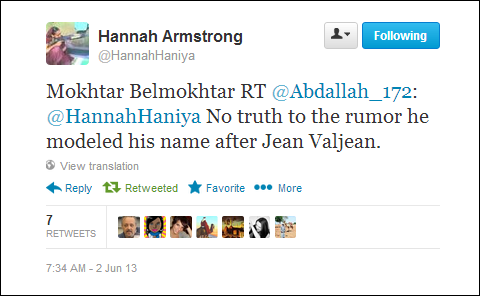
    First, there was the parallel between the names Mokhtar Belmokhtar and Jean Valjean (above). If you’re hunting either fellow, the parallelism isn’t going to yield a useful clue — but the mode of recognition is what matters, and the reason its such a rare mode is precisely because it’s playful. It plays with forms — in this case, the forms of the two names — without regard for practicality.

    And yet this playful spirit is what brought us Weil‘s conjecture and Pierre Deligne‘s Abel Prize, and the Taniyama-Shimura conjecture and Wiles‘ proof of Fermat’s Last Theorem.

    Serious playfulness is key… to serious, magical breakthroughs. In any and all domains.

    *

    With that in mind, here are the rest of the patterns I recognized in todays feed.

    Let’s start with self-reference, which can hardly get more succinct than the hackers hacked:

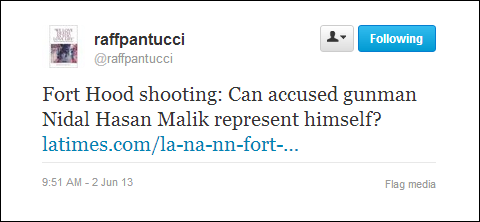
    There’s also a self-referential paradox at work in the question of a defendant appearing in his own defense — something that gives judges pause, because they see how tightly the serpent is chasing its own tail. Defendant defends self, From Raff Pantucci:

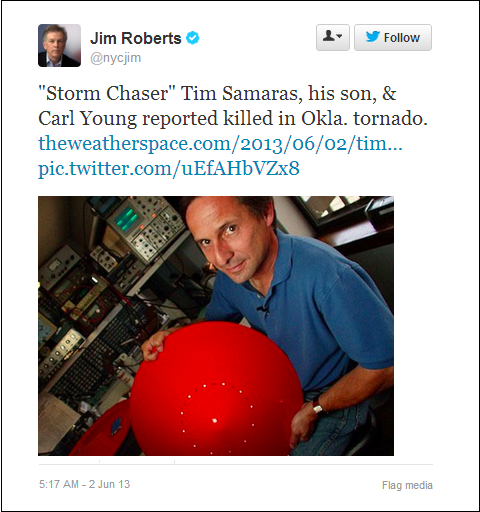
    The saddest self-reference of the morning’s tweets was this one, which could be encapsulated as storm-chaser chased by storm:

    Even tragedy can take self-referential form.

    **

    But lets move on to Turkey, which provided a rich dividend:

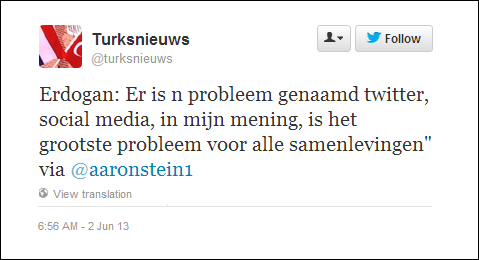
    There was this problem:

    Turkish I couldn’t read, Dutch I can more or less make out — but for an English tweet making the same point let’s go to Zeynep Tufekci, who has expertise in both matters Turkish and matters Internet, and tweets about Erdogan disapproving of tweeting:

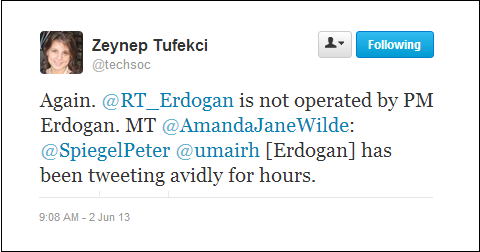
    Tufekci again, this time catching an even neater self-reference which doesn’t quite pan out — because, as she says, PM Erdogan is not the same as @RT_Erdogan:

    **

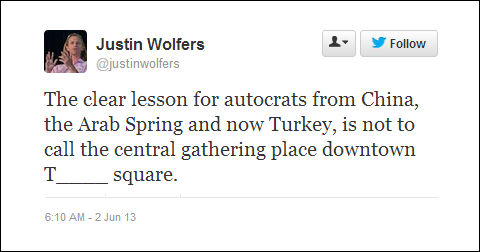
    While we’re on Turkey, this tweet about Tienanmen, Tahrir and Taksim Squares gave us another example of a bright mind catching a hint of pattern…

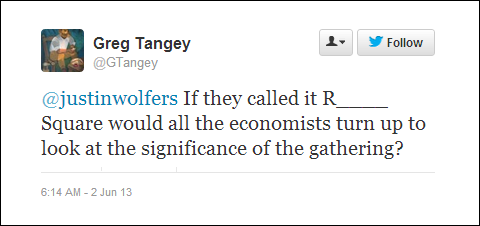
    And what a neat rejoinder!

    All of the above is quite useless, entirely playful — and of deep interest if creativity and insight matter

    **

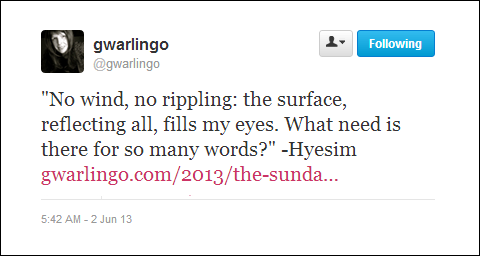
    Finally, I’d like to go someplace quiet and bathe in peace. This tweet, featuring a poem by a Korean zen master, does the trick nicely:

    AN appreciative bow to Gwarlingo for that one…

    Of images and likenesses

    Thursday, May 30th, 2013

    [ by Charles Cameron — a storm in a tea-kettle, various resemblances to Hitler, how Pudovkin perceived and practiced montage, what happened when the talkies came along, and four faces of Christ ]
    .

    It begins with something as innocent ad a tea kettle:

    Does this otherwise innocuous tea kettle resemble Hitler? Does it look enough like Hitler to merit JC Penney withdrawing it from sale?

    **

    Let’s take a look at a couple of other “resemblances to Hitler”:

    Who most resembles Hitler — Chaplin, or Stalin?

    On the face of it, that’s an easy question. If I were to just ask you the question “who is most like Hitler” in words, you might very well say Stalin, or Pol Pot perhaps — or, I suppose, if you were very focused on World War II and the Axis leaders, Mussolini.

    And if I asked you “who looks most like Hitler?” you might well say Charlie Chaplin — but you’d be “thinking visually” in terms of appearances, rather than “verbally” in terms of meanings.

    So there are at least two different ways someone can resemble Hitler — in terms of appearance, and in terms of behavior.

    **

    We don’t notice our own noses most of the time, even though they’re within our field of vision — and it’s a bit like that with likeness. We don’t have a grammar of resemblance, and that’s part of what I want to explore here, in drawing your attention to these two ways (at least) in which we can think of someone resembling Hitler.

    Placing two pictures side by side — Charlie Chaplin and Hitler, Hitler and Joseph Stalin — gets us to think a bit about the parallelisms and oppositions. And that’s a large part of what my DoubleQuotes format is good for. I am interested in what the mind does with juxtapositions, and I’m interested in getting us able to hold two contrasting thoughts in mind at the same time. As F Scott Fitzgerald said:

    The test of a first-rate intelligence is the ability to hold two opposed ideas in mind at the same time and still retain the ability to function.

    I’m in two minds as to whether he’s right, of course.

    **

    So montage. So the beginnings of Russian cinema, and the great directors of the silent era in film, Vsevolod Pudovkin and Sergei Eisenstein.

    Pudovkin wrote quite a bit about montage, about what he called relational editing, telling us:

    editing is not merely a method of the junction of separate scenes or pieces, but is a method that controls the “psychological guidance” of the spectator.

    He talked about five modes of editing, getting close to the foundations of a grammar of resemblance of the kind I mentioned above — contrast, paralleliem, symbolism, simultaneity and leit-motif. He said, for instance:

    Suppose it be our task to tell of the miserable situation of a starving man; the story will impress the more vividly if associated with mention of the senseless gluttony of a well-to-do man.

    and went on:

    it is possible not only to relate the starving sequence to the gluttony sequence, but also to relate separate scenes and even separate shots of the scenes to one another, thus, as it were, forcing the spectator to compare the two actions all the time, one strengthening the other.

    Under the heading of Symbolism, he noted:

    In the final scenes of the film Strike the shooting down of workmen is punctuated by shots of the slaughter of a bull in a stockyard. The scenarist, as it were, desires to say: just as a butcher fells a bull with the swing of a pole-axe, so, cruelly and in cold blood, were shot down the workers.

    I don’t suppose I’m alone in thinking here of the ending of Coppola‘s Apocalypse Now — and I doubt Coppola would have been unaware of the tribute he was paying to one of the early masters of cinematography, either. And what doe Pudovkin say about the symbolic editing together of the shooting of workmen punctuated by the slaughter of a bull?

    This method is especially interesting because, by means of editing, it introduces an abstract concept into the consciousness of the spectator without use of a title.

    **

    All this, of course, during the silent era. And when the talkies begin…

    After the advent of the talking pictures, Eisenstein, Pudovkin, Alexandrov and Vertov issue a statement, attempting to salvage the emotional impact of montage which is in danger of being capsized by the oh so new and glittery charm of verbals — of people talking:

    Only a contrapuntal use of sound in relation to the visual montage piece will afford a new potentiality of montage development and perfection.

    The first experimental work with sound must be directed along the line of its distinct nonsynchronization with the visual images. And only such an attack will give the necessary palpability which will later lead to the creation- of an orchestral counterpoint of visual and aural images

    You see what’s going on here? Eisenstein, Pudovkin, Vertov want the mind to be working on two tracks of ideation at once — a visual track, full of emotional impact, and a verbal track, in counterpoint to the visual.

    They want us to be able “to hold two opposed ideas in mind at the same time” — not in synchrony but in counterpoint.

    So this business of juxtaposition, of contrapuntal thinking, goes quite deep, and it’s my contention that it’s a skill we need both to develop and to understand — hence my interest in building a grammar of resemblance, of rhyme, of fugue, of graphic match, of equation.

    **

    One final example. If the “likeness of Hitler” example confronted us with the “nature of likeness” as between facial resemblance and similarities of behavior, this next instance will deal more with “evidence of likeness”:

    Here’s the question: are these “real” likenesses?

    **

    The two likenesses above are both of interest as possible “likenesses of Christ” — the top one taken from the Shroud of Turin, the lower one allegedly photographed in the snow, perhaps in China. The image on the Shroud might be a sort of “photographic negative” of the actual face of man a crucified two thousand years ago — and scientific techniques may or may not offer us evidence as to that likelihood. The other image — supposedly of the face of the same Christ, this time seen and recognized by a photographer in shadows on snow — how does one check the provenance of an image like that?

    We don’t have a photographic record of what Christ looked like to compare our own images with — unless the Shroud turns out to offer us just that — so it’s likely we’re back at the distinction first drawn by theologians over a century ago, between “the Jesus of History” and “the Christ of Faith”.

    Consider the two images below, neither one perhaps what a camera might have seen if a photographer could time-travel back two thousand years, but each suited to the people for whom it was produced — in China, in Africa:

    The Christs these two images evoke come from a different mode of seeing to the images captured in biometric scans and on ID cards — yet they are well-suited for devotion and inspiration…

    Switch to our mobile site