zenpundit.com » Sembl

Archive for the ‘Sembl’ Category

Glass Beads and Complexity

Monday, May 27th, 2013

[ by Charles Cameron — achieving something like closure on a post I started for Adam Elkus here, with a side dish along the way here ]
.

.

It’s astonishing to me how closely complexity science is related to Hermann Hesse‘s Glass Bead Game.

Adam Elkus recently pointed those who follow him to Cosma Rohilla Shalizi, Methods and Techniques of Complex Systems Science: an Overview, and just a quick dip there gave me the graphic I’ve put at the head of this post, together with this quote about “patterns” as Shalizi understands that term:

I mean more or less what people in software engineering do: a pattern is a recurring theme in the analysis of many different systems, a cross-systemic regularity. For instance: bacterial chemotaxis can be thought of as a way of resolving the tension between the exploitation of known resources, and costly exploration for new, potentially more valuable, resources (Figure 1.2). This same tension is present in a vast range of adaptive systems. Whether the exploration-exploitation trade-off arises among artifcial agents, human decision-makers or colonial organisms, many of the issues are the same as in chemotaxis, and solutions and methods of investigation that apply in one case can profitably be tried in another. The pattern “trade-off between exploitation and exploration” thus serves to orient us to broad features of novel situations. There are many other such patterns in complex systems science: “stability through hierarchically structured interactions”, “positive feedback leading to highly skewed outcomes”, “local inhibition and long-rate activation create spatial patterns”, and so forth.

**

Let’s start with patterns. The “people in software engineering” Shalizi mentions gleaned their use of the term “pattern” from the architect Christopher Alexander, author of the extraordinary, seminal book A Pattern Language, which in turn has hugely influenced computer science. Alexander distilled the essence of his thinking in his “Bead Game Conjecture”:

That it is possible to invent a unifying concept of structure within which all the various concepts of structure now current in different fields of art and science, can be seen from a single point of view. This conjecture is not new. In one form or another people have been wondering about it, as long as they have been wondering about structure itself; but in our world, confused and fragmented by specialisation, the conjecture takes on special significance. If our grasp of the world is to remain coherent, we need a bead game; and it is therefore vital for us to ask ourselves whether or not a bead game can be invented.

Manfred Eigen, Nobel laureate in Chemistry, called his book with Ruth Winkler-Oswatitsch Laws of the Game — and it deals with molecular biology, cellular automata, game theory, and games. But not just that — it is specifically written with Hesse’s concept in mind:

We hope to translate Hermann Hesse’s symbol of the glass bead game back into reality.

While we’re on about cellular automata, what about Stephen Wolfram? I don’t know that he talks about the Glass Bead Game himself, but at least three people talk about Wolfram’s book, A New Kind of Science, and/or his search engine, Wolfram Alpha as being strongly analogous to Hesse’s game — Jason Dyer, Graeme Philipson, and most recently, Mohammed AlQuraishi. Here’s a key para from Quraishi’s piece:

I think the Game is an intriguing concept, and I think it may one day be realized. In fact I think we are already on our way toward realizing it. In the simplest and most general sense, mathematics and programming languages allow us to formalize all knowledge. Contenders for the language of the Game already exist, at least in principle. But we are further along than that. Search engines like Wolfram Alpha have already begun the process of formalizing diverse pieces of knowledge, unifying them in a single medium, and providing the means to connect and reason about them. A repeated example in the book, the mapping of musical compositions to mathematical formulas or even historical events, is eminently doable within Wolfram Alpha. Much remains to be done of course, and there is no “game” yet that can be played across the vast sea of all human knowledge, but some enterprising individuals have already gotten started on creating it.

And then there’s John Holland, the “father of genetic algorithms”. Holland told an interviewer:

I’ve been working toward it all my life, this Das Glasperlenspiel. It was a very scholarly game, starting with an abacus, where people set up musical themes, then do variations on it, like a fugue. Then they’d expand it to where it could include other artistic forms, and eventually cultural symbols. It became a very sophisticated game for setting up themes, almost as a poet would, and building variations as a composer. It was a way of symbolizing music and of building broad insights into the world.

If I could get at all close to producing something like the glass bead game I can’t think of anything that would delight me more.

**

I’ve been working on a playable variant on the Glass Bead Game too, for twenty years quite consciously, and more if you count subterranean stirrings. And I don’t think glass beads, or stones, or chess or go pieces, or beads on an abacus, or strings of ones and zeros, or cells in an agent-based model for that matter, are the way to go. Which is not to say those approaches shouldn’t be tried, or don’t have remarkable things to teach us. I just don’t believe they give us quite what Hesse envisioned:

a direct route into the interior of the cosmic mystery, where in the alternation between inhaling and exhaling, between heaven and earth, between Yin and Yang, holiness is forever being created.

I think what’s important in Hesse’s game is that concepts that humans can grasp should reveal their stunning interrelations to heart and mind. And for that reason, the “moves” in my games [Hipbone, and more recently Sembl] consist of concepts — musical, verbal, visual, mathematical — and the links, the analogies, the “semblances” between them.

**

And thus the game is a search for analogies.

The human mind must inevitably perform what Shalizi calls the “trade-off between exploitation and exploration”. Some thoughts are proximate to others, they can be developed without any special insight by regular “linear” thinking. We do this every day, every minute — but it is not particularly revelatory. It doesn’t solve thorny problems, much less create beauty. There is another mode of thinking, however, that leaps between thoughts that are not so “close” but are nevertheless deeply related. To leap the apparent distance between such deeply related thoughts, we deploy analogy and creative thinking, and that is where the aha! of revelation occurs.

So I would suggest there is a close analogy here with the point Shalizi is making with the diagram atop this post. The human mind, to slightly paraphrase Shalizi’s caption, will “exploit the currently-available patch of food” for thought by linear, inside-the-patch thinking, but at full stretch it will also “explore, in hopes of ?nding richer patches elsewhere” — the “elsewhere” being attained precisely by “creative leaps” — by seeing semblances, patterns, analogies.

And to return to my earlier post, Thinking outside the cocoon, of which this post is a continuation, and perhaps the completion….

Shalizi’s “random walk” is thus also the archangel’s “zig-zag wantonness” in that great poem, Tom O’Roughley — when William Butler Yeats asks, “how but in zig-zag wantonness / could trumpeter Michael be so brave?” and writes, “wisdom is a butterfly / and not a gloomy bird of prey”…

The Abel Prize for a great Sembl move

Wednesday, May 22nd, 2013

[ by Charles Cameron — cross-posted from Sembl ]
.

You don’t have to be playing a Sembl or Hipbone game to make a great Sembl move — you just have to see a rich semblance between two concepts in (previously) widely separated fields of thought. Thus Pierre Deligne of Princeton’s Institute for Advanced Study, who won the Abel Prize in mathematics this year, did so by working on a rich Sembl-style insight from André Weil. As Scientific American reports today:

Deligne’s most spectacular results are on the interface of two areas of mathematics: number theory and geometry. At first glance, the two subjects appear to be light-years apart. As the name suggests, number theory is the study of numbers, such as the familiar natural numbers (1, 2, 3, and so on) and fractions, or more exotic ones, such as the square root of two. Geometry, on the other hand, studies shapes, such as the sphere or the surface of a donut. But French mathematician André Weil had a penetrating insight that the two subjects are in fact closely related. In 1940, while Weil was imprisoned for refusing to serve in the army during World War II, he sent a letter to his sister Simone Weil, a noted philosopher, in which he articulated his vision of a mathematical Rosetta stone. Weil suggested that sentences written in the language of number theory could be translated into the language of geometry, and vice versa. “Nothing is more fertile than these illicit liaisons,” he wrote to his sister about the unexpected links he uncovered between the two subjects; “nothing gives more pleasure to the connoisseur.”

**

While I was still a schoolboy, my favorite place to visit on vacation was the great Abbaye St. Pierre de Solesmes, celebrated for its central part in the renewal of Catholic liturgy and of the Gregorian Chant in particular. Two of my fondest memories are of the terrific bowls of coffee served in the monastic refectory at breakfast, and of my opportunity to take a class in chant under the chironomic hand of Dom Joseph Gajard, then Choirmaster at Solesmes. The liturgy and the chant were sublime.

I was an Anglican (“Episcopalian”) at the time, and just a wee bit concerned that the monks might want to convert me to the One Holy [Roman] Catholic and Apostolic version of the faith — but when I expressed my concern to one of the monks, I was reassured: they had had an earlier guest at the abbey, one Simone Weil, and she too had been unready to convert, though deeply moved by the liturgy…

So I’ve felt a quiet kinship with Simone Weil ever since, and try to keep a copy of her Letter to a Priest nearby me at all times. She begins:

When I read the catechism of the Council of Trent, it seems as though I had nothing in common with the religion there set forth. When I read the New Testament, the mystics, the liturgy, when I watch the celebration of the mass, I feel with a sort of conviction that this faith is mine or, to be more precise, would be mine without the distance placed between it and me by my imperfection.

I love her for that — and I love, too, that her brother should make such a splendid Sembl move.

**

I suppose I’d better post my reading of Wiles’ Proof of Fermat’s Last Theorem viewed as a Glass Bead Game as a follow up.

Jimmy Chen declares DQ on War

Tuesday, April 23rd, 2013

[ by Charles Cameron — juxtaposition offers us a potent way to connect “equal but opposite” dots ]
.

Jimmy Chen at HTMLGiant captures the griefs and joyful reliefs of war by juxtaposing two war photos that had separately become iconic — and their joint impact is precisely the kind I’m reaching for with my DoubleQuotes. I’ve re-framed them accordingly and slipped them into my DQ format, and here they are:

**

In Chen’s own words:

Time may be a sedative, for it’s always harder to know who exactly the bad people were, yet so easy to tell — in the incessant now from which we cannot run — who the bad people are. Either moral clarity diminishes with time, or we simply stop caring, the euphemism being humility. Prisoner of war Lt. Col. Robert L. Stirm is greeted by his family at Travis Air Force Base in Fairfield, California on March 17, 1973, about a year after Phan Thi Kim Phuc, aged 9, was photographed running from a South Vietnamese napalm attack on their own land after it had been occupied by the North.

The specifics of those two photographs may be slowly eroding in memory, as Chen suggests — but I don’t believe their power to evoke joy or grief will fade — and I am grateful to Jimmy Chen for reminding me, once again.

Beautifully.

Close reading, Synoptic- and Sembl-style, for parallels, patterns

Monday, March 25th, 2013

[ by Charles Cameron — if we omit all mention of the Qur’an, will the jihad perhaps disappear, you think? ]
.

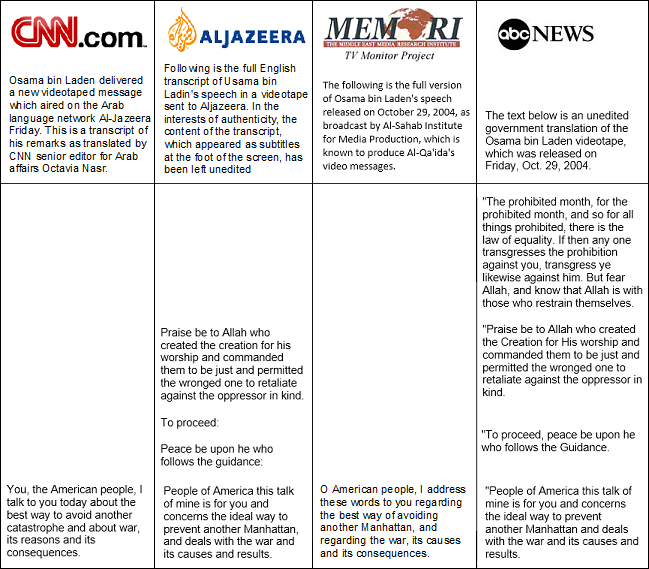
On Friday, Oct. 29, 2004, just before the 2004 US Presidential Election, a videotaped speech by Osama bin Laden was released online and variously reported:
.


.

Being a theologian at heart, I’ve formatted these versions in the style used in comparisons of the Synoptic Gospels, to give you an immediate sense of the differences I’ll be discussing…

**

Just how important was this particular speech by bin Laden?

It was important to bin Laden himself, as it was his first statement after his invitation to the US to convert to Islam. As I have noted before — quoting Michael Scheuer‘s Al-Qaeda’s Completed Warning Cycle – Ready to attack? — bin Laden had been criticized for failing to issue such an invitation:

After 9/11, bin Laden received sharp criticisms from Islamist scholars that dealt with the al-Qaeda chief’s failure to satisfy several religious requirements pertinent to waging war. The critique focused on three items: (1) insufficient warning; (2) failure to offer Americans a chance to convert to Islam; and (3) inadequate religious authorization to kill so many people. Bin Laden accepted these criticisms and in mid-2002 began a series of speeches and actions to remedy the shortcomings and satisfy his Islamist critics before again attacking in the United States.

MEMRI picks up the story here:

The Islamist website Al-Islah explains: “Some people ask ‘what’s new in this tape?’ [The answer is that] this tape is the second of its kind, after the previous tape of the Sheikh [Osama bin Laden], in which he offered a truce to the Europeans a few months ago, and it is a completion of this move, and it brings together the complementary elements of politics and religion, political savvy and force, the sword and justice. The Sheikh reminds the West in this tape of the great Islamic civilization and pure Islamic religion, and of Islamic justice…”

This video is also a significant “first” for bin Laden. In Raymond Ibrahim‘s words in his The Al Qaeda Reader:

This message also marks the first time bin Laden publicly acknowledged his role in the 9/11 strikes; previously he had insisted that he was merely an “inciter” and that it was the Muslim umma in general who had retaliated in defense of their faith.

It was important to the US because of the election four days later. The following exchange occurred on NBCNews’ Meet the Press, Jan 30th, 2005:

MR. RUSSERT: At the Clinton Library dedication on November 18, a few weeks after the election, you were quoted as saying, “It was the Osama bin Laden tape. It scared the voters,” the tape that appeared just a day before the election here. Do you believe that tape is the reason you lost the race?

SEN. KERRY: I believe that 9/11 was the central deciding issue in this race. And the tape–we were rising in the polls up until the last day when the tape appeared. We flat-lined the day the tape appeared and went down on Monday. I think it had an impact

The speech was important, in sum, both to bin Laden himself and to the US electorate: it deserves a close reading.

**

Sadly, however…

Posted, translated transcripts of Al Qaida and other jihadist materials often leave out the salutation and envoi (or other choice bits such as quotes from the Qur’an or Hadith) because they’re too religious or perhaps too Muslim — but when these same pieces of the puzzle are added back into the text, the whole document may cohere to a degree that is otherwise unapparent.

We tend not to “get” religious language. What do Daniel Benjamin and Steven Simon tell us in their book The Age of Sacred Terror?

So much of what was heard from al-Qaeda after the attacks sounded to Americans like gibberish that many chords of the apocalypse were missed.

Our prejudice against alien religious sentiment, or the assumption that it is ritualistic and hence irrelevant, or even worse, “babble” — the term FBI agents used to describe David Koresh‘s religious interpretation of events during the Waco siege — can blindside us to its very real discursive and exegetical power.

That’s the reason I’m offering you this post — years later — as a counter-example of the power of “Sembl thinking” — essentially, the power of pattern recognition as a key to understanding.

**

I read three versions of bin Laden’s videotaped speech of Oct. 29, 2004 at the time: those provided by CNN, MEMRI, and Al Jazeera — one “western secular” source, one with some degree of Israeli association, and one with roots in the Arabic cultures.

CNN cited al-Jazeera as having aired the video, and posted “a transcript of his remarks as translated by CNN senior editor for Arab affairs Octavia Nasr” which, as you can see above or at the link, began, “You, the American people, I talk to you today… “ MEMRI offered The Full Version of Osama bin Laden’s Speech followed by a transcript which began, “O American people, I address these words to you…” And Al Jazeera posted “the full English transcript of Usama bin Ladin’s speech in a videotape sent to Aljazeera” and noted, “In the interests of authenticity, the content of the transcript, which appeared as subtitles at the foot of the screen, has been left unedited” – above a transcript that began:

Praise be to Allah who created the creation for his worship and commanded them to be just and permitted the wronged one to retaliate against the oppressor in kind. To proceed: Peace be upon he who follows the guidance: People of America this talk of mine is for you…

That in itself is interesting — Al-Jazeera has two sentences with religious significance, one of them saying that God “permitted the wronged one to retaliate against the oppressor in kind” — with no mention of them in the MEMRI and CNN accounts.

**

As I read the Al Jazeera version, which seemed to me to be the one most likely to be accurate to bin Laden’s meaning, I came across the phrase:

We want to restore freedom to our Nation and just as you lay waste to our Nation, so shall we lay waste to yours.

There were several other parts of the speech which seemed to make (rhetorical) use of symmetry. There were the comments about “punishing the oppressor in kind” by destroying towers in the US, since towers in the Lebanon had been destroyed (which seems a pretty literal-minded reading of “in like manner”):

And as I looked at those demolished towers in Lebanon, it entered my mind that we should punish the oppressor in kind and that we should destroy towers in America in order that they taste some of what we tasted and so that they be deterred from killing our women and children.

There was a passage pointing up analogies between the Bush dynastic presidencies and similar dynastic rulerships in “our countries”:

… we have found it difficult to deal with the Bush administration in light of the resemblance it bears to the regimes in our countries, half of which are ruled by the military and the other half which are ruled by the sons of kings and presidents. Our experience with them in lengthy and both types are replete with those who are characterized by pride, arrogance, greed and a misappropriation of wealth.

And there was the comment translated in the CNN version:

Your security is not in the hands of [Democratic presidential nominee John] Kerry or Bush or al Qaeda. Your security is in your own hands. Any nation that does not attack us will not be attacked.

Each of these excerpts is couched in an analogical, symmetrical format, but it was the first one that really rang a bell for me — that phrase “just as you lay waste to our Nation, so shall we lay waste to yours” reminded me very strongly of one verse from the Qur’an, which contains the phrase, “And one who attacketh you, attack him in like manner as he attacked you” — the whole verse, Qur’an 2.194, has also been translated thus:

For the prohibited month, and so for all things prohibited, there is the law of equality. If then any one transgresses the prohibition against you, transgress ye likewise against him. But fear Allah, and know that Allah is with those who restrain themselves.

**

Okay, I’d read three versions of bin Laden’s text, and made a mental leap to a Quranic verse — and then I finally ran across ABC’s transcript, which opens with the very verse from the Quran my mind had leaped to.

Here’s where you can find the entire text, which ABC describes as “an unedited government translation of the Osama bin Laden videotape” – presumably from the Foreign Broadcast Information Service (then the FBIS, now the Open Source Center). It is certainly the most complete version I’ve seen:

Full Transcript of Bin Laden Video: ABC News Obtains Complete Text of Bin Laden’s Oct. 29 Video.

I don’t know for sure whether bin Laden used that verse himself (although I’d bet on it), or whether it was “framing matter” added by in the studio by Al-Jazeera (I very much doubt it) — either way, it confirmed my association, and reading the whole speech as a sermonette on that scriptural text gives it, in my view, notable added coherence.

**

Here’s what I wrote after I read the ABC transcript:

I’m particularly interested to note that bin Laden “opens” with the Qur’anic verse which says “for the prohibited month, and so for all things prohibited, there is the law of equality. If then any one transgresses the prohibition against you, transgress ye likewise against him. But fear Allah, and know that Allah is with those who restrain themselves” [Baqara 194].

That’s the central statement of the Islamic view of symmetrical morality in warfare, and prior to reading your full text, I thought I’d detected echoes of it in the OBL text in question — my own analytic process leans heavily on analogy and symmetry — and specifically in the passages I’ve quoted above…

The analogical, symmetrical format is present in each of these excerpts, and indicates how deeply the Qur’anic process runs in bin Laden, even here in a speech which attempts to present that very Qur’anic insight in secular terms to a western audience — explaining the first of the four excerpts above, for instance, with these following words:

No one except a dumb thief plays with the security of others and then makes himself believe he will be secure whereas thinking people when disaster strikes make it their priority to look for its causes in order to prevent it happening again.

and saying again, towards the end of the speech:

you may recall that for every action, there is a reaction.

We do indeed recall that phrase: in its complete form, as given in Isaac Newton‘s memorable Third Law of Motion:

For every action, there is an equal and opposite reaction.

**

For what it’s worth, the Qur’anic verse in question is not present in either Ibrahim’s Al Qaeda Reader, nor in Bruce Lawrence, Messages to the World: the Statements of Osama bin Laden. Ibrahim opens his version with the words, “Praise be to Allah, who created the worlds for his worship…” and Lawrence with, “Peace be upon those who are rightly guided. People of America…”

But no mention of Qur’an 2.194. It has just vanished. Gone. It has been ignored.

Isn’t that pretty much the definition of ignorance?

Words fail me.

The Story of Sembl, I: Herman Hesse’s Glass Bead Game

Wednesday, January 2nd, 2013

[ by Charles Cameron — cross-posted from Sembl — first in a series on the inspirations & developments that led to Sembl, & the aspirations that flow from them ]
.

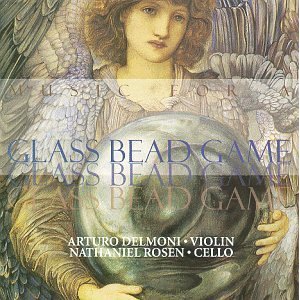
Music for a Glass Bead Game, Arturo Delmoni & Nathaniel Rosen, from  John Marks Records

.

Hermann Hesse is just about due for a revival.

While other novelists on the whole explored the “real world” around them, the outside world, the world of other people and things, Hermann Hesse was concerned with the “inner” world – the world of hopes, dreams, distress, anguish, rage and insight. With his 1927 novel Steppenwolf, he introduced us to the “dark side” of ourselves, our “shadow” to use Jung’s term, long before Star Wars, longer before the Sith Lord Cheney committed the United States to work “sort of the dark side, if you will … to spend time in the shadows in the intelligence world.” And if Steppenwolf showed us our shadow, in his earlier novel Siddhartha (1922) he had already shown us the light – in a deliciously sensual revisioning of the young Buddha‘s ascetic purity.

Siddhartha and Steppenwolf between them provided cover for generations of young idealists coming to terms with their own dreams and nightmares, but it was in his final great novel Das Glasperlenspiel (1943), known in English as The Glass Bead Game or Magister Ludi, which won him the Nobel Prize in Literature while confusing and losing many of his admirers — and inspiring beyond measure those who stayed with him.

Hesse’s grand vision was of a game played by the members of a scholarly caste – monastic Brahmins of a secular, post European world – whose purpose, pleasure and play it was to bring all human culture into one architecture, one music, woven of similarities, parallelisms, patterns, archetypes.

As an architecture of insights, Hesse spoke of this great game of his as “harmoniously building the hundred-gated cathedral of Mind.” In musical terms, he described the game as a virtual music in which “ideas” rather than “melodies” would be harmonized or held in counterpoint:

All the insights, noble thoughts, and works of art that the human race has produced in its creative eras, all that subsequent periods of scholarly study have reduced to concepts and converted into intellectual values the Glass Bead Game player plays like the organist on an organ. And this organ has attained an almost unimaginable perfection; its manuals and pedals range over the entire intellectual cosmos; its stops are almost beyond number.

And the game’s ultimate destination – besides the creation of an overarching synthesis uniting sciences and arts, great leaps of discovery and profound flights of imagination?

Every transition from major to minor in a sonata, every transformation of a myth or a religious cult, every classical or artistic formulation was, I realized in that flashing moment, if seen with a truly meditative mind, nothing but a direct route into the interior of the cosmic mystery, where in the alternation between inhaling and exhaling, between heaven and earth, between Yin and Yang, holiness is forever being created.

The ultimate aim is contemplative simplicity, meditation, a renewed sense of the sacred.

It was not the characters in the novel, nor its plot, that won Hesse the Nobel Prize: there is hardly a female character in the entire book, the males are largely cardboard imitations of people, and the plot such as it is might have made a fine twenty page novella – no need there for a 550-page masterpiece.

No, it is the game itself that holds the imagination, as the Himalayas might hold the attention of one who had lived a lifetime in the lowlands. And catch hold the imaginations of brilliant minds it has.

Hesse’s old friend and rival Thomas Mann inscribed a presentation copy of his novel Doctor Faustus with the words: “To Hermann Hesse, this glass bead game with black beads.”

Christopher Alexander, the progenitor of pattern languages, distilled the essence of his thinking in his “Bead Game Conjecture”:

That it is possible to invent a unifying concept of structure within which all the various concepts of structure now current in different fields of art and science, can be seen from a single point of view. This conjecture is not new. In one form or another people have been wondering about it, as long as they have been wondering about structure itself; but in our world, confused and fragmented by specialisation, the conjecture takes on special significance. If our grasp of the world is to remain coherent, we need a bead game; and it is therefore vital for us to ask ourselves whether or not a bead game can be invented.

Manfred Eigen, Nobel laureate in Chemistry, wrote of his book on molecular biology with Ruth Winkler-Oswatitsch, Laws of the Game:

We hope to translate Hermann Hesse’s symbol of the glass bead game back into reality.

John Holland, father of genetic algorithms, told an interviewer:

I’ve been working toward it all my life, this Das Glasperlenspiel. It was a very scholarly game, starting with an abacus, where people set up musical themes, then do variations on it, like a fugue. Then they’d expand it to where it could include other artistic forms, and eventually cultural symbols. It became a very sophisticated game for setting up themes, almost as a poet would, and building variations as a composer. It was a way of symbolizing music and of building broad insights into the world.

If I could get at all close to producing something like the glass bead game I can’t think of anything that would delight me more.

Mid-way between architecture and music, forming an arch between the arts and sciences, Hesse’s imaginative game has been construed on many levels and in many ways, serving the needs of molecular biology, artificial intelligence, architecture and more. But what of its nature as a game to be played?

From my point of view as a game designer, Hesse’s game is both an artwork – to be played as Bach or the blues are played – and a game – to be played as soccer or chess are played.

And what a game!


Switch to our mobile site