zenpundit.com » Sembl

Archive for the ‘Sembl’ Category

Of children, cultural differences, and computers

Saturday, December 15th, 2012

[ by Charles Cameron — kids, computers, creativity and games ]
.

Motorola Xoom tablet

.

It’s quite a triumphant story, with African kids in the foreground and Nicholas Negroponte and MIT playing the role of proud parents pushing them forward from behind…

With 100 million first-grade-aged children worldwide having no access to schooling, the One Laptop Per Child organization is trying something new in two remote Ethiopian villages—simply dropping off tablet computers with preloaded programs and seeing what happens. The goal: to see if illiterate kids with no previous exposure to written words can learn how to read all by themselves, by experimenting with the tablet and its preloaded alphabet-training games, e-books, movies, cartoons, paintings, and other programs. Early observations are encouraging, said Nicholas Negroponte, OLPC’s founder, at MIT Technology Review’s EmTech conference last week.

[ … ]

Earlier this year, OLPC workers dropped off closed boxes containing the tablets, taped shut, with no instruction. “I thought the kids would play with the boxes. Within four minutes, one kid not only opened the box, found the on-off switch … powered it up. Within five days, they were using 47 apps per child, per day. Within two weeks, they were singing ABC songs in the village, and within five months, they had hacked Android,” Negroponte said. “Some idiot in our organization or in the Media Lab had disabled the camera, and they figured out the camera, and had hacked Android.”

That’s a striking story, and it has caught many people’s attention since David Talbot wrote about it in a piece in MIT’s Technology Review in late October, titled Given Tablets but No Teachers, Ethiopian Children Teach Themselves.

**

I’d like to let that sink in — because I don’t want to deny it, in fact I want to share the excitement — but I do, too, want to juxtapose it with something else I read recently, where we’ll see some other African children, and where a different set of questions about their intelligence are in the air.

This quote is from Malcolm Gladwell, in a New Yorker piece titled None of the Above: what IQ can’t tell you about race:

The psychologist Michael Cole and some colleagues once gave members of the Kpelle tribe, in Liberia, a version of the WISC similarities test: they took a basket of food, tools, containers, and clothing and asked the tribesmen to sort them into appropriate categories. To the frustration of the researchers, the Kpelle chose functional pairings. They put a potato and a knife together because a knife is used to cut a potato. “A wise man could only do such-and-such,” they explained. Finally, the researchers asked, “How would a fool do it?” The tribesmen immediately re-sorted the items into the “right” categories. It can be argued that taxonomical categories are a developmental improvement— — that is, that the Kpelle would be more likely to advance, technologically and scientifically, if they started to see the world that way. But to label them less intelligent than Westerners, on the basis of their performance on that test, is merely to state that they have different cognitive preferences and habits. And if I.Q. varies with habits of mind, which can be adopted or discarded in a generation, what, exactly, is all the fuss about?

That one, of course, concerns me deeply — in fact they both do.

**

Look, my work with Cath Styles on the Sembl Game is predicated on the importance of resemblances — so the more cognitive preferences we can marshal by inviting people to make rich and varied links between things — Kpelle-style, western-style, art-style, science-style, you think of it, you name it — the better. But clearly we should also be aware in using and propagating the game that different styles of association exist, and should be explored.

And the first quote? That’s important too, because it shows the eagerness to learn that’s there, innate, before our culturally-acquired habits and assumptions and behaviors inhibit the childlike excitement of discovery, recognition, eureka! and aha!

**

Howard Rheingold once said of community-building digital media such as this blog, “Like all technologies, this medium has its shadow side, and there are ways to abuse it.”

When feeling the thrill of “up” stories like Negroponte’s, it may we wise to ask also what the “down” side might be. And IMO, there’s always room for optimism — but let’s keep it cautious, eh?
Steven Pinker on Analogy

Thursday, December 6th, 2012

[ by Charles Cameron — importance of analogy as an under-developed cognitive skill ]
.

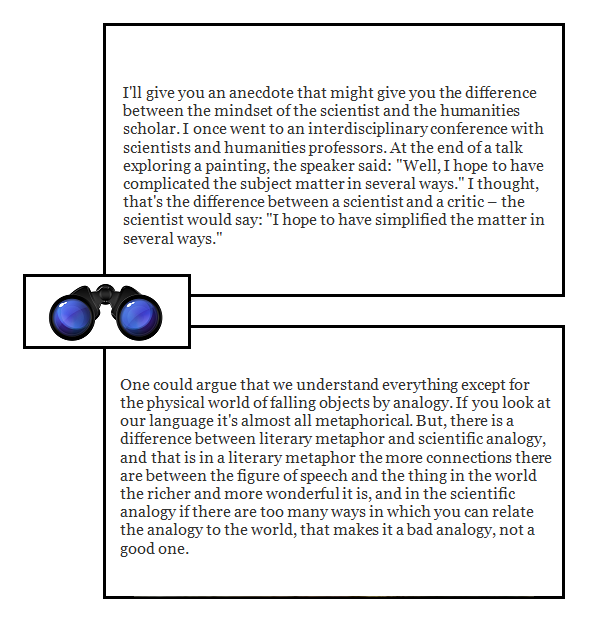
There was a interview with five prominent “science writers” in the Guardian a few days back, titled Science writing: how do you make complex issues accessible and readable? and one of the writers, Steven Pinker, makes two highly interesting observations:

**

There are a couple of things going on here that I’d like to note. One is that without intending to do so specifically, he is in essence formulating a view about a possible, central difference between scientific and religious thinking, since what he says about the humanities in general applies with great specificity to religion and the arts: in both religion and art, the expansive nature of “symbolism” is a key to the experience.

And that in turn prompts me to suggest that perhaps both the arts and religion are geared towards provoking, evoking or invoking an experience — whereas the sciences are geared towards obtaining an understanding.

I’ll have to think about that, and come to some sort of understanding of my own — perhaps expressed via symbolic means.

**

My second point of interest is that there’s an analogy to be made between Pinker’s two remarks: each of them has a form I could portray thus in terms of cause :: effect

science : humanities :: simplicity : complexity

Nobody present — the interviewer, Pinker himself, and four other very bright science writers — picked up on the close correspondence between those two statements at the time. And I find that very interesting.

I find it very interesting because the six of them were more interested in seeing what they could say (of what they already thought) than in saying what they could see (in light of the ongoing, immediate conversation).

I think we all tend to do that — which is why David Bohm‘s approach to dialogue is so important: if brings us to speak more into the moment as it surrounds us, not quite so much from the past as it has informed us.

**

Then there’s the interesting fact that Pinker’s sense of the difference between modes of thought in the humanities and the sciences as expressed in the top quote translates so directly to the difference between uses of analogy in the second — and his fairly emphatic statement:

one could argue that we understand everything except for the physical world of falling objects by analogy.

Analogy is the central device in our mental toolkit, and yet we know far more about trains of logic than we do about analogical leaps. We know so little, in fact, that distinguishing between “literary metaphor” and “scientific analogy” (both of which are based in the recognition of resemblance) on the basis of one looking for multiple, rich connectivity and the other for a single tight connection is something noteworthy enough for Pinker to bother to point it out. It is indeed a provocative and perhaps essential insight. But it is also pretty basic — dividing a field up into significant chunks, the way anthropology got divided into “cultural”, “archaeological”, “linguistic” and “physical anthropology”…

It’s time we learned to understand and use analogic with the same rigor we’ve applied to learning and using logic — and Sembl is just the tool for this.

**

Experience wants to be rich: factual understanding wants to be clear.

On the HipBone and Sembl games: update

Thursday, November 29th, 2012

[ brief intro by Charles Cameron, then shorter version of Dr. Cath Styles‘ presentation of Sembl at the National Digital Forum in New Zealand, 20 November 2012 ]
.

Charles writes:

I’ve been working for almost twenty years on the development of a playable variant on Hermann Hesse‘s concept of the Glass Bead Game.

It’s an astonishing idea, the GBG — that one could build an architecture of the greatest human ideas across all disciplinary boundaries and media — music, religion, mathematics, the sciences, anthropology, art, psychology, film, theater, literature, history all included — and it has engaged thinkers as subtle as Christopher Alexander, the author of A Pattern Language [See here, p. 74]. Manfred Eigen, Nobel laureate in Chemistry and author of Laws of the Game [see here], and John Holland, the father of genetic algorithms [see here].

Here’s Hesse’s own description of the game as a virtual music of ideas:

All the insights, noble thoughts, and works of art that the human race has produced in its creative eras, all that subsequent periods of scholarly study have reduced to concepts and converted into intellectual values the Glass Bead Game player plays like the organist on an organ. And this organ has attained an almost unimaginable perfection; its manuals and pedals range over the entire intellectual cosmos; its stops are almost beyond number.

My own HipBone Games were an attempt to make a variant of the game that would be simple enough that you could play it on a napkin in a cafe, and has in fact been played online — and more recently, my friend Cath Styles has adapted it for museum play, and introduced the basic concept and our future hopes in a presentation at the National Digital Forum 2012, New Zealand — which you can see very nicely recorded in Mediasite format.

Do take a look — Cath makes a first-rate presentation, and I love the Mediasite tech used to capture it.

Since the slides are shown in a small window concurrently with Cath’s presentation, I’ve edited her presentation for Zenpundit readers, and reproduced many of her slides full-size with some of her commentary below.

**

Sembl, the game of resemblance

Cath speaking:

In its first form, Sembl is an iPad game, called The Museum Game, at the National Museum of Australia. We’ve just released it in beta as a program for visiting groups.

Cath then talks about feedback from children and adults about their experience of playing the game. Some kids homed in on the principle of resemblance, others emphasised the social side of the game. She talks, too, about their teacher, and her observations about the ways the game engaged her kids.

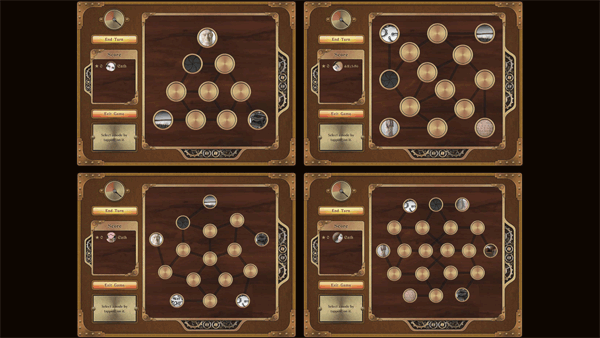
She then shows us various Sembl gameboards for iPad:

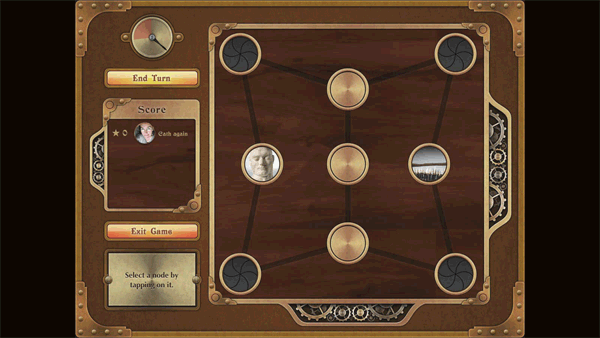
Sembl Museum gameboard for four teams of younger players

Four different Sembl Museum gameboards

Cath speaks:

But The Museum Game is just one form of Sembl. The Museum Game is played in real time, on site, and players take photos of physical objects to create nodes on the board.

The next step is to make a web-based form, that you could play at your own pace, and from your own place. Then, Sembl becomes a game-based social learning network, which amplifies the personal value of the game – it becomes social networking with cognitive benefits.

But it’s the bigger picture – of humans as a community – that I most want to explore: Sembl as an engine of networked ideas, or linked data.

Charles notes: I’m skipping the educational part — and the bit about my own role in the game’s development, to get to the core of her presentation as I see it: the cognitive facilitation it provides

Cath again:

Another way of saying this is that the Game provides a structure and impetus for dialogue, between the museum and visitors, between visitors and things, among visitors and between things. And this is not dialogue in the sense of an everyday conversation. It’s deeper than that. It’s a mutual experience of looking both ways, simultaneously.

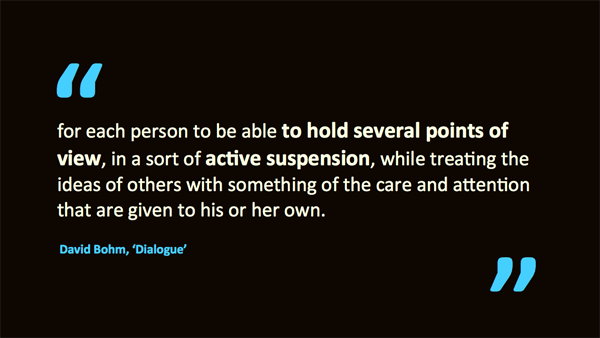
Cath next quotes David Bohm, the eminent quantum physicist:

to hold several points of view in active suspension – quotation of David Bohm

Cath speaks:

For Bohm, dialogue means holding several points of view in active suspension. He regarded this kind of dialogue as critical in order to investigate the crises facing society. He saw it as a way to liberate creativity to find solutions.

Cath then drops in an important topic header:

Toward a game-based social learning network

Cath:

The concept of Sembl, in its deepest sense, is social learning – game-based social learning. In its first instantiation, it is game-based social learning in a museum and – if things turn out as I hope they will – from next year it will be playable at any other exhibiting venue that has the infrastructure and the will to host games – galleries, libraries, botanic gardens, zoos and so on.

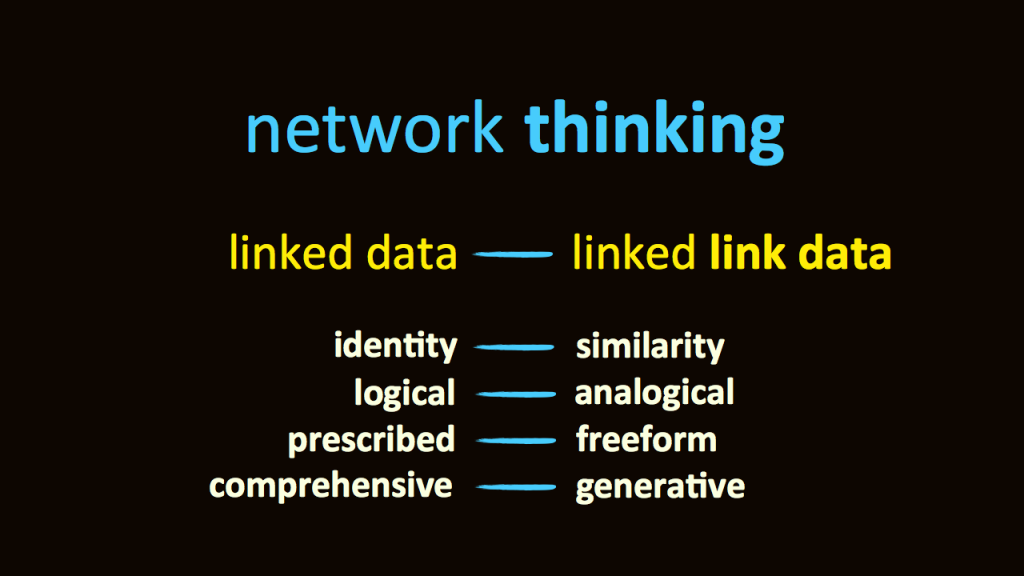
network thinking – how Sembl network links differ from traditional linked data links

A web-based form of Sembl can generate linked data with a difference. It’s linked link data, and quite different to normal linked data.

  • Instead of connections based on what a thing is – sculpture, or wooden, or red – Sembl generates connections based on a mutual resemblance between two things. Which, amazingly enough, is a great way of gaining a sense of what each thing is. And if your interest is to enable joyful journeying through cultural ideas, or serendipitous discovery, this approach just wins…
  • Instead of compiling logical links, Sembl cultivates the analogical.
  • Instead of building and deploying a structured, consistent set of relationships, Sembl revels in personal, imprecise, one-of-a-kind, free association, however crazy.
  • Instead of attempting to create a comprehensive and stable map of language and culture, Sembl links are perpetually generative, celebrating the organic, dynamic quirks of cognitive and natural processes.

But the most important way that Sembl is distinct from other systems of network links is that those who generate the links learn network thinking. Which is a critical faculty in this complex time between times, as many smart people will tell you.

Poets have always known the virtues of analogy as a path to the truth.

Tell all the truth but tell it slant – poem by Emily Dickinson

Sembl promotes dialogic, non-linear thinking, and new forms of coherence.

deliberative thinkers – quotation of Charles Cameron

It’s distinct from deliberative thinking, which is rational and causal and logical and linear.

eccentric thinkers – quotation of Charles Cameron

It’s another kind of thinking, which might be informed by rational thought, but its purpose is not singular.

bridge-builders – quotation of Charles Cameron

You might say its purpose is to create – and cohabit – a state of grace, from which ideas simply emerge.

every move you make is a creative leap

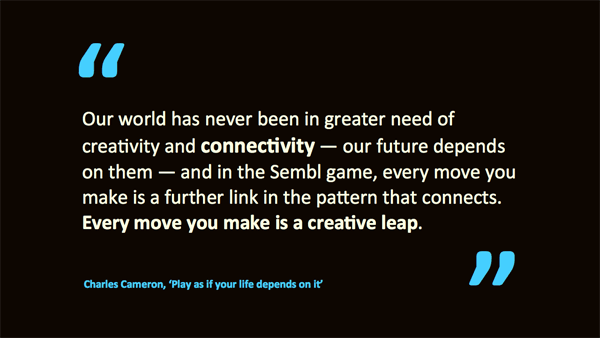
If playing Sembl gives us practice in polyphonic thinking, if it helps cultivate connectivity and our capacity to find solutions to local and global problems, it is good value. As Charles says, every move is a creative leap.

Cath concludes:

If you’re interested in working with us to supply content, develop strategy or raise capital, we’re keen to talk.

And I can’t tell you how much I’m anticipating being able to invite everyone to play.

thanks

**

Cath can be reached via Twitter at @cathstyles, and I’m at @hipbonegamer. The Sembl site is at Sembl.net.

Next up: what Sembl has to offer the IC.

Søren Kierkegaard on espionage & Kenneth Burke on strategy

Thursday, October 25th, 2012

[ by Charles Cameron — a meditation on theological espionage, literary strategy, a Sufi tale from Jalaluddin Rumi, and why the arts and humanities offer excellent preparation for analytic work ]
.

Kit Marlowe's portrait, Corpus Christi College, Cambridge, Kierkegaard sketch, Niels Christian Kierkegaard

.

It may seem somewhat strange, at least on the surface, for a poet to be interested in strategy and a theologian in the world of intelligence analysis.

We poets. however, have been termed “the unacknowledged legislators of the world” by Mr. Shelley, one of our own number, and we theologians long considered our study the Queen of the Sciences – so here we have the roots of attitudes that may flower into this strange hybrid being that is myself.

**

It’s not easy to list significant writers who were also in the intelligence business, in part because both “writing” and “intelligence” are subject to varied definitions — so my own list here will lean heavily British, and have the patina of old age rather than the glamor of the freshly minted. Let’s just say that Christopher Marlowe, who wrote the great play Doctor Faustus, was apparently sent on extended errands while up at Cambridge on “matters touching the benefit of his country”.

More recently Rudyard Kipling, John Buchan, Somerset Maugham, Graham Greene, even JRR Tolkien apparently, Ian Fleming, John le Carré, and Anthony Burgess have been among British writers who were also spies, and Peter Matthiessen can serve as a distinguished recent American example.

Which brings me to the OSS, and this quote from a 2003 piece on Boston.com:

Yale’s literature specialists played a key role in shaping the agency’s thinking. Mole-hunter James Jesus Angleton, the most controversial figure in CIA history, began his career as an apprentice of the New Critics on Yale’s English faculty, and his literary training in “close reading” may have shaped his hyper-skeptical (some would say paranoid) approach to counterintelligence.

**

Why do fine writers make decent intelligence analysts?

John le Carré, who has been both, has this to say:

Artists, in my experience, have very little centre. They fake. They are not the real thing. They are spies. I am no exception.

I’d like to take that a little further. I’d like to say that to be a keen observer of human behavior, you must be a keen observer of your own – only one who has taken the beam out of his own eye can see clearly the mote that is in another’s. That brings you, I believe that chameleon-like condition of receptivity and observation that Keats termed “negative capability” in his letter to Richard Woodhouse of October 27, 1818.

More on that in the Sufi story below. Now, onward to the two quotes that anchor this piece.

**

Here’s Kenneth Burke on “strategy” in the arts, in his Literature as Equipment for Living [link is to .pdf]:

For surely, the most highly alembicated and sophisticated work of art, arising in complex civilizations, could be considered as designed to organize and command the army of one’s thoughts and images, and to so organize them that one “imposes upon the enemy the time and place and conditions for fighting preferred by oneself.” One seeks to “direct the larger movements and operations” in one’s campaign of living. One “maneuvers,” and the maneuvering is an “art.”

Are not the final results one’s “strategy”?

And Kierkegaard on “spying” as a theologian, in the chapter, Governance’s Part in My Authorship from his The Point of View:

l am like a spy in a higher service, the service of the idea. l have nothing new to proclaim, I am without authority; myself hidden in a deception. l do not proceed directly but indirectly — cunningly; I am no saint — in short, l am like a spy who in spying, in being informed about malpractices and illusions and suspicious matters, in exercising surveillance, is himself under the strictest surveillance. See, the police also use such people. For that purpose they do not choose only people whose lives have always been most upright; what is wanted is only experienced, scheming, sagacious people who can sniff out everything, above all pick up the trail and expose. Thus the police have nothing against having such a person under their thumb by means of his vita ante acta [earlier life] in order precisely thereby to be able to force him unconditionally to put up with everything, to obey, and to make no fuss on his own behalf. It is the same with Governance, but there is this infinite difference between Governance and the municipal police — that Governance, who is compassionate love, precisely out of love uses such a person, rescues and brings him up, while he uses all his sagacity, which in this way is sanctified and consecrated. But in need of upbringing himself, he realizes that he is duty-bound in the most unconditional obedience.

**

To return, then, to the issue of those who spy upon themselves…

Jalaluddin Rumi has a story in his Masnavi, one of the many facets of which, I suspect, can illuminate this point, albeit a bit obliquely.

He describes a contest that a sultan once held between the Chinese and Greek schools of artists, to determine which had the greater ability in art. Each school was given one half of a room, and a great curtain fixed between them. The Chinese, with a vivid appreciation of nature’s moods and humanity’s place between skies and mountains, painted their half of the room with exquisite care and subtlety. The Greeks took quite an other approach, covering the walls on their side with silver plate, then buffing and burnishing it to a brilliant reflective sheen.

When the work was done and the curtain drawn back, the beauty of the Chinese room was stunning – but the loveliness of the Greek room, in which the Chinese room was reflected to dazzling effect, was even more so:

The image of those pictures and those works
was mirrored on those walls with clarity.
And all he’d seen in there was finer here –
his eyes were stolen from their very sockets.

Rumi explains that the Chinese in his fable are like those who see the outer world only, while the Greeks are those who “stripped their hearts and purified them” – and that “the mirror’s purity is like the heart’s”…

Those who examine their own hearts — Ursula le Guin nicely calls them “withinners” since their voyages, adventures, discoveries and treasures are found primary within themselves — may make reluctant spies, for they do not easily see one side of a dispute as entirely right and the other side utterly wrong: but their nuance places them among the finest of analysts.

**

Oh, but let’s be sensible and worldly: most of us like to balance our mundane lives with the more exciting possibilities that are their opposites, and espionage – the derring-do more than the analysis, to be sure – is a wonderful foil for scholars’ fantasies, just as being swept off one’s feet by a prince and loved tempestuously between the pages of a book is a sweet shift from the menial paper trails of office life, and space opera a fine venture for those beset by gravity and white lab coats.

And whether Jason Bourne, Jack Bauer, James Bond or just a little J&B‘s your tipple, you may find espionage, dealing as it does with secrets, is a natural launching pad for fantasy…

**

More sseriously, for the analysts and educators among our ZP readership — let me just suggest that the literary and humane arts will deepen analytic understanding as surely as big data will extend its technical reach.

And when you come right down to it — your human mind is still the best and subtlest software engine in the room…

Form is Insight: the project

Monday, October 22nd, 2012

[ by Charles Cameron — about the (not yet titled) book (or post-book project) i seem to be writing, which offers a grand slam intro to an array of box-free contemplative and artistic approaches to creative thinking, and hence opens fresh angles on intelligence ]
.

One thing I can promise: whatever this project turns out to be, it won’t be predictable.

credit for this incredible image: Roger Dean

.

This project won’t take you over familiar territory, congratulating you on holding the same opinions as the author and adding in enough choice details to keep you interested. I’m not aiming to teach you the same thing you already know, only better, more interestingly, more precisely, or in greater detail. I’m aiming to question you, challenge you, and give you a whole new range of optics through which to view the world.

**

So, here we go.

I think I am finally at the point where the book (or whatever it is) I’ve been gathering inside me all these years is ready to be written. Some of it has already emerged in earlier posts here on Zenpundit — you don’t known and couldn’t count how many thanks, Mark — and this is certainly where I’ve been developing the style of integrated visuals and verbals that gives the project its flavor — so I’d also like to use my posts here to discuss the thing with you as I go along.

The project is about intelligence in the widest sense, including heart and mind, and with particular focus on creativity. I’m addressing this from two standpoints that mesh together well, and I’m addressing it to two audiences that I believe also mesh together well.

The standpoints are (i) meditation and (ii) the arts, and the audiences are (i) the “intelligence community” and (ii) bright people in general.

I believe that meditation cultivates a spacious mind-set in which we can hold multiple concerns in mind at the same time – the opposing needs of different people, stakeholders, sections of society, the environment, etc – thus seeing things from multiple angles and in balancing & thus balanced ways. And I think the arts serve as the primary means for expressing these balances with all their nuances and shadings, and that techniques from within the arts such as polyphony, chiaroscuro, formal constraint and pattern can teach us to shape multi-faceted insights like these into rich and complex understandings – complex patterns that respond to complex situations. I’ll go into all this in detail as we move along, with examples.

I also believe that this kind of creatively patterned insight — embodying artistic methodology in the context of complex problems with a “fresh” and open mind – will be of interest beyond the intelligence agencies and policy-makers, to business people, artists, and also — importantly — the bright general public, which I take to be a far larger subset of the population than we commonly think, and always eager for reading that doesn’t talk down to them but appreciates their own intelligence and good will.

For now let me just say that I’m very excited, because this seems (at last) to be a project that ties together my game-work with Sembl, the think-tank side of me which has been monitoring religious violence, jihad and terror and working towards nuance, understanding and peace these last dozen years — and my sense of creativity as a writer and poet.

Ripeness is all: I suspect the time for this venture has arrived.

**

Here’s the single page overview I’ve written, with a working title:

Intelligence is Zen: understanding our complex world with koans in mind

Just a few days ago, the Director of National Intelligence, James Clapper, referenced Pirsig‘s book, Zen and the Art of Motorcycle Maintenance, as key to the Intelligence Community’s work in understanding and adapting to the many, varied, intersecting problems we face in the world today. As I noted, Clapper was focused a bit more on the biker wisdom than the Zen to be found in Pirsig’s book, but he does raise a question I’ve been addressing for some years now:

What does the contemplative mind have to offer in terms of understanding a complex world?

To my mind, the creativity which is all the buzz of the business world, aimed at solving what are called “wicked problems” — problems that feature multiple stakeholders with multiple aims and objectives, aims and objectives which themselves shift over time so the problems are “never the same river twice” – requires a major mental and emotional shift. Reverie and meditation free us up to make the shift: the shift itself is poorly understood.

Our present, mostly linear way of thinking favors either/or side-taking, dubious cause-and-effect expectations which fail to take complex feedback loops into account, followed all too often by a rush to judgment. We need a whole new – old, even ancient – way of thinking.

Our problems are complex because they overlap, they ripple through one another. In Buddhist terms, they are “interdependently arising.” Not surprisingly, the way of thinking that is required to gain a deeper insight into “interdependently arising” problems can be found in explicit form in such contemplative traditions as Madhyamika & Zen, Taoism, Sufism, and their Abrahamic contemplative analogs. At the heart of these systems is fresh thinking – thought refreshed by quiet.

Furthermore, the shaping of insights in an open field of thought is something the world’s artistic traditions have long dealt with, and there are schools of insight not just available but recorded in exquisite detail in the world’s traditions of poetry, music, painting, theater, film… in patterns that are found in nature, in culture, and in the very turbulence we now must learn to flow with.

The project therefore takes a meditation-influenced approach to intelligence, both in the sense in which Clapper would use the word, relating to the intelligence analysis which develops and influences our decision-makers’ understanding of what’s needed, and in the more general sense of those capable folk with bright minds, keen insights, sharp instincts, warm hearts.

I’ll propose a series of ways of looking differently – with application for anyone, whether artist, intel analyst, businessman, policy-maker, or lover – that cut to the essence of creativity: lateral, analogical, holistic thinking, witnessing pattern beneath the surface of things. My examples will be mainly drawn from terrorism, which I have been monitoring for a dozen years: my style is that of a poet and an eccentric Englishman.

My subtext, my subliminal message, will be contemplation and artistry as profound common sense.


Switch to our mobile site