zenpundit.com » Sembl

Archive for the ‘Sembl’ Category

A triptych for Jane McGonigal

Thursday, October 18th, 2012

[ by Charles Cameron — on play, games, vertigo and koan — technically this is a ludibrium, a jeu, a jest — a dervish whirl for the mind ]
.


.

I’m joining the conversation Jane McGonigal is leading over on Big Questions Online — our topic is How Might Video Games Be Good for Us? — and she came up with a gem of a quote from Huizinga‘s Homo Ludens which pointed me to two other quotes that are part of the collection I keep in mind, one from Wittgenstein, the other from Roger Caillois.

**

I’ve strung them together here because the way the mind hops and skips from one idea to the next in this series enchants me:


.

There’s more to those three quotes taken together, along with the leaps between them, than there is in keeping them apart. They have, what was it Wittgenstein said? — a family resemblance. They belong together. You could start with the third quote, in fact, and then hop to the first and second, and the effect would be much the same, you could make a ring of them.

**

They spiral so closely in on one another, indeed, as to induce ilynx, vertigo. Let’s keep on spinning.

To my mind, the master of vertigo in our times is Jorge Luis Borges, who uses the word “vertiginous” at least four times in his fictions — my favorite arriving in his story The Circular Ruins, where he writes:

He understood that modeling the incoherent and vertiginous matter of which dreams are composed was the most difficult task that a man could undertake, even though he should penetrate all the enigmas of a superior and inferior order; much more difficult than weaving a rope out of sand or coining the faceless wind.

Blam! — is there anything more vertiginous than paradox, enigma, koan, mystery?

**

In perspective, there’s the vanishing point. In service to others, there’s forgetfulness of self.

**

While we’re on the subject of play, I have a confession to make. Several times on this blog and elsewhere, I have cited the art historian Edgar Wind as saying that Ficino’s motto was “studiossime ludere” and that he translated it “play most assiduously” — Marsilio Ficino being the intellectual hub of Renaissance Florence under the Medici. When I was putting together my initial post to Jane McGonigal for her Big Questions discussion, I wanted to use that quote, but couldn’t quite find it in the source I thought it came from. Well, I’ve been doing some checking since then, and Wind does quote something very similar in his Pagan Mysteries in the Renaissance — but the phrase is “studiosissime ludere”, and what he writes is this —

Serio ludere was a Socratic maxim of Cusanus, Ficino, Pico, Calcagnini — not to mention Bocchi, who introduced the very phrase into the title of his Symbolicae quaestiones: ‘quas serio ludebat’.[1]

which he then footnotes thus (translation coming up shortly):

[1.] cf. Ficino, In parmeniden (Prooemium), Opera, p. 1137: ‘Pythagorae, Socratisque et Platonis mos erat, ubique divina mysteria figuris involucrisque obtegere, … iocari serio, et studiosissime ludere.’

Then there’s Ioan Couliano, another great scholar of Renaisssance thought — and a victim of Ceausescu‘s secret police — in Eros and Magic in the Renaissance, translates for us (pp. 37-38):

Pseudo-Egyptian hieroglyphics, emblems and impresae were wonderfully suited to the playful spirit of Florentine Platonism, to the mysterious and “mystifying” quality Ficino believed it had. “Pythagoras, Socrates, and Plato had the habit of hiding all divine mysteries behind the veil of figurative language to protect their wisdom modestly from the Sophist’s boastfulness, of joking seriously and playing assiduously, iocari serio et studiosissime ludere.” [34] That famous turn of phrase of Ficino’s — translation of a remark by Xenophon concerning the Socratic method — depicts, at bottom, the quintessence of every phantasmic process, whether it be Eros, the Art of Memory, magic, or alchemy — the ludus puerorum, preeminently a game for children. What, indeed, are we doing in any of the above if not playing with phantasms, trying to keep up with their game, which the benevolent unconscious sets up for us? Now, it is not easy to play a game whose rules are not known ahead of time. We must apply ourselves seriously, assiduously, to try and understand and learn them so that the disclosures made to us may not remain unanswered by us.

Couliano footnotes the quote thus:

[34.] Proem. in Platonis Parmenidem (Opera, II, p. 1137). This is simply the Latin translation of an expression Xenophon had used to designate the Socratic method (paizein spoude). On the custom of the “serious games” of Ficino and his contemporaries, see Edgar Wind, Pagan Mysteries in the Renaissance 3d ed. (Oxford, 1980), pp. 236-38.

**

Okay, I was trying to check a Latin tag that I’d obviously been quoting from memory, and things just kept on spinning — and weaving — together.

So where are we now? We’re talking of “playing with phantasms, trying to keep up with their game” (Couliano) — and thus back at that Borges quote, too, with its “incoherent and vertiginous matter of which dreams are composed”…

Which is us.

I mean, “We are such stuff as dreams are made on, and our little life is rounded with a sleep.”

**

Okay. Practical matters. To go along with Witty Wittgenstein and the others on my recommended reading list, here’s an image of McGonigal’s dissertation and book:

The dissertation is available here as a .pdf: the book is available here on Amazon.

On Super Mario Brothers and mental parcours games

Wednesday, October 3rd, 2012

[ by Charles Cameron — cross-posted from Sembl, side-scrollers for the mind, light but deep ]
.

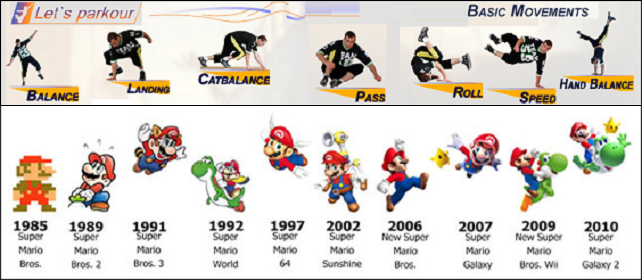
According to 25 Years of Super Mario Bros: A Look Back Through Mushroom Kingdom History, from which I grabbed the Mario Bros portion of the graphic at the foot of this page, “Since 1985’s release of the second-most selling console game of all-time, over 200 Nintendo titles have featured the eponymous Mario Bros” — on which I’ve played perhaps three or four levels of one or two early versions.

The Super Mario Bros side-scrollers (image above, left) are the work of the brilliant Shigeru Miyamoto, and part of what I find so fascinating about them is the way in which they resemble the mind-blowing practice known as Parcours (image, right), which apparently developed from the work of one David Belle, born in 1973 — who would have been 12 when the first Super Mario Bros game came out.

Let’s take a look at Super Mario Bros and Parcours, and then move on to the issue of parcours for the adventuring mind.

**

First, for those of you who don’t remember them, here’s what the early Mario Bros games were like…

I don’t think there’s much doubt that the Super Mario Bros games are essentially digital versions of Parcours, and you can see by comparing the video above with this next one:

Finally, this video from Jesse La Flair confirms the comnnection, at least in the mind of one top flight traceur:

**

My own question is: what would a mental parcours game look like?

I was thinking for a while last week about what a Mario-like side-scrolling game of mental parcours would be like. We already have the “creative leap” side pretty well covered with the various variants of Sembl we’ll be developing, so I thought about other types of mental agility, and what a game might look like if it incorporated a bunch of them — induction? deduction? causality? the sorts of pattern skills that go into IQ tests? — in a side-scroller with playful graphics…

Two things:

One: my friend Derek Robinson pretty quickly informed me that the actual build of such a game would be enormously complex — I resisted him, saying I wasn’t aiming to build the entire game, just to get the idea down on paper to see whether we could get the initial phases funded…

And two: I ran across Lumosity:

Let’s just say Lumosity seems to have a variety of cognitive skills well in hand, which leaves me free once again to concentrate on what Derek calls the mind’s opposable thumb.

**

That’s a brilliant concept, I think, and gets to the heart of what we’re working on with Sembl.

The various other conceptual skills that essentially add up to linear thinking — Zen calls it vertical thinking, see this helpful diagram — are important, and well-studied. They work best where what you are talking about is quantifiable and amenable to logic and cause and effect analysis, and is explored within fields, not across them.

But lo, that approach may help you quantify the trees and evaluate them as board feet of lumber, but consistently misses the forest, the greater context, the big picture –the combined systemic impact of many tiny details, insects, mosses, the tree as ecosystem within an ecosystem, and the ecosystems within that – the time scale, the slow growth, the root system, the transformation of mulch into nourishment, the sudden spurt of tiny leaves in spring, the photosynthesis — and the human wonder — the glory, dappled sunlight on fallen leaves, the shelter afforded to lovers by a weeping willow (I’m thinking of one willow in an Oxford college garden, but I’m time-traveling and I digress) – the poetry, of beech and birch, copper beech and silver birch, the trees, the words, the metals…

Context, quality, complexity, systems, dynamics, process, simplicity, value, passion, poetry – these are the things linear thinking has problems with. Poetry, passion, value, simplicity, process, dynamics, systems, complexity, quality, context – these are the things horizontal thinking does best.

**

That’s it.

Oh, and hey — just because I like the tiny antics they’re getting up to in the graphics:

What eye and mind can reasonably absorb

Friday, August 24th, 2012

[ by Charles Cameron — visual thinking, graphical presentation, the magical number seven plus or minus two, human intelligence ]
.

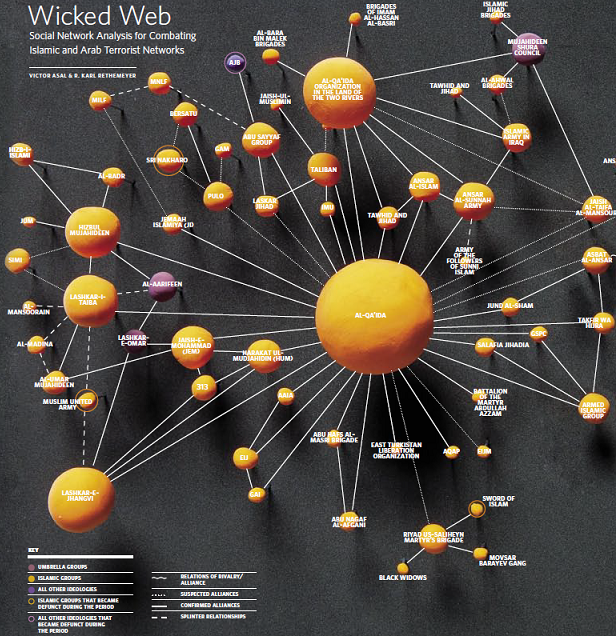
Look:

click image to download pdf & see pp 12-13 for closer, full-size look

Got it? That’s part of a double-page spread from the University of Maryland’s START Program report for 2011:

The National Consortium for the Study of Terrorism and Responses to Terrorism—better known as START – is a university-based research center committed to the scientific study of the causes and human consequences of terrorism in the United States and around the world.

Looking through the rest of the report, I’m tempted to say a snazzier, jazzier magazine I’ve seldom seen!

**

I maintain that’s far nicer to look at, but no more comprehensible than, this gorgeous and justly infamous power point slide:

click image for a closer, full size look

Got that one, too? That was a slide used to help GEN McChrystal understand that war he was fighting.

**

Watson and Crick introduced their 1953 paper in Nature, A Structure for Deoxyribose Nucleic Acid, with these words:

We wish to suggest a structure for the salt of deoxyribose nucleic acid (D.N.A.). This structure has novel features which are of considerable biological interest.

No less witty is the opening of George A. Miller‘s only somewhat less celebrated paper three years later in The Psychological Review, The Magical Number Seven, Plus or Minus Two: Some Limits on Our Capacity for Processing Information:

My problem is that I have been persecuted by an integer. For seven years this number has followed me around, has intruded in my most private data, and has assaulted me from the pages of our most public journals. This number assumes a variety of disguises, being sometimes a little larger and sometimes a little smaller than usual, but never changing so much as to be unrecognizable. The persistence with which this number plagues me is far more than a random accident. There is, to quote a famous senator, a design behind it, some pattern governing its appearances. Either there really is something unusual about the number or else I am suffering from delusions of persecution.

The gist of Miller’s piece (and by gist I explicitly mean the always misleading broad strokes version) is that we can usually manage to hold five to nine chunks of thought in mind at any given time, but that if we want to understand more than that, we need to “chunk” our thoughts in such a way that we think of “seven plus or minus two” items (Miller’s “magical number”) but can peer into any one of them and see it divided into lesser portions which we can also comprehend, in what I’ll call a tree > trunk > limb > branch > twig > leaf arrangement — always remembering that a tree may be part of a forest, and that sometimes ee just can’t see the forest for the trees…

Miller explains chunking succinctly thus:

It seems probable that even memorization can be studied in these terms. The process of memorizing may be simply the formation of chunks, or groups of items that go together, until there are few enough chunks so that we can recall all the items.

Neat, hunh? And he concludes, with another pleasant touch of wit:

And finally, what about the magical number seven? What about the seven wonders of the world, the seven seas, the seven deadly sins, the seven daughters of Atlas in the Pleiades, the seven ages of man, the seven levels of hell, the seven primary colors, the seven notes of the musical scale, and the seven days of the week? What about the seven-point rating scale, the seven categories for absolute judgment, the seven objects in the span of attention, and the seven digits in the span of immediate memory? For the present I propose to withhold judgment. Perhaps there is something deep and profound behind all these sevens, something just calling out for us to discover it. But I suspect that it is only a pernicious, Pythagorean coincidence.

**

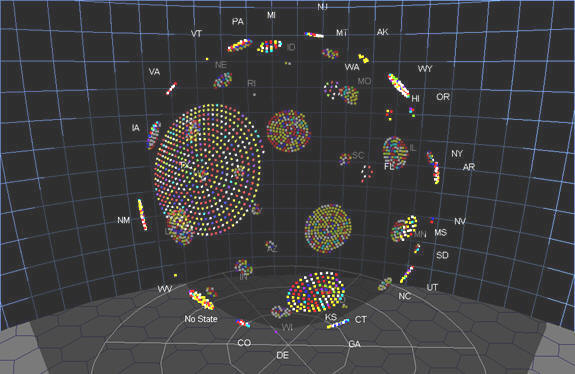
Of course there are high-node graphics programs like Starlight Analytics (from Future Point Systems via Battelle and the Pacific Northwest National Laboratory) which allow you to sample one of a cluster of very similar nodes, or to see where the outliers are and zero in on them…

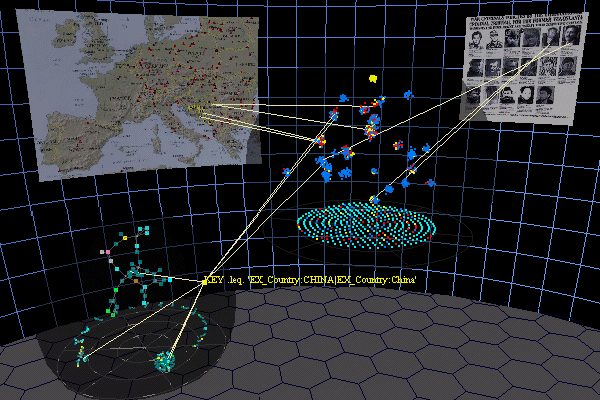
or to focus in on only those nodes connected to one particular name or place on a map:

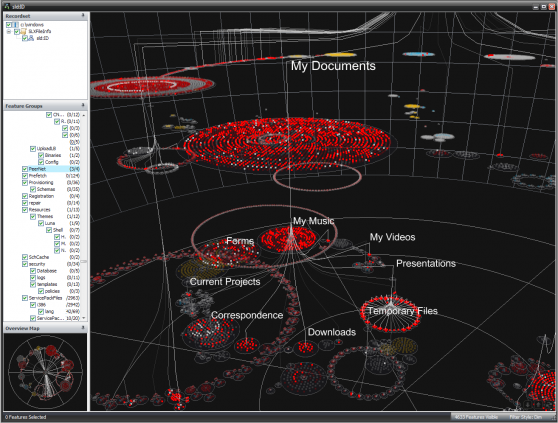
But can you find a file you’re looking for any faster by locating it somewhere in this graphic…

than by using your usual search methods?

So okay, high level analytics like Starlight may be useful for analysts who have the costly software and time to pinpoint and track and zoom and annotate and comprehend, become alarmed or calmed, and respond appropriately.

But people reading that glossy report from the START program? People trying to brief GEN McChrystal from a powerpoint slide?

Seven. Seven plus or minus is your number.

**

Once more, with feeling.

The moral of this tale is that graphical presentations of ideas to explain complexities should generally feature seven plus or minus two nodes, maximum, for eye and mind to consider at any one time, with perhaps an additional three or four that the eye can glide across to, forming a second chunk — thus delivering a maximum of 13 nodes without zooming in.

for the direct communication of major drivers in a complex situation — seven nodes plus or minus two is your optimal number.

**

Ah — but see, I forgot to show you the rest of that first image:

You can handle grasping the import of an image two parts, surely, can’t you?

Okay then — if you can, perhaps you can help me out…

The perils of juxtaposition: Aurora

Saturday, July 21st, 2012

[ cross-posted from SmartMobs – this post is not about the tragic Aurora shooting, but about internet advertising mechanics ]

Our hearts go out to all the bereaved.


.

If you know me & my Hipbone project, you know I’m always on about juxtaposition as a means of generating a sort of stereoscopic depth of understanding from two similar — or opposite — ideas, images etc.

And yes indeed, the juxtaposition of ideas and the creative leaps that juxtaposition generates are at the heart of the Sembl game approach that Cath Styles and I are prototyping.

-- image: board for an iPad Sembl game + detail of single move

But look, you need to have some sense of context.

And neither current algorithms nor remote humans seem to be terribly good at this.

**

aurora-boutique

The Celeb Boutique tweet above was posted when the word Aurora started trending after the recent awful cinema shooting, and was up for an hour before someone realized how inappropriate it was and took it down. In subsequent tweets, the boutique apologized and noted “our PR is NOT US based and had not checked the reason for the trend…”

I think that’s extremely unfortunate, but somewhat understandable: human error, outsourced.

The humans in question should have been as savvy as Paul Coelho, who counseled (just a day earlier, if I’m getting my dates right) as follows:

coelho-google-before-you-tweet

**

Then there was the Christian Science Monitor‘s article, Colorado shooting: A rare glimpse into Mitt Romney’s Mormon faith, which showed up on blog-friend Critt Jarvis‘ monitor with this ad:

Again, that’s unfortunate — but the CSM’s ads are presumably chosen by algorithm, and I wouldn’t know where to send an algorithm to repent if I met one and it was sincerely apologetic…

The CSM website does offer us humans an opportunity to object to ads we find tasteless and inappropriate, however:

The Monitor is committed to showing only those ads that meet our standards for appropriate content. These particular ads are sold by internet advertising partners who share the revenue with The Christian Science Monitor. We have implemented filters with them that are designed to prevent unacceptable advertising from showing on the site. If you feel an inappropriate ad is being displayed, please contact us immediately using the form below. Ads that violate our acceptance standards will be removed from the site and our filters will be adjusted to help prevent a recurrence.

So humans can backtop the algorithms when they play foul… that’s good.

**

But all this just reinforces my appreciation for Cath Stylestweet last week, after she met with Mel from Serena (neat video, btw!):

sembl-turing-test

There’s still no machine substitute for human wit and wisdom.

At the round earths imagin’d corners

Friday, July 20th, 2012

[ by Charles Cameron — mapping, holding two worldviews in mind at one time, a conductor’s score, complexity thinking ]
.


.

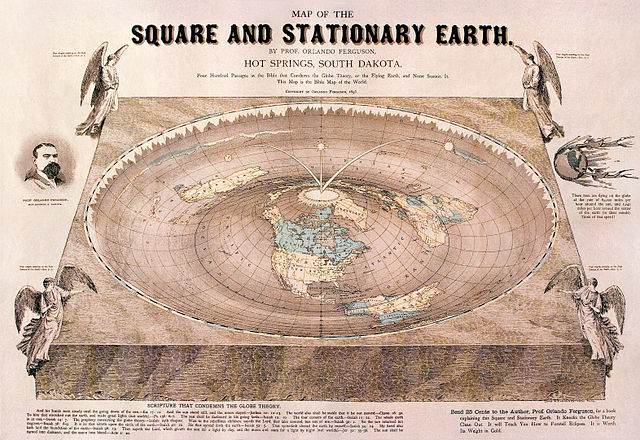
About a year ago, the Atlantic reported that the Library of Congress had been given a map of the flat earth, designed according to Biblical principles — yet showing knowledge of the border between the United States and Canada…

Thanks to a post from Jason Wells, I saw it today.

The view that the earth is flat is one worldview, of course, and no longer the prevailing one. As Nicholas Jackson noted at the Atlantic:

The interesting thing about the map is that it was created about 120 years ago by Orlando Ferguson, then a practicing physician in Hot Springs [South Dakota]. This is more than 500 years after most educated people gave up on the idea of the Earth as flat and accepted the spherical viewpoint first expressed by the Ancient Greeks.

**

It is, however, possible to hold two worldviews in mind at the same time. John Donne manages it in the first line of his extraordinary poem, written at a time when the two views were clashing:

At the round earths imagin’d corners, blow

AT the round earths imagin’d corners, blow
Your trumpets, Angells, and arise, arise
From death, you numberlesse infinities
Of soules, and to your scattred bodies goe,
All whom the flood did, and fire shall o’erthrow,
All whom warre, dearth, age, agues, tyrannies,
Despaire, law, chance, hath slaine, and you whose eyes,
Shall behold God, and never tast deaths woe.
But let them sleepe, Lord, and mee mourne a space,
For, if above all these, my sinnes abound,
‘Tis late to aske abundance of thy grace,
When wee are there; here on this lowly ground,
Teach mee how to repent; for that’s as good
As if thou’hadst seal’d my pardon, with thy blood.

Donne accomplishes the task of holding two worldviews in mind at one time with four simple words: “round earths imagin’d corners”.

**

I don’t know how many melodic “lines of thought” the mind can hold in counterpoint at once. I do know it’s an important cognitive skill for us to cultivate. A classical conductor must surely be able to hold as many lines as there are in this page of Olivier Messaien‘s Oiseaux:

As I pointed out in a recent comment here, “somewhere above three and before eleven there’s a point — Miller’s ‘magical number seven, plus or minus two‘ where the human mind can’t hold any more detail, so that’s a cut-off of sorts.”

Well, Messaien clearly imagines the conductor’s mind can follow more than eleven paths…

**

And then there’s Bob Milne.

I’ll let the Philosophy Compass take it from here:

Bob is predominantly known for his piano concerts of Ragtime and Bogie-Woogie music – and was given the moniker of ‘National Treasure’ by the United States Library of Congress. It was at one of these concerts that drew the attention of Penn State neuroscientist Kerstin Bettermann. At his concerts, Bob often carries on conversations, telling stories and jokes, while simultaneously modulating key signatures over the polyrhythmic Ragtime music. In their broadcast, Radiolab discusses with Dr. Bettermann why this is so surprising.

Language use and musical competency often use the same neural resources: the prototypical language areas in the left hemisphere of the brain, and the working memory circuit that keeps information available and rapidly accessible for a short-period of time. Our ability to use language and engage with music should, on most models of the brain, be competing for these neural resources and interfere with one another. Not so with Bob – he appears to be able to tackle both tasks with ease. Further, while most people can approach this kind of competency in multi-tasking, it usually involves many learning trials, a process of sedimenting the learning into what psychologists call procedural memory, which may have its roots in a different brain region, the cerebellum. But Bob can hear a tune just once, and play it back with commentary.

But that’s not all Bob can do.

In their interview, Dr. Bettermann heard Bob claim something extraordinary. He claims not only to be able to hear a symphony in his head, but that he normally does this with two symphonies simultaneously. Where most individuals would only hear a cacophonous mess – Bob claimed he could dial the relative volume of either symphony up or down, and could zoom in or out of individual instrumentations. To return to the considerations above, Bob further states on the Radiolab website that he does this while driving – another procedural memory task and presumable source of interference. But when Dr. Bettermann challenged him, Bob reluctantly claimed that he could probably do the same (not while driving, mind you) with four simultaneous symphonies.

The claim is something like this: Bob states that he can hold and listen to four symphonies with different keys, instrumentation, tempo and style in his working memory at the same time. And what is stunning is that when they put Bob into an fMRI machine, they verified his claim. Bob could be stopped at any time during his imaginative trip through the four simultaneous symphonies, and hum out the exact phrase that the original recording would be on. Remarkable.

**

This in turn takes us back to that point Edward Said made, which gave me the basic concept for my Said Sympohony (must get back to that soon):

When you think about it, when you think about Jew and Palestinian not separately, but as part of a symphony, there is something magnificently imposing about it. A very rich, also very tragic, also in many ways desperate history of extremes — opposites in the Hegelian sense — that is yet to receive its due. So what you are faced with is a kind of sublime grandeur of a series of tragedies, of losses, of sacrifices, of pain that would take the brain of a Bach to figure out. It would require the imagination of someone like Edmund Burke to fathom.

Edward W. Said, Power, Politics, and Culture, p. 447 — from the section titled “My Right of Return,” consisting of an interview with Ari Shavit from Ha’aretz Magazine, August 18, 2000.

I asked in a post yesterday how good we now are at modeling or simulating ideas in the “war of ideas” — just for a moment, suppose we could think through all complex geopolitical issues in this polyphonic, contrapuntal way…

**

Okay, you deserve a reward for faithful reading if you’ve come this far with me. Here’s the incomparable Richard Burton reading Donne’s poem — the text is up above, if you want to follow along:


Switch to our mobile site