zenpundit.com » poetry

Archive for the ‘poetry’ Category

Foolishness, Martin Luther King Jr and the Resurrection

Sunday, April 1st, 2018

[ by Charles Cameron — from MLK via St Basil the Great to Mullah Nasruddin ]
.

Three lines from the Apostles Creed locate the Resurrection between a descent into hell and an ascent into heaven. These lines are worth pondering in concert:

He descended into hell;
on the third day He rose again from the dead;
He ascended into heaven,

In what world of three worlds are these three utterances, so poetically juxtaposed, credible as declarative propositions?

**

He is risen!

Bach’s Easter Oratorio, with Ton Koopman and the Amsterdam Baroque Choir and Orchestra:

**

Martin Luther King Jr gently lays out the liberal / modernist perspective on the Resurrection:

The last doctrine in our discussion deals with the resurrection story. This doctrine, upon which the Easter Faith rests, symbolizes the ultimate Christian conviction: that Christ conquered death. From a literary, historical, and philosophical point of view this doctrine raises many questions. In fact the external evidence for the authenticity of this doctrine is found wanting. But here again the external evidence is not the most important thing, for it in itself fails to tell us precisely the thing we most want to know: What experiences of early Christians lead to the formulation of the doctrine?

The root of our inquiry is found in the fact that the early Christians had lived with Jesus. They had been captivated by the magnetic power of his personality. This basic experience led to the faith that he could never die. And so in the pre-scientific thought pattern of the first century, this inner faith took outward form. But it must be remembered that before the doctrine was formulated or the event recorded, the early Christians had had a lasting experience with the Christ. They had come to see that the essential note in the Fourth Gospel is the ultimate force in Christianity: The living, deathless person of Christ. They expressed this in terms of the outward, but it was an inner experience that lead to its expression.

**

The Jesuit priest Fr James Schall defends that outward interpretation, as found in the Apostles and Nicene Creeds, taken for dogmatic purposes as declarations of fact:

To the wise Greeks, as St. Paul tells us, the whole aura around Christ’s death and resurrection seemed to be “foolishness.” And it is foolishness unless considerable evidence is found showing that something astonishing was in fact going on. This evidence is basically the testimony of the women and men who attested to the fact that Christ did rise again. This is the same Christ whose death on the Cross they had witnessed a few days before.

**

To take these declarations as reporting historical fact, it may help to have an upside-down worldview — that of the wisdom of the fool. Appropriately, this year Easter is celebrated on April Fools Day. Indeed, Fr Schall opens his piece from which I quoted above by noting that fact, then moves to a discussion of Christ himself as a Fool:

A tradition exists about “Christ the Fool.” It probably originates from when Pilate sent Christ to see Herod. Herod was anxious to see him. See him do what? See him perform. He had heard much about this man and his miracles. So naturally the king wanted to see what Christ could do; he wanted a private show to entertain the court. In response, Christ was simply silent.

Christ, we might say, played the naïf for Herod.

**

Scripture declares how a naturalistic worldview perceives the eruption of God’s wisdom into this world as folly, and vice versa:

For the wisdom of this world is foolishness in God’s sight.

while:

the message of the cross is foolishness to those who are perishing, but to us who are being saved it is the power of God.

and, in an almost tongue-twisting formulation:

For since in the wisdom of God the world through its wisdom did not know him, God was pleased through the foolishness of what was preached to save those who believe.

**

All of which leads Christians to imitate the foolishness of Christ:

We are fools for Christ’s sake

That too is St Paul, writing of himself and his contemporaries, followers of the pattern set by Christ — and his message has echoed down the centuries among those who wish to imitate that pattern closely:

One form of the ascetic Christian life is called foolishness for the sake of Christ. The fool-for-Christ set for himself the task of battling within himself the root of all sin, pride. In order to accomplish this he took on an unusual style of life, appearing as someone bereft of his mental faculties, thus bringing upon himself the ridicule of others. In addition he exposed the evil in the world through metaphorical and symbolic words and actions. He took this ascetic endeavor upon himself in order to humble himself and to also more effectively influence others, since most people respond to the usual ordinary sermon with indifference.

**

In the Orthodox tradition — in which, this year, Easter and the Resurrection will be celebrated next Sunday — the foolishness of saints is a recurrent story. As I noted, quoting from the National Catholic Register in an earlier post:

In Russian history the greatest of the “holy fools” was Basil the Blessed, a man so revered that the famous Cathedral in Moscow’s Red Square next to the Kremlin was named in his honor. Basil walked through Moscow wearing nothing more than a long beard. He threw rocks at wealthy people’s houses and stole from dishonest traders in Red Square.

Few doubted Basil’s holiness. Tsar Ivan the Terrible feared no one but Basil. Basil was also given to eating meat on Good Friday. Once he went to Ivan’s palace in the Kremlin and forced the tsar to eat raw meat during the fast saying, “Why abstain from eating meat when you murder men?” Countless Russians died for much less but Ivan was afraid to let any harm come to the saintly Basil.

**

I don’t suppose one could speak of left and right wing parties under the Terrible Ivan, but evcen if one could, I don’t think St Basil’s approach would fit either description — he’s acting in a manner that is plain contrary to all sane opinion — and indeed, the term “Contraries” is applied by anthropologists to trickster shamans and holy foots in many traditions. Interestingly, in Sufism the “path of blame” has at times been highly esteemed — its practitioners, like the Russian Holy Fools, draw blame on themselves to awaken those around them while subverting their own propensity to take pride in how “spiritual” they are.

**

Mullah Nasruddin really didn’t want to loan his donkey to a neighbor.
My brother borrowed him yesterday and hasn’t brought him back, the Mullah said..
Just then, the donkey brayed.
Who are you going to believe, the Mullah asked hastilyy — me or a donkey?

Now, who in that little vignette is more of an ass?

Time In all his tuneful turning (ii)

Thursday, March 15th, 2018

[ by Charles Cameron — Dylan Thomas’ vision of time to set beside Stephen Hawking’s ]
.

**

I’m arguing here that Dylan Thomas is at least as great a thinker about time as Stephen Hawking, and his masterpiece, Fern Hill is my proof text to that effect.

I’ll borrow here from a piece I wrote called That HyperText is Linear: it’s the Northrop Frye applied to Dylan Thomas bit that’s of relevance here:

**

I get much of my thinking in this area from the literary critic, Northrop Frye, who says somewhere that you can (and should) read a poem through from beginning to end, and that this will give you what he calls the “diachronic” meaning — the sequential meaning “through time”: but when you have done this, you should also perceive what he calls the “synchronic” meaning — the meaning that comes from the poem as a whole, with all its parts simultaneously present and influencing one another, in a way that is impossible in a first sequential reading, but is possible in a meditative way afterwards…

Take Dylan Thomas’ poem, “Fern Hill”, for example. It’s an incredible tour-de-force, moving from the poet’s sense of wonder and praise at the natural world around him in childhood, to the moment when time takes him

Up to the swallow-thronged loft by the shadow of my hand

and he wakes

to the farm forever fled from the childless land…

— his “lamb white days” are over, and he realizes finally that

as I was young and tender in the mercy of his means,
Time held me green and dying…

That is, so to speak, the throughline, the sense of the poem from start to finish — as I child I was young and easy under the apple boughs, I was green and carefree: and yet, all the while, my childhood was slipping away from me, for Time itself held me green and dying…

That’s the “diachronic” reading…

But the “synchronic” reading is quite different. It doesn’t depend in the same way on a process through time. Instead, it works by the piling up of similar phrases:

the sun that is young once only…
All the sun long…
the sun grew round that very day…
the sun born over and over…

These phrases, scattered throughout the poem, seem to build on one another, almost imperceptibly, in a very remarkable way. Suppose that it was life, rather than the sun, that was at issue here:

A phrase like “life that is young once only” would clearly emphasize the freshness of youth and the decay that age brings — and thus be very much in line with the diachronic meaning of the poem. But a phrase like “life long” would emphasize the enduring quality in life, maybe even its eternal quality (“eternal life” even), while “life born over and over” would capture the cyclical feeling that’s present in the rotation of the seasons (and in the idea of reincarnation) — and “the sun grew round that very day”, while it doesn’t make sense to read it as “life grew round that very day”, clearly means that each moment is itself the moment of sunlight, in a way that’s akin to the zen sense of living in the moment…

So it’s as though the poem moves from beginning to end along a track that emphasizes initial innocence and its eventual loss: but read in the wholistic, “synchronous” sense, it quietly suggests that time can be viewed as a slowly entropic and degenerative process, as an endless and unbroken wholeness, as always and only the instant, and as a cyclical recurrence…

To me, that’s mind-blowing. Thomas isn’t presenting one of these as “the truth” — to the extent that there’s a “main” way to view time in the poem, it’s certainly in terms of a slow and not so slow process of the loss of innocence — but as four complementary ways in which we can see it. Four major philosophies of time in one poem, phrased in terms of the sun, and thus slipping almost unnoticed into our consciousness while we’re busy following the “throughline” or “plain sense” of the poem… four major philosophies, not contradicting one another, but spoken together, as in a polyphony.

There are some similar phrases relating to the moon, too, and they need to be similarly weighed and considered if you want to go deeper into “Fern Hill” — but that’s another part of the story, for another day…

**

That’s from That HyperText is Linear, not currently available on the web.

Four major philosophies of time, each seen from a human perspectove, voiced together as a polyphony, and presented “subcutaneously” — beneath the surface of the poem, and of the reader’s conscious awareness.

That’s what I admire in Thomas’ poem, and what I would compare with Stephen Hawking’s analog of another great scientist’s “Single vision & Newton’s sleep!” — for the juxtaposition of Dylan Thomas vs Stephen Hawking is indeed an age-old one, finding its classic instantiation in William Blake‘s antipathy towards Isaac Newton.


William Blake, Isaac Newton, The Tate Gallery

I’ll let Alan Moore, he of the comics [Watchmen, eg], explain:

For Blake, the boundaries of Newton’s thought were the cold, stone parameters of an internal dungeon to which all humanity had been condemned without its comprehension or its knowledge. Despite the invigorating consequences Newton’s influence would have for a then-nascent industry, Blake would elsewhere describe this rigid and reductive pall as ‘Newton’s Sleep’, a drowse insensible to vision or to ethical restraint beneath which it appeared the world had fallen. Goya to the contrary, here the monstrosity was birthed not by the sleep of reason, but instead born from that sleep which reason represented. From our own industrially despoiled and bankrupted contemporary perspective, Blake’s view surely seems a product of extraordinary prescience rather than of the angel-addled madness which some of his less insightful critics have attributed.

Enough.

Time In all his tuneful turning (i)

Thursday, March 15th, 2018

[ by Charles Cameron — Stephen Hawking, RIP, and synchronicity? ]
.

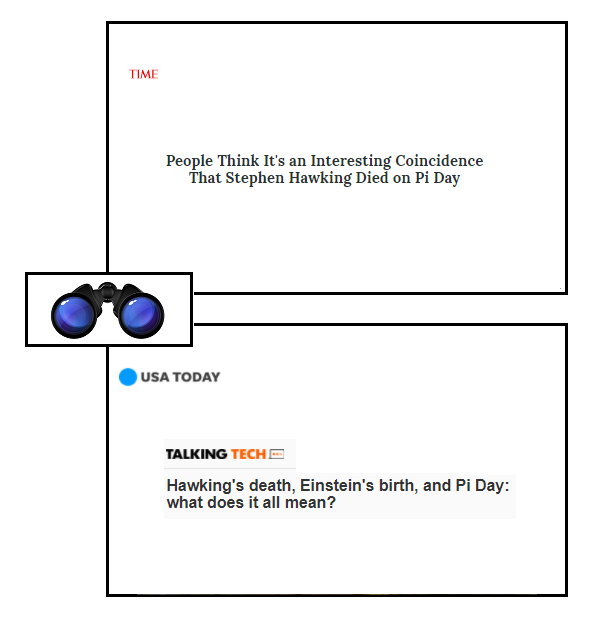
Connsider these high-popularity responses to Stephen Hawking‘s death:

Sources:

  • USA Today, Hawking’s death, Einstein’s birth, and Pi Day: what does it all mean?
  • Time, People Think It’s an Interesting Coincidence That Stephen Hawking Died on Pi Day
  • **”

    The Time article focused on the internet:

    Some people on the internet think Stephen Hawking couldn’t have calculated a better day to die.

    Calculated. Like it.

    The 76-year-old theoretical physicist, one of science’s most famous luminaries died on March 14, also known as National Pi Day — an annual day for scientists and mathematicians around the world to celebrate the value of pi that even includes deals on pizzas and actual pies. Suffice it to say that the noteworthy coincidence was not lost on the internet.

    The date of Hawking’s death — 3/14 — is significant because 3.14 are the first three digits of pi, a bedrock of geometry. Specifically, it’s the ratio of a circle’s circumference to its diameter. Naturally, the fact that science’s big celebration overlapped with the day the life of the party left us is making people geek out about the details.

    As soon as news spread that Hawking died early Wednesday morning in London, people were quick to connect the dots.

    Connect the dots, eh?

    **

    And here’s the complete USA Today article:

    So, is there some mystical theory explaining how noted astrophysicist Stephen Hawking died on the same day Albert Einstein was born, which also happens to be the day we honor the mathematical constant Pi?

    Nope. It’s just all one giant coincidence.

    Hawking died at 76, his family confirmed early Wednesday. He was considered one of the world’s foremost theoretical physicists, developing critical theories on black holes and writing A Brief History of Time to explain complex scientific concepts to the masses.

    That’s it. Nope, in a word. Nope. There is no “mystical theory explaining how noted astrophysicist Stephen Hawking died on the same day Albert Einstein was born, which also happens to be the day we honor the mathematical constant Pi”.

    That’s decided without consulting Pythagoras, Newton, Johann Valentin Andreae, Hermann Hesse‘s Joseph Knecht, or any of a dozen other worthies I might name..

    **

    But note: Warren Leight adds another datapoint and brings the circuit to completion:

    Galileo, ooh.

    It seems worth recalling at this point that pi is an irrational number.

    **

    Where do we go from here?

    First, note that Warren Leight posts that Hawking died on the 14th, in a tweet dated the 13th.

    One of Leight’s commenters challenges the whole coincidence chain:

    He died March 13th

    Leight’s response to that challenge could also serve as a response to mine:

    It depends on how and where you measure time

    Time is circular, date is relative..

    **

    God save us, here’s a game ref:

    Is that Johann Sebastian Bach?

    Kidding.

    **

    May the extraordinarily, ceaselessly curious mind of Stephen Hawking rest at last in the balm of peace.

    **

    And my title, Time in all its tuneful turning?

    It’s from Dylan Thomas, approximately. He wrote, in this masterpiece, Fern Hill:

    And nothing I cared, at my sky blue trades, that time allows
    In all his tuneful turning so few and such morning songs
    Before the children green and golden
    Follow him out of grace…

    I want to suggest that Dylan Thomas is at least as great a thinker about time as Stephen Hawking, and Fern Hill is my proof text to that effect. I’ll explain why in part ii of this post.

    Sunday surprise — Li Bai and the Song of Songs

    Sunday, March 11th, 2018

    [ by Charles Cameron — it’s all about a scarlet thread and some corks in a current ]
    .

    I have plenty of idle time between naps, and was binge watching The Churchmen on Netflix. Plus it’s a Sunday..

    **

    As you know, I track “twins” in events and quotations, mainly for sheer aesthetic pleasure, but also partly as an analytic tool — believing as I do that “two is the first number” and often a leading-edge clue to pattern, meaning, significance.

    I’m used to finding others who have noted these twins or “DoubleQuotes” as I call them — “DoubleQuotes in the Wild” — but I’m not sure I’ve ever run across a clear description of someone else noting them, let alone in a scholarly manner that bridges the secular west and spiritual east — but lookee here!

    **

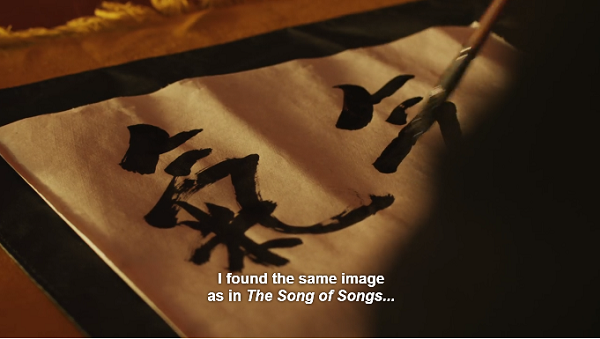
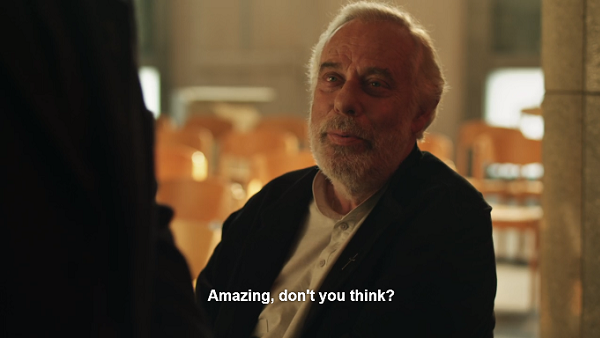
    Amazing indeed! And what a line! Your lips are like a thread of scarlet! worthy of Li Po, worthy indeed of the Song of Songs!

    I’d have been very chuffed if I’d run across the same doublet between Li Bai – better known to me as Li Po — and the Song of Songs — which, by the way, is Solomon’s.

    **

    Li Po, who, drunk and out in a shallow boat, saw the moon reflected in the Yellow River, leaned over to kiss it, and drowned..

    Solomon — but you know the story — seated in judgement, ordered a child be cut in two when two women claimed to be its mother — then commanded it be given to the one whose shocked pure love begged him to deliver it to the other.. wisdom as the test of love!

    **

    The discoverer of the binary “Your lips are like a thread of scarlet!” is a brilliant, generous-hearted, flawed founder and leader of a seminary in France who displeases ambitious Vaticanisti, is offered a choice of disgrace (on account off his flaws) or (as an “out”) a posting to an obscure but copacetic position in Shanghai..

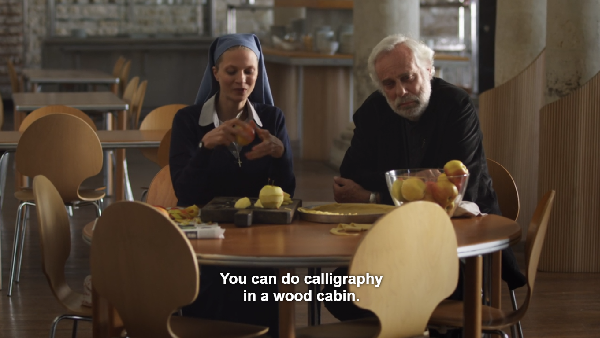
    A conversation ensues, in which he discusses his options with the nun who serves as his assistant:

    The nun ancourages him to consider the Shanghai option..

    That option has a certain seductive charm — following that scarlet thread.. but it represents being “bought off” rather than sticking by one’s guns come what may, and somehow weathering the consequences.

    **

    Our nun reflects:

    And that’s an interesting idea.

    At first glace it seems fatalistic — but that current moving the corks — the seminarians, the nun herself, the priest she serves, an ambitious president of the Franch bishops, various monsignori and a pope – maybe Christ, too? — has its own flows and undertows — a priest’s flaws included. It’s a complex system.

    The corks are afloat in a complex system. A scarlet thread traces its curve in the complex system, from contemporary France to eighth- century China.

    **

    And when you’re afloat in a complex system — as we all are — “go with the flow” may be sound advice. That’s why the “corks in a current” idea seems so interesting to me. Sunday surprise!

    Getting religion, forgetting circumcision

    Thursday, March 8th, 2018

    [ by Charles Cameron — some characteristicc lacunae in journalisti praxis ]
    .

    As you know, I used to work for Lapido Media, which in turn used to be a media-eductional outlet that emphasized the major role of religion(s) in world affairs, so often overlooked by typically skeptical, secular journos.

    Get religion is a fine site with a similar purpose, and today it has a fine article titled With Russia all over U.S. news map right now, how fares its huge Orthodox Church? For instance:

    In addition to politics, there’s a historic religious turnabout in Russia that stateside reporters could well develop through interviews with the experts. The dominant Orthodox Church, which managed to survive Communist terror and regained freedom, has latterly emerged as a strategic prop for Putin’s Kremlin.

    If that election day peg doesn’t work for your outlet, another signal event comes July 17. That’s the Orthodox feast day of the doomed final czar, Nicholas II, and his family, shot to death by Bolshevik revolutionaries in 1918 and canonized by the national church in 2000 as saints and “passion-bearers.”

    **

    It’s not just journos who forget / don’t get religion — pols in the extreme north do it, too. How else explain this header from Iceland: Iceland male circumcision ban: MP behind plan ‘didn’t think it was necessary to consult’ Jewish and Muslim groups, amid growing anger. The subhead is (from my POV) idf anytbing even more mind-boggling:

    ‘I don’t see it as a religious matter,’ insists Silja Dögg Gunnarsdóttir

    What does Silja Dögg Gunnarsdóttir imagine the origin of the practice was?

    **

    What else do journos tend to miss?

    Well, there’s female obits, for onr thing — although things may be improving in that regard. Here’s a New York Times’ obit, belated but in a good faith effort to catch and patch up: 1932-1963 Sylvia Plath –A postwar poet unafraid to confront her own despair. It begins:

    She made sure to spare the children, leaving milk and bread for the two toddlers to find when they woke up. She stuffed the cracks of the doors and windows with cloths and tea towels. Then she turned on the gas.

    And it quotes her poetry:

    Dying
    Is an art, like everything else.
    I do it exceptionally well.
    I do it so it feels like hell.

    Okay, it’s International Women’s Day 2018.

    Thank you, Anemona Hartocollis and the NYT editors. We mourn you, Mrs easily forgotten behind your husband Hughes.


    Switch to our mobile site