It contains quite a bit of low-key Daniel and Revelation. Dylan recalls being booed for suggesting that Russia would intervene in the Middle East just a few months before Russia invaded Afghanistan.
I read the Bible a lot, you know, it just happens I do, and .. so it says certain things in the Bible that I wasn’t really aware of until just recently.. anyway, in the Bible it tells you specific things. In the books iof Daniel and in the Book of Revelation which just might apply to these times here, and is says there are certain wars that are soon, about to happen, I can’t say exactly when, you know, but.. pretty soon anyway..
He goes on to mention two countries, which he identifies as Russia and China, and with regard to Russia, says:
So anyway, I was telling this story to these people. I shouldn’t have been telling it to them, I just got carried away. I mentioned to them “well you know, watch now, because Russia is going to come down and attack the Middle East. It says this in the Bible. .. These things in the Bible, they seem to uplift me and tell me the truth. I said “Russia’s gpoing to attack the Middle East” and they just booed. They couldn’t hear that, they didn’t believe it. And a month later, Russia moved their troops into Afghanistan it was, and that whole situation changed, you know. And I’m not saying this to tell you they were wrong and I was right or anything like that, but these things that it mentions in the Bible I pay mighty close attention to.
This is pretty much straightforward from a Hal Lindsey era Dispensationalist point of view, though the bit about Russia interfering in the Middle East fits Russia’s campaign in Syria today, thirty-seven years later, better than its 1979 invasion of Afghanistan did back then.
Dylan then follows up with a discussion of the Antichrist, mentions Jim Jones and Hitler along the way.. and closes with a rendition of his gospel song, Slow Train Coming.
**
So just one technical note here on that apocalyptic aspect.
Antinomianism is the name given to a common feature of apocalyptic rhetoric — the doctrine that the law (to include the moral law) no longer applies — so that both theft from the rich and sexual anarchism are permitted to “the pure”. Norman Cohn documents this doctrine extensively in The Pursuit of the Millennium, see particularly his chapters VII and VIII on “An Élite of Amoral Supermen” — ie the 12th century “heresy of the Free Spirit“.
Listening to Dylan’s Slow Train with that in mind, these lyrics take on a new significance:
Man’s ego is inflated, his laws are outdated, they don’t apply no more
You can’t rely no more to be standin’ around waitin’
**
To end on a lighter note..
Some critics of the Nobel award seem to feel that “song” is not a category that sits easily within the scope of “literature”. To put it bluntly:
If only he’d thrown away that damn guitar, written his stuff down, and read it out loud as poetry, we might have given Orpheus the prize sooner..
[ by Charles Cameron — how Bill Benzon and Will Shakespeare lead me to Angus Wilson and Ruth Ozeki ]
.
Comments are now closed on my fairly recent post, Triangulation: Hoboken, Ramesses II, Ozymandias, so I can’t add there to the strand of the discussion that dealt with Shakespeare‘s language becoming barnacle-encrusted with time and our lack of knowledge, but today was something of a red-letter day for me, so I’ll start from there…
OSF is commissioning 36 playwrights and pairing them with dramaturgs to translate 39 plays attributed to Shakespeare into contemporary modern English between now and December 31, 2018. By seeking out a diverse set of playwrights (more than half writers of color and more than half women), we hope to bring fresh voices and perspectives to the rigorous work of translation. Each playwright is being asked to put the same pressure and rigor of language as Shakespeare did on his, keeping in mind meter, rhythm, metaphor, image, rhyme, rhetoric and emotional content. Our hope is to have 39 unique side-by-side companion translations of Shakespeare’s plays that are both performable and extremely useful reference texts for both classrooms and productions.
I’m not sure, but as we decolonialize and globalize culture (world music, eg), I suspect that English adds national streams from Barbados, Mumbai, Brooklyn, Adelaide, Louisiana and hiphop to its already rich mix, and that a Shakespeare using the spectrum of the language available in London today as keenly as Wm S used the spectrum available in London in his own day would appear no less neologistic and extraordinary than his older namesake. And then throw in an oligarch’ daughter speaking Russian, as Katherine speaks French in Henry V III.2, explaining as Katherine does, “I cannot speak your England”…
**
That’s “past is prologue”. Today, blog-friend Bill Benzon posted a brief squib that ties in with this — and here my advanture begins:
McWhorter has argued that Shakespeare’s language is so difficult that it should be “adjusted” into modern English for modern readers and theatre-goers. I’m sympathetic. Yesterday I started watching the Zeferelli movie version of Hamlet, with Mel Gibson in the title role and Glenn Close as Gertrude, and at times the language just lost me. Here’s a podcast where he discusses the subject with John Lynch.
And he explains something of what we are missing, in Hamlet for instance:
“Give thy thoughts no tongue, / Nor any unproportion’d thought his act.” First of all, thought to Shakespeare meant “plan,” not just mental activity. Thus “Give thy thoughts no tongue” meant “Don’t show your hand,” not just “button up.” “Nor any unproportion’d thought his act” – whose act? Who does the his refer to? To a modern listener this is the sort of opaque little splotch we must just let by, which in combination with the thousands of others over three hours leaves us yearning for a drink or a pillow. Actually, his could refer to things as well as men in earlier English. And act meant “execution”: the phrase meant “Do not act on your intentions until they are well proportioned, i.e. completely thought out,” not just “Don’t be a silly-billy.”
At the end, the famous “Neither a borrower or a lender be, / “For loan oft loses both itself and friend, / And borrowing dulls the edge of husbandry.” Did Shakespeare suppose that the reason one shouldn’t borrow is because it interferes with the raising of livestock? Actually, husbandry meant “thrift” at the time. It will say that in the footnotes of a Hamlet book; but at the theatre, you don’t have that with you.
**
All that led me to Kent Richmond, and I wanted to hear his voice, which gives Miranda in The Tempest these lines:
If through your magic, dearest father, you’ve
Made the wild waters roar, now let them rest.
The sky looks set to pour down stinking tar,
But then the sea, climbing the cheeks of heaven,
Dashes the fire out. O, I have suffered
With those that I saw suffer! A splendid vessel,
Which no doubt had some noble creature in her,
Dashed all to pieces! O, their cries knocked hard
Against my heart itself! Poor souls, they perished.
Had I the power of a god, I would
Have sunk the sea beneath the earth before
It could have swallowed up the good ship and
The souls that were her cargo.
Intelligible, yes, in a way that Shakepeare’s version may no longer be, and way better than a crude “version” for students of study notes — but not something that encourages me to see Richmond’s version of the play.
**
But wait — McWhorter’s title doesn’t mention Richmond, it merntions August Wilson, and his piece opens:
Reading the deserved critical huzzahs for the current production of August Wilson’s Joe Turner’s Come and Gone has me thinking about a bee always in my bonnet.
I don’t know Wilson, and I hold much of modern “poetry” in disrespect, but I go searching with little hope in my back pocket, and lo —
It is August in Pittsburgh, 1911. The sun falls out of heaven like a stone. The fires of the steel mill rage with a combined sense of industry and progress. Barges loaded with coal and iron ore trudge up the river to the mill towns that dot the Monongahela and return with fresh, hard, gleaming steel. The city flexes its muscles. Men throw countless bridges across the rivers, lay roads, and carve tunnels through the hills sprouting with houses.
From the deep and the near South, the sons and daughters of newly freed African slaves wander into the city. Isolated, cut off from memory, having forgotten the names of the gods and only guessing at their faces, they arrive dazed and stunned, their hearts kicking in their chest with a song worth singing. They arrive carrying Bibles and guitars, their pockets lined with dust and fresh hope, marked men and women seeking to scrape from the narrow, crooked cobbles and the fiery blasts of the coke furnace a way of bludgeoning and shaping the malleable parts of themselves into a new identity as free men of definite and sincere worth.
Foreigners in a strange land, they carry as part and parcel of their baggage a long line of separation and dispersement which informs their sensibilities and marks their conduct as they search for ways to reconnect, to reassemble, to give clear and luminous meaning to the song which is both a wail and a whelp of joy.
My God, the language! The warmth and depth of voice!
Since the virtues of the mountain are high and broad, the spiritual power to ride the clouds is always mastered from the mountains, and the marvelous ability to follow the wind is inevitably liberated from the mountains.
Here’s Ozeki, herself a zen priest — skip the beginning intros, start at around the 9’35” point, or at 11’17” where her actual reading from the book begins:
**
Again, such a voice! Two such voices in one day, new to me! Today I consider the world with fresh and thankful eyes.
[ by Charles Cameron — Peter Thiel, Rainer Maria Rilke, and the importance of unheard voices ]
.
Noting Peter Thiel‘s comment below, I was reminded of the opening of Rilke‘s Duino Elegies — Himalayas of the human spirit.
**
Stephen Mitchell‘s version of the Elegies is the one I like best, and lends itself well to the speaking voice. Mitchell’s opening lines read thus:
Who, if I cried out, would hear me among the angels’ hierarchies?
and even if one of them pressed me suddenly against his heart:
I would be consumed in that overwhelming existence.
For beauty is nothing but the beginning of terror, which we are still just able to endure,
and we are so awed because it serenely disdains to annihilate us.
Every angel is terrifying.
**
My own version, which I’ve placed in the lower panel of the DoubleQuote above, alludes to Rilke’s storm-driven physical environment at the time the beginning of the poem came to him at Schloss Buino. In the words of Princess Marie von Thurn und Taxis:
Rilke climbed down to the bastions which, jutting to the east and west, were connected to the foot of the castle by a narrow path along the cliffs. These cliffs fall steeply, for about two hundred feet, into the sea. Rilke paced back and forth, deep in thought, since the reply to the letter so concerned him. Then, all at once, in the midst of his brooding, he halted suddenly, for it seemed to him that in the raging of the storm a voice bad called to him: “Who, if I cried out, would hear me among the angelic orders?” (Wer, wenn ich schriee, hörte mich denn aus der Engel Ordnungen?)… He took out his notebook, which he always carried with him, and wrote down these words, together with a few lines that formed themselves without his intervention … Very calmly he climbed back up to his room, set his notebook aside, and replied to the difficult letter. By that evening the entire elegy had been written down.
In that instant, as I understand the matter, Rilke shouts into the wind, into the heedless world, into the angelic immensity..
**
Whether it’s a still small voice that goes unheard, a voice hurled into the tumultuous storm, heedless void, or transcomprehensible angelic choirs, or a voice crying from desert or wilderness, it is always the unattended, the unlistened voice which carries the note unnoticed — the truth we’d find in the blindspot if we took it for a mirror, the seed and germination of those so-often catastrophic unanticipated consequences that trend-based analysis and front-view vision so regularly miss.
[ by Charles Cameron — from sand he came, to sand he shall return ]
.
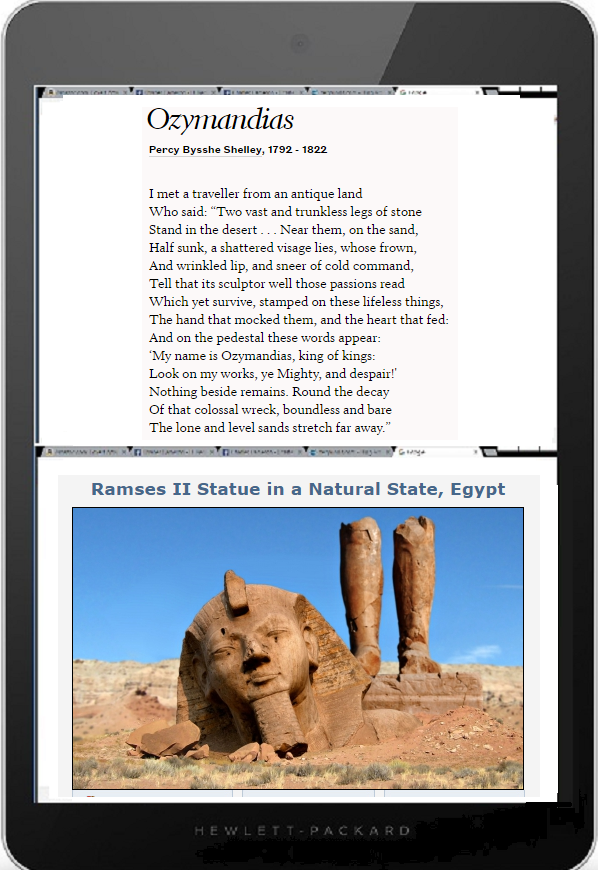
The two images below — the upper image from Wm Benzon‘s New Savanna blog today, the lower from Wikipedia‘s article on Ramesses II —
— between them evoke Percy Bysshe Shelley‘s celebrated poem Ozymandias.
I was going to call Shelley’s poem “longstanding” — but given the erosion to which both images and the poem itself testify, it seems plausible that Shelley’s poem — like Shelley himself — may soon be dust.
**
Mark you, if I were DoubleQuoting the poem, I’d do it thus:
More details fit — the shattered visage, the trunkless legs of stone — but the image is by the same token further from Benzon’s photo, my starting point for this now quadrangular voyage.
To be exact, the lower image in the second DoubleQuote came from the DeskTop Nexus site, but a version of Foreman’s article is where I found it, and I tracked it to Foreman’s original pamphlet from there.
Zenpundit is a blog dedicated to exploring the intersections of foreign policy, history, military theory, national security,strategic thinking, futurism, cognition and a number of other esoteric pursuits.