zenpundit.com » poetry

Archive for the ‘poetry’ Category

Poems, 20-30 March 2016

Friday, April 1st, 2016

[ by Charles Cameron ]
.

As I’ve said on rare occasions before, Madhu, a wonderful friend of this blog, encouraged me some while back to post some of my poems here. I don’t do it often, and I hope you will at least tolerate it when I do.

**

Staring at a gravestone
.

Staring at a gravestone as though the dead might —
contrary to science, in line with hope – break through death,
through death writ in stone, to speak, loom
grey under the sun like a hard silk ghost emerging
from granite, half nowhere half here, speak
out of beyond the thoughts of ever and one and no-one,
chant, perhaps, in some dead tongue, language
of the dead, of death, of one’s own family, intimate,

vast and impersonal.. staring with hope, grief,
a touch of rage perhaps, melded in incomprehension,
listening without hearing, seeing, though
dumb, by doubt and shroud clouded, deluded:
and all this observed from that all-knowing other place, by
the all-giving nothing to which galaxies are specks, lives speak.

**

Of, by and for itself: the poem
.

Let me write a poem that has music to it, that conjures
images out of ink, that echoes into silence,
let it flow from me as the mind waves in the wind,
here and there, yet tethered, tethered, yet hither and yon,
veering away from and towards rhymes, swaying
itself, myself and the reader – your self, yourselves –
my son was pillowing his head on a weight-bar
a few minutes ago – drifting off topic and weaving

back in, let me write in such a way you will wonder,
will wander into wonder, whither wonder yonder hither,
torn, and suddenly so, asunder – may the poem
wrench me, wrench itself, wrench syntax, yourself, selves,
in the sheer mind play of itself on self, in the sheer
wind play, grass on grass, of itselves on our all selves..

**

Unbreakable mirror
.
.
There is such ghastly blood spurting at home and abroad
I must get back to Pasadena, walk again down Marengo, take joy
in the living shoots breaking up the concrete paving.
There are such foolish beheadings, blood spurting, abroad
I must close my eyelids like rose petals, discern petal from thorn.
There is so much hatred spurting blood lost to kin flesh and blood
in the passing down of abuse across generations here at home
I must get to the pool in mind where breath moves, motion is still.

I must get clear past understanding to peace, wherein the face
of understanding is seen in the beloved face, mirror, love, lake:
and what if yours is the divine face, and yourself at war, in grief,
broken in broken marriage, fragmented by frag-grenade, lost
in self-esteem high or low, in alcohol, lost in lust or unloved,
if it should be your broken face i see, in the unbreakable mirror?

**

On the Thursday before All and Everything
.

How sad can that woman be, painted, whose son’s eyes
know and convey that those creatures with bird wings and
Botticelli features who once told her “Fear Not”
arrived from a court or realm in which a higher octave
of fear named awe is the only octave ever sung,
came visiting a realm where the mother’s torn flesh
is the only sacrifice sufficient for the birth of the young,

how sad, seeing those eyes, can a woman be, her son next
to crucifixion, next to resurrection, next to literary
criticism, next to demythologization, next to indifference
by all but Bach, El Greco, Hopkins, Grunewald, how
lanced with grief can that mother be to see her son broken
and spilled, bones and blood, flesh and spirit, wine
and unleavened bread that is nonetheless risen, risen, risen?

**

One frail voice in a whirlwind
.

Okay I am joyed to overflowing that enough dust gathers
and swirls here to formulate a momentary dervish,
crying “for love’s sake, love” against the world’s maelstrom,
one frail voice in a whirlwind, one small silence
amidst such shouting, shooting, eardrum-piercing sound.
I will love you before and after I am gone, I will echo
love on the drumbeat of your heart, I will dance to Bach’s
bacchanalian orgy of the divine love crucified, seated

in lotus, absolute, incarnate, flexible to each soul’s need,
tireless, fatigued unto death, l will dance my dust
into full-throated voice for you, quiver or quaver my wings
faster than birds hum, stretch like the night, warm
your heart at my hearth, I am none and gone, I am here
only to toll and tell you, you are beyond boundlessly dear.

**

How best to crumple your face
.

Aging offers no guarantee of the desired effect
so clearly displayed in that photo of Jim Harrison — a poet
I’m told, and now I’ve seen that image a poet
I shall seek out and read – half blind, half drunk?
Withered as an old oak stump? Gnarly? A grump?

Attack through the voice, it strikes me, would be
the fast, best strategy – dumbfound but not dumb down
or out, soak voice in whiskies, wreathe it in smoke —
sing it — above all, doubtless and doubting — SHOUT!!

Zen it. Turn your head into the headwinds, face whatever
sandblasts you back to your original face. You, I
are forever baby-faced, mirror-faced, and wizened.
How best to crumple your face? How dare you even ask?
You think that life’s a whaddayacallit goddam task?

**

Assessment
,

Rough me up, chisel, throw me down, rampart, cliff,
brine me in and dry me out, season me, in and out and about
in all seasons, snow me under, bake, broil me, boil,
blister, shell-shock, shake, shellac me, chain, drain on me,
break, bust me, cake me in excremental blood, curse,
catcall me, caterwaul, blame, shame me, if I protest, bluster,
I am naked, spare, your slings and arrows wound me, you
have nothing on me, I am but better for your battering, bruising.

Brush me, wash, bathe, comb, coax me, clean me, I
shall remain pliant to your pleasing, soap, soft soap, sponge
me up and down, inside and within, I will respond
in response, loathe me — but clothe me, rob me
but robe me, foist your delusions on me, I am hoist
on my own penis, pride, flagpole, priesthood, petard.

**

Of Diotima and Beatrice
.

Who spawned Diotima of Mantinea? For Socrates
drank wisdom at her teats, Plato from Socrates, Aristotle
from Plato, Alexander from Aristotle, so who
was Diotima, what her thoughts, and who spawned
the thoughts which taught her? I have asked Siri,
I have interrogated Wolfram’s Alpha, have challenged
Googles AI to fight Wittgenstein’s PI to the death —
yet for me it suffices that she, Diotima was no he but a

she, female, a woman. To say more would be to
slather it on, mansplain, overtell, sell, hence overkill,
to say less would leave Aristotle with the boys,
and what could be worse? Think you on this: peace
outshines war by far; Venus is brighter than Mars.
Love’s gravity it is, spins hearts, the sun, all other stars.

**

I was writing these over Holy Week, four of them on Maundy Thursday, and the most recent one came through yesterday. Jim Morrison’s death was the occasion for th poem in which he is named.

Your comments are welcome.
I’ve seen Christianity described as..

Wednesday, March 30th, 2016

[ by Charles Cameron — a little matter of rising (i trust) between the two stools of belief and unbelief ]
.

I have seen Christianity described as —

The popular belief that a celestial Jewish baby, who is also his own father, born from a virgin mother, died for three days so that he could ascend to heaven on a cloud and make you live forever if you symbolically eat his flesh, drink his blood, and telepathically tell him you accept him as your Lord and master, so he can remove an evil force from your spiritual being that is present in all humanity because an immoral woman made from a man’s rib was hoodwinked by a talking reptile possessed by a malicious angel to secretly eat forbidden fruit from a magical tree.

Don’t these atheists understand anything about poetry?

**

Don’t the Christians understand anything about poetry?

Try this as an exercise for the imagination — picture this —

To suppose the Eucharist

Suppose the hypothetical all of everything
in unspooling itself chose to exhibit itself in
one human, suppose further all the sun’s
light were caught in wheat and baked into
bread, all the world’s pains and passions
crushed like grapes into wine, suppose the
one person took loaf and cup and with
word and gesture raised them blood, body

of his own self to be supped and sipped,
thus woven into his one flesh, blood, mind —
just when his flesh is torn, blood spills —
suppose then that his mind to love were to
entrain this new body of many bodies to
heal with all radiance each instance of pain..

**

I offer this poem as a bridge in two directions — to allow the sensible atheist a means of glimpsing what might be admirable in his Christian friend’s faith.. — and to allow the Christian on the brink of leaving the faith for “sensible atheism” a means of retaining much of the deep beauty of that faith while leaving behind both the bribes of heaven and the threats of hell.

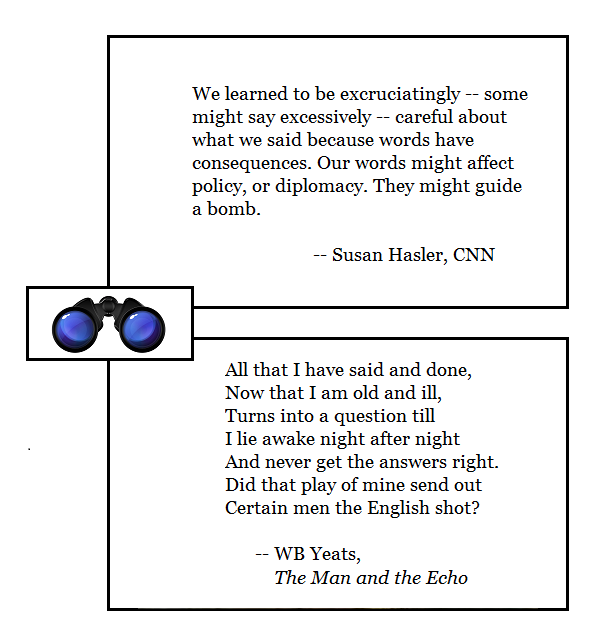
Susan Hasler on Trump & Cruz, Yeats on 1916

Monday, March 28th, 2016

[ by Charles Cameron — the self-examining word ]
.

DQ Hasler Yeats

Hasler‘s Getting the response to terrorism completely wrong — which goes after Trump and Cruz by name — was published tomorrow — it’s 11.58pm Sunday here in California.

Yeats‘ poem remembers the Easter of 1916, a hundred years ago today.

Getting deeper into Koestler

Friday, March 18th, 2016

[ by Charles Cameron — on creativity at the intersection of the fleeting and the eternal ]
.

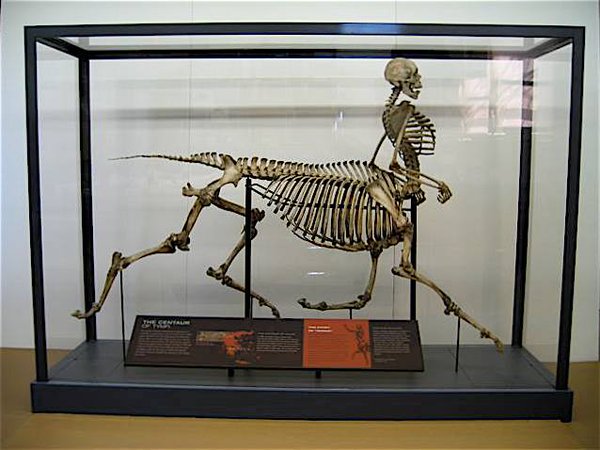
centaur skeleton
Centaur, displayed in the International Wildlife Museum, Tucson, AZ

**

You know Lao Tzu’s “uncarved wood” (pu) — and Spencer Brown’s “Mark” or “first distinction? It is hard to speak of “the one and the many” without language itself favoring the many, the one being “one” and the many “another”. The Greek phrase “Before Abraham was, I am” attributed to Christ may be as close as we get.

The “uncarved wood” is not some definite -– named and thus defined -– “one” -– it is also “raw silk” (su), the simple -– the natural way or stream, from which things have not yet been separated out by naming.

There is delight, however, both in one becoming two and thus many, in the making of distinctions and naming of names, and no less in two (or the many) becoming one, in the resolution of paradox, the release of tension, peace after strife. In human terms, there is joy in both solo and collaborative achievement.

What better, then, than the perfect fit between disparate entities?

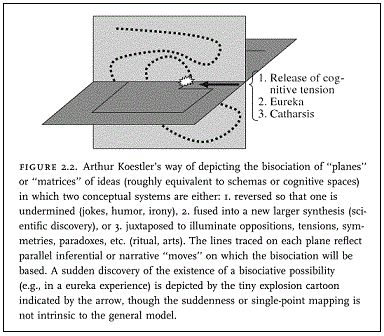
I have written often enough about Arthur Koestler and the place where two disparate spheres of thought link up — the centaur links horse and man in an indissoluble unity — there’s no question here of dismounting after a ride, giving the horse a rub down and some feed, then retiring to the verandah for a whiskey…

The mythological aha! we get from the centaur displayed in the museum hinges on the fit of horse and human skeletons, the perfection with which disparates are joined.

**

Thus far, whenever I’ve discussed Koestler‘s notion of bisociation, I’ve focused on the sense that it liea at the heart of creativity. Koestler himself takes it deeper. Here’s Nicholas Vajifdar, in a review titled Summing Up Arthur Koestler’s Janus: A Summing Up:

Koestler .. asserts that there are two planes of existence, the trivial and the tragic. The trivial plane is the stage for paying bills, shopping, working. Most of life takes place on the trivial plane. But sometimes we’re swept up into the tragic plane, usually due to some catastrophe, and everything becomes glazed with an awful significance. From the point of view of the tragic plane, the trivial plane is empty and frivolous; from the point of view of the trivial plane, the tragic plane is embarrassing and overwrought. Once we’ve moved from one plane to the other, we forget why we could have felt the way we used to.

That’s not just any old distinction between two realms, that’s the one Koestler himself prioritizes. And following his basic principle that a creative spark is lit when two disparate “planes of ideas” intersect, we shouldn’t be too surprised to find Vajifdar continuing:

“The highest form of human creativity,” Koestler writes, “is the endeavor to bridge the gap between the two planes. Both the artist and the scientist are gifted — or cursed — with the faculty of perceiving the trivial events of everyday experience sub specie aeternitatis, in the light of eternity…”

William Blake made a similar observation in The Marriage of Heaven and Hell, writing:

Eternity is in love with the productions of time.

Finally, Vajifdar tells us why he finds Koestler’s definition of art maybe the best he’s ever read:

What I value in this definition of creativity is its emphasis on the subjective being of those who experience the work of art or scientific theory, a surer gauge than cataloguing formal properties or whether it’s “interesting.” Art has always seemed like a kind of sober drunkenness, or drunken sobriety. Most people probably have wondered whether the feelings they felt while drunk were more or less real than their sober feelings. Koestlerian art joins these seemingly irreconcilable feelings together.

Let’s just go one step further. In Promise and Fulfilment – Palestine 1917-1949, Koestler specifically singles out this intersection as an aspect of the experience of warfare:

This intense and perverse peace, superimposed on scenes of flesh-tearing and eardrum-splitting violence, is an archetype of war-experience. Grass never smells sweeter than in a dug-out during a bombardment when one’s face is buried in the earth. What soldier has not seen that caterpillar crawling along a crack in the bark of the tree behind which he took cover, and pursuing its climb undisturbed by the spattering of his tommy-gun? This intersecting of the tragic and the trivial planes of existence has always obsessed me in the Spanish Civil War, during the collapse of France, in the London blitz.

**

I am grateful to David Foster for his ChicagoBoyz post The Romance of Terrorism and War which triggered this exploration, and that on the glamour of war which will follow it.

Aesthetics of love & death

Friday, March 4th, 2016

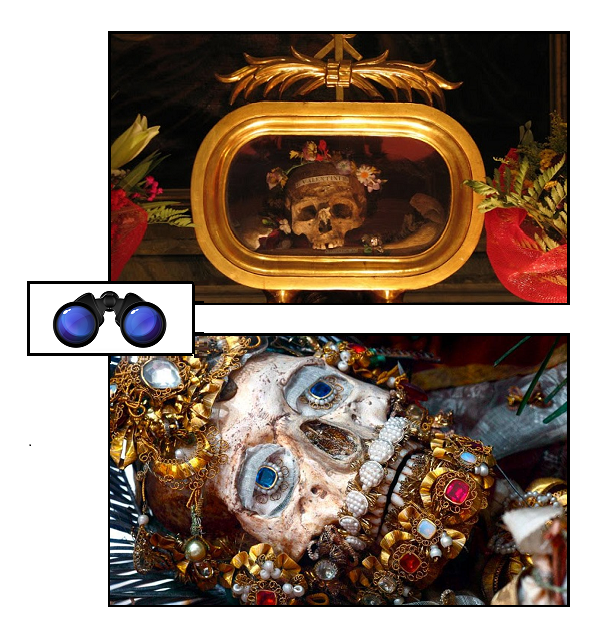
[ by Charles Cameron — relics of a catacombs martyr, St Valentine and more ]
.

SPEC DQ valentine catacomb martyrs

**

There are times when the DoubleQuote format is confining, and the comparative method it is based on could be uswed effectively with more than two examples. Here consider also:

The Tamil Tiger martyr Jenny, as discussed in a fascinating article by anthropologist Michael Roberts aka Thuppahi, Death and Eternal Life: contrasting sensibilities in the face of corpses:

jenny-dead-ltte-female-11

The Al-Qaida martyr al-Zubayr al-Sudani as screencapped by Chris Anlazone:

al-Zubayr al-Sudani

And the Irish Catholic martyr Michael Collins as portrayed in death by Sir John Lavery:

michael_collins_by_john_lavery1

**

Buddha is reported to have said:

Of all the footprints, that of the elephant is supreme. Similarly, of all mindfulness meditation, that on death is supreme.

The cover of American Poet Laureate Robert Pinsky‘s book of poems, Gulf Music, features a Tibetan Buddhist Dance of Death:

Gulf Music Pinsky

Likewise, the Jesuit St Peter Faber meditates on the crucifixion and death of Christ:

Jesus Christ, may your death be my life
and in your dying may I learn how to live.
May your struggles be my rest,
Your human weakness my courage,
Your embarrassment my honor,
Your passion my delight,
Your sadness my joy,
in your humiliation may I be exalted.
In a word, may I find all my blessings in your trials.
Amen.

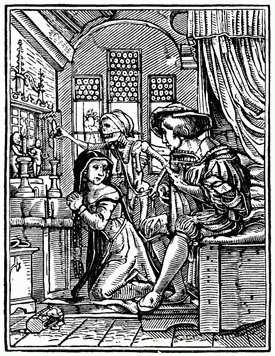
while Hans Holbein invites us to contemplate death behind the varied appearances of human life:

Holbein Dance the Nun


Switch to our mobile site