zenpundit.com » poetry

Archive for the ‘poetry’ Category

Review: Poetry of the Taliban

Friday, July 20th, 2012

[ by Charles Cameron — poetry, humanity, dehumanizing, enmity and amity, image and likeness ]
.

I wrote this review-essay for Books & Culture: A Christian Review — the book review site associated with Christianity Today — where it was published earlier today. I am grateful to my old friend John Wilson for permission to cross-post it here.

I posted a reading of a single poem from the same anthology here on ZP in May: Change: a poem from The Poetry of the Taliban
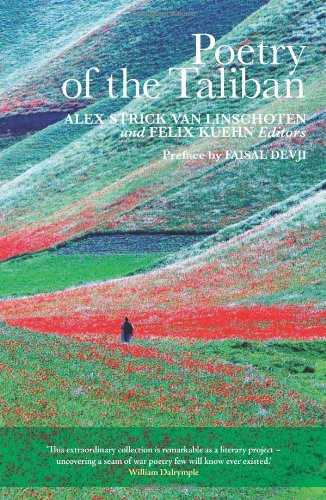
Poetry of the Taliban (Columbia/Hurst)

Columbia University Press, 2012
176 pp., $24.50Buy Now


CHARLES CAMERON

Poetry of the Taliban

Regarding the image and likeness.

Which heart’s voice is this that directly enters into my heart?
Which brute’s ears are these that are deaf to this?
Which sigh of the defenceless is shaking God’s domain?

The poet is Dr. Faizullah Saqib, and the poem is taken from an anthology of poetry written by the Taliban, our enemies. Could it not have been written when an earlier generation of mujaheddin, resisting the Soviet occupation, were our friends? What is this thing, enmity?

Poetry is not simply another weapon the Taliban have decided to use for wartime purposes. Poetry is integral to Afghan culture, and while there are “official” Taliban poems, the flourishing “unofficial” poetry of the Taliban is the place where their Afghan love of poetry takes flight, and the varied aspects of war have been woven into it in much the same way that helicopters have been woven into Afghan carpets: as part of the pattern. There’s an interesting quote on the Textile Museum of Canada website, in fact, relating to Afghan war rugs: “On their rugs flowers turned into cluster bombs, birds turned into airplanes.”

War changes us, war changes everything. Most significantly, I’d suggest, war changes the nature of those we label enemies. We do this anti-sacramental thing, we de-humanize them. As Samiullah Khalid Sahak writes in a poem in this volume,

They don’t accept us as humans,
They don’t accept us as animals either.
And, as they would say,
Humans have two dimensions.
Humanity and animality,
We are out of both of them today.

We are not animals,
I say this with certainty.
But,
Humanity has been forgotten by us,
And I don’t know when it will come back.
May Allah give it to us,
and decorate us with this jewellery,
the jewellery of humanity,
For now it’s only in our imagination.

War tends to do this; it strips people of their humanity—and the stripping tends to boomerang. As Archbishop Desmond Tutu put it,

when we dehumanize someone, whether you like it or not, in that process you are dehumanized. A person is a person through other persons. If we want to enhance our personhood, one of the best ways of doing it is enhancing the personhood of the other.

I said we “do this anti-sacramental thing, we de-humanize’ those we identify as the enemy. And there are really two significant points here, one to do with dehumanizing the other and its impact on us, while the other has to do with the sacramental—with humanizing and loving the other.

Brigadier General S. L. A Marshall, later the official historian of the European theater in World War II for the US Army, found by asking soldiers in the field that “out of an average of one hundred men along the line of fire only fifteen men … would take any part with the weapons.” As a Guardianarticle put it much later,

Marshall’s astonishing contention, debated vigorously ever since, was that about 75% of second world war combat troops were unable to fire their weapons on the enemy. Guns were discharged, but they would be deliberately aimed over the heads of the enemy. The vast majority of soldiers couldn’t actually kill. And, in the midst of combat, they became de facto conscientious objectors.

Marshall’s conclusion, contained in his 1947 book Men Against Fire, was that:

It is therefore reasonable to believe that the average and healthy individual—the man who can endure the mental and physical stress of combat—still has such an inner and usually unrealized resistance towards killing a fellow man that he will not of his own volition take life if it is possible to turn away from that responsibility.

And the result of this?

Lt. Col. Dave Grossman, a former Ranger who has taught psychology at West Point, wrote in 2007, “Since World War II, a new era has quietly dawned in modern warfare: an era of psychological warfare, conducted not upon the enemy, but upon one’s own troops.” That too is a sort of boomerang effect: we now find ourselves needing not only to dehumanize the enemy, but to desensitize (and how different is that?) ourselves.

Grossman, whose book On Killing: The Psychological Cost of Learning to Kill in War is another major contribution to our understanding here, goes on to describe the “triad of methods used to enable men to overcome their innate resistance to killing” as including “desensitization, classical and operant conditioning, and denial defense mechanisms”:

During the Vietnam era millions of American adolescents were conditioned to engage in an act against which they had a powerful resistance. This conditioning is a necessary part of allowing a soldier to succeed and survive in the environment where society has placed him. If we accept that we need an army, then we must accept that it has to be as capable of surviving as we can make it.

But if society prepares a soldier to overcome his resistance to killing and places him in an environment in which he will kill, then that society has an obligation to deal forthrightly, intelligently, and morally with the psychological repercussions upon the soldier and the society. Largely through an ignorance of the processes and implications involved, this did not happen for Vietnam veterans—a mistake we risk making again as the war in Iraq becomes increasingly deadly and unpopular.

And what’s the basis for this? Sebastian Junger hung out for the better part of a year with troops in one of the most heavily contested parts of Afghanistan’s Korengal Valley, describing what he saw there in the bookWar and the film Restrepo, which he directed. Junger commented not so long ago in the Washington Post:

I can’t imagine that there was a time in human history when enemy dead were not desecrated. Achilles dragged Hector around the walls of Troy from the back of a chariot because he was so enraged by Hector’s killing of his best friend. Three millennia later, Somali fighters dragged a U.S. soldier through the streets of Mogadishu after shooting down a Black Hawk helicopter and killing 17 other Americans …. Clearly, the impulse to desecrate the enemy comes from a very dark and primal place in the human psyche. Once in a while, those impulses are going to break through.

And:

They are very clear about the fact that society trains them to kill, orders them to kill and then balks at anything that suggests they have dehumanized the enemy they have killed.

But of course they have dehumanized the enemy—otherwise they would have to face the enormous guilt and anguish of killing other human beings …. It doesn’t work …, but it gets them through the moment; it gets them through the rest of the patrol.

People who fight wars find it easier to kill people they have dehumanized. Perhaps, as Junger suggests, it makes it easier to handle, for a while, the burden of having killed. But then comes the post-traumatic stress, the label “PTSD,” the rising tide of military suicides.

It’s almost easier for me to go to the sacramental side.

All terror is sacramental, Joseba Zulaika suggests in Terror and Taboo: The Follies, Fables, and Faces of Terrorism—an “outward and visible sign of an inward and spiritual grace,” as evidenced by the stories of miracles recounted by bin Laden’s mentor Abdullah Azzam in his book, The Signs of the Merciful in the Jihad of Afghanistan.

It is with sacramental eyes, then, that we must understand and oppose terror, as William Cavanaugh in Torture and Eucharist suggests we should the “disappearances” and torture under the Pinochet regime in Chile. The issue, again, is that of personhood, of humanity, of the image and likeness.

Of which the poets Samiullah Khalid Sahak and Faizullah Saqib speak.

Sun Tzu in The Art of War advises us to know our enemy. Christ goes further, and instructs us to love. He instructs us in loving:

But I say unto you, Love your enemies, bless them that curse you, do good to them that hate you, and pray for them which despitefully use you, and persecute you.

Somehow, we are to understand a new relationship of enmity with amity.

Perhaps the poetry of the Taliban can show us something of our enemy’s humanity, brutal and angelic by turns, as is that humanity with which we ourselves contend:

Like those who have been killed by the infidels,
I counted my heart as one of the martyrs.
It might have been the wine of your memory
that made my heart drunk five times.
The more I kept the secret of my love,
This simple ghazal spoke more of my secrets.
—Khairkhwa

Charles Cameron is a writer, teacher, and game designer.
At the round earths imagin’d corners

Friday, July 20th, 2012

[ by Charles Cameron — mapping, holding two worldviews in mind at one time, a conductor’s score, complexity thinking ]
.


.

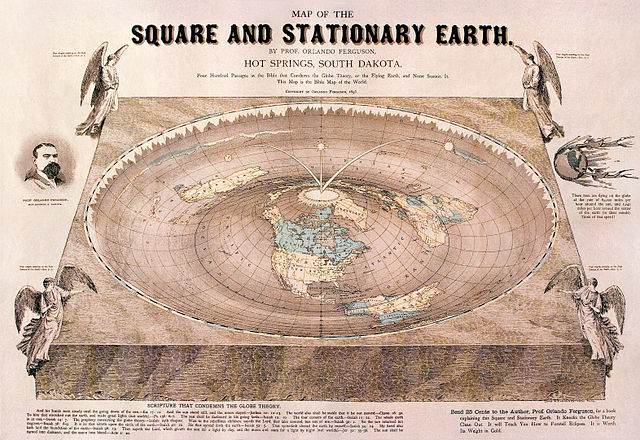
About a year ago, the Atlantic reported that the Library of Congress had been given a map of the flat earth, designed according to Biblical principles — yet showing knowledge of the border between the United States and Canada…

Thanks to a post from Jason Wells, I saw it today.

The view that the earth is flat is one worldview, of course, and no longer the prevailing one. As Nicholas Jackson noted at the Atlantic:

The interesting thing about the map is that it was created about 120 years ago by Orlando Ferguson, then a practicing physician in Hot Springs [South Dakota]. This is more than 500 years after most educated people gave up on the idea of the Earth as flat and accepted the spherical viewpoint first expressed by the Ancient Greeks.

**

It is, however, possible to hold two worldviews in mind at the same time. John Donne manages it in the first line of his extraordinary poem, written at a time when the two views were clashing:

At the round earths imagin’d corners, blow

AT the round earths imagin’d corners, blow
Your trumpets, Angells, and arise, arise
From death, you numberlesse infinities
Of soules, and to your scattred bodies goe,
All whom the flood did, and fire shall o’erthrow,
All whom warre, dearth, age, agues, tyrannies,
Despaire, law, chance, hath slaine, and you whose eyes,
Shall behold God, and never tast deaths woe.
But let them sleepe, Lord, and mee mourne a space,
For, if above all these, my sinnes abound,
‘Tis late to aske abundance of thy grace,
When wee are there; here on this lowly ground,
Teach mee how to repent; for that’s as good
As if thou’hadst seal’d my pardon, with thy blood.

Donne accomplishes the task of holding two worldviews in mind at one time with four simple words: “round earths imagin’d corners”.

**

I don’t know how many melodic “lines of thought” the mind can hold in counterpoint at once. I do know it’s an important cognitive skill for us to cultivate. A classical conductor must surely be able to hold as many lines as there are in this page of Olivier Messaien‘s Oiseaux:

As I pointed out in a recent comment here, “somewhere above three and before eleven there’s a point — Miller’s ‘magical number seven, plus or minus two‘ where the human mind can’t hold any more detail, so that’s a cut-off of sorts.”

Well, Messaien clearly imagines the conductor’s mind can follow more than eleven paths…

**

And then there’s Bob Milne.

I’ll let the Philosophy Compass take it from here:

Bob is predominantly known for his piano concerts of Ragtime and Bogie-Woogie music – and was given the moniker of ‘National Treasure’ by the United States Library of Congress. It was at one of these concerts that drew the attention of Penn State neuroscientist Kerstin Bettermann. At his concerts, Bob often carries on conversations, telling stories and jokes, while simultaneously modulating key signatures over the polyrhythmic Ragtime music. In their broadcast, Radiolab discusses with Dr. Bettermann why this is so surprising.

Language use and musical competency often use the same neural resources: the prototypical language areas in the left hemisphere of the brain, and the working memory circuit that keeps information available and rapidly accessible for a short-period of time. Our ability to use language and engage with music should, on most models of the brain, be competing for these neural resources and interfere with one another. Not so with Bob – he appears to be able to tackle both tasks with ease. Further, while most people can approach this kind of competency in multi-tasking, it usually involves many learning trials, a process of sedimenting the learning into what psychologists call procedural memory, which may have its roots in a different brain region, the cerebellum. But Bob can hear a tune just once, and play it back with commentary.

But that’s not all Bob can do.

In their interview, Dr. Bettermann heard Bob claim something extraordinary. He claims not only to be able to hear a symphony in his head, but that he normally does this with two symphonies simultaneously. Where most individuals would only hear a cacophonous mess – Bob claimed he could dial the relative volume of either symphony up or down, and could zoom in or out of individual instrumentations. To return to the considerations above, Bob further states on the Radiolab website that he does this while driving – another procedural memory task and presumable source of interference. But when Dr. Bettermann challenged him, Bob reluctantly claimed that he could probably do the same (not while driving, mind you) with four simultaneous symphonies.

The claim is something like this: Bob states that he can hold and listen to four symphonies with different keys, instrumentation, tempo and style in his working memory at the same time. And what is stunning is that when they put Bob into an fMRI machine, they verified his claim. Bob could be stopped at any time during his imaginative trip through the four simultaneous symphonies, and hum out the exact phrase that the original recording would be on. Remarkable.

**

This in turn takes us back to that point Edward Said made, which gave me the basic concept for my Said Sympohony (must get back to that soon):

When you think about it, when you think about Jew and Palestinian not separately, but as part of a symphony, there is something magnificently imposing about it. A very rich, also very tragic, also in many ways desperate history of extremes — opposites in the Hegelian sense — that is yet to receive its due. So what you are faced with is a kind of sublime grandeur of a series of tragedies, of losses, of sacrifices, of pain that would take the brain of a Bach to figure out. It would require the imagination of someone like Edmund Burke to fathom.

Edward W. Said, Power, Politics, and Culture, p. 447 — from the section titled “My Right of Return,” consisting of an interview with Ari Shavit from Ha’aretz Magazine, August 18, 2000.

I asked in a post yesterday how good we now are at modeling or simulating ideas in the “war of ideas” — just for a moment, suppose we could think through all complex geopolitical issues in this polyphonic, contrapuntal way…

**

Okay, you deserve a reward for faithful reading if you’ve come this far with me. Here’s the incomparable Richard Burton reading Donne’s poem — the text is up above, if you want to follow along:

Numbers by the numbers: four

Wednesday, July 18th, 2012

[ by Charles Cameron — importance of the ratio form (“this is to that as thus is to so”) as a bridge between domains and silos, creative leaps, the glass bead game, and finally, Chittick’s joke about camels, sex and translations from the Arabic ]
.

.

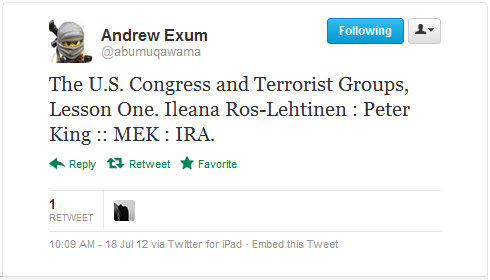
I retweeted this tweet of Andrew Exum‘s to my friend Paul Pilkington because I know he’s working on a project to find out what “this is to that” is to some other “this is to that” — across a wide swathe of human culture.

Note particularly that Exum is using this formal device to illuminate, to give insight, in an area of importance to analysts, strategic thinkers and decision makers.

I’m also retweeting Exum to Paul because I believe Paul’s simple experiment, based as it is on his reading of Hermann Hesse‘s Glass Bead Game, has the capacity to build an architecture of thought (a) crossing all disciplines and (b) spanning the trivial with the profound.

I’m doing something similar with Cath Styles in our Sembl games project — but this time I want to concentrate on Paul’s approach, and since there are four moving parts in an a is to be as c is to d configuration, I’m calling this post Numbers by the numbers: four — number three will just have to wait a while.

**

To get a sense of what Paul is up to, we can go to his Twitter Project page, which describes the fourth in a series of books he’s writing — and also follow him on Twitter, where he posts as Just Knecht.

Two of Paul’s recent tweets express his sense of the task pretty incisively:

The whole of language is the holding up of one unlike thing to compare, contrast and connect with another

Curating is a matter juxtaposition of work against work, artist against artist, place against place – A.Searle on Documenta 13, The Guardian

On his Twitter Project Page, he tells us:

Each tweet is an individual Glass Bead Game move, which is a comparison (metaphor, simile or analogy) across different areas, and may be either a statement or a question.

In question form, these are not unlike analogy questions from SAT tests with an additional dimension of general knowledge, cultural invention and intellectual playfulness. The basic challenge is to work out the relationship between two terms in one context, and apply it in another. Sometimes a tweet will extend an analogy further, which would be the beginning of forming a larger game from an individual move.

Some of the most interesting moves do not have right or wrong answers. Some have canonical or original answers, but they’re not necessarily right. In fact, very often I will post something I’ve picked up from elsewhere which I would love to see improved on, challenged, or at least better explained by others.

He then poses some of the sorts of questions that intrigue him:

Who is the J.H.Prynne of contemporary dance? Like Prynne in contemporary poetry they need to have been ‘out there’ right at the edge of theory and practice for some time, and also deeply steeped in tradition at the same time. Merce Cunningham? Suggestions welcome … And Heston Blumethal or Ferran Adrià might be the Prynne of cookery. But what about the Prynne of contemporary warfare?

What is the equivalent of sonata form in architecture? Goethe and Hegel both said ‘architecture is frozen music’ but neither really explained what they meant. If it is, then is there an architectural equivalent in Western architecture of the key structural form in Western art music? Suggestions welcome …

So, Zenpundit readers — who is the JH Prynne of contemporary warfare?

**

Not so long ago, in Numbers by the numbers: one, I posted a series of self-referential tweets that I’d collected over the last month or two — here I’d like to present some of Paul’s recent tweets:

Let’s start with one that’s a foreign policy insight, arguably as significant to day as it was when Vance first said it:

16 Jul @justknecht
“The Strait of Hormuz is the jugular vein of the West” (Cyrus Vance)

If these tweets can be timeless, they can also be timely:

4 Jul @justknecht
The Higgs boson is the quantum of the Higgs field, just as the photon is the quantum of the electromagnetic field

As they accumulate over time, they can build a conceptual “mesh” that engages an entire field — in this case, recent classical music — while linking it to a variety of other areas:

16 Jul @justknecht
“Boulez’ Derive 2 sounds like birthday cakes ought to” – Philip Clark, Gramophone

22 Jun @justknecht
Wagner was a beautiful sunset that was mistaken for a dawn – Claude Debussy, quoted by Geoffrey Norris in Gramophone

30 May @justknecht
Fauré’s Theme and Variations (no. 9) is like an evening star falling slowly from the sky – Bryce Morrison cites Alfred Cortot in Gramophone

11 May @justknecht
Kraftwerk is the Warhol of pop music – The New Yorker

There’s profundity here:

9 Jun @justknecht
“Space is to place as eternity is to time.” – Joseph Joubert

This could be, as Paul says, “the beginning of forming a larger game from an individual move” — that quote in itself could plausibly be the keystone of an architecture bridging science with religion…

There are historical parallels to consider:

31 May @justknecht
Robert Burton : Oxford :: Jeremy Prynne :: Cambridge

Catty remarks by Nobel laureates:

21 May @justknecht
“Thinking is to humans as swimming is to cats” (Nobel laureate Daniel Kahneman)

Near-tautologies:

21 May @justknecht
Macon Telegraph: Recipes are to food as blueprints are to buildings.

And, ooh, exotic forms of slander!

18 May @justknecht
“[Your daughter] has lovers as numerous as the striking of tablas on Palm Sunday” – Arabic satire by Abu Nawas, 756 – 813 AD

Once again, it’s form that generates insight, not content. Get used to form, play around with it, and content will leap out at you from the page, from the screen.

**

I’m no Arabist myself, but ah! that last quote reminds me irresistibly of the difficulties faced by translators from the Arabic, as recounted by William Chittick in The Self-disclosure of God: Principles of Ibn Al-‘Arabi’s Cosmology (SUNY Press, 1998, pp. xxxv-xxvi.)

An old joke among orientalists tells us that every Arabic word has four meanings: It means what it means, then it means the opposite of what it means, then it has something to do with sex, and finally it designates something to do with a camel …. The rational mind tends to push the meaning of a word away from experience to ‘what it means’ but the imaginal mind finds the self-disclosure of the Real in the sex and the camel … it is in the world’s concrete realities that God is found, not in its abstractions.

I’d been looking for an excuse to post that quote on Zenpundit — now I’ve found it!

Prophecy, Poetry and Prediction

Tuesday, July 17th, 2012

[ by Charles Cameron — personal preference, gangs, Chicago, insurgency, Afghanistan, and admitting the uncomfortable ]
.

Albrecht Durer, The Blessed Virgin enthroned on the crescent moon

**

Poetry, on the whole, has a liking for prophets. Thus Sylvia Plath writes:

By the roots of my hair some god got hold of me.
I sizzled in his blue volts like a desert prophet.

There’s an undeniable affinity there, the sense of giving voice to a lightning strike. Or as Randall Jarrell puts it:

A good poet is someone who manages, in a lifetime of standing out in thunderstorms, to be struck by lightning five or six times; a dozen or two dozen times and he is great.

**

Okay. I’m a poet, I think, partly because I have such a damnably literal mind that I need to break out in metaphor the way athletes break out in a sweat.

And the trouble with prophecy, from my point of view, is that it’s all too often read in damnably literal-minded ways, as though:

And there appeared a great wonder in heaven; a woman clothed with the sun, and the moon under her feet, and upon her head a crown of twelve stars

wasn’t clearly poetry. Let me clarify: it is.

And it is because prophecy (not “false prophecy”) is all too often read literally that the end of the world is so regularly promised, without once having come to pass thus far.

Even though the scriptures proclaim, But of that day and hour knoweth no man, no, not the angels of heaven

**

I suppose it goes along with being a poet rather than a statistician that I’m far more interested in qualitative than in quantitative approaches to modeling — or understanding, as we used to call it.

There are times, though, when it’s advisable to acknowledge the approaches most different from one’s own — for they too have their moments.

**

A Reporter’s Notebook entry yesterday on Fox News titled Chicago gang database intends to predict and prevent further violence tells us “One shooting sets the next shooting in motion.” That’s poignant even if a tad banal. But what comes next is interesting:

In an attempt to predict the next violent act, Chicago police are turning to technology. They have established a database that includes information on more than 100,000 known gang members. Even the lowest members of the gangs are entered as soon as police become aware of them. Their arrest records and affiliations are all entered and cross-referenced and available to the cop on the street. This is the kind of information a good beat cop would keep in his head; now it’s available to every cop on every beat. Sgt. Tom Ryan is in the gang unit on the South Side. “This is just a great way that we can look at all the information gathered because it is hard for the detectives to talk to all the different units. This is a good way of filtering down data through the departments to each other.

Probably of greatest use to the officers, when a guy gets shot, police see who his buddies are. “We can make predictions about where retaliations might be likely to happen,” says Commander Jonathan Lewin.

**

And I bring this to your attention because today I ran across an article in Wired’s Danger Room with the headline Study: WikiLeaked Data Can Predict Insurgent Attacks which resonated with yesterday’s Chicago gang report:

Insurgencies are amongst the hardest conflicts to predict. Insurgents can be loosely organized, split into factions, and strike from out of nowhere. But now researchers have demonstrated that with enough data, you might actually predict where insurgent violence will strike next. The results, though, don’t look good for the U.S.-led war.

And they’re also laden with irony. The data the researchers used was purloined by WikiLeaks, which the Pentagon has tried to suppress. And the Pentagon has struggled for years to develop its own prediction tools.

That data would be the “Afghan War Diary,” a record of 77,000 military logs dated between 2004 and 2009 that were spilled onto the internet two years ago by WikiLeaks. In a paper published Monday by the Proceedings of the National Academy of Sciences, a team of researchers used the leaked logs to (mostly) accurately predict violence levels in Afghanistan for the year 2010. (Behind a paywall, alas, but a summary is available for free in .pdf.)

**

I’m focused on minds and hearts, as the saying goes — but I’ll admit that mines and HK417s are also significant.

If the quant side of the house can reduce casualties, I’m all for that.

Tree series, II: Phototropic Simplexities

Monday, June 25th, 2012

[ by Charles Cameron — this one’s a prose poem: it begins with a statement so tight it needs to be unwound, and unwinds it ]
.

I wrote this urgently starting when it “woke” me at 4am one morning in the late 1990s or 2000, and as soon as it was out, I found myself writing #3 in the series, a game design. Together, the pair of them represent a stage in my games and education thinking intermediate between Myst-like Universities of 1996 and my vision today of games in education, which I hope to address in a further post addressed to Sebastian Thrun & with appreciation to Bryan Alexander and Lewis Shepherd. In this posting, I have added the words “figuratively speaking” for absolute clarity: otherwise, the piece remains as written all those years ago.

***


A copse. Photo credit: Ian Britton via FreePhoto.com under CC license. Note how the wind sweeps the trees into a group shape.

***

Trees: Phototropic Simplexities

Trees are phototropic simplexities, no wonder we like them they cowork so well too: copses, see.

*

Meaning:

Trees we know: I as writer can refer you, reader, safely to them, “trees”, in trust that the word I use will signal to you too — triggering for you, also — pretty much the assortment of branching organic thingies about which I’m hoping to communicate that they are complex entities whose complexity comes from a simplicity of rule — branching — repeated with variations, said variants doing their branching in thirst of light, each trunk rising, limb outpushing, branch diverging, twig evading other twig much as one who seeks in a crowd a clear view of a distant celebrity shifts and cranes and peers — branching, thus, by the finding of light in avoidance of nearby shadow and moving into it, into light as position, that light, that position, growing, and thus in the overall “unified yet various”, we, seekers of the various and unified love them, to see them in greens themselves various in their simplexity is to say “tree” with a quiet warmth; while they themselves also, by the necessity of their branching seeking, if clumped together seek in an avoidance of each other’s seeking, growing, thus space-sharing in ways which as the wind sweeps and conforms them to its own simplex flows, shapes them to a common curve we call aerodynamic, highlit against the sky huddled together as “copse” — this, in the mind’s eyes and in your wanderings, see…

*

Meaning:

Trees we can talk about. Simplexity is a useful term for forms — like trees — which are neither simple only nor complex only, but as varied as complexity suggests with a manner of variation as simple as simplicity implies.

Trees? Their simplexity is conveyed in principle by the word “branching”. Its necessity lies in the need of each “reaching end” of the organism to ascertain from its own position and within the bounds of its possible growing movement, some “available” light — this light-seeking having the name “phototropism”.

Simplexities — and thus by way of example, trees — we like, we call them beautiful.

Clustered together, too, and shaped by the winds’ patterns of flow, these individual simplexities combine on an English hilltop (or where you will) to form yet other beauties.

*

Thus:

Trees are phototropic simplexities, no wonder we like them they cowork so well too: copses, see.

*

Meaning:

I love trees. Want to talk about simplexities, beauty.

I wish to talk about beauty because it is beauty that I love, if I love it, that is beauty: love is kalotropic, a beauty-seeking. I am erotropic, love seeking — you can find in this my own simplexity, my own varieties of seeking, of the growths that are my growth, and clumping me with others under the winds, the pressures that form and conform us, you can find also the mutual shapes that we adopt, beautiful.

Simplexity, then, is a key to beauty, variety, self, character, cohabitation… Tropism, seeking, is the key to simplexity. Love is my tropism. Ours, I propose.

*

Meaning:

Beauty is one simplexity perceived by another: the eye of the beholder, with optic nerve, “brain”, branching neuron paths that other simplexity, “consciousness” the perceiving.

*

Meaning also:

That all is jostle, striving — a strife for life, in which the outcome overall is for each a “place in the sun” but not without skirmishes, shadows. The overall picture, therefore, beautiful — but this overall beauty hard to perceive when the specific shadow falls in the specific sought place of the moment, the “available” is not available, and the strife of the moment is paramount.

Branching being the order behind simplexity, differentiation…

Differentiation for maximal tropism at all levels — life seeking always the light, honey, beauty, is always and everywhere in conflict also with itself, competitive: and competition the necessary act of the avoidance of shadow, and the shadow creating act.

And beauty — the light, thing sought, implacably necessary food and drink, the honey — thus the drive that would make us kill for life.

I could kill for beauty.

I could kill for honey.

Figuratively speaking.

*

Implying:

Paradise and Fall, simultaneous, everywhere.

It is at this juncture, at this branching, that we are “expelled from the garden” — can no longer see the beauty that is and remains overall, that can allow us to say also, “we are never outside the garden” — for the dappling of light on and among the leaves has become to us, too closely jostled, shadow.

And shadow for shadow we jostle, and life is strife.

*

Thus:

The dappling of light on leaves, beautiful, is for each shadowed leaf, shadow, death-dealing, is for each lit leaf, light, life-giving: a chiaroscuro, beautiful, see.

Roots, too, have their mirror branchings.


Switch to our mobile site