zenpundit.com » Islam

Archive for the ‘Islam’ Category

ISIS and the Crisis in American Statecraft

Tuesday, December 30th, 2014

[by Mark Safranski, a.k.a. “zen“]

A Facebook friend with an astute comment pointed me toward this Wall Street Journal article by Joe Rago on the mission of General John Allen, USMC  as “Special Presidential Envoy for the Global Coalition to Counter ISIL”. What is a “Special Presidential Envoy” ?

In diplomatic parlance, a special envoy is an official with full powers (a “plenipotentiary”) to conduct negotiations and conclude agreements, but without the protocol rank of ambassador and the ceremonial duties and customary courtesies. A special envoy could get right down to business without wasting time and were often technical experts or seasoned diplomatic “old hands” whom the foreign interlocuter could trust, or at least respect. These were once common appointments but today less so. A “Special Presidential Envoy” is typically something grander – in theory, a trusted fixer or VIP to act as superambassador , a deal-maker or reader of riot acts on behalf of the POTUS. Think FDR sending Harry Hopkins to Stalin or Nixon sending Kissinger secretly to Mao; more recent and less dramatic examples would be General Anthony Zinni, USMC and former Senate Majority Leader George Mitchell.  

In practice, a presidential special envoy could also be much less, the foreign policy equivalent of a national commission in domestic politics; a place to park thorny, no-win, political headaches the POTUS wants to ignore by creating the illusion of action and get them off the front pages. The position is really whatever the President wishes to make of it and how much power and autonomy he cares to delegate and what, if anything, he wishes the Special Envoy to achieve. Finally, these appointments are also a sign the President does not have much confidence or trust in the bureaucracy of the State Department or DoD, or their respective Secretaries, to carry out the administration’s policy. I wager that this is one of the reasons for General Allen’s appointment.

This means that General Allen is more or less stuck with whatever brief he was given, to color within the lines and make the best uses of any carrots or sticks he was allotted ( in this micromanaging administration, probably very little of either). Why was he chosen? Most likely because the United States sending a warfighting Marine general like Allen ( or a high CIA official) will always concentrate the minds of foreigners, particularly in a region where the US has launched three major wars in a quarter century. If not Allen, it would have been someone similar with similar results because the policy and civilian officials to whom they would report would remain the same.

So if things with ISIS and Iraq/Syria  are going poorly – and my take from the article is that they are – the onus is on a pay grade much higher than General Allen’s.

I will comment on a few sections of the interview, but I suggest reading the article in full:

Inside the War Against Islamic State 

Those calamities were interrupted, and now the first beginnings of a comeback may be emerging against the disorder. Among the architects of the progress so far is John Allen, a four-star Marine Corps general who came out of retirement to lead the global campaign against what he calls “one of the darkest forces that any country has ever had to deal with.”

ISIS are definitely an bunch of evil bastards, and letting them take root unmolested is probably a bad idea. That said, they are not ten feet tall. Does anyone imagine ISIS can beat in a stand-up fight, say, the Iranian Army or the Egyptian Army, much less the IDF or (if we dropped the goofy ROE and micromanaging of company and battalion commanders) the USMC? I don’t. And if we really want Allen as an “architect” , make Allen Combatant Commander of CENTCOM.

Gen. Allen is President Obama ’s “special envoy” to the more than 60 nations and groups that have joined a coalition to defeat Islamic State, and there is now reason for optimism, even if not “wild-eyed optimism,” he said in an interview this month in his austere offices somewhere in the corridors of the State Department

Well, in DC where proximity to power is power, sticking General Allen in some broom closet at State instead of, say, in the White House, in the EOB or at least an office near the Secretary of State is how State Department mandarins and the White House staff signal to foreign partners that the Presidential Special Envoy should not be taken too seriously. It’s an intentional slight to General Allen. Not a good sign.

At the Brussels conference, the 60 international partners dedicated themselves to the defeat of Islamic State—also known as ISIS or ISIL, though Gen. Allen prefers the loose Arabic vernacular, Daesh. They formalized a strategy around five common purposes—the military campaign, disrupting the flow of foreign fighters, counterfinance, humanitarian relief and ideological delegitimization.

The fact that there are sixty (!) “partners” (whatever the hell that means) and ISIS is still running slave markets and beheading children denotes an incredible lack of seriousness here when you consider we beat Nazi Germany, Imperial Japan and Fascist Italy into utter submission in the largest war in the history of the world with barely a third that number.  The best that can be said here is that Allen, in trying to be a herder of cats, got them to graciously agree on letting the US set a reasonable list of open-ended operations and policy priorities.

Gen. Allen cautions that there is hard fighting ahead and victory is difficult to define….

I think my head is going to explode. I’m sure General Allen’s head is too because this means that President Obama and his chief advisers are refusing to define victory by setting a coherent policy and consequently, few of our sixty partners are anxious to do much fighting against ISIS. When you don’t know what victory is and won’t fight, then victory is not hard to define, its impossible to achieve.

At least we are not sending large numbers of troops to fight without defining victory. That would be worse.

Gen. Allen’s assignment is diplomatic; “I just happen to be a general,” he says. He acts as strategist, broker, mediator, fixer and deal-maker across the large and often fractious coalition, managing relationships and organizing the multi-front campaign. “As you can imagine,” he says, “it’s like three-dimensional chess sometimes.”

Or its a sign that our civilian leaders and the bureaucracies they manage are dysfunctional, cynical and incompetent at foreign policy and strategy. But perhaps General Allen will pull off a miracle without armies, authorities or resources.

Unlike its antecedent al Qaeda in Iraq, Islamic State is something new, “a truly unparalleled threat to the region that we have not seen before.” Al Qaeda in Iraq “did not have the organizational depth, they didn’t have the cohesion that Daesh has exhibited in so many places.” The group has seized territory, dominated population centers and become self-financing—“they’re even talking about generating their own currency.”

But the major difference is that “we’re not just fighting a force, you know, we’re fighting an idea,” Gen. Allen says. Islamic State has created an “image that it is not just an extremist organization, not just a violent terrorist organization, but an image that it is an Islamic proto-state, in essence, the Islamic caliphate.” It is an “image of invincibility and image of an advocate on behalf of the faith of Islam.”

This ideology has proved to be a powerful recruiting engine, especially internationally. About 18,000 foreign nationals have traveled to fight in Iraq or the Syria war, some of them Uighurs or Chechens but many from Western countries like the U.K., Belgium, Australia and the U.S. About 10,000 have joined Islamic State, Gen. Allen says.

“Often these guys have got no military qualifications whatsoever,” he continues. “They just came to the battlefield to be part of something that they found attractive or interesting. So they’re most often the suicide bombers. They are the ones who have undertaken the most horrendous depredations against the local populations. They don’t come out of the Arab world. . . . They don’t have an association with a local population. So doing what people have done to those populations is easier for a foreign fighter.”

Except for the “never seen before” part – we have in fact seen this phenomena in the Islamic world many times before, starting with the Khawarijites, of whom ISIS are just the most recent iteration – this is all largely true.

ISIS, for all its foul brigandage, religious mummery and crypto-Mahdist nonsense is a competent adversary that understands how to connect  in strategy its military operations on the ground with symbolic actions at the moral level of war. Fighting at the moral level of war does not always imply (though it often does) that your side is morally good. Sadly, terror and atrocities under some circumstances can be morally compelling to onlookers and not merely repellent. In a twisted way, there’s a “burning the boats” effect in openly and gleefully committing horrific crimes that will unify and reinforce your own side while daunting your enemies and impressing onlookers with your strength and ruthlessness. Men flocked to Spain to fight for Fascism and Communism. A remarkable 60% of the Nazi Waffen-SS were foreigners, most of whom were volunteers. Ample numbers of Western left-wing intellectuals were abject apologists not only for Stalin and Mao but the Khmer Rouge during the height of its genocide. ISIS atrocities and horror are likewise political crack for certain kinds of minds.

The problem is that none of this should be a surprise to American leaders, if they took their responsibilities seriously.

William Lind and Martin van Creveld were writing about state decline and fourth generation warfare twenty five years ago. We have debated 4Gw, hybrid war, complex war, LIC, terrorism, insurgency, failed states, criminal insurgency and terms more obscure in earnest for over a decade and have wrestled with irregular warfare since John F. Kennedy was president. Yet the USG is no closer to effective policy solutions for irregular threats in 2014 than we were in 1964.

A more hopeful sign is that the new Iraqi government is more stable and multiconfessional after the autocratic sectarian rule of Prime Minister Nouri al-Maliki. His replacement, Haider al-Abadi, has been “very clear that the future of Iraq is for all Iraqis,” Sunni, Shiite and Kurd. He has restored relations with Middle Eastern neighbors and believes in the “devolution of power” across Iraq’s regions, Gen. Allen says. “Maliki believed in the centralization of power.”

So did we. Maliki and Hamid Karzai were originally our creatures. There was at least a bad tradition of centralization in Iraq, but we imposed it in Afghanistan ex nihilo because it suited our bureaucratic convenience and, to be frank, the big government technocratic political beliefs of the kinds of people who become foreign service officers, national security wonks, military officers and NGO workers. Unfortunately, centralization didn’t much suit the Afghans.

Critics of the Obama administration’s Islamic State response argue that the campaign has been too slow and improvisational. In particular, they argue that there is one Iraqi-Syrian theater and thus that Islamic State cannot be contained or defeated in Iraq alone. Without a coherent answer to the Bashar Assad regime, the contagion from this terror haven will continue to spill over.

Gen. Allen argues that the rebels cannot remove Assad from power, and coalition members are “broadly in agreement that Syria cannot be solved by military means. . . . The only rational way to do this is a political outcome, the process of which should be developed through a political-diplomatic track. And at the end of that process, as far as the U.S. is concerned, there is no Bashar al-Assad, he is gone.”

Except without brute force or a willingness to make any significant concessions to the states that back the Assad regime this will never happen. What possible incentive would Assad have to cooperate in his own political (followed by physical) demise?  Our Washington insiders believe that you can refuse to both bargain or fight but still get your way because most of them are originally lawyers and MBAs who are used to prevailing at home by manipulation, deception, secret back room deals and rigged procedures. That works less well in the wider world which rests, under a thin veneer of international law, on the dynamic of Hobbesian political violence.

As ISIS has demonstrated, I might add.

The war against Islamic State will go on long after he returns to private life, Gen. Allen predicts. “We can attack Daesh kinetically, we can constrain it financially, we can solve the human suffering associated with the refugees, but as long as the idea of Daesh remains intact, they have yet to be defeated,” he says. The “conflict-termination aspect of the strategy,” as he puts it, is to “delegitimize Daesh, expose it for what it really is.”

This specific campaign, against this specific enemy, he continues, belongs to a larger intellectual, religious and political movement, what he describes as “the rescue of Islam.” He explains that “I understand the challenges that the Arabs face now in trying to deal with Daesh as an entity, as a clear threat to their states and to their people, but also the threat that Daesh is to their faith.”

While Iraqi and Iranian Shia have ample existentiall motive to fight ISIS. Sunni Muslims find ISIS brutality pretty tolerable, so long as it is far away from them personally and furthermore ISIS religious-theological lunacy is not terribly far removed from the extreme Salafi-Wahhabi version preached and globally proselytized by our good friends, the House of Saud – or exported violently by our other good friends, the Pakistani Army.  Or at least Sunni Muslims are not bothered enough yet by ISIS to pick up arms and fight.

General Allen is doing his best at a herculean task, but American statecraft is broken and seduced by a political culture vested in magical thinking.
UN Human Rights Commissioner Prince Zeid bin Ra’ad al-Hussein

Monday, December 22nd, 2014

[ by Charles Cameron — WINEP hosts Countering Violent Extremism and Ideology discussion ]
.

Addressing the Washington Institute for Near East Policy earlier this month, Prince Zeid bin Ra’ad al-Hussein, United Nations High Commissioner for Human Rights and former Jordanian Ambassador to the United States said of the IS / Daesh “caliphate”:

I think it requires a much deeper sort of analysis than what we often see coming through to us via the media outlets.

He went on to explain what he meant — emphasizing not military force but an Islamic theological response to the Daesh doctrinal claims:

We listened very carefully in Geneva to the remarks made by Walid Muallem, the foreign minister of the Syrian government, and he was dismissive of the efficacy of the airstrikes. Now this is something that I think has to be studied because we have learned from other sources that this may well be the case – or at least, if they were not supplemented by a concerted discussion within the Islamic world to confront, line by line, the thinking of the takfiri groups, that the results may not be what we hope they will be, and fall short of where we want them to be.

The letter that I have alluded to [..] was issued by a hundred and twenty-six Muslim scholars back in September as a response to the July Jumaa sermon issued by Abu Bakr al-Baghdadi. And what I found really quite unfortunate is that this letter which was remarkable, in the sense that it was scholarly, it was backed by Muslim scholars from all over the world, it dealt by each of the points raised in the sermon, rebuttal followed by another rebuttal to each of Abu Bakr al-Baghdadi’s points, that this received far less in the way of media attention than the decisions to launch airstrikes and take very active military operations. Because I felt at the time and still do that this letter needs to be supported and alluded to and spoken about and referred to by politicians in the Islamic world and beyond — not least because if it isn’t shown that the Islamic world is responding, at least from a scholarly angle, then we will continue to see the phenomena we see in Europe and we saw in germany yesterday, of demonstrations basically targeting Islam as a religion, as opposed to the takfiri ideology where the denunciations should be properly be directed.

**

Here, then, so that we can better grasp these issues as they can be understood within Islam, is the Letter al-Hussein spoke of:

**

The Letter can also be downloaded as a .pdf. Among the highlights of the Executive Summary:

9. It is forbidden in Islam to declare people non-Muslim unless he (or she) openly declares disbelief.
10. It is forbidden in Islam to harm or mistreat—in any way—Christians or any ‘People of the Scripture’.
11. It is obligatory to consider Yazidis as People of the Scripture.
12. The re-introduction of slavery is forbidden in Islam. It was abolished by universal consensus.
13. It is forbidden in Islam to force people to convert.
14. It is forbidden in Islam to deny women their rights.

**

For those of you who watch the video of the WINEP discussion, I should warn you that the close captioning is inexcusably poor. I’m betting, eg, that Zeid bin Ra’ad al-Hussein did not say “jihadi nostra” (cute though that might be) when the context clearly suggests “Jabhat al-Nusra”.

Black Banners in Sydney 2: on flags and their meanings

Monday, December 22nd, 2014

[ by Charles Cameron — the history and dwindling significance of a sign ]
.

two flags

**

In my previous post in this series, Black Banners in Sydney 1: a DoubleQuote in the Wild from Ardeet, I wrote:

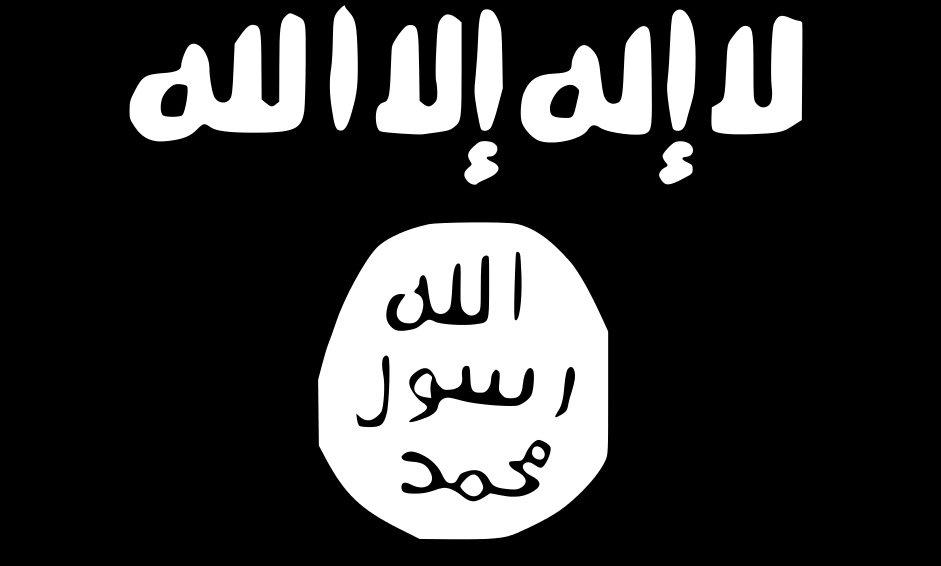
The flag in the image from the Lindt cafe is not in fact the Daesh / Islamic State flag, and indeed the hostage-taker appears to have asked for a genuine Daesh / IS flag as one of his demands. The flag shown is a black flag containing the Shahada or Islamic profession of faith in white, and black flags in Islam have a history as war flags dating back to the time of the Prophet himself.

The banners are black, and there are implications.

**

First, the black banner was the Prophet’s flag, the raya.

The Islamic Imagery Project at West Point’s Combating Terrorism Center lists “Black Flag” under the heading “Warfare Motifs“, saying:

The Black Flag (al-raya) traces its roots to the very beginning of Islam. It was the battle (jihad) flag of the Prophet Muhammad, carried into battle by many of his companions, including his nephew ‘Ali ibn Abi Talib. The flag regained prominence in the 8th century with its use by the leader of the Abbasid revolution, Abu Muslim, who led a revolt against the Umayyad clan and its Caliphate. The Umayyads, the ruling establishment of the Islamic world at the time, were seen as greedy, gluttonous, and religiously wayward leaders. The Abbasid revolution, then, was aimed at installing a new, more properly Islamic ruling house that would keep orthodox Islam at the center of its regime. Since then, the image of the black flag has been used as a symbol of religious revolt and battle (i.e. jihad). In Shiite belief, the black flag also evokes expectations about the afterlife. In the contemporary Islamist movement, the black flag is used to symbolize both offensive jihad and the proponents of reestablishing the Islamic Caliphate.

The Abbasids flew black banners, and were therefore known as the musawwids, or “wearers of the black”.

**

There are ahadith, considered by the scholar David Cook and others to be Abbasid forgeries, which claim that black banners from the east are a sign of the Mahdi’s coming. One such hadith reads:

If you see the black flags coming from Khurasan, join that army, even if you have to crawl over ice, for this is the army of the Caliph, the Mahdi and no one can stop that army until it reaches Jerusalem.

In Understanding Jihad, Cook writes:

Since Afghanistan, as Khurasan, has powerful resonance with many Muslims because of the messianic expectations focused on that region, this gave the globalist radical Muslims associated with al-Qa’ida under the leadership of Bin Ladin additional moral authority to proclaim jihad and call for the purification of the present Muslim governments and elites.

And as I have said before, Cook notes in his Contemporary Muslim Apocalyptic Literature that bin Laden’s mentor, Abdullah Azzam, made fresh use of this line of messianic tradition and “popularized the position of Afghanistan as the messianic precursor to the future liberation of Palestine” in his book, From Kabul to Jerusalem, while bin Laden refers to finding “a safe base in Khurasan, high in the peaks of the Hindu Kush” in his 1996 Declaration of Jihad.

**

There are many variants on the black flag, some of them carrying the Shahada or proclamation of faith, some decorated with the Prophet’s seal, some identifying particular jihadist factions. And while AQ in particular has capitalized on the hadith for recruitment as Ali Soufan detailed in his book The Black Banners, the breakaway “caliphate” use of black banners has been so prominently reported in the media that what used to be termed “the Al-Qaida flag” is now often called “the ISIS” (or “Islamic State”) flag.

It is against that somewhat confused background that we must understand Man Haron Monis’ demand, once he realized that the black flag with Shahada he was forcing hostages to hold in the window of the Lindt café was not the “right” black flag, that he be brought an “Islamic State” black flag – presumably the one with the Prophet’s seal, which had in fact been known as the “Al-Qaeda flag” before Daesh / IS took it up.

I once asked the American jihadist Omar Hammami, late of Al-Shabaab – who used that same black flag with Shahada and Prophetic seal in Somalia – whether their choice of flag referred only to Muhammad’s banner, or to the “black banners of Khorasan” ahadith also? – to which he replied:

the raayah is something general in religion regardless of color, but obviously those hadiths influenced black choice

**

I have been harping on the “end times” and specifically Mahdist significance of black banners in the contemporary context for seven years now, and lamenting that so little mention is made of the black banners’ apocalyptic connotations.

For the Islamic State / Daesh, there is no need to question its apocalyptic significance – all five issues to date of their magazine Dabiq have focused on the great “end times” battle to be fought at Dabiq in Syria – a name to compare with Har Megiddo, where the battle of Armageddon will be fought in the equivalent Christian “end times” narrative.

But for some demented guy taking hostages in a café in Sydney?

**

It now appears to me that the “meme” of black flags simply meaning “jihadist” is now so wide-spread, that the apocalyptic resonances may no longer be intended when someone picks up such a flag – or photographs it in some new context —

— no more so than the sign of a Che Guevara poster in a college dorm betokens a serious adherent to Marxist revolution.

Black Banners in Sydney 1: a DoubleQuote in the Wild from Ardeet

Monday, December 22nd, 2014

[ by Charles Cameron — feeling kinship with the cartoonist who calls himself Ardeet ]
.

two images

**

As my regular readers know by now, I have a “form” I use for juxtaposing ideas — verbal, visual, and even mathematical on occasion — that I term DoubleQuotes, and I believe that juxtaposition, whether it be used to make a point of raise a question, is a standard feature of human thinking and a very powerful rhetorical device, yet little explored, critiqued, explained and appreciated.

In my view, when humans consistently use a certain way of doing things on many otherwise unrelated occasions, it’s a good bet that “sharpening” that way of doing things into a tool — making a point of it, if you like — will result in both practical and educational benefit.

Thus when I spot others using juxtapositions in a similar way, I call them DoubleQuotes in the Wild. They are an inspiration to me, confirming my hunch of the general utility and ongoing prevalence of the DQ principle.

**

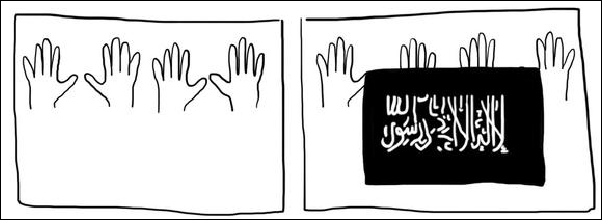
Here, then, is a “DQ in the Wild” from cartoonist Ardeet:

Local situation

That’s powerful, the suggestion being that the world press takes an event where there’s a suggestion of possible jihadist involvement (“terrorism”) a lot more seriously than one where that is not the case (“spree killing”). While the hostage situation was playing out in Sydney, for instance, a US vet killed “his ex-wife and five of her relatives” in Pennsylvania, drawing far less media interest.

**

I could see how Ardeet’s cartoon could be read in that sense, but I wasn’t sure how he intended it, having been exposed recently to dozens of images of hands raised as a sign of the Ferguson protests.

A somwhat different pairing therefore suggested itself to me, one with a different emphasis:

SPEC DQ hands & banner

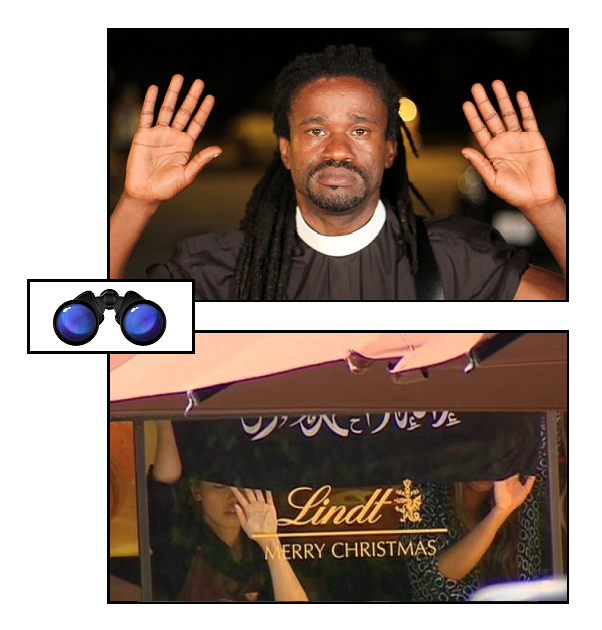
Here the point is not that an event moves from local to global interest when the jihadist’s black banner appears, but that the hostage-taking in Sydney offers a curious and ironic (albeit unintended) take on one of the chief symbols of the protests in and about Ferguson, while the Ferguson protest gesture adds resonance to the image of hostages forced to hold up the black banner in Sydney.

**

I have been talking about the “black banners from Khorasan” hadith an its Mahdist implications online since 2007 if not earlier, and on Zenpundit since September 2009, and I think a clarification is in order at this point.

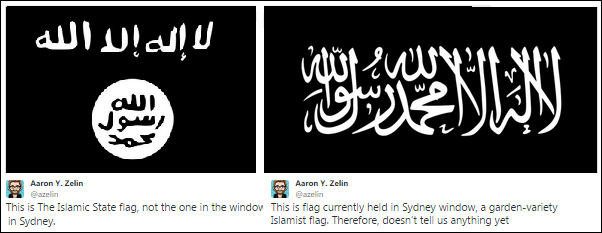
The flag in the image from the Lindt cafe is not in fact the Daesh / Islamic State flag, and indeed the hostage-taker appears to have asked for a genuine Daesh / IS flag as one of his demands. The flag shown is a black flag containing the Shahada or Islamic profession of faith in white, and black flags in Islam have a history as war flags dating back to the time of the Prophet himself.

Two tweets from Aaron Zelin will clarify the matter visually:

**

More on this in Black Banners in Sydney 2: on flags and their meanings.

Phineas Priesthood 2: The Tanakh

Thursday, December 18th, 2014

[ by Charles Cameron — continuing exploration of the Phineas story as it leads to the recent Larry McQuilliams incident among others ]
.

pinchas
Phineas vs Zimri & Cozbi
.

I

Paradise is depicted in many traditions as a garden — indeed the very word “paradise” (pardes) means “garden” or “orchard” in Hebrew. It is a place where the divine presence “walks with man in the cool of the day” — glorious phrase — a green and fruitful garden, rich in beauty and tranquility, where the purity of love is unsullied by despair or hatred.

In our scriptures, myths and rituals, we give expression to all that is noblest and most generous in our nature: the “peace that passeth all understanding” manages somehow to cross the great Cartesian divide between mind and body, promising us both inner peace of mind, and external relief from war and strife.

All is not well in this garden, however. Along with the refreshing breezes and the sounds of voices lifted in praise, our scriptures and religions also offer us reasons for killing and warfare, divinely sanctioned injunctions to the sword as well as to peace. One of the recorded sayings of Muhammad teaches that Paradise is found under the shade of swords.

Christ, too, is reported to have said he “came not to bring peace, but a sword”.

Like a perennial landmine in paradise garden, the story of Phineas (also spelled Phinehas or Pinchas) lies await in the Tanakh / Old Testament for some reader to take a wrong step and explode it once again.

Introducing this series in Phineas Priesthood I: Larry McQuilliams, I said:

Since I shall be discussing how the tale of Phineas / Pinchas / Phinehas has been used as offering divine scriptural sanction for acts of religiously-motivated killing, I shall chiefly focus on the negative implications of the tale .. Accordingly, I’d like to invite my friends in the Jewish and Christian scholarly communities, in particular, to assist me in the comments section by suggesting alternative ways of reading a story which in its most literal interpretation has been the cause of untimely and hateful deaths

That goes for the series as a whole. In later posts in this series I shall follow the trail of Phineas (the lone wolf) and touch on the Maccabees and Zealots (his “group” equivalents), first in the ancient world, and then more recently.

II

The story of Phineas is told in the book of Numbers / Bamidbar, chapter 25:

While Israel dwelt in Shittim the people began to play the harlot with the daughters of Moab. These invited the people to the sacrifices of their gods, and the people ate, and bowed down to their gods. So Israel yoked himself to Baal of Peor. And the anger of the Lord was kindled against Israel; and the Lord said to Moses, “Take all the chiefs of the people, and hang them in the sun before the Lord, that the fierce anger of the Lord may turn away from Israel.” And Moses said to the judges of Israel, “Every one of you slay his men who have yoked themselves to Baal of Peor.” Take all the chiefs of the people, and hang them in the sun before the Lord.

In all likelihood, I must have heard this passage read aloud at least once before the age of eighteen in the chapels of the British boarding schools I attended — yet I have no vivid childhood memory of a God who encourages mass hangings out in the open air. The God of my childhood and schooling was caring, loving, far-seeing (which I understood to be one of those divine omni-attributes, thus distinguishing him from my parents or teachers), and wise.

Thinking back on my time as a choir-boy, I imagine those sonorous phrases about the anger of the Lord, delivered in the splendid prose of the King James Version, must have rolled right over me, like Alan Bennett‘s reading of the text, “My brother Esau is an hairy man, but I am a smooth man” in his sermon in the satirical revue, On the Fringe — something along these lines:

And the Lord said to Moses, “Take all the chiefs of the people, and hang them in the sun before the Lord, that the fierce anger of the Lord may turn away from Israel.” Here endeth the first lesson. Let us now sing Hymn five hundred and eighty seven, All Things Bright and Beatuiful.

God, however, has not finished with the Baal of Peor and those who worship it. But whereas in these first verses he had commanded Moses and the Judges of Israel to string some of his own chosen people up in the sun, the next episode describes an independent action taken by someone who knows His divine anger, knows His wishes, and does not need a direct command nor any official permission or sanction to act on that knowledge:

And behold, one of the people of Israel came and brought a Midianite woman to his family, in the sight of Moses and in the sight of the whole congregation of the people of Israel, while they were weeping at the door of the tent of meeting. When Phinehas the son of Eleazar, son of Aaron the priest, saw it, he rose and left the congregation, and took a spear in his hand and went after the man of Israel into the inner room, and pierced both of them, the man of Israel and the woman, through her body. Thus the plague was stayed from the people of Israel. Nevertheless those that died by the plague were twenty-four thousand.

That’s a fairly graphic description of a double murder, particularly when one considers that the phrase “pierced both of them, the man of Israel and the woman, through her body” is generally taken to mean that Phinehas caught the pair of them in flagrante and speared them through their conjoined offending parts.

God, who according to other passages in scripture is Love, is distinctly pleased by this turn of events:

And the Lord said to Moses, “Phinehas the son of Eleazar, son of Aaron the priest, has turned back my wrath from the people of Israel, in that he was jealous with my jealousy among them, so that I did not consume the people of Israel in my jealousy. Therefore say, `Behold, I give to him my covenant of peace; and it shall be to him, and to his descendants after him, the covenant of a perpetual priesthood, because he was jealous for his God, and made atonement for the people of Israel.”

Killing is killing, however, and it is only fitting that we should know the names of the victims. Our text continues:

The name of the slain man of Israel, who was slain with the Midianite woman, was Zimri the son of Salu, head of a fathers’ house belonging to the Simeonites. And the name of the Midianite woman who was slain was Cozbi the daughter of Zur, who was the head of the people of a fathers’ house in Midian.

Cozbi and Zimri: their names have not perished from memory.

And the Lord said to Moses, “Harass the Midianites, and smite them; for they have harassed you with their wiles, with which they beguiled you in the matter of Peor, and in the matter of Cozbi, the daughter of the prince of Midian, their sister, who was slain on the day of the plague on account of Peor.”

From a counter-terrorist perspective, this is the incipit — chapter one in the still unfolding history of religio-political violence, and our first instance of the “lone wolf” operative.

III

As Steven Bayme of the American Jewish Committee notes in his article, Extremism and Zealotry: The Case of Pinchas, the story certainly appears to offer some sanction for religious violence.

At initial glance, this text appears to validate extremist ideology and behavior. An Israelite male and a Midianite female are engaged in publicly lewd behavior. God is angry and sends a plague. Moses appears to be incapacitated, possibly on account to his own marriage to a Midianite woman. So Aaron’s grandson, Pinchas, decides to act on his own, grabs a spear, kills the offending couple, and the plague is stopped. Subsequently, God confers his “covenant of peace” upon Pinchas as a reward for his “zealotry.” Latter-day zealots in fact have modeled themselves upon the case of Pinchas.

In writing these posts, I take the story of Phineas as emblematic of all the apparent sanctions for religious violence (the “landmines in the garden” of my title) buried in the world’s scriptures, rituals, histories and hagiographies. But the issue is not restricted to Judaism alone, or Judaism and Christianity, or indeed the three Abrahamic religions. Krishna in the Bhagavad Gita gives sanction to Arjuna‘s battlefield violence, and even Buddhism has a prophecy of a righteous war between the Buddhists and Islam in the very same Kalachakra Tantra that HH the Dalai Lama teaches — though in that case, the violence is envisioned as taking place centuries hence.

IV

Perhaps not surprisingly, given its place within the scriptures of two great religions, this story of Phineas, Cozbi and Zimri echoes down the centuries.

It is first retold in Psalm 106, and again, I probably sang these words to the glorious four-part harmonies of the English choral tradition (at the 6.27 mark in this Guildford Cathedral rendition) in my childhood:

Then stood up Phinees and prayed * and so the plague ceased.
And that was counted unto him for righteousness * among all posterities for evermore.

This might seem to add nothing to the account in Numbers, but in fact a subtle shift is already taking place. As Bayme puts it, the Psalmist “quietly transformed the word for Pinchas’s zeal into one connoting prayer.”

It is often the case that the normative teachings of a great religion strongly promote peace and are at pains to offer alternative interpretations of such passages as the Phineas story, while individuals or extreme groups within them still refer to these “landmine” passages for religious sanction.

**

In the next section of this post I shall follow the trail of Phineas / Pinchas through the deutero-canonical Books of the Maccabees, in New Testamental, Talmudic and Patristic writings, and perhaps up through Milton and Brigham Young.

A final post will deal with Hoskin‘s book Vigilantes of Christendom, its tie in with Louis Beam‘s theory of “leaderless resistance” and related events of the last half-century or so — and the happily failed attempt at a massacre in Austin these last few days.

I have a lot of work before me, as well as much already written: I look forward to your pointers, corrections and support.


Switch to our mobile site