zenpundit.com » photography

Archive for the ‘photography’ Category

Of images and likenesses

Thursday, May 30th, 2013

[ by Charles Cameron — a storm in a tea-kettle, various resemblances to Hitler, how Pudovkin perceived and practiced montage, what happened when the talkies came along, and four faces of Christ ]
.

It begins with something as innocent ad a tea kettle:

Does this otherwise innocuous tea kettle resemble Hitler? Does it look enough like Hitler to merit JC Penney withdrawing it from sale?

**

Let’s take a look at a couple of other “resemblances to Hitler”:

Who most resembles Hitler — Chaplin, or Stalin?

On the face of it, that’s an easy question. If I were to just ask you the question “who is most like Hitler” in words, you might very well say Stalin, or Pol Pot perhaps — or, I suppose, if you were very focused on World War II and the Axis leaders, Mussolini.

And if I asked you “who looks most like Hitler?” you might well say Charlie Chaplin — but you’d be “thinking visually” in terms of appearances, rather than “verbally” in terms of meanings.

So there are at least two different ways someone can resemble Hitler — in terms of appearance, and in terms of behavior.

**

We don’t notice our own noses most of the time, even though they’re within our field of vision — and it’s a bit like that with likeness. We don’t have a grammar of resemblance, and that’s part of what I want to explore here, in drawing your attention to these two ways (at least) in which we can think of someone resembling Hitler.

Placing two pictures side by side — Charlie Chaplin and Hitler, Hitler and Joseph Stalin — gets us to think a bit about the parallelisms and oppositions. And that’s a large part of what my DoubleQuotes format is good for. I am interested in what the mind does with juxtapositions, and I’m interested in getting us able to hold two contrasting thoughts in mind at the same time. As F Scott Fitzgerald said:

The test of a first-rate intelligence is the ability to hold two opposed ideas in mind at the same time and still retain the ability to function.

I’m in two minds as to whether he’s right, of course.

**

So montage. So the beginnings of Russian cinema, and the great directors of the silent era in film, Vsevolod Pudovkin and Sergei Eisenstein.

Pudovkin wrote quite a bit about montage, about what he called relational editing, telling us:

editing is not merely a method of the junction of separate scenes or pieces, but is a method that controls the “psychological guidance” of the spectator.

He talked about five modes of editing, getting close to the foundations of a grammar of resemblance of the kind I mentioned above — contrast, paralleliem, symbolism, simultaneity and leit-motif. He said, for instance:

Suppose it be our task to tell of the miserable situation of a starving man; the story will impress the more vividly if associated with mention of the senseless gluttony of a well-to-do man.

and went on:

it is possible not only to relate the starving sequence to the gluttony sequence, but also to relate separate scenes and even separate shots of the scenes to one another, thus, as it were, forcing the spectator to compare the two actions all the time, one strengthening the other.

Under the heading of Symbolism, he noted:

In the final scenes of the film Strike the shooting down of workmen is punctuated by shots of the slaughter of a bull in a stockyard. The scenarist, as it were, desires to say: just as a butcher fells a bull with the swing of a pole-axe, so, cruelly and in cold blood, were shot down the workers.

I don’t suppose I’m alone in thinking here of the ending of Coppola‘s Apocalypse Now — and I doubt Coppola would have been unaware of the tribute he was paying to one of the early masters of cinematography, either. And what doe Pudovkin say about the symbolic editing together of the shooting of workmen punctuated by the slaughter of a bull?

This method is especially interesting because, by means of editing, it introduces an abstract concept into the consciousness of the spectator without use of a title.

**

All this, of course, during the silent era. And when the talkies begin…

After the advent of the talking pictures, Eisenstein, Pudovkin, Alexandrov and Vertov issue a statement, attempting to salvage the emotional impact of montage which is in danger of being capsized by the oh so new and glittery charm of verbals — of people talking:

Only a contrapuntal use of sound in relation to the visual montage piece will afford a new potentiality of montage development and perfection.

The first experimental work with sound must be directed along the line of its distinct nonsynchronization with the visual images. And only such an attack will give the necessary palpability which will later lead to the creation- of an orchestral counterpoint of visual and aural images

You see what’s going on here? Eisenstein, Pudovkin, Vertov want the mind to be working on two tracks of ideation at once — a visual track, full of emotional impact, and a verbal track, in counterpoint to the visual.

They want us to be able “to hold two opposed ideas in mind at the same time” — not in synchrony but in counterpoint.

So this business of juxtaposition, of contrapuntal thinking, goes quite deep, and it’s my contention that it’s a skill we need both to develop and to understand — hence my interest in building a grammar of resemblance, of rhyme, of fugue, of graphic match, of equation.

**

One final example. If the “likeness of Hitler” example confronted us with the “nature of likeness” as between facial resemblance and similarities of behavior, this next instance will deal more with “evidence of likeness”:

Here’s the question: are these “real” likenesses?

**

The two likenesses above are both of interest as possible “likenesses of Christ” — the top one taken from the Shroud of Turin, the lower one allegedly photographed in the snow, perhaps in China. The image on the Shroud might be a sort of “photographic negative” of the actual face of man a crucified two thousand years ago — and scientific techniques may or may not offer us evidence as to that likelihood. The other image — supposedly of the face of the same Christ, this time seen and recognized by a photographer in shadows on snow — how does one check the provenance of an image like that?

We don’t have a photographic record of what Christ looked like to compare our own images with — unless the Shroud turns out to offer us just that — so it’s likely we’re back at the distinction first drawn by theologians over a century ago, between “the Jesus of History” and “the Christ of Faith”.

Consider the two images below, neither one perhaps what a camera might have seen if a photographer could time-travel back two thousand years, but each suited to the people for whom it was produced — in China, in Africa:

The Christs these two images evoke come from a different mode of seeing to the images captured in biometric scans and on ID cards — yet they are well-suited for devotion and inspiration…

Jimmy Chen declares DQ on War

Tuesday, April 23rd, 2013

[ by Charles Cameron — juxtaposition offers us a potent way to connect “equal but opposite” dots ]
.

Jimmy Chen at HTMLGiant captures the griefs and joyful reliefs of war by juxtaposing two war photos that had separately become iconic — and their joint impact is precisely the kind I’m reaching for with my DoubleQuotes. I’ve re-framed them accordingly and slipped them into my DQ format, and here they are:

**

In Chen’s own words:

Time may be a sedative, for it’s always harder to know who exactly the bad people were, yet so easy to tell — in the incessant now from which we cannot run — who the bad people are. Either moral clarity diminishes with time, or we simply stop caring, the euphemism being humility. Prisoner of war Lt. Col. Robert L. Stirm is greeted by his family at Travis Air Force Base in Fairfield, California on March 17, 1973, about a year after Phan Thi Kim Phuc, aged 9, was photographed running from a South Vietnamese napalm attack on their own land after it had been occupied by the North.

The specifics of those two photographs may be slowly eroding in memory, as Chen suggests — but I don’t believe their power to evoke joy or grief will fade — and I am grateful to Jimmy Chen for reminding me, once again.

Beautifully.

Across my tweet-deck this day shone…

Tuesday, December 11th, 2012

[ by Charles Cameron — h/t Arash Karami ]
.

Across my tweet-deck this day shone this illuminating picture of Ahmadinejad with Khamenei:

Simple. Elegant. Eloquent.

Sweet.

Don’t you mess with my mother the moon

Tuesday, November 27th, 2012

[ by Charles Cameron — a poor, low-res copy of the greatest photo, a poem of mine, and a recent report of a scenario involving nuking the moon, apparently considered and, I am happy to say, rejected by the military ]
.

First, the greatest photo:
.

Photo: Ansel Adams, Moonrise, Hernandez, New Mexico, 1941

**

Next, the poem:

Don’t you mess with my mother the moon!
.

i

Don’t you mess with my mother the moon!
Pearl.
Superb in the night sky.
Which you treat as a junkyard.

ii

I am serious. I was never
more serious. This, which you thinking
life to be composed of things consider
real estate, rock,
subtly balances that other,

portending at the eye
that same angle — and that other, too
you would colonize,
strip, slash, mine, burn,
rape had you the chance, were it not
so magisterial a furnace.

Gold, which figures the sun
with silver the moon,
you have tapped for coinage,
despoiling hills for greed,
valleys for your convenience:
nor is your idiocy limited in reach
by anything but your idiocy.

Sun and moon are married
in a wedding you cannot conceive,
to which you lack invitation
though it was offered you.
The simple light of the night sky
escapes you, neither glimpse
nor sonata troubles your soul with its ripples,

for you lack, altogether,
reflection.

**

I wrote that poem quite a few years ago, and intended it as an appeal from the side of joyous poetic appreciation against the prevalent idea that the moon is a chunk of rock to be mined and otherwise exploited like any other. I didn’t suppose then that my voice would be heard against the amplified voices of technology, commerce, and human hubris—but voices will be voices, even in the wilderness.

The Japanese have a tradition of “moon-viewing” festivals — Tsukimi – a superb idea, appropriately reflective of the culture that produced the zen poet Ryokan, who celebrated a thief’s visit to pillage his mountain hermitage with the words:

The thief left it behind:
the moon
at my window.

The thief couldn’t steal it — but boyo, we still might be able to figure out a way to mess it up…

**

I for one don’t ever want to look at the moon and know that someone is using it as a projection screen for advertisements, let alone that its face is disfigured by robotic factories producing cheap running shoes – bad enough that we’ve left our trash there already!

Credit: NASA / Orbiter shows trash, tracks at Apollo moon landing sites

Look, my techno-leaning human friends — mine the asteroid belt if you must, I suppose Disney will eventually get the rights to Saturn, and make a ride of it – but leave the moon, leave the moon alone.

**

Then, the scenario:

I mean, how myopic can we get? According to Forbes yeaterday:

There’s a couple of preposterous reports out today alleging that the United States considered blowing up the moon in order to freak out the Soviets during the Cold War. Apparently something called “A Study of Lunar Research Flights” seriously pondered a moon bombing, and scientists as notable as Carl Sagan were even involved in planning the lunar attack, which was to take place in 1959 — before cooler heads prevailed.

Yup. There was a scenario — not a plan but a scenario — that was being explored: A STUDY OF LUNAR RESEARCH FLIGHTS:

Nuclear detonations in the vicinity of the moon are considered in this report along with scientific information which might be obtained from such explosions. The military aspect is aided by investigation of space environment, detection of nuclear device testing, and capability of weapons in space. A study was conducted of various theories of the moon’s structure and origin, and a description of the probable nature of the lunar surface is given. The areas discussed in some detail are optical lunar studies, seismic observations, lunar surface and magnetic fields, plasma and magnetic field effects, and organic matter on the moon.

I’ve corrected a spelling error, but otherwise that’s the abstract, as found within the .mil domain. I haven’t seen the document itself, but the abstract speaks for itself.

And no, as far as I can tell, the scenario didn’t involve “blowing up” the moon, which would have been pretty difficult as the Forbes article indicates. Apparently, though, some part of the military-industrial machine explored, discussed, and finally rejected the idea of hitting the moon with a single nuke — enough to switch a light-bulb on, it was hoped, above the Soviet military-industrial head.

**

And finally:

I’ve dragged this poem out of retirement, and hereby give you permission to reproduce it in toto, with or without the rest of this post — and indeed encourage you do to so. Tweet and RT the URL for this post, repost the poem, agree with me, disagree —

This latest revelation makes me feel it’s time for a conversation about convenience, commerce and science vs beauty, reverence and awe — about what the moon is worth to us.

It’s my birthday, do me a favor — spread the word: Don’t you mess with my mother the moon!

The War and Peace koan, episode n+1

Wednesday, November 21st, 2012

[ by Charles Cameron — glimpsing the Necker Cube effect, when the weapons of war meet the prayers of peace ]
.

Necker cube image credit -- youramazingbrain.org

.

A while back I co-authored a book with a physician friend, Cleaves Bennett MD, on the control of high blood pressure, and since he wanted to include the idea that humor had a role to play in reducing stress, we included a joke with each week’s exercises — and one of the jokes I suggested, and which made it into the book, was this:

A Catholic priest, a Dominican, once walked into London’s Farm Street Jesuit Church and found one of his Jesuit friends kneeling in prayer, smoking a cigarette.

“How do you get away with it?” the Dominican muttered. “I asked my father confessor if I could smoke while I was praying and he absolutely forbade it.”

“No wonder,” said the Jesuit. “I inquired if I could pray while I was smoking, and my confessor said, ‘Of course, old boy, feel free. … I don’t believe you should ever stop praying.'”

**

This post could well be included in my “form is insight”: series, with the form in question being “the reversal”.

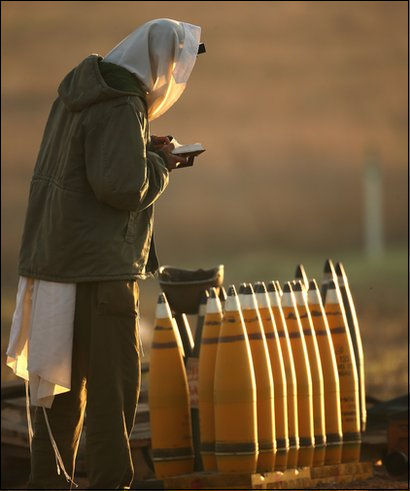
Here’s a recent BBC picture with the tag-line “An Israeli soldier prays at dawn on Israel’s border with the Gaza Strip”:

Some readers might look at that picture and recall Psalm 94, verses 3-5:

Lord, how long shall the wicked, how long shall the wicked triumph? How long shall they utter and speak hard things? and all the workers of iniquity boast themselves? They break in pieces thy people, O Lord, and afflict thine heritage.

Some might reflect on Psalm 122, verses 6-7:

Pray for the peace of Jerusalem; may they prosper that love thee. Peace be within thy walls, and prosperity within thy palaces.

Some might recall the Qur’an 49, verse 13:

O mankind, We have created you male and female, and appointed you races and tribes, that you may know one another.

Others might think of the Gharqad Tree hadith, quoted in the charter of Hamas:

The Day of Judgement will not come about until Muslims fight the Jews (killing the Jews), when the Jew will hide behind stones and trees. The stones and trees will say O Muslims, O Abdulla, there is a Jew behind me, come and kill him. Only the Gharkad tree, would not do that because it is one of the trees of the Jews.

And I myself have no idea what the prayers that Jewish soldier offered were all about — his own safety, that of his family and loved ones, that of his own people, that of all the world’s people — nor about the prayers of young Muslims on the other side of the wall…

**

I look at that photo of the soldier boy praying beside the munitions of a brutal war, and my first instinct is to feel sadness — because the essence of prayer, surely, is shalom, peace, salaam.

And then I am reminded of the Dominican and the Jesuit in that story I told you.

Substituting “peace” for “prayer” and “war” for “munitions” to get at the essence here — should I be more sad that here, peace is depicted in the presence of war — or more glad that here, war is depicted in the presence of peace?


Switch to our mobile site