zenpundit.com » ideas

Archive for the ‘ideas’ Category

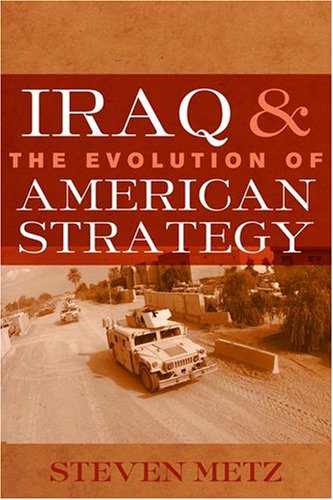
Metz on Iraq and the Evolution of American Strategy

Tuesday, November 25th, 2008

Nothing like a change in administrations to generate a string of excellent books on strategy and national security.

I’ve just ordered Iraq and the Evolution of American Strategy by  Dr. Steven Metz  of the Strategic Studies Institute ( and also of the Small Wars Council ). As I do not yet have a copy of Iraq and the Evolution of American Strategy, which also contains a foreword by Dr. Colin Gray, I will yield the floor to the comment  of Lt. General Paul K. Van Riper:

“Two institutions failed the American people in the run-up to the ongoing war in Iraq. Neither the Congress nor the media provided oversight of the Executive Branch, which is constitutionally required of the first institution and expected of the latter. As a consequence a fundamentally flawed strategy was implemented by an equally flawed military plan. The results have been tragic and costly. Dr. Steven Metz does our nation a great service by exploring the causes of this U.S. strategic debacle, one that may well exceed that of the Vietnam War. Recognizing a problem and its cause are the first steps in setting things right. In this book Dr. Metz identifies the problem, explains what caused it, and most importantly, shows us a better path for the future.”

One for the top of your bookpile.

Anyone else having Trouble with 2025 ?

Friday, November 21st, 2008

I’m getting errors in trying to download the Global Trends 2025: A Transformed World from the DNI.gov/NIC site despite having up to date Adobe Acrobat/Reader. Is anyone else having a similar problem ?

UPDATE:

Thanks Charles and Dan

In the meantime, while we wait for the USG to post a working link, here is some early analysis by Jeff at IntelFusion.

UPDATE II.

Courtesy of Shlok Vaidya –  Global Trends 2025: A World Transformed. Thanks Shlok – Fingar should offer you a job.  Will have comments on the report later tonight.

UPDATE III.

Commentary on 2025 in a series of posts at Atlantic Council by James Joyner, by Dr. Barnett and SWJ Blog,

UPDATE IV.

I’m still sifting the report but I’m not impressed. Aside from the cautious positions on possible developments heavily rooted in presentist analysis I kind of get the drift that the possibilities have not been looked at too closely as to how their interactions might or might not be countervailing with one another. Sort of an implicit assumption of synergism.

Obama’s New Deputy Chief of Staff a Former Blogger

Sunday, November 16th, 2008

More than that, but it is a sign of changing times and the mainstreaming of blogging.

Mona Sutphen, a former diplomat, Clinton NSC aide and Rahm Emanuel’s Chief of Staff, has been named White House Deputy Chief of Staff – a powerful, albeit very “insider”, post. Until last February, Sutphen was also briefly a foreign policy blogger at The Next American Century , which was a short-lived vehicle to promote  The Next American Century: How the U.S. Can Thrive as Other Powers Rise
 a book Sutphen co-authored with Nina Hachigian.

I have not read their book ( nor heard of it  before today, to be frank) but from listening to Sutphen and Hachigan opine on their infomercial video (see below) The Next American Century sounds more or less as a breezy and happy version of the themes in Thomas P. M. Barnett’s yet to be released Great Powers: America and the World After Bush that I’m reading, minus the sharp elbows thrown by Tom and the latter book’s deep dive into historical and strategic drivers for the 21st century. Otherwise, there’s a lot of big picture congruency going on – no wonder Tom’s so happy about the incoming Obama administration; it seems like it will have at least some personnel in high places who are predisposed toward his strategic views.

Be interesting if anyone out there has a copy of the Sutphen-Hachigan book to see if they cited PNM or BFA in the footnotes or index.

A final point, that Obama is moving such relatively young faces, like Mona Sutphen, to high posts is a good sign. Regardless of how my more liberal readers and fellow FP/mil/Intel/security bloggers may feel, the Democratic bench in these areas range from fair to decidely weak with a shortage of “stars” in the critical late 40’s to middle 50’s age band that normally fill the first through second tier appointive posts (of course, that deficit partly comes from liberal activist hostility toward more conservative Democrats like Sam Nunn or Lee Hamilton who are always shortlisted but never appointed). Normally, you need a talent pool at least 2-3 deep at each position to handle the burnout, transience and delay in confirmation hearings that every administration faces. The Democrats have to build up that pool instead of relying on ancient Carter and aging Boomer, Clinton retreads ( even so, look to seeing a lot of familiar GOP faces seatwarming in the first year in the bureaucracy, unless the Senate rushes through every Obama appointment in record time).

The Social Science of War

Tuesday, November 11th, 2008

Briefly, here is a juxtaposition of posts worth looking at that portray war through the lens of the social scientist:

Rethinking SecurityThe Study of War as A Social Science

…Rather, it would be better to re-concieve the study of strategic affairs as a multi-disciplinary social science major combining sociology, international relations, philosophy, political science, cognitive science, economics, history, and “pure” military theory. This would be intellectually rigorous enough to banish forever the stereotype of the armchair general and the wargamer.

I see learning about strategy in itself as the key aim of such a curriculum–the goal would be to produce a student able to either apply his or her learnings in a think-tank or government, join the armed forces, come up with reasonable anti-war critiques as an activist, resolve conflict as a humanitarian, or apply strategy in the corporate world.

War as a social science akin to sociology or economics would bring empirical and quantitative rigor into the study of military history and affairs on the undergraduate level as well as a focus on the mechanics of war (tactics, operational art, strategy, and grand strategy) rarely seen outside of a Professional Military Education (PME).

SWJ Blog –  The Genetic Roots of the War on Terrorism

….In the article, titled “A Natural History of Peace,” Stanford Professor Robert M. Sapolsky compares and contrasts human aggressive tendencies with well-documented propensities for violence among several species of primates, and develops a case suggesting that human aggression of the kind that produces warfare mainly stems from the genetic impulses rooted in humans as primates (not a new suggestion of itself). But more significantly, he offers proof extracted from a now robust body of field work that even strong genetic tendencies for violence in certain species of primates can be mitigated by exposure to the equivalent of “cultural” forces. He singles out from the body of such observations the case history of one group of baboons (a particularly aggressive and violent species of primate) that he calls the Forest Troop, the intensely aggressive behavior of which was ameliorated after exposure to the more peaceful and tolerant “mores” of another baboon troop of an identical species with which the Forest Troop had come in contact. He concludes by asserting that “some primate species can make peace despite violent traits that seem built into their natures.” He goes on to muse, “The challenge now is to figure out under what conditions that can happen, and whether humans can manage the trick themselves.”

Sapolsky’s argument frames the issues associated with the current global conflict in which the United States is now engaged in a potentially very useful light: as a biological problem best understood and dealt with using means specifically tailored to deal with human genetic tendencies in order to promote cooperation and tolerance instead of competitive violence. This stands in contrast to the current approach which appears to assume that the conflict mainly results from a combination of cultural and economic factors that can be dealt with by a strategy that combines selected violence, targeted monetary investments mixed, and cross cultural messages through so called strategic communications.

The Social Sciences are a powerful but fractionating, reifying lens. Individually, they unearth certain aspects of large and highly complex phenomena albeit at the cost, at times, of distorting the proportional importance to the whole of the aspect that the social scientist chooses to study. The sociobiological perspective is a radical and controversial one but it is a position that is far more open to empirical investgation in a scientific sense than are many traditional components of strategic theorizing.  At Rethinking Security, Adam wisely tries to balance the heavy load of quantitative methods in his proposed program with at least a few qualitative disciplines; input from military practitioners and security experts would also be helpful to the prospective student in this regard as well.

Kesler: “What McCain did Right and Conservatives Wrong”

Tuesday, November 4th, 2008

My friend Bruce Kesler no longer is a “regular” blogger but he has recently found the time for an occasional guest-post at Maggie’s Farm. It’s good to see Bruce back in the game even on a sometime basis and I’m pleased to point your attention to his following post:

Appearances and Mood

What McCain did right and conservatives wrong

 By Bruce Kesler

Over the past four years, conservatives have debated whether the Republican Party is serving them and the country.  This discussion was stirred by several  proposals by the Bush administration — particularly not vetoing some budget-busters, the nomination of Harriet Miers to the Supreme Court, and the immigration reforms that didn’t prioritize border controls – and the failure to fire back at the gross distortions and language by opponents.

Bush earned respect for his stalwart stance in Iraq, but even there lost points for his failure to act earlier to change a troubled strategy and command.  Seeming backpeddling and soft-shoeing on the threats from Iran and North Korea, though following closer to the liberals’ playbook, didn’t earn him support from liberals or conservatives.

The debate among conservatives and libertarians after this election is likely to grow much more heated, whether McCain wins or loses.

Although conservatives have stood most strongly behind McCain, conservatives do not expect much thanks or loyalty from McCain if he wins, and do expect McCain to continue his practice of alliance with many liberal proposals, as he has in the past.  That alone will add heat the pot.  On the other hand, conservatives will welcome his Trumanesque temper and bluntness replying to the likely continuation of intemperate Democrats in the Congress.

If McCain loses, conservatives will likely place most of the blame on him and his campaign for failing to take more advantage of Obama’s coterie of radical mentors, to alert more voters of their dangers.

At the same time, in defense of McCain’s campaign approach, those most likely to hold these associations as important are aware of them.  Meanwhile, in a campaign during which the overwhelming portion of the major media have utterly failed to research or expose Obama’s lack of record and record of shady allies, McCain would likely not have gotten much further in educating the wider public.

So, McCain has concentrated on trying to woo marginal voters.  Those non-partisans react more to appearances and mood.

McCain earned none of the points he should have for trying to tackle the credit-economic meltdown, even by comparison to Obama’s passivity.  Neither did McCain draw attention to the Congress’ tainted hands in creating it, but there are many Republican members who sat by and prospered from the false sense of well-being that preceded the deluge.  McCain did not throw the Congressional Republicans under the bus, as Obama repeatedly did every time a mentor was exposed.  And, McCain did exhibit a bully optimism in reacting to the meltdown and focused on quick actions.

It is that indefatigable optimism and sense of fair play that has been highlighted and redounded to his credit.  This is in line with his military and political record of bravely meeting challenges.  Despite every odd, McCain has fought the election to a near thing.

Conservatives must recognize that, for any of McCain or his campaign’s failings, it is among conservatives that reform must come.  Much of our NY-DC commentariat are corrupted by overlong proximity to comfortable power and cocktail circuits, exhibiting callowness, lethargy or outright capitulation.  Their lack of principle and intestinal fortitude must be replaced.  Much of our bloggers have been consumed by editorializing and not organizing.  The think-tanks we built and many major donors have been cringing or avoiding confrontation.  Rank and file conservatives mostly looked to this inadequate leadership instead of to ourselves to step forward and fight.

It will take a major overhaul to revive the conservative movement.  As in 1964, it will not come from the establishment, but must depend on openness to new participants and leaders.  Of course, that does not mean fringe elements or ideas.  The crucial role that National Review played post-1964 in guarding against that will require a new central forum of conservative sanity and principle.

No one can predict where they will come from.  But they must be encouraged, welcomed and supported when they appear.  Indeed, each of us must see in ourselves the willingness and determination to be those participants and leaders

Wise words.

American conservatism needs a substantial overhaul – perhaps even a 12 Step program – to recover it’s essence as an optimistic philosophy that profoundly empowers individuals and trusts them to make their own choices. Then, in my opinion, conservatives need to harness that spirit to a thorough comprehension of how globalization changed the world to operate in terms of metasystems and networks, so as to balance economic dynamism with resiliency (and learn how to get that point across in normal English). Then go on message and do not deviate.

The other side, if Senator Obama wins Tuesday, will be so consumed with jerry-rigging top-down, hierarchical, statist, solutions out of a fantasist version of the New Deal that they will inevitably overreach and create an opening for a new brand conservatism four years from now.

Or perhaps just two years. Time to get busy.

Switch to our mobile site

