zenpundit.com » ideas

Archive for the ‘ideas’ Category

Hoover on Charles Hill and Hill on Grand Strategy

Tuesday, November 8th, 2011

Lexington Green sent this extended profile/interview with Charles Hill by Emily Esfahani Smith. The tone of the article is somewhat hagiographic because Hill is a fellow at the Hoover Institution and….well…. this is in Hoover’s journal 😉  If you can get past that, it is a worthwhile read about a deep thinker and scholar of grand strategy.

Profile in Strategy: Charles Hill

….In diplomacy, literature is relied upon because, as he writes in “Grand Strategies,” “The international world of states and their modern system is a literary realm; it is where the greatest issues of the human condition are played out.” That is why Alexander the Great carried the Iliad with him on his conquests, and why Queen Elizabeth studied Cicero in the evenings. It is why Abraham Lincoln read, and was profoundly influenced by, Walt Whitman’s “Leaves of Grass,” and why Paul Nitze paged through Shakespeare on his flights to Moscow as America’s chief arms negotiator.

Hill, for his part, has always kept the “History of the Peloponnesian War” in his mind as the “manual of statecraft.”

Why Thucydides? He explains: “When you read the Peloponnesian War, you realize that Thucydides is moving from one set of problems to another, and you have to deal with them all-rhetorical problems, material problems, and moral problems. That’s the closest literary work related to statecraft that I can imagine.”

To understand world order-and those who manipulate it for their own aims-requires a literary education, the kind students were once able to find at such places as Yale, where Hill now teaches the humanities to freshman undergraduates.

This is a departure from his days at the State Department, where he helped orchestrate monumental events in the grand strategy of the Cold War. One of his first memories as a diplomat was of being seated behind Adlai Stevenson at the UN during the Cuban missile crisis, characteristically scribbling notes-in grand strategy, no detail can be lost. Later, Hill was a “China watcher” during that country’s Cultural Revolution. And when the Iran-Contra scandal nearly brought down the Reagan administration, Hill’s meticulous notes played an influential role in the Congressional investigations by shedding light on the chronology of then-Secretary of State George Shultz’s knowledge of the arms sale. Over the years, Hill has also served as confidante to Secretaries of State. For Henry Kissinger, Hill was speechwriter and policy analyst. For Shultz, Hill was an executive aide and trusted ally.

These days, Hill embodies grand strategy in a different way. After a long and distinguished career as a diplomat, Hill is now a heralded figure in academia. Beyond his appointment as a research fellow at the Hoover Institution, he is the Brady-Johnson Distinguished Fellow in Grand Strategy, a Senior Lecturer in Humanities, and a Senior Lecturer in International Studies at Yale. Alongside historians John Gaddis and John Kennedy [ sic] , he teaches one of Yale’s most legendary courses to a select group of elite students-future statesmen-the Grand Strategies course.

And yet, Hill tells me stoically, “There is no grand strategy in our time.” Turning his attention to the turmoil in the Middle East, Hill provides an example. “America’s lack of strategic outlook responding to the Arab Spring is really distressing.”

Hill retains the diplomat’s gift for understatement.

Read the rest here.

ADDENDUM:

Book Review: Grand Strategies by Charles Hill 

Trial of a Thousand Years, by Charles Hill-a review

On War as an Unfinished Symphony

Thursday, November 3rd, 2011

cvcforming.jpg

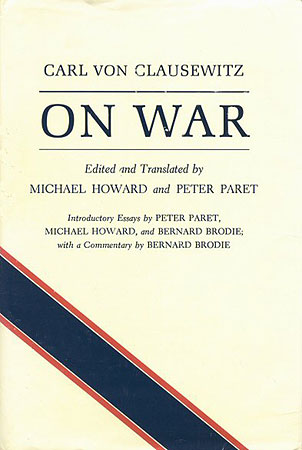
On War by Carl von Clausewitz has been the most influential book on strategy and war of all time.

We can say this because On War is the standard by which all other works of strategy are measured and only a few compared – notably Sun Tzu’s Art of War and The Peloponnesian War by Thucydides. The odd thing is that we can say this despite the fact that On War is more frequently shelved, cited or understood secondhand rather than read, even by military professionals. And furthermore, within the narrow demographic that reads Clausewitz seriously and critically, there can be heated dispute over what he meant, due to the difficulty of the text. Then there are the secondary effects, historical and military, of Clausewitz having been misunderstood, forgotten, ignored or at times, his strategic philosphy consciously rejected.

The shadow cast by On War is all the more remarkable given it’s circumstances of publication. Clausewitz died in 1831, at fifty-one, of cholera, having finally risen to a military post his talents merited. He had been writing On War since 1816 and it was far from completed or refined to his satisfaction and it is highly unlikely, in my view, that Clausewitz would have consented to it’s publication in the condition in which he left it. His determined and intellectually formidible widow, Marie von Clausewitz, further shaped the manuscript of On War, guided by her intimate knowledge of her husband’s ideas and was likely the best editor Clausewitz could have posthumously had.



Nevertheless, to my mind On War remains a magnificent unfinished symphony.

What would On War have looked like if Clausewitz had lived another twenty-five or thirty some years? Assuming continued good health, Clausewitz would have seen, perhaps commanded in, the First Schleswig War and at least studied the Crimean War from afar. He would have had another quarter-century of reading and mature reflection on his subject. Clausewitz, who had a keen understanding of history, would have also witnessed the grand European upheaval of liberal revolution in 1848 that rocked the Hohenzollern monarchy to it’s core. What new insights might Clausewitz have gleaned or expanded upon? Would his later chapters On War have evolved to equal the first?

Having outlived Marie (who died in 1836), would Clausewitz have become a deeply changed man?

What I find it difficult to believe is that Clausewitz, with his creatively driven and philosophically exacting mind,  would have been content to let the manuscript of On War rest where it stood in 1831. Or that we read today what Carl von Clausewitz ultimately intended.

Observations from the Pointy-End

Monday, October 31st, 2011


An interesting new blog. An operator type, an Iraq and Afghan vet,  quesopaper blogging from AfPakland on situational awareness and much later in the post, on leadership:

Running To Contact

….I thought we’d cover danger in Afghanistan again by examining, “When Insurgents attack.”

A quick aside…over the years one develops a sense for explosions. Some are “ours”…outgoing mortars, rounds from a gun or controlled detonations. We learn the sounds of different weapon systems. A helicopter followed by a high pitched drone and several whooshes is an Apache firing it’s main gun and rockets. Whomp Whomp Whomp  is an M60/M240. Ma duece says Bum Bum Bum. Artillery is LOUD and has a pointy sound when outgoing. Incoming is more spherical.

We also develop a sense of distance and direction for the booms…it’s all part of our survival mechanism. Another aspect is awareness of our surroundings. We constantly scan and consider what to do if we are attacked …where is the nearest bunker or where is the closest safest place?

This sounds frightening, but we all do this. Motorcycle riding is a good analog. When riding we have to be aware of spacing. Scanning for threats and escape routes saves a rider’s life.

The sound that puts me face first on the ground are mortars wobbling towards me. They make a unique sound that I can’t quite describe. Sort of of a frantic flutter…the closest sound I can come up with is the rattle of a door stop when accidentally brushed. Rockets and their vibrating engine sound are also unnerving. If you can hear them flying, they are too damned close…

Very relevant to past blog discussions of fingerspitzegehful and the OODA Loop – a good descriptive narrative, in fact, of OODA working correctly. Theory is not the interest of the quesopaper gent, but his firsthand observations of COIN in Afghanistan are intriguing, for those interested in military policy or theory. Ideas that are often great on a whiteboard or ppt slide but may not seem quite as great once they collide with reality.

Another post from quesopaper, in the vein of theoretical rubber meeting the practitioner road:

What do they Need?

….indulge me while I inject some confusion into our clarity regarding Afghans. This is a paraphrased version of a Benedictine Grima tale from her field work. If one desires knowledge about AfPak, particularly the female’s role, Ms Grima is THE source.

The tale….Two men travel to village 1. While there, they commit robbery and murder. These crimes are detected by local police. The police debate their response, and decide to chase the perpetrators.

They enter the criminal’s village (village 2) where locals set upon the police and kill them. These villagers for whatever reason don’t appreciate nor require police involvement in their affairs. Villages 1 and 2 are content to solve crimes of any type within their own system of justice. In response to the police incursion, village 2 blocks outside access to the road preventing further police/outsider interference. Up the road a bit, the next village (village 3) hears of this incident. The road blockage makes them fighting mad. A village 2 v. village 3 mini-war occurs; people die. Why? Village 3 needs that road to survive or, shoot-some other reason. We don’t and honestly; we can’t know.

The point isn’t “should we” or “shouldn’t we” be here; that’s a different blog…Fact is we are here.

So let’s do this…Let me take you to a village. You comment below on how we are going to help….maybe we’ll all learn something….

Read the rest here.

The Myth of British Counterinsurgency?

Sunday, October 30th, 2011

This SSI monograph by Dr. Andrew Mumford should stir some robust debate in the COIN community:

Puncturing the Counterinsurgency Myth: Britain and Irregular Warfare in the Past, Present, and Future

Most of Mumford’s points are valid criticisms but I need to quibble with Myth # 1 The British Military is an Effective Learning Institution:

MYTH #1: THE BRITISH MILITARY IS AN EFFECTIVE LEARNING INSTITUTION

According to John Nagl, the British succeeded in Malaya-in contrast to the American failure in Vietnam-because the British army had an organizational culture akin to a so-called “learning institution,” whereby the army quickly adapted to COIN conditions and changed tactics accordingly.2 The array of operational activity, ranging from limited to total war, that the British army has experienced has arguably led to a greater degree of pragmatism in its military outlook. A dogmatic adherence to rigid military doctrine has been absent, which, when compared to the generation-long postmortem on the failure of U.S. strategy in Vietnam, perhaps explains more than most other factors why an almost mythic reputation has descended upon the British. However, this does not explain, nor should it obscure, the languid application of appropriate irregular warfare tactics and the absence of swift strategic design. When it comes to COIN, the British are slow learners.

The early phases of nearly every campaign in the classical era were marred by stagnancy, mismanagement, and confusion. The military was 2 years into the Malayan Emergency before it conceived of a cohesive civil-military strategy in the form of the Briggs Plan. The crucial early years of the troubles in Northern Ireland were marked by displays of indiscriminate force and an inability to modulate the response.3

The Director of the United Kingdom (UK) Defence Academy also concedes that, in relation to Northern Ireland, “[I]t is easy in the light of the later success . . . to forget the early mistakes and the time it took to rectify them.”4 As Lieutenant General Sir John Kiszely rightly observes, the Malayan Emergency was, “a much lauded counterinsurgency campaign, but often overlooked is the fact that in the early years . . . the British Army achieved very little success.” In COIN terms, therefore, the British have been consistently slow to implement an effective strategy and achieve operational success. Moreover, the vast body of campaign experience has not translated into a cogent COIN lesson-learning process within the British military. The very need to re-learn COIN in the post-September 11, 2001 (9/11) conflict environment has undermined assertions as to the British military’s being an effective learning institution. Such amnesia has created an imperative for the armed forces now to hone their lesson-learning abilities while simultaneously adapting to the intricate challenges of sub-state and transnational post-Maoist insurgent violence in the third millennium.

What sort of time frame is reasonable for “organizational learning” – that is, transforming a large, hierarchical, bureaucratic entity’s conceptualization and understanding of a situation and reforming and adapting it’s practices in light of experience? How fast can this really happen? An org is not an individual, two years while under fire does not seem slow to me. Am I missing something in Mumford’s argument?

Furthermore, I infer from the third paragraph that Mumford expects evidence of learning were for the Brits to have arrived in Basra good-to-go on COIN doctrine. Learning, whether in a person or org, is not represented by doctrine (lessons frozen in time) but rather a capacity to adapt to new circumstances. Mumford is on firmer ground criticizing British general officers for their blind assumption that they had all the answers on counterinsurgency  while the ragtag Mahdi Army bullied and ran circles around British units.

A monograph worth reading.

Hat tip to Lexington Green and SWJ Blog)

Rivalrous and non-rivalrous goods and the OWS library

Friday, October 28th, 2011

[ by Charles Cameron — Jefferson, economics of possession and ideas, Occupy COG, library ]
.

library-long.jpg

photo credit: Monique Zamir for Untapped Cities

.

1.

Let’s start with Thomas Jefferson. I don’t know if he was the first to mention this curious distinction on record, but he makes the point nicely:

If nature has made any one thing less susceptible than all others of exclusive property, it is the action of the thinking power called an idea, which an individual may exclusively possess as long as he keeps it to himself; but the moment it is divulged, it forces itself into the possession of everyone, and the receiver cannot dispossess himself of it. Its peculiar character, too, is that no one possesses the less, because every other possesses the whole of it. He who receives an idea from me, receives instruction himself without lessening mine; as he who lights his taper at mine, receives light without darkening me. That ideas should freely spread from one to another over the globe, for the moral and mutual instruction of man, and improvement of his condition, seems to have been peculiarly and benevolently designed by nature, when she made them, like fire, expansible over all space, without lessening their density at any point, and like the air in which we breathe, move, and have our physical being, incapable of confinement or exclusive appropriation. Inventions then cannot, in nature, be a subject of property.

John Perry Barlow quotes that gobbit of Jefferson as the epigraph to his essay, The Economy of Ideas.

2.

Here’s Lawrence Lessig, in his essay Against perpetual copyright:

Tangible goods are rivalrous goods

For one person to gain some tangible item, another person must lose it. For one person to gain the ownership of some piece of land, the previous owner must surrender ownership. T his is the ordinary state of physical property, and the laws around physical property are designed around this fact. Property taxes, zoning laws, and similar legal constructs are examples of how the law relates to physical property.

Intellectual works are non-rivalrous

Intellectual works are ordinarily non-rivalrous. It is possible for someone to teach a work of the mind to another without unlearning it himself. For example, one, or two, or a hundred people can memorize the same poem at the same time. Here the term “work of the mind” refers not to physical items such books or compact discs or DVD’s, but rather to the intangible content those physical objects contain.

3.

As someone whose work falls almost entirely in the “non-rivalrous” category, I am naturally very interested by this distinction, both for my own sake, and because (if the coming economy is an “information” or “imagination” economy) it may be the hinge on which the future of that economy turns…

4.

Which brings me to the Occupy movement, and to this curious fact which I found in an article I didn’t otherwise read. It’s from David Graeber, On Playing By The Rules – The Strange Success Of #OccupyWallStreet :

It’s no coincidence that the epicenter of the Wall Street Occupation, and so many others, is an impromptu library: a library being not only a model of an alternative economy, where lending is from a communal pool, at 0% interest, and the currency being lent is knowledge, and the means to understanding.

In quoting this, I mean neither to endorse nor to condemn the movement, but simply to note that its center of gravity as described here (although technically, books are rivalrous goods) falls clearly within the non-rivalrous category: it is a market-place of ideas.

5.

As a one-time tank-thinker, I was trained to spot early indicators.

I don’t know what this one means, but I suspect it’s an indicator.  Give me another to pair it with, and I may be able to foresee a trend.

What do you see?

6.

I spotted a copy of Mikhail Bulgakov‘s  The Master and Margarita in one of the photos.

tumblr_lsdaiufma61qzpfhxo1_500.jpg

photo credit: Blaine O’Neill under a CC BY-NC 2.0 license

and DH Lawrence, Sons and Lovers and Christopher Isherwood, The Berlin Stories; Strindberg, The Plays and Beckett, Krapp’s Last Tape; Dr Who, yeah and Star Wars too; William Gibson‘s Neuromancer and his Mona Lisa Overdrive; Max Marwick‘s Witchcraft and Sorcery; Orson Scott Card‘s Ender’s Game and Lewis Carroll‘s Alice in Wonderland — and for the politics of it all, Marina Sitrin, Horizontalism: Voices of Popular Power in Argentina and Erica Chenoweth and Maria J. Stephan, Why Civil Resistance Works: The Strategic Logic of Nonviolent Conflict… which I’ve linked for your convenience.

7.

For what it’s worth…

Nathan Schneider‘s article, What ‘diversity of tactics’ really means for Occupy Wall Street, cites blog-friend David Ronfeldt‘s study (with John Arqilla) Swarming & the Future of Conflict — along with (among others) Gene Sharp, whose work I discussed here a few months back.


Switch to our mobile site