zenpundit.com » military training & education

Archive for the ‘military training & education’ Category

In Search of Strategy(s), a Voice, a Narrative because, ‘Gentlemen, We Have Run Out Of Money; Now We Have to Think’

Friday, December 13th, 2013

[by J. Scott Shipman] [Warning: Maritime in flavor]

No matter how far humanity may go in seeking to foster the arts of civilization and the ideals of civic peace, there will come times when acts of war are required in order to defend world order and sustain the peace of civilized peoples. Charles Hill’s, Grand Strategies, Literature, Statecraft, and World Order, page 48

The lift quote in the title is attributed to Winston Churchill, and in this period of uncertainty with sequestration and deep cuts in defense commanding the attention of military leadership, one thing is becoming crystal clear: we have no cogent or explainable military strategy. Sure, we have “concepts” like Air-Sea/Air-Land Battle, A2/AD, and Off-Shore Control, but our most recent unclassified Navy strategy document A Cooperative Strategy for 21st Century Seapower was written in 2007 may be a bit dated.

This week I attended the U.S. Naval Institute’s annual Defense Forum, Shaping the Maritime Strategy and Navigating the Budget Gap Reality and given the title, there was a lot of talk about funding and in that light/context, strategy was that thing “we’re in the process of doing.” Several people I spoke with expressed concern about “telling the navy’s story,” “why we have a navy,” and one member of Congress encouraged us to build an engaged constituency to put pressure on Congress to knock-off the schizophrenic approach to appropriations, so that a bit of certainty will allow the development of a strategy. Since DoD hasn’t been successfully audited in a long, long time (if ever), I wouldn’t hold out hope for a grass-roots rescue. As Mr. Churchill wisely advises, “now we have to think.”

Strategy Defined

Since strategy is a hot topic, offered here are several definitions ranging from the classic to practitioners and academics, with the goal of framing the elegant simplicity of strategy as a theory, and challenge of defining in reality. As Colin Gray points out in his National Security Dilemmas: “The United States has shown a persisting strategy deficit.” (page 170) Dilemmas, written in 2009 before the budget axe fell in earnest he offers: “One would think that the following definition and explanation must defy even determined efforts of misunderstanding:” (he then quotes Clausewitz)

Strategy is the use of engagement for the purpose of war. The strategist must therefore define an aim for the entire operational side of the war that will be in accordance with its purpose. In other words, he will draft the plan of the war, and the aim will determine the series of actions intended to achieve it: he will, in fact, shape the individual campaigns and, within these, decide the individual engagements.” (On War, page 177)

The definition of strategy from the Department of Defense Dictionary of Military and Associated Terms, Joint Publication 1-02:

strategy — A prudent idea or set of ideas for employing the instruments of national power in a synchronized and integrated fashion to achieve theater, national, and/or multinational objectives. (JP 3-0)

Other definitions:

J.C. Wylie, RADM, USN, Ret., Military Strategy, page 14

“A plan of action designed in order to achieve some end; a purpose together with a system of measures for its accomplishment” 

Henry E. Eccles, RADM, USN, Ret., Military Concepts and Philosophy page 48:

Strategy is the art of comprehensive direction of power to control situations and areas in order to attain objectives. (emphasis in original)

Bernard Brodie, Sea Power in the Machine Age, page 78

“Tactics may be distinguished from strategy by the criterion proposed by Mahan—the fact of contact. “Tactics” refers to localized hostilities that occur where the adversaries are in contact; “strategy” refers to those basic dispositions in strength which comprise the entire conduct of a war.” 

General André Beaufre, Introduction á la stratégie, 1963, page 16. (note: I don’t read/speak French, I found the quote in Edward Luttwak’s Strategy, The Logic of War and Peace)

“…the art of the dialectics of wills that use force to resolve their conflict.” 

Paul Van Riper, LtGen, USMC, Ret, Infinity Journal, Volume 2, Issue 3, Summer 2012

“…strategy is specifically about linking military actions to a nation’s policy goals, and ensuring the selected military ways and means achieve the policy ends in the manner that leaders intend.”

From John Boyd’s Strategic Game of ?And?

What is strategy?

A mental tapestry of changing intentions for harmonizing and focusing our efforts as a basis for realizing some aim or purpose in an unfolding and often unforeseen world of many bewildering events and many contending interests.

What is the aim or purpose of strategy?

To improve our ability to shape and adapt to unfolding circumstances, so that we (as individuals or as groups or as a culture or as a nation?state) can survive on our own terms. (emphasis added)

Our own Lynn Rees

Politics is the division of strength. Strategy, its tool, squares drive, reach, and grip while striving for a certain division of strength.

Drive falls between too weak and too strong. Reach falls between too short and too far. Grip falls between too loose and too tight.

How strategy squares the three is open ended and ongoing. Outside friction, deliberate or not, always conspires with inside friction, intentional or not, to keep things interesting for strategy.

Drive is the certainty you want. Reach is the certainty you try. Grip is the certainty you get. Grip can be a little sway over certain minds. It can be big hurt carved in flesh and thing. Amid uncertainty, strategy strives for certain grip. The varying gulf between certain want, uncertain try, and not certain getting is the father of strategy.

Observations

Paradoxically, complexity is easy to design.  Colin S. Gray, The Strategy Bridge, page 25

All of these definitions have merit, and most coalesce around: power, conflicting wills, violence, and control. Lynn recently had a post on “Grip” where he offers a guide to physically grasp strategy (I do admire his imagery). Admiral Eccles also has a similar and complementary list:

A strategic concept is best expressed in explicit statements of

What to control,

What is the purpose of this control,

What is the nature of the control,

What degree of control is necessary,

When the control is to be initiated,

How long the control is to be maintained,

What general method or scheme of control is to be used. (page 48)

Both of these lists are unambiguous. (One of the biggest complaints about Air-Sea Battle and A2/AD is the ambiguity. Sam Tangredi wrote a book on the latter which I’ll review soon.) Bernard Brodie in A Layman’s Guide to Naval Strategy, page 14-15 (emphasis added), reminds us:

There is no need for a complicated terminology. However, to say that the basic principles of war are easy to understand is not to say that it is easy to comprehend the finer points, or what is more important, to determine upon a wise plan of strategy and then carry it out. The great commander must of course have a profound insight into all the ramifications of strategic principle, but that is only the first requirement of military leadership. He must thoroughly understand tactics, which with modern arms is bound to be exceedingly complex and require long training and experience. He must know how to solve problems of supply or “logistics,” he must know human nature, and he must have certain qualities of character and personality which transcend mere knowledge. He must be able to stick to his course despite a thousand distractions and yet be sufficiently elastic to recognize when a change in circumstances demands a change in plan. He must above all be able to make adjustments to the inevitable shocks and surprises of war.

Unfortunately, the very preoccupation of commanders with specific and inevitably complex problems sometimes tends to make them impatient with the age old verities. Long-tested doctrines which are utterly simple are rejected in part because of their very simplicity, and in part too because of the dogma of innovation so prevalent in our age. The French High Command in the summer of 1940 found out too late that the side which carries the ball makes the touchdowns, and that all the maxims of great military leaders of the past relative to the merits of initiative had not been outmoded by modern arms. We live in an age when basic theories of naval warfare are being rejected out of hand by responsible officials on the wholly unwarranted assumption that they do not fit modern conditions. One can say about theory what Mahan said about materiel: “It is possible to be too quick in discarding as well as too slow in adopting.”

There’s a lot to digest in those two paragraphs, but one take away is that whatever the Navy presents as a strategy should be easy to understand and explain. The strategy should also explain how it plans to maintain control or “command the seas.” And finally, as Wylie reminds the planner:

Wylie’s assumptions in a General Theory of War:

Despite whatever effort to prevent it, there will be war

The aim of war is some measure of control over the enemy

We cannot predict with certainty the pattern of the war for which we prepare ourselves

The ultimate determinate in war is the man on the scene with a gun

As we build our strategies and plans, these decidedly old-fashioned and many cases very simple guides can help us get it right.
USNI Press to Rerelease J.C. Wylie’s Classic

Tuesday, October 29th, 2013

[by J. Scott Shipman]

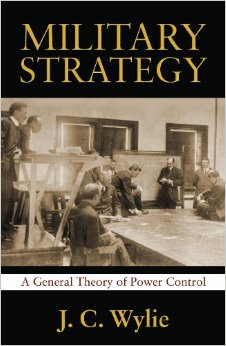
Military Strategy, A General Theory of Power Control, J. C. Wylie

Mark your calendar; March 15, 2014, the USNI Press will rerelease J.C. Wylie‘s classic Military Strategy. A couple years ago I reviewed here.

If you have not read Wylie, I strongly recommend adding his little book to your list.

And a big “Thank You!” to the USNI Press!

POSTSCRIPT: A representative of the USNI notified me that an eBook will be forthcoming, too. 

Nairobi tweets 2: Sun Tzu and more

Sunday, September 22nd, 2013

[ by Charles Cameron — further hints from the HSM Press twitter stream, following on from part 1 on bullet-proofing ]

Update:


As of Monday morning 11am California time:

I now think it’s clear that the twitter stream I was commenting on in this post and the first in the series was not an official Shabaab feed, and thus untrustworthy as to its statements — although it’s exact status (fan, mimic, troll, loosely connected?) is undetermined.

I am leaving the post up (a) for the record, and (b) for whatever minor interest it may still have.

Original post:


.

Okay, let’s pick up the thread from my earlier post in this series with this sheer poetry — sheer Anglo-Chinese poetry in fact, the poetry of Sun Tzu from The Art of War — Chapter 7, “Maneuvering”, # 19 in the Lionel Giles translation.

I won’t be presenting the rest of these tweets in graphical form, since that would be labor intensive and I’m trying to be conservative about my labor, but there’s one more Sun Tzu quote I noticed in their stream, and we’ll come to it.

In the meantime, HSM Press tweeted on a variety of topics, all of which seem relevant to them:

**

Let’s note first the importance given to prayer in these tweets:

  • our mujahideen just prayed salat dhuhr! #westgate #alshabaab #Nairobi
  • our mujahideen are preparing to pray salat maghrib! #westgate #AlShabaab #Nairobi
  • The Qur’an is cited:

  • and kill them wherever you find them! ring a bell? #westgate #AlShabaab
  • Their Islam is a religion of peace —

  • yes islam is a religion of peace! thats undebatable. the debate here is who hit first? #westgate #AlShabaab
  • dont blame islam! islam never told you wage war on another country! #westgate
  • — but peace comes arms-in-arms with justice.

    There are matters of logistics:

  • we tweeted arrival of 2 squads and they are replacing our first two now. hooo-ah! #Westgate
  • update: our third mujahideen squad just crossed the border, enroute to #garisa and other undisclosed locations. #Westgate #AlShabaab
  • update: 4th mujahideen squad rendezvous to undisclosed location! brace yourselves #kenya #westgate #AlShabaab
  • Here’s that other Sun Tzu quote, along with a mention of training camps:

  • the first thing they taught us in training camps: know your enemy! #AlShabaab #Westgate
  • and there, making a fine DoubleQuote, is Margaret Atwood‘s nifty variant on Clausewitz:

  • “War is what happens when language fails.” #westgate @nairobi
  • Now, about those “training camps”?

  • have we mentioned we trained in this same building months ago! our mujahideen know every corner of this building! #alshabaab #westgate
  • But also:

  • our mujahideen are all under 25 years old. 7 of them having completed training in black water facility in north california! #Westgate
  • So they train with Blackwater / Academi and in situ, eh? And they’re all under 25 — when they started naming namesa bit later, they identified at least one 27 year old, but you get the drift — and at least one is a young woman:

  • our female combatant took out 15 kenyan soldier! what an amazing woman! #Westgate
  • They count the cost — though unlike AQC in the case of 9/11, they don’t do so to show what a huge ROI they have, just to be glad it wasn’t a flop:

  • the vast amount of time, money and dedication we contributed to this operation were glad it was carried successfully! #westgate #AlShabaab
  • They call it an op here, but their view of its size and importance is pretty flexible as to scale…

    It’s a game — the “war as game meme” once again!:

  • lets see how yall enjoy this game! #westgate #alshabaab #Nairobi
  • They also call it a war:

  • this is a war and its not going to end well. #westgate #AlShabaab
  • It’s not a Jihad, though:

  • #JIHAD is a big word to use for this drill. #kneyans you will know when jihad is happening its unevitable! #westgate #AlShabaab
  • It’s gonna get worse:

  • you call few hundred death a deadly attack. well see what a deadly attack is. brace yourselves #lenya #westgate #AlShabaab
  • — and hey, it looks as though they have their eye on S Africa as a target further down the road:

  • #southafrica gere we come!!! #Westgate
  • **

    Those are the tweets I found interesting on a first read. HSM followed up with the names and home cities of three American participants, and then their feed was suspended and I was invited to return to my home timeline…

    Credit goes to JM Berger for getting Twitter to be a whole lot quicker in disabling their feeds, but it’s all a bit whack-a-mole, and I suspect they’re probably back up by now, under some variant name or other.

    Octavian Manea Interviews General David Petraeus

    Monday, September 2nd, 2013

    [by Mark Safranski a.k.a. “zen“]

    Octavian Manea has had an excellent series of COIN  interviews at SWJ and this is one of the more important ones:

    Reflections on the “Counterinsurgency Decade”: Small Wars Journal Interview with General David H. Petraeus

    SWJ: In his recent op-ed published in the New York Times, “The Pipe Dream of Easy War”, General H.R. McMaster warned against the fantasy of “a new era of war”, and especially about the dangers in the blind faith in the transformative effects that technology promises to have on war. He argued that over the past counterinsurgency (COIN) decade we relearned a few lessons that we really should keep in mind as we head into the future: “American forces must cope with the political and human dynamics of war in complex, uncertain environments”. His warning reminds me of an article you wrote in 1986 with General John Galvin about “uncomfortable wars”. You warned to take into consideration “the societal dimension of warfare”. To what extent do you see that prophecy still holding true post Iraq and post Afghanistan?

    General Petraeus: I think the essence of the article back in 1986 with General Galvin was frankly the importance of the human terrain in each particular situation, and the importance of understanding the terrain, having a very nuanced, detailed feel for the context of each situation, not just nationally, but sub-nationally and literally all the way down to each valley and each village. That kind of knowledge was achieved in Iraq and helped us enormously during the Surge. We had a greater understanding there, earlier than we did in Afghanistan, just because we had so many more forces on the ground, 165,000 American military alone at the height of the surge. In Afghanistan at the height of our deployment, we had 100,000 US troopers and about 50,000 coalitional forces, and we maintained that level for a relatively brief period of time. As I noted on a number of occasions, we never really got the inputs close to right in Afghanistan until late 2010.

    So, noting the importance of human terrain, I believe, is a fundamental aspect of crafting a counterinsurgency campaign. In fact, it was the biggest of the big ideas when we launched the Surge in Iraq, and we knew that since the human terrain was the decisive terrain, we would had to secure it as our principal focus – and to do so by living with the people, locating forward operating bases/joint security stations in the neighborhoods and villages, and specifically right on the sectarian fault-lines across which the heaviest fighting was ongoing in the capital. We ultimately established 77 additional locations just in the Baghdad area of operations alone, and many dozens more elsewhere throughout the country. There were other big ideas to be sure:  e.g., that you can’t kill or capture your way out of an industrial strength insurgency, such as we faced, therefore you need to reconcile with as many of the insurgents as was possible, seeking to maximize the number of the reconcilables; correspondingly, we also needed to intensify our campaign of targeted operations against the irreconcilables. But I think, fundamentally, it comes back to this issue, that it is all about people, counterinsurgency operations are wars in, among, and, in essence, for the people. And the first task of any counterinsurgency campaign has to be to secure those people.

    Read the rest here.

    How to Lose a War: A Primer

    Sunday, July 28th, 2013

    [by Mark Safranski a.k.a. “zen“]

    Since Pakistan is now attempting to get its victory over the United States in Afghanistan formally ratified, now seemed to be a good time to reflect on the performance of American statesmen, politicians and senior generals.

    It has occurred to me that we have many books and papers outlining how to win wars. Certainly the great classics of The Art of War, The History of the Peloponnesian War and On War are the foremost examples, but there are also other useful classics in the strategic canon, whole libraries of military histories, memoirs of great commanders and an infinite number of PDFs and powerpoint briefs from think tanks and consultants. Strangely, none of these have helped us much. Perhaps it is because before running this war so few of this generation’s “deciders” read them en route to their law degrees and MBAs

    We should engage in some counterintuitive thinking:  for our next war, instead of trying to win, let’s try to openly seek defeat. At a minimum, we will be no worse off with that policy than we are now and if we happen to fail, we will actually be moving closer to victory.

    HOW TO LOSE A WAR

    While one of these principles may not be sufficient cause for losing an armed conflict, following all of them is the surest road to defeat.

    1. War is the Continuation of Domestic Politics:

    The point of politics is to acquire, hold and enjoy using power. When we lose sight of this fact due to romantic notions of “national interest” or “duty” and spend too much attention prosecuting a war against foreign armies then our real enemies – the political opposition – can take advantage. What good is overseeing a global victory over an epochal tyranny if the result is you get immediately voted out of office like some hapless loser? While on the surface, it might seem wise during a war to staff a government with able statesmen, experienced generals, capable diplomats and other experts, the truth is that if you do so you will have very few plum jobs left with which to reward the cronies, ideologues, campaign consultants, activists, wealthy grafters and partisan hacks who got you into power in the first place. Without their continued support, you will not be long for political office.

    The fact is that the nation can survive many lost wars far longer than your career will survive lost elections.  Once you view the war solely through the prism of how any action might impact your fortune in domestic politics, you will have a marvelous clarity that the war is the best pretext upon which to expand your power at the expense of the opposition and the people.

    2. Policy is the True Fog of War:

    Having a clearly defined, coherently articulated policy based upon vital interests and empirical facts that sets a few realistic objectives in a way that makes possible shared understanding and broad political support is no way to go about losing wars.

    Keeping in mind #1, the point of war policy is to generate a set of politically compelling slogans that remain ill-defined enough to serve as an umbrella  under which many contradictory and competing agendas can cohabit until some of them can be opportunistically realized. These agendas may not be realistic – in fact, it is easier to put them forward as attractive fantasies for the public if your administration is unburdened with officials with genuine expertise in warfare, economics, foreign cultures, history and other inconvenient information that the media and the political opposition will only be too happy to seize upon. The more abstractly and arcanely expressed the policy the harder it is for critics to demolish and the  better it is for losing wars. “Unconditional surrender” for example, is bad because it is too concrete and easily evaluated – either an enemy is totally defeated and in your power or he is not. “Make the world safe for Democracy” by contrast,  is better as it is more ill-defined and subjective, permitting a larger range of politically tolerable bad outcomes.  “Responsibility to Protect” and “War on Terror” are even more abstract, being essentially unlimited, open-ended, process goals that do not have any point of “victory” whatsoever and can thus not only potentially bring about losing wars but very long ones.

    3.  Strategy is a Constraint to be Avoided:

    Strategy is about lining up Ends-Ways-Means to construct a theory of victory. While that might give us hope of prevailing over an enemy in an armed conflict, forging a strategy – any strategy -comes with a severe cost: namely the discipline of the government adhering to a strategy requires choices be made about the use of limited resources rather than keeping “all options open” to react  to transient and trivial political concerns on a moment’s notice. Strategy for the nation equates with diminished political flexibility and mobility for the politician.

    In other words, having a strategy might require elected officials expend their precious political capital in order to pursue it without getting anything in return that might expand their powers or further their personal careers.  Doing strategy would mean prioritizing winning the war over other possible objectives and putting key decision-makers in the uncomfortable position of having to say “No” or “Not now” to powerful and influential people or factions. Worse, having a strategy also implies that the results can be quantified and evaluated for success, costs, failure and ultimately, personal accountability for leaders.

    Obviously locking ourselves into a strategy is something to be avoided if we wish to stay in power, so “strategy” is only invoked rhetorically to mean a wide and confusing array of other non-strategy things – tactics, goals, operational art, planning,  public relations, nation-building,  diplomacy, policy, routine procedures, withdrawal dates, theories, fantastical pipe dreams and so on.  When “strategy” means anything and everything it ultimately means nothing.

    4. All Lost Wars are based on Self-Deception: 

    It is not enough to avoid strategy, there must also be a collective political determination to avoid reality enforced from the inception until the bitter end.

    Wars have real and physically destructive consequences for the people who fight them, but unless you are engaged in a desperate struggle to repel a foreign invader, chances are the battlefield is far away from your home territory. This gives political leaders wiggle room to manipulate perceptions – most importantly their own – to political advantage by controlling information about the war and shaping the ideological boundaries of acceptable public discourse. This will eventually lead to a vicious cycle of bad decisions as misinformation and deceit corrupts the OODA Loop, but political leaders will maintain their political advantage over their critics, at least until the day of reckoning arrives.

    Here we must begin with an insistence of a position of firmly held ignorance regarding the prospective enemy, their military capabilities, economic resources, the geographic characteristics, their cultural attitudes toward conflict and their history as a people. Should such information become widely known, it might result in popular skepticism about the wisdom of the entire enterprise, the difficulties that might be encountered and the prospects for success. If you wish to lose a war ignominiously, the less you know the better.

    Likewise, once war has begun, the initial jingoistic overconfidence that greeted the war will quickly fade unless actively sustained by preventing an honest analysis of  events and providing a steady stream of rationalizations for the gullible public. It would be a good idea to ban discussion that accurately characterizes the form of warfare  or the nature of the enemy, though these things alone will not be sufficient. The intelligence process itself should be corrupted when possible to provide the “right” answers and censored or circumvented when it is not; while public assessments should use irrelevant metrics divorced from their  context so that they will not have to be gamed later.  Critics, truth-tellers, whistleblowers and those not towing the party-line should be retired, fired, demonized and punished.

    5. Isolate the War and those Fighting it from the People: 

    A war forgotten by the folks at home is a war that is much easier to quietly lose.

    At the outset of the war, ask no sacrifice of the people because that will give them too much of a stake in a victorious outcome and raise expectations about your own leadership. Neither raise their taxes (at least not for the war at any rate) nor conscript their sons. Do not even issue a national call to the colors for volunteers, instead encourage people to be at ease and go about their business. Supplement your small regular army that increasingly feels itself a caste apart with highly paid mercenaries and foreign paramilitaries while neglecting the needs of your own troops. Speaking of the troops, always lavish the soldiers with superficial public pieties about service, sacrifice and heroism, but cynically break faith when it comes to your obligations to look after their interests.

    6.  Complexity= Opacity and Micromanagement= Power

    Most things in war are simple, but they are not easy. By deliberately making everything incredibly complicated, war can also become impossible too

    While adding superfluous complexity does not help win wars, it does offer a number of immediate benefits for the political class. First, in real life the consequence of increasing complexity in any governmental endeavor (not just war) is that you will have more jobs and contracts to hand out to followers as bureaucracy and regulations require new inspectors, secretaries, managers, clerks, lawyers, advisers and in a military context, also new commands, staff officers, promotions, headquarters, increased budgets and so on. Chances are, most of these new jobs will continue on, if not forever, for a very long time.

    Secondly the sheer complexity and number of offices, bureaus, agencies, departments, teams, commands, commissions and committees offer excellent “cover” for carrying out unpopular or illegal actions “under the radar” and with diffusion of responsibility, should these antics come to light.  If everyone is in charge, then no one is.  So if your military, intelligence agencies, diplomats, cultural advisers, aid and development people and senior administration officials talk and behave as if they are all hailing from different planets, you are well on your way to losing the war.

    Third, the control of people at the top is reinforced by excessive complexity because the initiative of lower levels is strangled by micromanagement. If every idea from the field ( or even basic actions) requires two, three or more levels of command approval with consultation with lawyers at each step the answer is always going to be “No” or a very delayed “Yes” long past the point of being useful. This, plus making examples of those who exercise initiative and act without orders, teaches everyone in the system to eschew risk, value passivity, play it safe and wait for higher-ups to spoon-feed them instructions. With modern, networked online communications every colonel, brigadier to three-star can play company commander while the President of the United States can ride virtual shotgun on SEAL team raids.

    7.  Enormous Tail, Tiny Tooth: the Worse the ROI the Better

    When you regularly use hundred million or billion dollar platforms to kill illiterate tribesmen with AK-47s and RPGs and build food courts in the Hindu Kush, something is eventually going to give.

    Generally, a reasonably well governed country at war can afford to employ either a massive military force for a short campaign or a small, “light footprint“, force for the long haul. What few nations in history can afford, unless it is Persia under Xerxes, is to field a massive force disproportionately composed of rear echelon support troops and what used to be called “camp followers” and “auxiliaries” for years on end. There are two ways this can bring you to defeat.

    First, obviously, fielding an enormous army for too long can lead to bankruptcy as costs of the war exceed tax revenues and the state begins to rely on various forms of credit, foreign bankers and debasing the currency to carry on. This does not guarantee an economic collapse or hyperinflation as war can also greatly stimulate production and other variables are always in play, but the risk of dire negative economic effects is significantly increased.

    The second issue is that if you are moving your armed host into a desperately poor region to wage war against an impoverished enemy, the passage and encampment of your own military introduces the economic surplus to the local economy the enemy needs to afford to wage war. You are like a red hot iron in a bucket of ice water. Through bribery, extortion and theft the enemy will siphon from you money, arms and contraband and eventually, corrupt your own officials and officers.

     8. Cultivate Hatred and Contempt:

    If you wish to lose a war, be hated but not feared.

    While most principles of losing a war  are political, strategic or operational in nature and therefore the province of incompetent politicians and generals, cultivating contempt and hatred in all observers can be done at anytime by anyone regardless of rank, experience or status. Technology has revolutionized this sphere of losing warfare: where once undermining an entire war effort could only be done by an arrogant national blowhard, today any grinning idiot on a battlefield with a smart phone is only a tweet away from an international media firestorm.

    It is import in cultivating hatred to remember that mere violence, an inevitable part of all wars, is not sufficient. One can respect and admire an honorable but fierce opponent. Conveying a bullying attitude of casual cruelty to all onlookers by mistreating prisoners and civilians, especially if you humiliate and abuse them is a surefire goad to hatred while also alienating allies and neutrals, especially when doing so contradicts the nation’s deeply held values.  Hatred can also be stirred in less dramatic ways, from posing with Nazi flags to widespread ignorance of and expressions of disdain for local customs and mores. Disrespect has legs.

    Contempt by contrast, is earned more by exhibiting moral weakness and truckling appeasement of the enemy and his sympathizers. For example, have your own PA and diplomatic organs in speaking to the media, repeat enemy propaganda against your own soldiers and abuse the military justice system to prosecute soldiers for splitsecond combat decisions in order to appease these critics. Loudly trumpet the “culturally appropriate meals” to the guys you are going to waterboard and appoint enemy sympathizers as “cultural advisers” and “liaisons” to government security and law enforcement agencies. Do nothing as your own heavily infiltrated host nation “ally” repeatedly frags your soldiers.

    9. Protect that Which is Most Unimportant:

    Organizations signal what they really value not by what they say, but what they spend time and money on.

    Make sure that as the war is steadily being lost that top brass and their civilian overseers frantically emphasize politicized trivialities and institutional martinet nonsense. Reflector belt mania, giving everyone and their brother breathalyzer tests, cultural sensitivity training, counterproductive regs for MEDEVAC helicopters, promoting the gender equality of foreign societies and gender-neutrality of our own should bump out boring, old training exercises for future combat deployment in terms of priority. Remember, the military is not really there to win wars – it is a captive social engineering project for things the wackier members of Congress wish they could impose on their constituents were it not for those damned free elections.

    10. Level the Playing Field: Paralyze Your Own Tactical Advantages.

    While a war is often lost by having a bad strategy or no strategy at all, the power of crapping away your tactical advantages to no purpose ought not be underestimated. There are thousands of ways to do this but if you are cutting the enemy repeated breaks you can’t go wrong.

    First and foremost, you wish to avoid bringing all of your combat power to bear on the enemy’s weakest point in a combined arms assault because he very well may break and then where the hell will you be? You can hardly lose a war if the enemy dies or surrenders first.

    Treat your combat arms, services and host nation military as separate, autonomous and almost unrelated units, each with their own objectives and set of ROE guidance more restrictive than required by the Laws of War (while mixing in allied and host nation forces of varying levels of capability and different ROE). Make it difficult for fire support, armor and air to work with your infantry commanders dealing with unforseen circumstances, who you should also spread thin over remote operational areas the size of, say, Iowa to maximize their vulnerability. If a battalion is needed, send a company. If a company is called for, send a squad. Allow the enemy to have safe havens in adjacent countries whose military power is dwarfed by your own by many orders of magnitude. Make sure that your intelligence and public diplomacy services are shorthanded on personnel  fluent in the languages used by the enemy, whom you allow to practice perfidy without punishment.

    Remember, there are no guarantees in war. No matter how badly you screw up, the enemy might still be more poorly led and less adaptive than are you. That said, if you practice these ten principles you can become a master of the art of defeat.


    Switch to our mobile site