zenpundit.com » bach

Archive for the ‘bach’ Category

Contrapuntal video, fugal braiding

Friday, March 11th, 2016

[ by Charles Cameron — from Trumpery to Altman’s Nashville ]
.


Tufte’s illustration of the Kathasaritsagara or Ocean of the Streams of Story

**

Wired had a piece titled Never Mind Trump. The Internet Wants to Watch What’s Behind Him a couple of days ago, and it contained a sentence that caught my attention:

Like a Bach fugue, the counterpoint rivaled, and then overtook, the original melody.

**

I’m always interested in non-musical forms of counterpoint, whether we’re talking Glenn Gould‘s radio dramas, Claude Levi-Strauss‘s structure for his Mytholoogiques, Tufte‘s Rushdie‘s Kathasaritsagara, or the various attempts to make Hermann Hesse‘s Glass Bead Game playable. Hesse himself invokes both fugue and counterpoint in the passage in which he describes actual moves in his game about as clearly as anywhere:

A Game, for example, might start from a given astronomical configuration, or from the actual theme of a Bach fugue, or from a sentence out of Leibniz or the Upanishads, and from this theme, depending on the intentions and talents of the player, it could either further explore and elaborate the initial motif or else enrich its expressiveness by allusions to kindred concepts. Beginners learned how to establish parallels, by means of the Game’s symbols, between a piece of classical music and the formula for some law of nature. Experts and Masters of the Game freely wove the initial theme into unlimited combinations. For a long time one school of players favored the technique of stating ide by side, developing in counterpoint, and finally harmoniously ombining two hostile themes or ideas, such as law and freedom, individual and community. In such a Game the goal was to develop both themes or theses with complete equality and impartiality, to
evolve out of thesis and antithesis the purest possible synthesis.

**

I was accordingly interested to read this paragraph, ending as it does with the sentence I quoted above:

The Christie videos were just the latest installment in what might be the defining video format of this election. Call it marginal media, in which background activity overwhelms the intended subject. Most candidates have found themselves inadvertently sidelined at some point. Hillary Clinton was overshadowed by the surreal stylings of “Sticker Kid,” who mugged, jerked, and danced throughout her stump speech. Another short video treated Bernie Sanders’ endorsement of marijuana decriminalization as a preamble to an audience member’s startled reaction. Another Trump rally was undercut when a member of the crowd behind the lectern began reading a copy of Claudia Rankine’s Citizen. The drama unfolded over the course of Trump’s speech, as the reader’s neighbors began to argue with her, then brought their neighbors into the fray. Soon, the tension made it impossible to pay attention to Trump at all. Like a Bach fugue, the counterpoint rivaled, and then overtook, the original melody.

**

We need, it seems to me, to get used to thinking contrapuntally — and accordingly it is instructive to see just how many of the great artists of recent times have employed some measure of contrapuntal thinking in their work. From the same Wired piece:

The frames of Robert Altman’s Nashville are packed with overlapping dialogue and activity—it’s often hard to determine which storyline should dominate—granting his aspiring losers the same weight as the country-music superstars they idolize. Tom Stoppard applied the same lens to Hamlet when he made two lackeys — whose off-stage death was barely remarked upon in Shakespeare’s play — the heroes of his fan-fic spin-off, Rosencrantz and Guildenstern Are Dead.

Okay, I’m off to see Nashville if I can find it..
On the felicities of graph-based game-board design: five

Tuesday, October 20th, 2015

[ by Charles Cameron — Hofstadter Langdon Kim — for Gabi Nasemann, & in recognition of Gödel Escher Bach ]
.

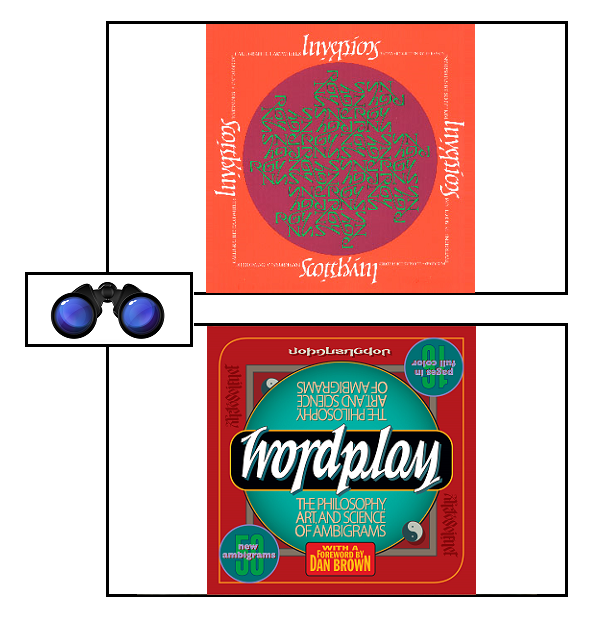
My friend the photographer Gabi Nasemann recently inquired whether I knew John Langdon‘s book, Wordplay, and I responded, DoubleQuote-style, with Scott Kim‘s Inversions:

SPEC kim langdon

I had the pleasure of meeting Scott Kim lo these many years past at the Computer Game Developers Conference, and he was kind enough to say of my HipBone Games:

Your game does seem to really call to mind the Bead Game. Almost a divination system, much more metaphorical than most games.

**

Scott Kim and his friend Doug Hofstadter both have a keen interest in Bach, so I thought it might be neat to see Scott’s treatment of the name — an ambigram, lower panel below — and how John Langdon might treat it — upper panel:

SPEC bach

Langdon’s Bach I assembled from his own typeface, Biform, which apparently seeped from his grasp into the wider world under the entirely irrelevant name Lampoon.

**

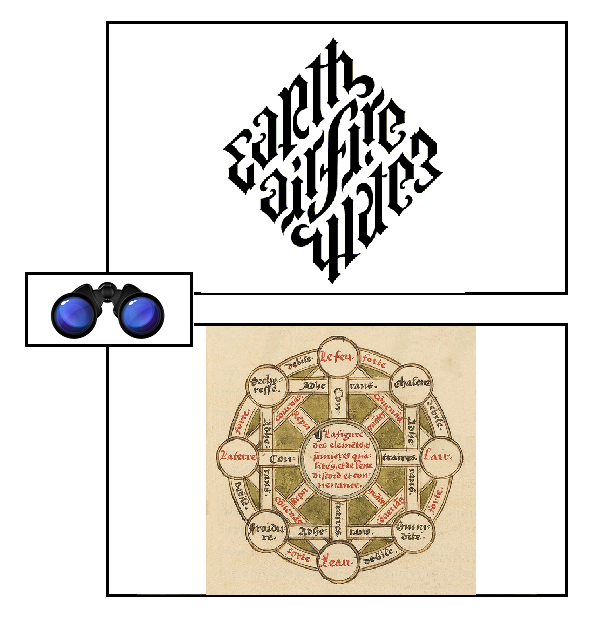
Of all Langdon’s ambigrams, the one that’s no doubt best known — since Dan Brown used it in one of his execrable books — is his square of the four elements, upper panel, below:

SPEC langdon oronce

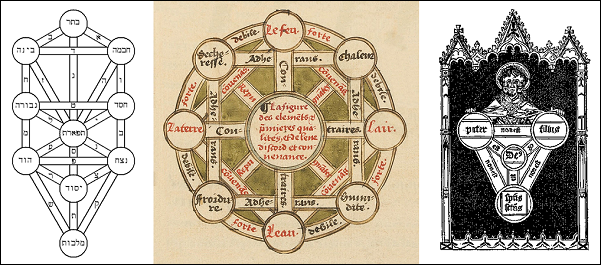
It was a nice touch, though, that Brown offered Langdon an hommage by naming his professor of symbiology after him. No doubt the fictional Robert Langdon would be familiar with the glorious diagram of the elements created by Oronce Fine, which he’d have run across in a 1549 Harvard Houghton Library volume, Le Sphere du Monde, and which I have elsewhere compared with Jewish and Christian diagrams:

Sembl and HipBone gameboards are in the same genre.. being games of linkage that you play with your mind:

games you play in your mind

**

Sources and further readings:

  • John Langdon, Ambigrams
  • Scott Kim, Ambigrams on Google Search
  • Scientific American, Remembering Martin Gardner, with Douglas Hofstadter
  • Slate, Can You Really Be a Professor of Symbology?
  • The New Yorker, Harvard_ No Symbology Here
  • Wikipedia, Robert Langdon
  • Random House, The Official Website of Harvard Symbologist Robert Langdon
  • John Langdon, Biform
  • John Langdon, Lampoon
  • Triple Canopy, This is your brain on paper
  • A Bit of Summer Reading

    Tuesday, July 28th, 2015

    [by J. Scott Shipman]

    dead wakestraight to hellGhost Fleet

    The Fate of a ManBachCalvin Coolidge


    Dead Wake, The Last Crossing of the Lusitania, by Erik Larson

    Straight to Hell, True Tales of Deviance, Debauchery and Billion Dollar Deals, by John Lefevre

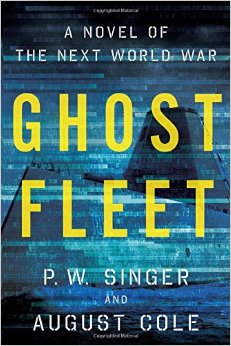
    Ghost Fleet, A Novel of The Next Work War, by P.W. Singer & August Cole

    The Fate of a Man, by Mikhail Sholokhov

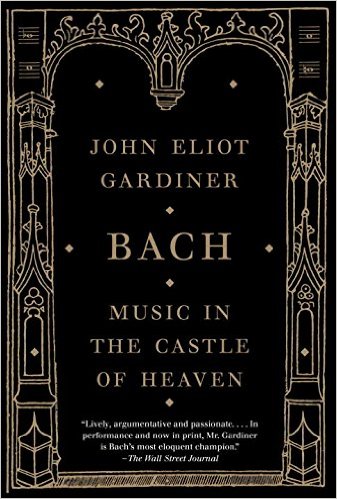
    BACH, Music in the Castle of Heaven, by Sir John Eliot Gardiner

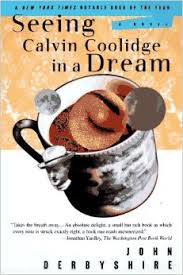
    Seeing Calvin Coolidge in a Dream, by John Derbyshire

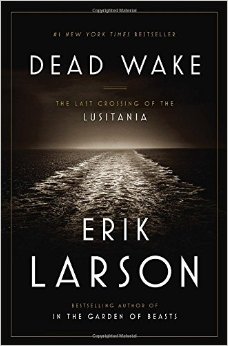
    The summer of 2015 for me is becoming memorable for the diversity of the books making it into my queue through unexpected circumstances. Larson’s Dead Wake was an surprise gift from a neighbor familiar with my professional pursuits. I read “Wake” in two sittings and it is superb. Larson puts faces on the victims, and highlights the politics from both sides of the Atlantic, to include the German U-boat commander responsible for the sinking. This tragedy reads like a novel and is wicked good.

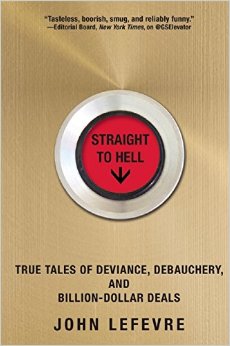
    Last year my son turned me on to the feed of @GSElevator on Twitter. I would have never read this book  had I not become a fan of Mr. Lefevre’s decidedly politically incorrect sense of humor. With over 700k followers on Twitter he created an instant potential market and I bit. Straight to Hell is an entertaining irreverent look at the top of the banking profession, and is not for the faint of heart—and very funny.

    Ghost Fleet is one of the most anticipated techno-thrillers in recent memory. Singer and Cole have spun a good yarn of how a future world war between the USA and China/Russia. While the book is a page turner, the authors thankfully sourced their technology assertions in 22 pages of notes! A great resource for a very good book. One could quibble over lack of character development, but this book is driven more by technological wizardry and is a fun and instructive read.

    Fate of Man was recommended either at a blog or in blog comments—I don’t remember. This tiny but poignant book (it is more a bound short story) provides the reader with a glimpse of the hardships and sacrifices in Russia post WWII. Torture and suffering on a scale foreign to 99.9% of those living in the modern Western world.

    BACH was a birthday gift, and I would like to report I have finished Gardiner’s masterpiece, but that may take some time (I’m at page 330). Gardiner shares insights on JS Bach’s life and music, and while I have over forty Bach recordings in my iTunes account, this lovely book is introducing a massive body of Bach’s cantata work—over 200 and I’m unfamiliar with most. My method has been to read Gardiner’s description of the piece, then find a recording on YouTube. Unfortunately, Gardiner does not discuss one of my all-time favorite Bach Cantatas Ascension Oratorio BWV-11 (the last five minutes are simply divine).

    Finally, the Calvin Coolidge book came to me via CDR Salamander in a Facebook thread. As a fan of Coolidge and Derbyshire, I grabbed a copy and I’m glad I did. Derbyshire has written a sweet and insightful story of love, betrayal, and redemption, all the while providing the reader a frightening description of China’s cultural revolution.

    My China study continues, adding Edward Rice’s Mao’s Way, along with CAPT Peter Haynes’ Towards a New Maritime Strategy: American Naval Thinking on the Post-Cold War Era—-both are thus far very good. Also thanks to a friend, I recently spent some quality time with the late master naval strategist, Herbert Rosinski’s The Development of Naval Thought. This is my third or fourth pass through a very good little book.  If naval strategy holds any interest, this little book is not to be missed.

    Are you reading any unusual titles?

    Christmas and Season’s Greetings

    Thursday, December 25th, 2014

    [ by Charles Cameron — eine kleine weihnachtsmusik ]
    .

    Since we are divided on the name, nature and very existence of the all-encompassing, please allow me greet you this day from within my own “home” tradition:
    .

    .
    Wishing those of my friends who are believers a blessed Christmas, and to those who are not — why, feasting, family, joy, and a great blast of Bach’s trumpets!

    May you each and all find even the gloom of the gloomiest circumstances and darkest days of the year a little lifted by the spirit in these voices!

    When the visuals don’t agree with the soundtrack

    Tuesday, December 16th, 2014

    [ by Charles Cameron — and Bach’s motto was Soli Deo Gloria, To God alone be Praise ]
    .

    I have commented before on the curious blend of Bach and bin Laden to be found on one YouTube channel. It now seems the same kind of cognitive dissonance is being used to parody IS nasheed videos: my own favorite example being this one:

    Whether such parodies actually dissuade anyone who would otherwise have done so from joining IS I don’t know; that they are entertaining for those of us who are wary and perhaps weary of the videos they parody may be as much as we can hope.

    They do, however, raise the question, again, of what exactly the intention of someone posting silent videos of OBL speaking from his cave along with the entire Bach B Minor Mass might be?

    Support for OBL? Delight in Bach? Allahu Akbar? Soli Deo Gloria?

    **

    Getting away from jihad for a moment, the same YouTube account now features my nephew Daniel Harding‘s Don Giovanni from the Aix festival, with Disney‘s Frozen for visuals:

    **

    Hat tip: Hayes Brown, Buzzfeed.


    Switch to our mobile site