zenpundit.com » paradox

Archive for the ‘paradox’ Category

Serpent bites tail, or Genesis revisited

Wednesday, October 21st, 2015

[ by Charles Cameron — serpent, dragon — take your pick ]
.

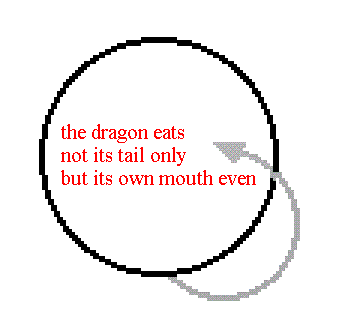
I’ve been interested in the form of the serpent that bites its own tail at least since I was in Oxford and wrote the poem:
dragon eats self reference bd

Putting it in a circle-with-tail like that, however, was a much later business, dating to a time when I was figuring out how to annotate recursion in a HipBone game move, and suddenly realized I’d tumbled on the smallest HipBone game board in the process..

Recursion is a key indicator, as Douglas Hofstadter explained in Godel Escher Bach, and as the Cretan philosopher Epimenides knew, with St Paul echoing him at Titus 1.12:

One of themselves, even a prophet of their own, said, The Cretians are alway liars, evil beasts, slow bellies.

**

SPEC Westboro Baptist

The God Hates Fags church protesting Kim Davis, the Rowan (Kentucky) County Clerk who fasted, prayed, and then refused to issue licenses to gay couples who wished to marry, is surely a serpent bites tail moment..

Madness.

Unless, perhaps, publicity is your god, your sole aim and glory.

**

Sources:

  • HuffPo, Kentucky Clerk Says She ‘Prayed And Fasted’ Before Deciding To Stop Issuing Marriage Licenses
  • HuffPo, Westboro Baptist Church Picketed Kim Davis For ‘Enabling Fag Marriage’
  • On the felicities of graph-based game-board design: five

    Tuesday, October 20th, 2015

    [ by Charles Cameron — Hofstadter Langdon Kim — for Gabi Nasemann, & in recognition of Gödel Escher Bach ]
    .

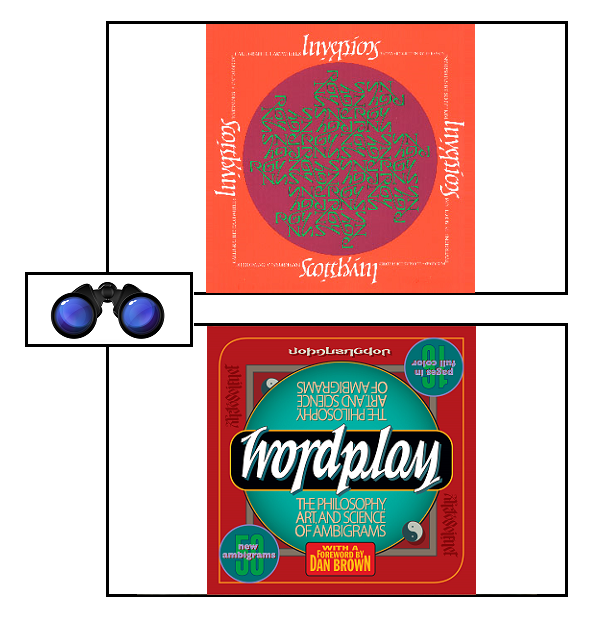
    My friend the photographer Gabi Nasemann recently inquired whether I knew John Langdon‘s book, Wordplay, and I responded, DoubleQuote-style, with Scott Kim‘s Inversions:

    SPEC kim langdon

    I had the pleasure of meeting Scott Kim lo these many years past at the Computer Game Developers Conference, and he was kind enough to say of my HipBone Games:

    Your game does seem to really call to mind the Bead Game. Almost a divination system, much more metaphorical than most games.

    **

    Scott Kim and his friend Doug Hofstadter both have a keen interest in Bach, so I thought it might be neat to see Scott’s treatment of the name — an ambigram, lower panel below — and how John Langdon might treat it — upper panel:

    SPEC bach

    Langdon’s Bach I assembled from his own typeface, Biform, which apparently seeped from his grasp into the wider world under the entirely irrelevant name Lampoon.

    **

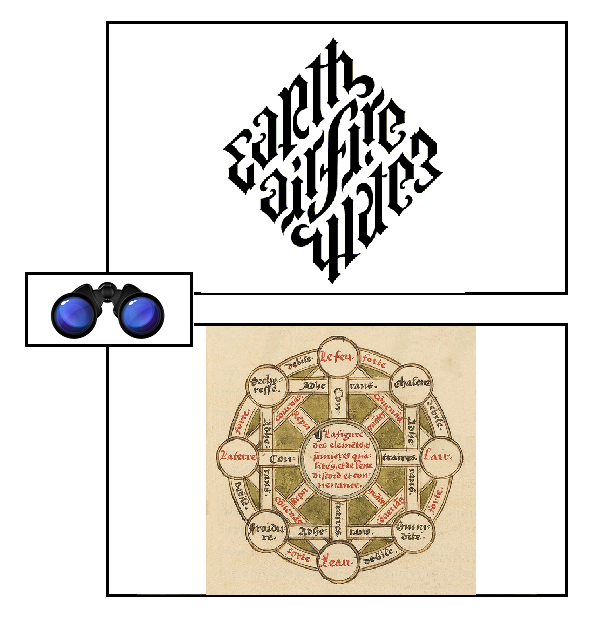
    Of all Langdon’s ambigrams, the one that’s no doubt best known — since Dan Brown used it in one of his execrable books — is his square of the four elements, upper panel, below:

    SPEC langdon oronce

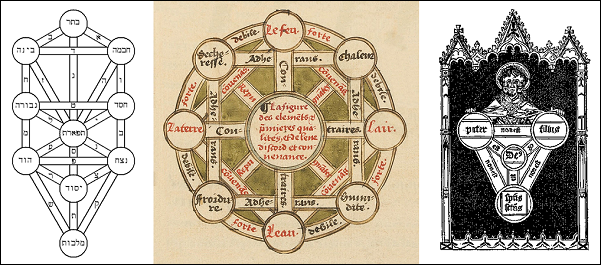
    It was a nice touch, though, that Brown offered Langdon an hommage by naming his professor of symbiology after him. No doubt the fictional Robert Langdon would be familiar with the glorious diagram of the elements created by Oronce Fine, which he’d have run across in a 1549 Harvard Houghton Library volume, Le Sphere du Monde, and which I have elsewhere compared with Jewish and Christian diagrams:

    Sembl and HipBone gameboards are in the same genre.. being games of linkage that you play with your mind:

    games you play in your mind

    **

    Sources and further readings:

  • John Langdon, Ambigrams
  • Scott Kim, Ambigrams on Google Search
  • Scientific American, Remembering Martin Gardner, with Douglas Hofstadter
  • Slate, Can You Really Be a Professor of Symbology?
  • The New Yorker, Harvard_ No Symbology Here
  • Wikipedia, Robert Langdon
  • Random House, The Official Website of Harvard Symbologist Robert Langdon
  • John Langdon, Biform
  • John Langdon, Lampoon
  • Triple Canopy, This is your brain on paper
  • DoubleQuotes, DQs in the Wild, DQs @pmarca style

    Sunday, October 11th, 2015

    [ by Charles Cameron — first post in a series, with brief intro to series on top ]
    .

    Okay, a three-post series coming up, of which this is post one. To help you navigate:

  • This post reports a conversation between Adam Elkus, Marc Andreessen (briefly) and Daniel Griffin about “@pmarca style” DoubleQuotes
  • DoubleQuotes — origins discusses the seeds of my own DoubleQuotes practice in the form of a visualization game from 1994
  • DQs in the Wild and DQs @pmarca style offers links to a number of examples of “prior art” relating to all of the above.
  • Some readers may be interested in all three, which would delight me — for myself, they’re an attempt to corral a dispersed set of matching ideas, mostly for the record.

    **

    So here’s the conversation, as far as I managed to track it. It opens with Adam quoting a paragraph from Jean-Marie Guéhenno‘s The Problem with Coalition Airstrikes in Syria, which he finds paradoxical, followed by his comment to that effect:

    **

    It was in fact Adam who first drew my attention Andreessen’s style of “double-tweeting”, as we’ll see in the final post in this series.

    Next up: DoubleQuotes — origins, or what the HipBone Games looked like, shortly before I first considered playing them on a board.

    The peace koan

    Friday, October 2nd, 2015

    [ by Charles Cameron — turning the wheel ]
    .

    When Erik Schelzig tweeted:

    Kevin Kruse responded

    — and that’s about as neat and sweet a statement of the peace paradox as any I’ve seen.

    **

    War and Peace: yang and yin?

    **

    John 14.27:

    Peace I leave with you, my peace I give unto you: not as the world giveth, give I unto you.

    I don’t believe there’s any promise of the cessation of war here — the peace offered here is a peace that’s operative in times of both war and peace.

    It must be peace from the warness of war, peace even in fighting, no?

    To my mind this is the koan all peace-lovers, peace-keepers, and peace-makers must grapple with: stillness within?

    I’ll be returning to this — “the dance at the still point of the turning wheel..”

    Either you are with us, or you are with the terrorists

    Tuesday, September 29th, 2015

    [ by Charles Cameron — what color does a chameleon turn in a hall of mirrors? ]
    .

    oy

    **

    There’s an interesting ascetic aesthetic in photography which prefers black and white to full spectrum color, but the black and white in question has a rich spectrum of its own, a continuum of shades of grey between black and white poles. Not so with black and white choices of the sort President Bush proposed when he said:

    Either you are with us, or you are with the terrorists.

    **

    Some of the nuances to consider:

    David Kilcullen on this video at 48.55:

    A lot of families in Afghanistan have one son fighting with the government, and another son fighting with the Taliban. It’s a hedging strategy.

    Compare:

    In Syria, many families face a terrible dilemma

    In recent months I have noticed a trend of some families sending at least one of their children to join ISIL because that was the only way for them to generate an income in the family.

    **

    And then this:

    U.S. Soldiers Told to Ignore Afghan Allies’ Abuse of Boys

    Rampant sexual abuse of children has long been a problem in Afghanistan, particularly among armed commanders who dominate much of the rural landscape and can bully the population. The practice is called bacha bazi, literally “boy play,” and American soldiers and Marines have been instructed not to intervene — in some cases, not even when their Afghan allies have abused boys on military bases, according to interviews and court records.

    **

    This:

    Is the CIA undercounting civilian deaths from drone strikes?

    Determining the number of civilian casualties under such circumstances is a difficult task — even for the human rights groups that devote significant resources to doing so. If the CIA is simply counting zero civilians killed in operations where it can’t say for certain who the agency is even firing at, that doesn’t inspire much confidence in their numbers.
    assumed to be combatants.

    **

    And then there’s the paradox, found even in scripture:

    The Synoptic Gospels attribute the following quote to Jesus of Nazareth: “Whoever is not with me is against me, and whoever does not gather with me scatters” (Matthew 12:30), as well as its contrapositive, “Whoever is not against us is for us” (Luke 9:50; The Synoptic Gospels attribute the following quote to Jesus of Nazareth: “Whoever is not with me is against me, and whoever does not gather with me scatters” (Matthew 12:30), as well as its contrapositive, “Whoever is not against us is for us” (Luke 9:50; Mark 9:40)

    **

    As I said at the top of this post —

    oy


    Switch to our mobile site