zenpundit.com » complexity

Archive for the ‘complexity’ Category

Global Guerillas, Meet the Resilient Communitarians!

Saturday, May 17th, 2008

John Robb is hard at work on Book II which will be about the building of ” Resilient Communities”. He’s batted a few comments about on twitter and worked up a series of posts on the RC theme at his “formal” site. Here are a few samples to give the flavor of his enterprise:

Journal:COIN without a model for Resilience is Futile

AUTHOR’S NOTE: The Resilient Community

THE THERMODYNAMIC CRISIS

JOURNAL:Why use the thermodynamic crisis as a framework

DISSIPATIVE STRUCTURES

“Resilience” is a particularly intriguing concept with multiple meanings though John is honing in on those related to Newtonian physics and complexity theory ( one source in the last post, Ilya Prigogine ,was a significant influence on John Boyd). I particularly liked this bit by John:

The modification of thermodynamics necessary to accommodate this observable fact was formulated by the Nobel laureate Ilya Prigogine in a theory called “dissipative systems” (read his excellent book: “The End of Certainty” for more). One important leap in this theory is that a dissipative system isn’t a closed system. Rather, it lives within a larger system (an “environment”) that it can interact with.

This upshot of this is that it can extract energy from this larger external environment to increase its structural complexity (build itself up through a process called self-assembly). It can also use this external environment to dump the entropy created during the energy conversion process to minimize the deleterious impact on its structure.

We’ve been pretty good at building up the complexity and are rather poor at dissipating the entropy, mostly for reasons related to the structure of our political system that ties self-interest of politicians and corporate CEOs to short-term frameworks and gives comparative advantage to rentier interests over innovators. The problem has become more difficult because many aspects of “the system” due to globalization are now beyond any state’s control.

Resiliency will involve decentralization and independence within greater interdependence in order to put natural “brakes” on high velocity forces without using draconian state controls ( which won’t work and never did  – except with globalization they will be all side effects and no benefits). I’m very much looking forward to reading what solutions Robb proposes in Book II.

ADDENDUM: Past posts on resiliency:

THE RESILIENCE OF CIVILIZATIONS

DIMENSIONS OF RESILIENCE

LEADERSHIP, RESILIENCE AND OSSIFICATION

COUNTERING 4GW: STATE RESILIENCE, NOT STATE BUILDING, IS KEY
New! Vandergriff’s Adaptive Thinking Blog & Cameron’s Cognitive Mapping Blog

Sunday, March 23rd, 2008

Military education reformer and author Don Vandergriff has joined the blogosphere and  he is off to a nice start:

First of all, my hat’s off to anyone that ventures out and participates in something like the adaptability conference. It takes moral courage to admit, “maybe I can get better, let’s see what happens here.” More compliments to the person’s organization if the organization was willing to support and encourage its people to get better. Too many organizations focus on the short term profit and simply don’t want to lose control of its people, don’t take the opportunity to make a long term investment in making its people more competent and confident. These attributes are the hallmark of adaptability.

I use a series of different games and scenario based education to involve the students (or participants) in the discussion about how to evolve adaptability in themselves and in their organization. The students end up doing the talking and usually solving or finding the answers to their questions. Each and every time any group does these exercises, they assume that I, as the facilitator, limit what they can do, like asking question to broaden their assumptions and courses of actions, and that I will always say no if they do ask a question, like “can we have more time.”

I will leave you with this thought, after doing this approach with games and getting similar results from audiences the past 50 times, why do students box themselves in? What does that tell us about ourselves and our organizations, when we always assume the negative? How does this limit our “evolutionary adaptability”?

Facilitation is the skill that separates the great teacher, who leaves an intellectual legacy in the form of students whose worldviews they have been profoundly impacted, from the scholar who is merely competent in the classroom. The latter knows their field while the former knows how to elicit students to think about the field in a deep and meaningful way.

Not all “star” scholars are great facilitators because that skill requires a good deal of self-restraint to guide students to the point where they can make the leap to discovery and comprehension on their own ( genuine learning, in other words). A high tolerance for failure and error is required because students will initially go down well-trod blind alleys ( well trod to the instructor, not to the students – this is a perspective that academics frequently overlook) before realizing that they need to generate alternative solutions. Facilitation, unlike pontification, keeps students cognitively active and on-task with timely re-direction or adaptively ( modeling for the students) takes advantage of a student insight to create a learning moment for the larger group.

I look forward to reading more in this vein from Major Vandergriff in the future ( Hat tip to DNI )

Charles Cameron, who already blogs in his area of professional expertise at Forensic Theology, has added Hipbone Out Loud to his arsenal:

Understanding is modeling, mapping.

In this blog, I want to capture the glimpses I have of an extraordinary world, each glimpse being a tiny area of a vast map – certainly more sophisticated than any individual can generate with data visualization tools and modeling software, perhaps more complicated than a single culture can grasp as a collective – but important, as it is the matrix in which our individual and cultural life-maps fall.

You will find I favor quotes and anecdotes as nodes in my personal style of mapping – which lacks the benefits of quantitative modeling, the precision with which feedback loops can be tracked, but more than compensates in my view, since it includes emotion, human identification, tone of voice.

The grand map I envision skitters across the so-styled “Cartesian divide” between mind and brain. It is not and cannot be limited to the “external” world, it is not and cannot be limited to the quantifiable, it locates powerful tugs on behavior within imagination and powerful tugs on vision within hard, solid fact.

Doubts in the mind and runs on the market may correlate closely across the divide, and we ignore the impacts of hope, fear, anger and insight at our peril.

I’ve featured the writing of Charles Cameron here before because he produces posts rich in both complexity and depth, generating intriguing horizontal-thinking patterns that would have easily escaped my attention.  This another blog that I’ll be checking frequently.

Marxist Gorillas and Chimpanzee Capitalists?

Wednesday, January 2nd, 2008

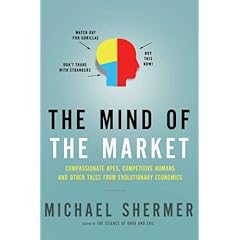
Caught my eye today: The Mind of the Market: Compassionate Apes, Competitive Humans and other Tales From Evolutionary Economics by Michael Shermer.  A premise that intuitively makes sense to me ( and therefore, I’ll have to read it with a critical eye).

Going to have to pick this one up.


Robb on Radical Privatization

Saturday, December 29th, 2007

John Robb puts on his futurist hat and engages in some imaginative scenario thinking (PDF) over at Global Guerillas. Note John’s comment:

“The goal of this brief is to get people thinking about the future in a way that helps them make decisions today.”

John has the methodology right. Most experts, habituated to the over-use of analytical thinking, will try to nit-pick scenarios like these to death from the inception , either reflexively or intentionally in order to avoid having to reexamine cherished ideological assumptions, instead of engaging in the thought experiment. This is the major cultural-cognitive reason bueaucracies and academic institutions are notoriously poor at thinking outside the box or anticipating anything other than directly linear outcomes of policies. 

Analytical-reductionism was a reasonable enough epsitemological approach for the 19th and 20th centuries of the “Second Wave”, “Mass Man”  industrial-bureaucratic nation-states. It’s not enough for the more heterogeneous, alinear, high-velocity, “complex networks as evolving ecologies” of the 21st century. We need other cognitive tools in our kit alongside analysis.

Tuesday, August 14th, 2007

ROBB’S COMING URBAN TERROR

New article in The City Journal by John Robb.

John is in the important post-publication stage of proselytizing his work and worldview which he introduces well to City Journal readers. As someone more familiar with Global Guerillas, I especially liked John’s neat summative explanation of networks, tight coupling and cascading effects in a social-political-economic-infrastructural complex system.

Network theory is one of the key concepts for the intelligent public to understand for the 21st century.


Switch to our mobile site

