zenpundit.com » russia

Archive for the ‘russia’ Category

Pussy Riot VI: counterpoint and counterfactuals

Wednesday, August 22nd, 2012

[ by Charles Cameron — compare and contrast as a means of contextualizing, suggesting a tool that might be of use to the IC in any number of circumstances ]
.

In this particular case, Pussy Riot is the topic, comparison with is the method, and some form of graphic the appropriate medium around which to build a presentation.


.

Both these statements have been made recently by Catholic priests, and they portray opposite positions on the matter. Again, it is my sense that the graphical representation of these remarks calls forth in the reader both similarities and differences, as Cath Styles nicely put it:

A general principle can be distilled from this. Perhaps: In the very moment we identify a similarity between two objects, we recognise their difference. In other words, the process of drawing two things together creates an equal opposite force that draws attention to their natural distance. So the act of seeking resemblance – consistency, or patterns – simultaneously renders visible the inconsistencies, the structures and textures of our social world. And the greater the conceptual distance between the two likened objects, the more interesting the likening – and the greater the understanding to be found.

From my point of view, the direct juxtaposition in a DoubleQuote or equivalent format does the job nicely when two fairly simple quotes are considered together.

Things can get more complex than that when a variety of discourses come together, but the same general principles can still be applied, and a graphical representation sought.

Bearing Cath’s point in mind, then, I’d like to examine some of the ways in which people have contextualized the Pussy Riot event in the Cathedral with counterfactual instances (ie by contrasting it with instances that in some ways parallel the factual instance, but in “what if” style alternate universes.

**

Here, then, are the documents I’ll be drawing on. First, from Khanya, a blog I’ve praised in an earlier post:

An Amnesty International petition site (Take Action Now – Amnesty International USA) urges people to send an email with the following text to the Russian prosecuting authorities:

I respectfully urge you to drop the charges of hooliganism and immediately and unconditionally release Maria Alekhina, Ekaterina Samutsevich and Nadezhda Tolokonnikova. Furthermore, I call on you to immediately and impartially investigate threats received by the family members and lawyers of the three women and, if necessary, ensure their protection. Whether or not the women were involved in the performance in the cathedral, freedom of expression is a human right under Article 19 of the Universal Declaration of Human Rights, and no one should be jailed for the peaceful exercise of this right. Thank you for your attention to this serious matter.

Now imagine, for a moment, that the boot was on the other foot.

Imagine that it was a Western European country, and that the act of “hooliganism” concerned was daubing swastikas on a synagogue. If that were the case, would Amnesty International be urging its members and the general public to send messages saying:

Whether or not the women were involved in writing the graffiti on the synagogue, freedom of expression is a human right under Article 19 of the Universal Declaration of Human Rights, and no one should be jailed for the peaceful exercise of this right. Thank you for your attention to this serious matter.

I think that in Western Europe such a petition would be widely regarded as “hate speech”, and “anti-Semitic”, as would the graffiti. So why does Amnesty International think that it is OK to encourage people to send such things to Russia?

And then, of course, one can put the boot back on the first foot again. If these same three young women had daubed graffiti on a synagogue in Moscow, would they have been prosecuted for the same offence and in the same way as they have been in this case?

So there are differences between Russian culture and Western culture, and differences within Russian and Western culture.

That’s a pretty impressive example of the counterfactual genre — and doubly so, it seems to me, because of the final reversal, the twist in its tail.

**

Next, here’s another quote from the same Fr. Hogan we quoted above. In this case, the mosque is used as the primary contrast to the cathedral, but the synagogue also makes an appearance — and Fr. Hogan throws at least one other interesting contrast into the mix — comparing Putin and western leaders:

Protest is fine, the day will come, I’m sure, and not too far away either I think, when we Christians may be protesting against our governments and engaging in civil disobedience, but protest must always respect others and the faith of others. As some have asked, would these ladies do the same in a mosque? They would not for two reasons – it would not be politically incorrect and they might end up being stoned to death before they had a chance to get out of the building. Is it legitimate to mock faith and descecrate places held sacred by people in order to protest against a political regime?

Some will say these ladies did so because the Orthodox Church is too close to the Russian government. Okay, well Judaism is considered by many to be too close to Zionism and the State of Israel – well, where are the lewd feminists dancing in the synagogues mocking Abraham and Moses? They are not there because they know it is inappropriate and wrong – just as it is inappropriate and wrong to desecrate a place of Christian worship.

What interests me here is that he uses multiple counterfactual contrasts, which perhaps makes his paragraphs a little less elegant than Khanya’s — but interesting in the complexity it adds to his analysis.

I’ll return to that remark about “we Christians may be protesting against our government” later.

**

My last text — and I’ve quoted it here on ZP before — is Josh Shahryar‘s tweet:

I wonder if #PussyRiot would get so much attention if they were a band of men called #DickMob.

That comes at the Pussy Riot issue from a completely different angle, and is very elegantly done.

**

Our next task is to see what oppositions we can find in these three statements.

  • Kanya uses Amnesty’s concerns regarding freedom of expression vs appropriateness of expression by comparing the cathedral incident with women “in a Western European country” daubing swastikas on a synagogue, thus also proposing a comparison between eastern and western European mores.
  • Then, in a reversal, Kanya uses the same cathedral incident vs daubing graffiti on a synagogue specifically in Moscow this time, to explore the degree to which Moscow might be more tolerant of anti-Semitism than of anti-Orthodoxy, both in terms of public opinion and via political and legal systems.
  • Fr Hogan’s question poses a contrast between the cathedral (and Orthodoxy and Putin) and a hypothetical mosque (and Islam and, say, a militant faction in Pakistan).
  • His second comparison is between two church-and-state collaborations, Orthodoxy with the Russian state and Judaism with the Zionist, and again the question he raises is whether similar behavior in a parallel situation would be tolerable.
  • Then there’s his intriguing third comparison, which I said I’d return to, in which he suggests that the “not too far” future may hold the need for civil disobedience and anti-government protests by Christians – in the west presumably. Fr Hogan hails from Ireland, which has had its own share of Church troubles and no longer wields the power it once did over Irish people and politics. Present day Russia, then, contrasted with a hypothetical future Ireland.
  • But the malaise is more widespread, and to add a comparison of my own into the pot, Fr Hogan’s remark reminds me of something Cardinal George of Chicago said not so long ago, looking at the looming battle between an increasingly secular state and his own moral stances on such issues as abortion and same sex marriage:

    I expect to die in bed, my successor will die in prison and his successor will die a martyr in the public square.

  • But that’s oblique to our narrative here…

  • Finally, there’s Josh Shahryar’s contrast between a factual girl band named Pussy Riot and a counterfactual boy band called DickMob.

**

What sort of a graphic would allow us to rotate all these polarities in our minds?

One answer is a Sembl-type game board — see design below — but with concepts rather thyan objects in the “positions” on the board:

But I’m also after other possibilities here. What would our fine artists, engineers, architects, dancers, cartographers, logicians, musicians, data visualizers and computer scientists suggest?

**

It would of course be nice if we could wrap this whole business of counterfactuals with a nice British cuppa tea, eh? Perhaps we can…

From a comment in the Guardian:

With the best will in the world I can’t see that if a bunch of noisy youngsters stood up in Westminster Abbey and screamed obscenities about the Queen to the accompaniment of electric guitars turned up to eleven, that the rest of the world would throw up its hands in horror if they were first stopped and then charged with an offence.

What’s that? We endured the Blitz, for goodness sake!

Pussy Riot V: Kasparov

Tuesday, August 21st, 2012

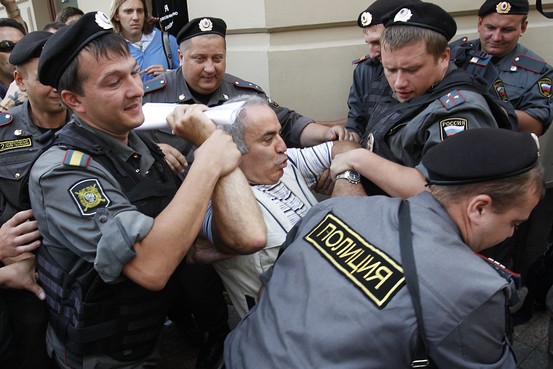
[ by Charles Cameron — the Garry Kasparov arrest ]
.

It isn’t chess. It isn’t, as we’d say in England, cricket. It besmirches the good name athletes like Arsen Galstyan brought Russia in the London Olympics.

It is Garry Kasparov, arrested for protesting the trial of Pussy Riot.

photo credit: Reuters

.

In yestrdays Wall Street Journal, under the title When Putin’s Thugs Came for Me, Kasparov — Russia’s one-time youngest ever undisputed World Chess Champion — wrote:

The men refused to tell me why I was being arrested and shoved me into a police van. When I got up to again ask why I had been detained, things turned violent. I was restrained, choked and struck several times by a group of officers before being driven to the police station with dozens of other protesters. After several hours I was released, but not before they told me I was being criminally investigated for assaulting a police officer who claimed I had bitten him.

It would be easy to laugh at such a bizarre charge when there are already so many videos and photos of the police assaulting me. But in a country where you can be imprisoned for two years for singing a song, laughter does not come easily. My bruises will heal long before the members of Pussy Riot are free to see their young children again. In the past, Mr. Putin’s critics and enemies have been jailed on a wide variety of spurious criminal charges, from fraud to terrorism.

But now the masks are off. Unlikely as it may be, the three members of a punk band have become our first true political prisoners.

**

If it was chess, here’s what we’d have to call it: a knight hustled into a van by pawns.

Pussy Riot IV: Exorcising Madonna

Tuesday, August 21st, 2012

[ by Charles Cameron — culture clash, Madonna, Pussy Riot, Union of Orthodox Banner Carriers ]
.

The gentleman on the left is Leonid Simonovich-Nikshich of the Union of Orthodox Banner Bearers, whose t-shirt bears the rubric “Orthodoxy or Death”. In the first video, he can be seen burning the photo of Madonna reproduced to his right above.

I apologize for the fact that you will need to click through to see this video on the AFP site, but am grateful to them for making it available via YouTube.

The second video shows the portion of Madonna’s stage performance in Moscow in which she spoke about freedom, the United States, and Russia’s treatment of Pussy Riot — she speaks directly about Pussy Riot starting at 3′.15″:

**

I was reading an article about the “political theologian” Reinhold Niebuhr in The American Conservative yesterday, and noted with interest the author’s discussion of the delicate balancing of opposed concerns:

To read Niebuhr is to relish these tensions, to grip the fundamental balance of the moral universe. “Man’s capacity for justice makes democracy possible,” he wrote. “But man’s inclination to injustice makes democracy necessary.” The concepts gear together like great cosmic cogs. “Goodness, armed with power, is corrupted,” he wrote. But “pure love without power is destroyed.” Much of Niebuhr’s worldview depends on these balances.

Reading Obama yields a similar effect. In 2009, literary critic Andrew Delbanco pointed out in the New Republic that Obama’s books are populated by counterweighted sentences, for instance: “There’s the middle-aged feminist who still mourns her abortion, and the Christian woman who paid for her teenager’s abortion.” Obama expresses his worldview, Delbanco wrote, in sentences “organized around pairs of sentiments or arguments that exert equal force against each other–a reflection of ongoing thinking rather than a statement of settled thoughts.”

That’s the sort of thing I was getting at yesterday — much less elegantly, in terms that come across far too “black and white” when the continuum in question could equally be “hot and cold” — when I wrote:

How can I put this? The white swirl in the tai-chi’h symbol is shocked and appalled at the black spot in its own heart — and the black swirl has no idea how to handle the purity of the white dot that has somehow crept into and illuminated its darkness.
.
And yet, as Eliot says, this is all “That the pattern may subsist, that the wheel may turn and still / Be forever still.”

and:

So pious-Charles the lover of Gregorian (or Znamenny) Chant would almost certainly have been appalled. But Charles-the-anthropologist would have to admit, afterwards, once the shock had subsided — that these actions strike deep into the heart of “sacred” paradox.

As a lover of liturgy, I understand one side of the balance, as a love of liberty I understand the other.

The paradox is perhaps most succinctly stated in the phrase “whose service is perfect freedom” — but while that’s an admittedly, profoundly and joyously liturgical phrase — one of Cranmer‘s, from the Book of Common Prayer I think — I don’t believe it is in any way dictatorial.

An Unquiet Riot

Monday, August 20th, 2012

The Master and the Minion

The Russian girl-punk rock band Pussy Riot has done something with their protest at  Christ the Savior Cathedral that prior cases of oppression, election-fraud, corruption and murder of Putin’s critics by agents of the siloviki regime failed to do – put a defiant human face on political persecution in Russia. Something we have not seen since the days of Sakharov and Solzhenitsyn.


Photo credit: The Guardian 

A reminder that when men are not free, mocking insolence is a form of bravery.

In a thoughtful post, Charles Cameron suggests that their performance was not a “political protest”. I disagree, though I think Charles’ examination of the tradition of “Holy Fools” in Russia is useful and culturally relevant as to how this event was intended to register with a Russian audience. Pussy Riot was being audaciously offensive in their selection of performance sites, as TM Lutas explains:

Orthodoxy is not a religion that is widely understood in the West. So it’s actually the rare pundit that catches how offensive what this punk riot group was doing actually was. There’s a subtitled version of the video that helps. The video misses the positional problems. The picture screen, called an iconostasis is something like the old altar rails of Catholicism but with fairly elaborate rituals surrounding the structure. There are three doors, the center one is called the holy doors. As a lay person you’re not even supposed to walk in front of that door. It’s viewed as disrespectful, even sacrilegious. So the people in charge of order and discipline were a bit stuck because these girls were dancing in the sanctuary, in front of the iconostasis and extracting them actually meant that they had to break the rules too. Several times a Pussy Riot girl bowed and did a full prostration. One does these things towards the altar in Orthodoxy. Reversing this as the protesters did is viewed as idolatry. Who, exactly, are they bowing to? That’s the genesis of the “devil dancing” talk in their trial.

Putin may have been a target but he certainly wasn’t the target. Their attack had a much wider range of victims. This was an attack on Orthodoxy, an attack on symphonia, the concept of church and state in complementary roles and mutual respect, and also an attack on Putin. 

In 4GW thinking, the strong lose when they are forced to fight the weak on terms that favor the weak. Pussy Riot – a group of young women – engineered a protest at a location whose significance meant that the authorities could not easily ignore or suppress it quietly with brutal thuggery in the shadows. By making Vladimir Putin the lyrical center of gravity, local officials were  made to look sycophantic and toadying, national officials petty and foolish. The Russian authorities, burly and oafish like their Soviet counterparts, have been reduced to fighting young girls while the rigged legal system that passes for justice in Russia is showcased in the unsparing glare of the global media.

By daring the authorities to make them political prisoners, Maria Vladimirovna Alyokhina, Yekaterina Stanislavovna Samutsevich and Nadezhda Andreyevna Tolokonnikova have made the regime look weak.

Moreover, their actions are a not so subtle reminder to Russians that the Orthodox Church is a corrupt vessel, a propaganda arm of the regime with a long tradition of KGB agents as Patriarchs and squalid informers as clergymen. The Church in Russia has not been free of the tentacles of state security since the day Lenin ordered the arrest of St. Tikhon. President Putin and Patriarch Kyrill are not peers temporal and spiritual, but fellow alumni of the same organs as the Big Lubyanka’s gaolers and policemen.

I would like to close this post by letting Yekaterina Samutsevich speak for herself:

In the closing statement, the defendant is expected to repent, express regret for her deeds, or enumerate attenuating circumstances. In my case, as in the case of my colleagues in the group, this is completely unnecessary. Instead, I want to voice some thoughts about what has happened to us.
That Christ the Savior Cathedral had become a significant symbol in the political strategy of the authorities was clear to many thinking people when Vladimir Putin’s former [KGB] colleague Kirill Gundyayev took over as leader of the Russian Orthodox Church. After this happened, Christ the Savior Cathedral began to be openly used as a flashy backdrop for the politics of the security forces, which are the main source of political power in Russia.
Why did Putin feel the need to exploit the Orthodox religion and its aesthetic? After all, he could have employed his own, far more secular tools of power—for example, the state-controlled corporations, or his menacing police system, or his obedient judicial system. It may be that the harsh, failed policies of Putin’s government, the incident with the submarine Kursk, the bombings of civilians in broad daylight, and other unpleasant moments in his political career forced him to ponder the fact that it was high time to resign; that otherwise, the citizens of Russia would help him do this. Apparently, it was then that he felt the need for more persuasive, transcendent guarantees of his long tenure at the pinnacle of power. It was then that it became necessary to make use of the aesthetic of the Orthodox religion, which is historically associated with the heyday of Imperial Russia, where power came not from earthly manifestations such as democratic elections and civil society, but from God Himself.
How did Putin succeed in this? After all, we still have a secular state, and any intersection of the religious and political spheres should be dealt with severely by our vigilant and critically minded society. Right? Here, apparently, the authorities took advantage of a certain deficit of the Orthodox aesthetic in Soviet times, when the Orthodox religion had an aura of lost history, of something that had been crushed and damaged by the Soviet totalitarian regime, and was thus an opposition culture. The authorities decided to appropriate this historical effect of loss and present a new political project to restore Russia’s lost spiritual values, a project that has little to do with a genuine concern for the preservation of Russian Orthodoxy’s history and culture.
It was also fairly logical that the Russian Orthodox Church, given its long mystical ties to power, emerged as the project’s principal exponent in the media. It was decided that, unlike in the Soviet era, when the church opposed, above all, the brutality of the authorities toward history itself, the Russian Orthodox Church should now confront all pernicious manifestations of contemporary mass culture with its concept of diversity and tolerance.
Implementing this thoroughly interesting political project has required considerable quantities of professional lighting and video equipment, air time on national television for hours-long live broadcasts, and numerous background shoots for morally and ethically edifying news stories, where the Patriarch’s well-constructed speeches would in fact be presented, thus helping the faithful make the correct political choice during a difficult time for Putin preceding the election. Moreover, the filming must be continuous; the necessary images must be burned into the memory and constantly updated; they must create the impression of something natural, constant, and compulsory.
Our sudden musical appearance in the Cathedral of Christ the Savior with the song “Mother of God, Drive Putin Out” violated the integrity of the media image that the authorities had spent such a long time generating and maintaining, and revealed its falsity. In our performance we dared, without the Patriarch’s blessing, to unite the visual imagery of Orthodox culture with that of protest culture, thus suggesting that Orthodox culture belongs not only to the Russian Orthodox Church, the Patriarch, and Putin, but that it could also ally itself with civic rebellion and the spirit of protest in Russia.
Perhaps the unpleasant, far-reaching effect of our media intrusion into the cathedral was a surprise to the authorities themselves. At first, they tried to present our performance as a prank pulled by heartless, militant atheists. This was a serious blunder on their part, because by then we were already known as an anti-Putin feminist punk band that carried out its media assaults on the country’s major political symbols.
In the end, considering all the irreversible political and symbolic losses caused by our innocent creativity, the authorities decided to protect the public from us and our nonconformist thinking. Thus ended our complicated punk adventure in the Cathedral of Christ the Savior.
I now have mixed feelings about this trial. On the one hand, we expect a guilty verdict. Compared to the judicial machine, we are nobodies, and we have lost. On the other hand, we have won. The whole world now sees that the criminal case against us has been fabricated. The system cannot conceal the repressive nature of this trial. Once again, the world sees Russia differently than the way Putin tries to present it at his daily international meetings. Clearly, none of the steps Putin promised to take toward instituting the rule of law has been taken. And his statement that this court will be objective and hand down a fair verdict is yet another deception of the entire country and the international community. That is all. Thank you.

Pussy Riot II: the closing statements

Monday, August 20th, 2012

[ by Charles Cameron — theopolitics in the closing statements of the Pussy Riot team ]
.

In my most recent post, I outlined some of the theological and political contexts that can add nuance to our understanding of the Pussy Putin trial.  Here I want to point up some of the remarkable theopolitical elements in the three defendants’ impressive closing statements.

**

Yekaterina Samutsevich opens with a closely interwoven account of the politics, spirituality, and aesthetics of Putin‘s Russia and the Pussy Riot response, coupled with a savvy media critique… I’ll simply present the bulk of it as is, and focus in on specifics in the other two women’s statements:

That Christ the Savior Cathedral had become a significant symbol in the political strategy of the authorities was clear to many thinking people when Vladimir Putin’s former [KGB] colleague Kirill Gundyayev took over as leader of the Russian Orthodox Church. After this happened, Christ the Savior Cathedral began to be openly used as a flashy backdrop for the politics of the security forces, which are the main source of political power in Russia.

Why did Putin feel the need to exploit the Orthodox religion and its aesthetic? After all, he could have employed his own, far more secular tools of power — for example, the state-controlled corporations, or his menacing police system, or his obedient judicial system. It may be that the harsh, failed policies of Putin’s government, the incident with the submarine Kursk, the bombings of civilians in broad daylight, and other unpleasant moments in his political career forced him to ponder the fact that it was high time to resign; that otherwise, the citizens of Russia would help him do this. Apparently, it was then that he felt the need for more persuasive, transcendent guarantees of his long tenure at the pinnacle of power. It was then that it became necessary to make use of the aesthetic of the Orthodox religion, which is historically associated with the heyday of Imperial Russia, where power came not from earthly manifestations such as democratic elections and civil society, but from God Himself.

How did Putin succeed in this? After all, we still have a secular state, and any intersection of the religious and political spheres should be dealt with severely by our vigilant and critically minded society. Right? Here, apparently, the authorities took advantage of a certain deficit of the Orthodox aesthetic in Soviet times, when the Orthodox religion had an aura of lost history, of something that had been crushed and damaged by the Soviet totalitarian regime, and was thus an opposition culture. The authorities decided to appropriate this historical effect of loss and present a new political project to restore Russia’s lost spiritual values, a project that has little to do with a genuine concern for the preservation of Russian Orthodoxy’s history and culture.

It was also fairly logical that the Russian Orthodox Church, given its long mystical ties to power, emerged as the project’s principal exponent in the media. It was decided that, unlike in the Soviet era, when the church opposed, above all, the brutality of the authorities toward history itself, the Russian Orthodox Church should now confront all pernicious manifestations of contemporary mass culture with its concept of diversity and tolerance.

Implementing this thoroughly interesting political project has required considerable quantities of professional lighting and video equipment, air time on national television for hours-long live broadcasts, and numerous background shoots for morally and ethically edifying news stories, where the Patriarch’s well-constructed speeches would in fact be presented, thus helping the faithful make the correct political choice during a difficult time for Putin preceding the election.

Our sudden musical appearance in the Cathedral of Christ the Savior with the song “Mother of God, Drive Putin Out” violated the integrity of the media image that the authorities had spent such a long time generating and maintaining, and revealed its falsity. In our performance we dared, without the Patriarch’s blessing, to unite the visual imagery of Orthodox culture with that of protest culture, thus suggesting that Orthodox culture belongs not only to the Russian Orthodox Church, the Patriarch, and Putin, but that it could also ally itself with civic rebellion and the spirit of protest in Russia.

**

Maria Alyokhina keeps a strong focus on Pussy Riot’s protests and courtroom appearances as dialogue between people and State, and this informs her diagnosis of the state — funny word that — of affairs:

Russia, as a state, has long resembled an organism sick to the core. And the sickness explodes out into the open when you rub up against its inflamed abscesses. At first and for a long time this sickness gets hushed up in public, but eventually it always finds resolution through dialogue. And look — this is the kind of dialogue that our government is capable of. This trial is not only a malignant and grotesque mask, it is the “face” of the government’s dialogue with the people of our country.

She focuses in on the abuse of language, on Orwellian “Double-Speak” — and interestingly enough given the context of the action for which they were charged, the word she specifically chooses to examine in light of Orwell’s insight is humility:

I would like to note that this method of personal development clearly impedes the awakening of both inner and religious freedoms, unfortunately , on a mass scale. The consequence of the process I have just described is ontological humility, existential humility, socialization. To me, this transition, or rupture, is noteworthy in that, if approached from the point of view of Christian culture, we see that meanings and symbols are being replaced by those that are diametrically opposed to them. Thus one of the most important Christian concepts, Humility, is now commonly understood not as a path towards the perception, fortification, and ultimate liberation of Man, but on the contrary as an instrument for his enslavement. To quote [Russian philosopher] Nikolai Berdyaev, one could say that “the ontology of humility is the ontology of the slaves of God, and not the sons of God.”

Not only that, she calls on the Russian theological philosopher Berdyaev in support of her position — Berdyaev being the 1874-1948 theologican credited with the saying:

The question of bread for myself is a material question, but the question of bread for my neighbor is a spiritual question.

Abthough she has been, and remains, an activist, she sees activism as proceeding from interiority:

When I was involved with organizing the ecological movement, I became fundamentally convinced of the priority of inner freedom as the foundation for taking action. As well as the importance, the direct importance, of taking action as such.

It is, after all, interiority which allows us to see our living connection with all that is…

During the pickets and demonstrations [of the winter and spring], back when I was collecting signatures and organizing petitions, many people would ask me—and ask me with sincere bewilderment — why in the world they should care about, what business could they possibly have, with that little patch of forest in the Krasnodar region — even though it is perhaps unique in Russia, perhaps primeval? Why should they care if the wife of our Prime Minister Dmitry Medvedev wants to build an official residence there and destroy the only juniper preserve in Russia? These people … this is yet another confirmation that people in our country have lost the sense that this country belongs to us, its citizens. They no longer have a sense of themselves as citizens. They have a sense of themselves simply as the automated masses. They don’t feel that the forest belongs to them, even the forest located right next to their houses. I doubt they even feel a sense of ownership over their own houses.

As any artist might, she sees the play of forms within forms — like Plotinus’ “world stage which men have dotted with stages of their own constructing” [Enneads III.ii.15] We might term it, in her honor, the Matrioshka principle:

Having spent almost half a year in jail, I have come to understand that prison is just Russia in miniature.

Indeed, her statement on values, immediately following this, also echoes Plotinus in that same passage:

In this framework, people begin to place high value on meaningless trifles. In prison these trifles are things like a tablecloth or plastic dishes that can only be procured with the personal permission of the head warden. Outside prison, accordingly , you have social status, which people also value a great deal. This has always been surprising to me.

Plotinus it was who said in that same passage:

All this is the doing of man knowing no more than to live the lower and outer life, and never perceiving that, in his weeping and in his graver doings alike, he is but at play; to handle austere matters austerely is reserved for the thoughtful: the other kind of man is himself a futility. Those incapable of thinking gravely read gravity into frivolities which correspond to their own frivolous Nature. Anyone that joins in their trifling and so comes to look on life with their eyes must understand that by lending himself to such idleness he has laid aside his own character. If Socrates himself takes part in the trifling, he trifles in the outer Socrates.

Next up, Maria makes an explicit comparison of Gospel with Church and note the discussion of blasphemy and demonic possession as accusations leveled against Christ:

Our motivation is the same motivation that goes with the use of a direct quotation. This motivation is best expressed in the Gospels: “For every one who asks receives; the one who seeks finds; and to the one who knocks, the door will be opened.” [Matthew 7 :8] I — all of us — sincerely believe that for us the door will be opened. But alas, for now the only thing that has happened is that we’ve been locked up in prison. It is very strange that in their reaction to our actions, the authorities completely disregard the historical experience of dissent. “[H]ow unfortunate is the country where simple honesty is understood, in the best case, as heroism. And in the worst case as a mental disorder,” the dissident [Vladimir] Bukovsky wrote in the 1970s. And even though it hasn’t been very long, now people are acting as if there was never any Great Terror nor any attempts to resist it. I believe that we are being accused by people without memory . Many of them have said, “He is possessed by a demon and insane. Why do you listen to Him?” These words belong to the Jews who accused Jesus Christ of blasphemy. They said, “We are … stoning you … for blasphemy .” [John 1 0:33] Interestingly enough, it is precisely this verse that the Russian Orthodox Church uses to express its opinion about blasphemy. This view is certified on paper, it’s attached to our criminal file. Expressing this opinion, the Russian Orthodox Church refers to the Gospels as static religious truth. The Gospels are no longer understood as revelation, which they have been from the very beginning, but rather as a monolithic chunk that can be disassembled into quotations to be shoved in wherever necessary — in any of its documents, for any of their purposes. The Russian Orthodox Church did not even bother to look up the context in which “blasphemy” is mentioned here — that in this case, the word applies to Jesus Christ himself.

Then she offers us religion as a process, not a product — and its relation to the creative process in art, a major theme in Berdyaev’s thinking:

I think that religious truth should not be static, that it is essential to understand the instances and paths of spiritual development, the trials of a human being, his duplicity, his splintering. That for one’s self to form it is essential to experience these things. That you have to experience all these things in order to develop as a person. That religious truth is a process and not a finished product that can be shoved wherever and whenever. And all of these things I’ve been talking about, all of these processes — they acquire meaning in art and in philosophy. Including contemporary art. An artistic situation can and, in my opinion, must contain its own internal conflict. And what really irritates me is how the prosecution uses the words “so-called” in reference to contemporary art.

**

Nadezhda Tolokonnikova, finally, begins her statement with a reversal of logic — or at least of appearances:

By and large, the three members of Pussy Riot are not the ones on trial here. If we were, this event would hardly be so significant. This is a trial of the entire political system of the Russian Federation, which, to its great misfortune, enjoys quoting its own cruelty toward the individual, its indifference toward human honor and dignity , repeating all of the worst moments of Russian history.

Again, it’s a strategic re-framing, zooming out from the momentary to a longer view.

She’s the one who explicitly suggests that punk is a contemporary equivalent of holy folly:

What was behind our performance at the Cathedral of Christ the Savior and the subsequent trial? Nothing other than the autocratic political system. Pussy Riot’s performances can either be called dissident art or political action that engages art forms. Either way, our performances are a kind of civic activity amidst the repressions of a corporate political system that directs its power against basic human rights and civil and political liberties. The young people who have been flayed by the systematic eradication of freedoms perpetrated through the aughts have now risen against the state. We were searching for real sincerity and simplicity, and we found these qualities in the yurodstvo [the holy foolishness] of punk.

She too is concerned with values, virtues — and in particular with integrity rather than hypocrisy:

Passion, total honesty, and naïveté are superior to the hypocrisy, mendacity, and false modesty that are used to disguise crime. The so-called leading figures of our state stand in the Cathedral with righteous faces on, but, in their cunning, their sin is greater than our own.

She notes with joy and gratitude that the Church, though its leaders might wish it were, is not in fact monolithic:

I know that a great number of Orthodox Christians speak out on our behalf, the ones who gather near the court in particular. They pray for us; they pray for the imprisoned members of Pussy Riot. We’ve seen the little booklets the Orthodox pass out containing prayers for the imprisoned. This fact alone demonstrates that there is no single, unified group of Orthodox believers, as the prosecutor would like to prove. This unified group does not exist. Today, more and more believers have come to the defense of Pussy Riot. They don’t think that what we did warrants a five-month term in a pretrial detention center, let alone three years in prison, as the prosecutor has called for.

Interestingly, she views sincerity as prophetic virtue, finding it stressed more in the Old Testament than the New — although in the Gospels Christ frequently attacks hypocrites:

Every day, more people understand that if the system is attacking three young women who performed in the Cathedral of Christ the Savior for thirty seconds with such vehemence, it only means that this system fears the truth, sincerity, and straightforwardness we represent. We have never used cunning during these proceedings. Meanwhile, our opponents are too often cunning, and people sense this. Indeed, the truth has an ontological, existential superiority over deception, and this is described in the Bible, particularly the Old Testament.

The paths of truth always triumph over the paths of cunning, guile, and deception. Every day, truth grows more victorious, despite the fact that we remain behind bars and will probably be here for a long time.

She sees human imperfection as the natural precursor to the quest for wisdom and metanoia:

A human being is a creature that is always in error, never perfect. She quests for wisdom, but cannot possess it; this is why philosophy was born. This is why the philosopher is the one who loves wisdom and yearns for it, but does not possess it. This is what ultimately calls a human being to action, to think and live in a certain way . It was our search for truth that led us to the Cathedral of Christ the Savior. I think that Christianity, as I understood it while studying the Old and especially the New Testament, supports the search for truth and a constant overcoming of oneself, the overcoming of what you were earlier. It was not in vain that when Christ was among the prostitutes, he said that those who falter should be helped; “I forgive them,” He said.

And throughout, she wishes to take a non-judgmental approach:

I don’t want to label any one. It seems to me that there are no winners, losers, victims, or defendants here. We all simply need to reach each other, connect, and establish a dialogue in order to seek out the truth together.

Here we see the theme of dialogue again — and the alternative is clearly presented as Inquisition:

Together, we can seek wisdom and be philosophers, instead of stigmatizing people and labeling them. That is the last thing a person should do. Christ condemned it. With this trial, the system is abusing us. Who would have thought that man and the state he rules could, again and again, perpetrate absolutely unmotivated evil? Who could have imagined that history, especially Stalin’s still-recent Great Terror, could fail to teach us any thing? The medieval Inquisition methods that reign in the law enforcement and judicial systems of our country, the Russian Federation, are enough to make you weep.

Her emphasis, therefore, is on dialogue, not confrontation:

On July 30th, we spoke openly for the first time; we called for making contact and facilitating dialogue, not for battle and confrontation. We reached our hands out to the people who, for some reason, consider us their enemies, and they spat into our open hands. “You are not sincere,” they said to us. Too bad. Do not judge us according to your behavior. We spoke sincerely, as we always do — we said what we thought. We were unbelievably childlike, naïve in our truth, but nonetheless we are not sorry for our words, and this includes our words on that day.

and exeprience has taught her: “having been maligned, we do not want to malign others in response”:

And having been maligned, we do not want to malign others in response. We are in desperate circumstances, but we do not despair. We are persecuted, but we have not been abandoned. It is easy to degrade and destroy people who are open, but “When I am weak, then I am strong.”

She then presents a powerful invocation of the cases of Dostoyevsky, Socrates, St Stephen the proto-martyr, and Christ himself:

Do you remember why young Dostoyevsky was sentenced to death? His entire guilt lay in the fact that he was fascinated by socialist theories, and during meetings of freethinkers and friends — which met on Fridays in the apartment of [Mikhail] Petrashevsky — he discussed the writings of Fourier and George Sand. On one of the last Fridays, he read Belinsky’s letter to Gogol aloud, a letter that was filled, according to the court that tried Dostoevsky (listen!) “with impudent statements against the Orthodox Church and the State government.” After all the preparations for execution and “ten agonizing, infinitely terrifying minutes awaiting death” (Dostoyevsky), it was announced that the sentence was changed to four years of hard labor in Siberia followed by military service.

Socrates was accused of corrupting the youth with his philosophical discussions and refusing to accept the Athenian gods. He had a living connection with the divine voice, and he was not, as he insisted many times, by any account an enemy of the gods. But what did that matter when Socrates irritated the influential citizens of his city with his critical, dialectical thought, free of prejudice? Socrates was sentenced to death and, having refused to escape Athens (as his students proposed), he courageously emptied a cup of hemlock and died.

Have you forgotten under what circumstances Stephen, the disciple of the Apostles, concluded his earthly life? “Then they secretly induced men to say, ‘We have heard him speak blasphemous words against Moses and against God.’ And they stirred up the people, the elders and the scribes, and they came up to him and dragged him away and brought him before the Council. They put forward false witnesses who said, ‘This man incessantly speaks against this holy place and the Law.” [Acts 6:11-13] He was found guilty and stoned to death.

I also hope that you all remember well how the Jews answered Christ: “It is not for good works that we are going to stone you but for blasphemy .” [John 10:33] And finally we would do well to keep in mind the following characterization of Christ: “He is demon-possessed and raving mad.” [John 10:20]

Lastly, she makes a plea for the court (and those of us in the world outside it) to hear the Riot’s own words:

The prosecutors have refused to voice excerpts from Pussy Riot interviews, since these excerpts would only further prove the absence of any motive. Why wasn’t the following text by us — which, incidentally, appeared in the affidavit — presented by the prosecution? “We respect religion in general and the Orthodox faith in particular. This is why we are especially infuriated when Christian philosophy , which is full of light, is used in such a dirty fashion. It makes us sick to see such beautiful ideas forced to their knees.”

**

The full text of the three closing statements can be found on the N+1 magazine site.


Switch to our mobile site