zenpundit.com » Glass Bead Game

Archive for the ‘Glass Bead Game’ Category

Leap Worlds: my 3QD attempt

Wednesday, December 11th, 2013

[ by Charles Cameron — another runup to the glass bead game ]
.

Below you can read my submission to the wonderful 3 Quarks Daily “web aggregator” site as a candidate to join their regular Monday blogging team — it didn’t even make their “close but no cigar” list, but I wrote it and I like it, so I’m posting it here.
.
___________________________________________________________________________________________________
.

They are both fine American authors, stylists of high repute yet little known, Annie Dillard and Haniel Long, but I hadn’t associated the two of them particularly closely until that day. I’d snarfed up a copy of Long’s Letter to Saint Augustine from the dollar box at Pasadena’s magnificent Archives theological bookstore, and on my way home to nearby Eagle Rock, stumbled on a passage that seemed hazily familiar.

My friend Jens Jensen, who is an ornithologist, tells me that when he was a boy in Denmark he caught a big carp embedded in which, across the spinal vertebrae, were the talons of an osprey. Apparently years before, the fish hawk had dived for its prey, but had misjudged its size. The carp was too heavy for it to lift up out of the water, and so after a struggle the bird of prey was pulled under and drowned. The fish then lived as best it could with the great bird clamped to it, till time disintegrated the carcass, and freed it, all but the bony structure of the talon.

By the time I arrived back at my books, I knew it was Annie Dillard I’d been reminded of, and a quick, no, excited but fumbling search turned up this passage from her Teaching a Stone to Talk:

And once, says Ernest Seton Thompson–once, a man shot an eagle out of the sky. He examined the eagle and found the dry skull of a weasel fixed by the jaws to his throat. The supposition is that the eagle had pounced on the weasel and the weasel swiveled and bit as instinct taught him, tooth to neck, and nearly won. I would like to have seen that eagle from the air a few weeks or months before he was shot: was the whole weasel still attached to his feathered throat, a fur pendant? Or did the eagle eat what he could reach, gutting the living weasel with his talons before his breast, bending his beak, cleaning the beautiful airborne bones?

They’re emblematic, those two quotes, the way I see them: emblematic in the sense that each could be the basis for a heraldic shield, the eagle stooping to carry off the weasel, air creature triumphant over creature of earth in the one, the fish dragging the bird down in the other — creature of water gathering the air creature into its own fatal realm.

Emblematic too, I see them, of the possibility of a rhyme between thoughts — and I have quoted them as such in previous essays, alongside rhymes of sound and rhymes of meaning, womb and tomb being the classic examples of choice, but also rhymes of image, the fan rotors and helicopter rotors in the opening sequences of Coppola‘s Apocalypse Now, rhymes of melody in counterpoint, in fugue… and rhymes, yes, in history, as when Sir Frederick Stanley Maude told the people of Baghdad in 1917, “Our armies do not come into your cities and lands as conquerors or enemies, but as liberators…” and Donald Rumsfeld chimed in, telling his own troops in that same weary city, almost a century later, “Unlike many armies in the world, you came not to conquer, not to occupy, but to liberate and the Iraqi people know this.”

Oh yeah?

**

The world is woven, Jung tells us in one of his most original and illuminating insights, of woof and warp, causaland acausal principles , it is at once at every point synchronic and diachronic.

Moving through time, we have the causal, diachronic principle, one things leads to another: let us sort and analyze the actions of one thing on another until psychology becomes sociology, sociology turns into evolutionary biology, biology into genetics, genetics a form of chemistry that is essentially physics — and physics, at the quark-level at last, a matter of statistics, mathematics unfettered even by the dualism of wave and particle.

Let me be clear about this. I do not begrudge Higgs his boson or his Nobel, nor Chandrasekhar his Nobel or his limit. But both men followed the warp, the causal, time-bound length-wise threads of discovery to their fraying edges. And the causal threading of events, time’s warp in our lived universe, is the mode best suited to quantity, to the determinable, and knows little of mystery unless magnitude alone — the infinities of astronomy, the infinitessimals of subatomics, alone will qualify.

Oh, scale is a marvel, true enough — but it is quality, not quantity, where the mystery and the greater meaning resides.

**

And so we come to the mind’s other faculty, the other manner in which the world is woven, the manner of rhyme and repetition, synchronicities and semblances, of patterns recognized within and across disciplines. The cross-weave.

This has been the step-child of cognition for too long — but with the rise of cybernetics, feedback loops, complexity theory, network thinking and multi-causality, we can no longer think only in linear progressions, but must also cultivate associative, lateral, sideways thinking — in short, creative leaps.

Creative leaps occur when we recognize commonalities across conceptual distances — theme and variations, as musicians would say, rhymes in the nature of things, multiple perspectives and voices in counterpoint. So the nature of our current world, in all its complexity and variegation, calls for what I would call a music of ideas.

I’m not the first to have this idea, Glenn Gould was pursuing it in his work for radio, blending the many voices and conversations in a train compartment, or at the different tables in a truck-stop café, to form an interwoven whole that comprehended all of its voices, all of its parts in a greater music. But it is Edward Said — another musicians, when he was not occupied with Israeli-Palestinian politics or literature — who observed in an essay in Power, Politics and Culture, p. 447:

When you think about it, when you think about Jew and Palestinian not separately, but as part of a symphony, there is something magnificently imposing about it. A very rich, also very tragic, also in many ways desperate history of extremes — opposites in the Hegelian sense — that is yet to receive its due. So what you are faced with is a kind of sublime grandeur of a series of tragedies, of losses, of sacrifices, of pain that would take the brain of a Bach to figure out. It would require the imagination of someone like Edmund Burke to fathom.

So that’s the symphonic scope of the thing, seeing the whole with all its fractures and dissonances as a music — a music that calls for harmonization, but remains in complex counterpoint.

**

Hermann Hesse was the first great proponent of the music of ideas, at least in modern western times, and his glass bead game — evoked but never defined in his Nobel-winning novel of that name — offers us a glimpse both of the nature of moves and of the possible grandeur of an implicit world-architecture, formed of resonances and semblances, rather than of causes and effects.

Hesse gives us an insight into how the game is played at the level of moves and themes when he says a given game might have explored “the rhythmic structure of Julius Caesar’s Latin and discovered the most striking congruences with the results of well-known studies of the intervals in Byzantine hymns” — but he could hardly have known, back in the 1940s, that in 1978 the University of Wisconsin Press would publish Jane-Marie Luecke OSB’s monograph, Measuring Old English Rhythm: an Application of the Principles of Gregorian Chant Rhythm to the Meter of Beowulf. Intentionally or unintentionally, his game is played by all whose minds play with meanings. And there’s a game move right there, in the conviviality between the fictional move of Hesse himself, and the monograph, years later, of a Benedictine nun.

Tiny, you say, a tiny move — but a move in what Hesse termed the “hundred-gated Cathedral of Mind.”

And the scope of that cathedral, in its gradual entirety, is vast — encompassing all the vast quantities of the sciences, with the qualitative depths and heights of the arts and humanities too:

The Glass Bead Game is thus a mode of playing with the total contents and values of our culture; it plays with them as, say, in the great age of the arts a painter might have played with the colors on his palette. All the insights, noble thoughts, and works of art that the human race has produced in its creative eras, all that subsequent periods of scholarly study have reduced to concepts and converted into intellectual values the Glass Bead Game player plays like the organist on an organ. And this organ has attained an almost unimaginable perfection; its manuals and pedals range over the entire intellectual cosmos; its stops are almost beyond number. Theoretically this instrument is capable of reproducing in the Game the entire intellectual content of the universe.

We are drawing close, in a humanly possible way and without making any predications of the being or non-being of such a supposed entity, to the very mind of god.

**

And with immediate real world application, as when Maxwell sees the commonality between electricity and magnetism, Kekulé the serpent-biting-it’s-tail like form of the benzene ring — or Taniyama‘s 1955 “surmise” as Barry Mazur puts it, that “every elliptic equation is associated with a modular form” — an insight that was to bear rich fruit forty years later, in Andrew Wiles‘ proof of Fermat’s Last Theorem.

Hesse’s vision of the game was lucid, elegant, intellectual — but lacked real world application. Viewed as a method of scoring the music of ideas, it offers illuminations from the most abstract and theoretical of mathematics to the most complex of opposed political intrangencies — from Tamiyama to Edward Said, and from Christopher Alexander‘s Pattern Language to John Holland‘s “genetic algorithms“. Alexander and Holland each indicate their debt to Hesse’s fictional game in their own respective works.

How, then, to notate this game, these moves that leap side-wise, pattern-wise, semblance-wise across boundaries and boxes, limitations and disciplines — for it is these leaps, as Arthur Koestler notes in his The Act of Creation, that give us the surprised aha! of discovery, the unexpected ha! of laughter, the gut-wrenching wail aiiyeee! when tragedy strikes.

My own inclinations favor play — solo or with a friend — at a coffee house, with pencil and paper napkin, with a small graph for a board, ideas played at its nodes, connections and resonances represented by its edges. I’m thinking of network mapping on a human scale, between seven and a dozen nodes, each one rich in meaning, anecdote, quote, statistic, image, snatch of song…

But the essence is the single move, the single resemblance. And for this I have a form which I would like to offer you, downloadable, for your own experiments:
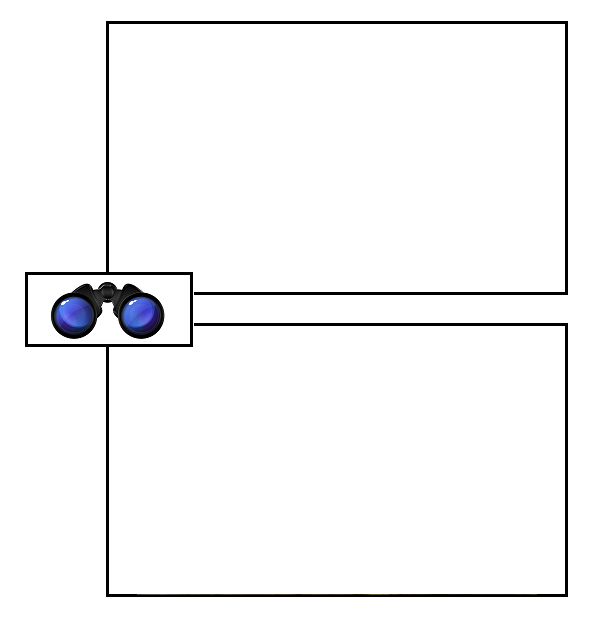
Download the image and fill the two spaces with what you will — whatever you can sketch, whistle, count out or scribble —

I think you’ll find the greatest reward comes when the two ideas, visuals, verbals, aurals you juxtapose are closely related yet drawn from distantly separated regions of thought.

At their best, such juxtapositions cross galaxies. My own most cherished example to date compares a night sky by Van Gogh with a von Kármán diagram of turbulent flow…

**

And where does this lead us? What becomes of CP Snow‘s famed Two Cultures?

Two great rows of pillars in Hesse’s hundred-gated cathedral, perhaps — best appreciated when one looks up, and sees the great vaulted roof, the magnificence of the arches between them.

In future Monday columns here on 3QD, I hope to bring you some further moves in the great game of correspondences, weaving together topics that have caught my attention in the preceding month — now in poetry, now on the morning news.

The leaps.

___________________________________________________________________________________________________
I’m happy to report that friend Bill Benzon made the 3 Quarks Daily cut and will be blogging there, and that friend Omar Ali is already one of their regulars.

Jeff Jonas, Nada Bakos, Cindy Storer and Puzzles

Thursday, September 19th, 2013

[ by Charles Cameron — at the intersection of filmcraft, tradecraft, and gameplay ]
.

**

IBM Fellow Jeff Jones has a powerful insight into puzzles and analytics which I explored in one of my early guest posts here, A Hipbone Approach to Analysis III. I quoted him thus:

The first piece you take out of the box and place on the work surface requires very little computational effort. The second and third pieces require almost equally insignificant mental effort. Then as the number of pieces on the table grows the effort to determine where the next piece goes increases as well. But there is a tipping point where the effort to determine where to place the next piece gets easier and easier … despite the fact the number of puzzle pieces on the table continues to grow.

and — being a theologian and poet, hence interested in creative leaps — I threw this in for bonus points, since in it he talks about epiphanies:

Some pieces produce remarkable epiphanies. You grab the next piece, which appears to be just some chunk of grass – obviously no big deal. But wait … you discover this innocuous piece connects the windmill scene to the alligator scene! This innocent little new piece turned out to be the glue.

**

That, being (at least a little) past — I was quoting Jonas back in 2010 — is prologue.

Yesterday I was listening to Nada Bakos, ex-CIA analyst and targeter, and more recently one of the stars of the HBO documentary Manhunt, which just won an Emmy — and which I have written about twice here on Zenpundit, first in Manhunt: Radicalization, & comprehending the full impact of dreams, and then in Manhunt: religion and the director’s eye.

Chelsea Daymon interviewed Nada Bakos on yesterday’s Loopcast, and I’d just got to the point, one minute and thirteen seconds in, where Bakos said the words that triggered my urgent need to reconnect with Jonas and his puzzle insights. She says:

It’s not unlike what an investigative journalist would do, when you’re piecing together an intelligence picture. You’re looking at disparate bits of information, and you’re trying to form them to make a puzzle. So from our perspective at the Agency, we were looking at it from signal intelligence, to human intelligence, to technical collection, foreign intel services — across the board, we were gathering this information from a variety of different sources. And any one of those pieces of information. in and of itself, may look innocuous, or not representative of what we’re trying to find, but when you add it to the larger puzzle, that’s when you can see if its going to fit. So it’s hard to sift through the chaff to find your actual information that you need to piece together.

I also wrote briefly about Manhunt in A feast of form in my twitter-stream today, quoting Bakos’ colleague Cindy Storer:

Even in the analytical community there’s a relatively smaller percentage of people who are really good at making sense of information that doesn’t appear to be connected. So that’s what we call pattern analysis, trying to figure out what things look like. And those people, you really need those people to work on an issue like terrorism, counternarcotic, international arms trafficking, because you’ve got bits and pieces of scattered information from all over the place, and you have to try to make some sense of it. … That takes this talent, which is also a skill, and people would refer to it as magic — not the analysts doing it, but other people who didn’t have that talent referred to it as magic.

Storer’s “magic” and Jones’ “epiphany” seem to me to have a great deal in common…

**

[ and yes, personal disclosure, I’ve been working for almost 20 years on games that teach that kind of magic, the whole of that kind of magic across all domains, and nothing but that kind of magic. ]

**

Back to Nada Bakos, and a crucial distinction between two types of analytic puzzle-solving:

From a predictive standpoint, if you’re looking at trying to gauge when or if an attack is going to happen, that is really difficult, and you’re going about looking at the data in a very different way. Because if you have a piece of intelligence that said that there will be an attack, but you don’t know the timing or location, your focus is going to be strictly on those two pieces.

That’s narrow focus. Wide focus, by contrast?

When you’re trying to look at an overall picture, you’re not — this is typical of intelligence gathering, when you don’t know what you have in front of you — you’re letting the information tell you what the picture is going to be. And that’s the objective challenge for intelligence analysis, and that’s what the Agency tries to drill into their analysts, to always let the information lead you, rather than you lead the information, so you’re…

**

Wait a moment, though — I’d like to come back to that — but just for the record, here’s what looks to be a parallel use of “leading” from a legal definition…

LEADING QUESTION, evidence, Practice. A question which puts into the witness’ mouth the words to be echoed back, or plainly suggests the answer which the party wishes to get from him. 7 Serg. & Rawle, 171; 4 Wend. Rep. 247. In that case the examiner is said to lead him to the answer. It is not always easy to determine what is or is not a leading question.

I’m hypothesizing that the idea here is, in effect, “to always let the witness lead you, rather than you lead the witness” — in the interests of justice, not of prosecution or defense… And that “justice” in this case parallels “objectivity” in the case of intelligence analysis.

Analysts may yawn and attorneys quietly splutter at this truism — yet when the same pattern crops up in two distinct fields, you can bet it has more general application. From an intel standpoint, it’s a matter of avoiding your own biases and assumptions, and dealt with as such in Heuer. In the arts, it’s this need to avoid painting what one thinks what one knows, rather than what one sees, that’s behind Betty Edwards‘ instruction to her students to draw an upside-down photo of Albert Einstein, as in her book, Drawing on the Right Side of the Brain, see p. 51. In music, it’s what permits the fresh interpretation of the Goldberg Variations by Glenn Gould, 1955 — and then years later in 1981, but Gould again — so very different from all previous interpretations.

It’s the stuff of creativity, and at its highest pitch, the stuff of genius.

**

But let Ms Bakos continue… Here’s another distinction she draws for us:

From a targeting perspective, your focus is, operationalizing the analysis. So you’re taking all that big picture and you’re doing something about it, so that is your intent from the get-go.

When you’re a traditional analyst, you’re actually writing pieces for the policy maker, and you’re adding to the larger picture so they can make decisions based upon that intelligence.

The second of these is clear enough, but I’d have a question for Ms Bakos about the first.

Roughly speaking –and I know the answer is likely to be a bit more complex than my formulation of the question — does this mean t hat the policy maker has by this point signed off on a “do whatever’s needed in your best judgment to achieve the stated goal”? — and if so, where is the threshold where targeting and execution take over from decision-making, in a Clausewitzian extension of the politics by other means?

**

Towards the very end of the interview, and having covered a number of topics that were specific to Iraq and al-Zarqawi and thus not pertinent to my interests here, Ms Bakos asks:

How do we effect change, how do we actually deprogram people to get out of these groups, these regional groups, this ideology, and I think we haven’t effectively tapped into that, yet. I think we’re always fighting yesterday’s war. So, I think we need to start looking forward as well: What’s the way out? Are we working with host governments to figure out how we help people to get out of al-Qaida, how do they get out of the situation that they’re currently in — because once they’re in I think it’s very difficult, for some of these younger followers, if they’ve become disenchanted, to move on.

That’s something I feel passionate about, since Leah Farrall posted a series on Children, jihad, agency, and the state of counter terrorism making much the same point in considerable, painful detail. I invite you to open that link in another window and bookmark it for later reading.

If I’m reading both Ms Bakos and Leah right, this is a serious and underappreciated issue, and one that is both humane and eminently practical.

** ** **

Okay, that’s the gist of what Manhunt tells us about the analytic process, as I see it. So this is where I’d like to take what Nada Bakos, Manhunt, and Cindy Storer tell us, view it through the lens of Jeff Jonas’ insight, and see where else that leads us.

This to me is the crux of the thing.

For myself as a curious mind and game designer, what this boils down to is an investigation of the gameplay involved inp roblem solving, when the game-board extends from the virtual to the real, from thought to action, from the ideal to the practicable…

Indeed, our board also extends from our own models and games via the Great Game (in both its intel and Afghan meanings) to the deep game of life itself, of which Plotinus observed “Men directing their weapons against each other- under doom of death yet neatly lined up to fight as in the pyrrhic sword-dances of their sport- this is enough to tell us that all human intentions are but play…” — and not forgetting Keith Oatley‘s contemporary interpretation of the metaphor in his Shakespeare’s invention of theatre as simulation that runs on minds.

The gameplay of life, then — as is it practiced by the intelligence analyst, by the investigative journalist as Ms Bakos points out — by curious minds, as the phrase goes — and by game designers. Which last consideration is why I’d like to invite Mike Sellers, Brian Moriarty, and Amy Jo and/or Scott Kim and others to add their wisdom to the mix, should they happen to read this post…

**

Alternate Reality Games (ARGs) are the ones I think of most easily whose boards include both virtual and real spaces. Myths, beliefs and hard-nosed realities all impact both the Israeli-Palestinian issue and such games about it as PeaceMaker. The warfare in Mjolnir’s Game is deliciously asymmetrical. Three-dimensional chess has different “levels” to its boards, but no metaphysical distances between them — my own story-telling chess variant (see Playing a double Game) has both competitive and cooperative aspects tied in to every board move…

What other examples should we be thinking about? What other game design rules and heuristics might we apply?

The end game as Jonas describes it, happens quickly — in the context of a puzzle in which the “big picture” was complete for the designer before the pieces were scattered for play to commence, in which all the pieces in play are in fact part of the final picture, with none of them originating in other games and tossed randomly into the box, where none of the pieces are “false” in the sense of false flags, lies, propaganda, dissimulations, and so on.

Compared to the possibilities of deliberately deceptive pieces, duplicative pieces, partially obscured pieces and pieces of unrelated puzzles, the technical issue of pieces arising in different media is relatively easily handled by purely technical means (this I assume, having worked briefly with an early version of Starlight, correct me if I’m wrong).

And it is here — also an assumption of mine — that the analytic, pattern-recognizing mind will have the advantage over the machine.

**

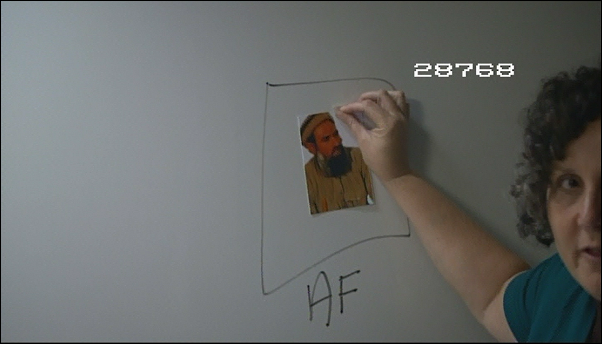
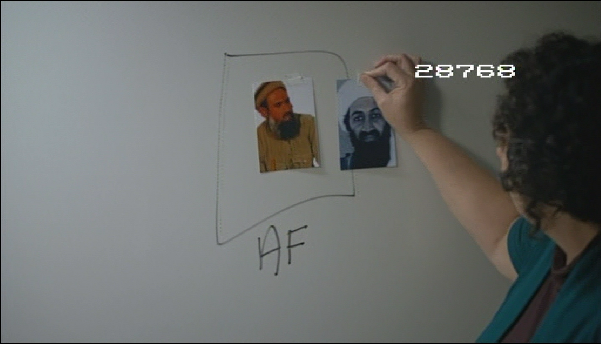
It’s the beginning of the game that interests me most — Jonas says that the moves are quickly made in the beginning, and in Manhunt there’s a moment where Cindy Storer pins the first puzzle piece — a photo of Abdullah Azzam, whose book The signs of Ar-Rahmaan in the Jihad of Afghanistan I’ve discussed before — into the first board space, which she’s labeled AF:

with the words:

Your starting point is Afghanistan. Abdullah Azzam is the Godfather of the Afghan jihad…

That’s a cinematic description of the process, of course, and there must have been a small flotilla of facts floating around in her brain — and the other brains working with her — at the time. Nevertheless, disciplined thought has to have a starting point, and Afghanistan, Azzam and the muj war against the Soviets offer the immediate context for the next face up and central focus of the pursuit, that of Osama bin Laden

whose photo she pins up with the words “and his partner is Osama bin Laden…”

**

For additional context, here are some other quotes from Manhunt about the process:

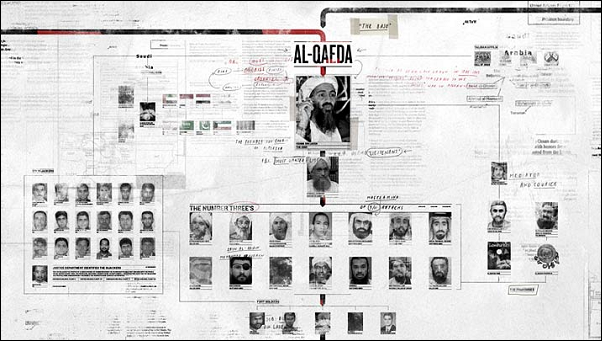
A link chart is the visual representation of a terrorist network and it’s what terrorism analysts spend much of their time building.

and:

My mental image is that, you know, I’m doing Jacob’s Ladder, you’ve got this string where you’re pulling the strings in your fingers, I feel like that’s what I feel I’m doing mentally.

and:

You know, trying to keep track of all the threads of various threats and which ones are real and which ones aren’t real and what connects to what. And, you know, people say, why didn’t you connect the dots? Well, because the whole page is black.

**

A sea of thoughts, then, in more than one mind yet strongly interconnected by whatever intel comes across the transom, conversations, memories, that needs to become physically represented in a way which represents links between the parties and their ideas, stated or surmised. With wild-cards, seepage, and needless duplication. Some oriented to materiel, some to morale: from munitions to Qur’anic meditations. A “semantic network“, with links as vertices, people and ideas as nodes (cf also “conceptual graphs“).

Something very like, in fact, Hermann Hesse‘s Glass Bead Game — only with a focus on threat, rather than conceptual elegance across the full range of human thought…

**

It’s a formidable task, then, moving first from copious scraps of intel to human minds that perform their own evaluative sorting. Here I’d invoke Coleridge‘s “hooks and eyes of memory” and suggest the process, like other forms of combinatorial insight, may require passionate examination, sub-conscious-threshold processing, and some reverie or rest time in which the unanticipated connection can be presented to consciousness… in a highly complex iterative process. And with each new connection or cluster of dots requiring is own drilling down for verification, and weighting adjustment so that salient masses and intriguing outliers are both held in steady remembrance…

— I think this whole process is what Ms Bakos was talking about when earlier she gave us the overall injunction, “you’re letting the information tell you what the picture is going to be” –_

And all this without the benefit of the “red and yellow thumbs” that Jonas talks about in jigsaw puzzles [ see interview here ], or more accurately, with the exact nature of the thumbs ranging from quantifiable links between telephones to near-stochastic leaps from a theological imperative to a tactic…

And with a board that doesn’t have the neat rectangular frame of a picture puzzle, where the frame is in fact the particular analyst’s account — a geographic area, a nation perhaps, or some other area of specific expertise. So there are no “easy corners” to find, just a buzz of data, a murmuration…

It’s magnificently hard. It’s epiphanic, it’s magical. Much of the magic takes place below the threshold of consciousness, but consciousness is not fond of admitting that. And Cindy Storer’s comments, to my ear, convey a whole lot of that magic without “capturing” it.

John Livingstone LowesThe Road to Xanadu: A Study in the Ways of the Imagination, is I’m not mistaken, is a guided tour through the superb analytic puzzle piece and dot connecting mind o Samuel Taylor Coleridge, and a fir bed-time read for analysts. And I could go on, but this is long enough already.

**

My thanks to HBO, the crew and cast of Manhunt — and congratulations on the Emmy.

We’re at the beginning of an understanding of how the mind puts puzzle pieces together, connects dots, spots needles in haystacks, and in general recognizes patterns and irregularities, at this point– and there’s much more to be uncovered.

  • I recommend the Loopcast with Nada Bakos, and the series in general.
  • I recommend the Greg Barker / HBO documentary, Manhunt
  • and you might also like to watch the fascinating mini-docu about the film’s title graphics
  • and read this comprehensive account of the titles
  • **

    Filmcraft, like tradecraft, goes an order of magnitude above and beyond what is easily noticed to achieve its effect…

    And damn, I still want time and attention to give that movie the close review it richly deserves!

    Glass Beads and Complexity

    Monday, May 27th, 2013

    [ by Charles Cameron — achieving something like closure on a post I started for Adam Elkus here, with a side dish along the way here ]
    .

    .

    It’s astonishing to me how closely complexity science is related to Hermann Hesse‘s Glass Bead Game.

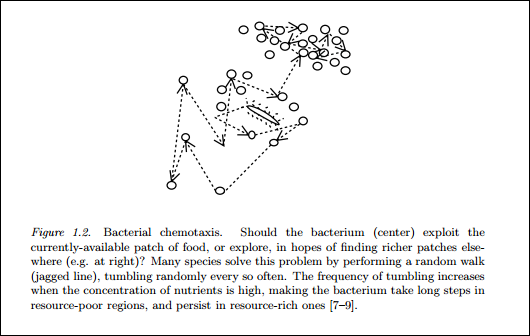
    Adam Elkus recently pointed those who follow him to Cosma Rohilla Shalizi, Methods and Techniques of Complex Systems Science: an Overview, and just a quick dip there gave me the graphic I’ve put at the head of this post, together with this quote about “patterns” as Shalizi understands that term:

    I mean more or less what people in software engineering do: a pattern is a recurring theme in the analysis of many different systems, a cross-systemic regularity. For instance: bacterial chemotaxis can be thought of as a way of resolving the tension between the exploitation of known resources, and costly exploration for new, potentially more valuable, resources (Figure 1.2). This same tension is present in a vast range of adaptive systems. Whether the exploration-exploitation trade-off arises among artifcial agents, human decision-makers or colonial organisms, many of the issues are the same as in chemotaxis, and solutions and methods of investigation that apply in one case can profitably be tried in another. The pattern “trade-off between exploitation and exploration” thus serves to orient us to broad features of novel situations. There are many other such patterns in complex systems science: “stability through hierarchically structured interactions”, “positive feedback leading to highly skewed outcomes”, “local inhibition and long-rate activation create spatial patterns”, and so forth.

    **

    Let’s start with patterns. The “people in software engineering” Shalizi mentions gleaned their use of the term “pattern” from the architect Christopher Alexander, author of the extraordinary, seminal book A Pattern Language, which in turn has hugely influenced computer science. Alexander distilled the essence of his thinking in his “Bead Game Conjecture”:

    That it is possible to invent a unifying concept of structure within which all the various concepts of structure now current in different fields of art and science, can be seen from a single point of view. This conjecture is not new. In one form or another people have been wondering about it, as long as they have been wondering about structure itself; but in our world, confused and fragmented by specialisation, the conjecture takes on special significance. If our grasp of the world is to remain coherent, we need a bead game; and it is therefore vital for us to ask ourselves whether or not a bead game can be invented.

    Manfred Eigen, Nobel laureate in Chemistry, called his book with Ruth Winkler-Oswatitsch Laws of the Game — and it deals with molecular biology, cellular automata, game theory, and games. But not just that — it is specifically written with Hesse’s concept in mind:

    We hope to translate Hermann Hesse’s symbol of the glass bead game back into reality.

    While we’re on about cellular automata, what about Stephen Wolfram? I don’t know that he talks about the Glass Bead Game himself, but at least three people talk about Wolfram’s book, A New Kind of Science, and/or his search engine, Wolfram Alpha as being strongly analogous to Hesse’s game — Jason Dyer, Graeme Philipson, and most recently, Mohammed AlQuraishi. Here’s a key para from Quraishi’s piece:

    I think the Game is an intriguing concept, and I think it may one day be realized. In fact I think we are already on our way toward realizing it. In the simplest and most general sense, mathematics and programming languages allow us to formalize all knowledge. Contenders for the language of the Game already exist, at least in principle. But we are further along than that. Search engines like Wolfram Alpha have already begun the process of formalizing diverse pieces of knowledge, unifying them in a single medium, and providing the means to connect and reason about them. A repeated example in the book, the mapping of musical compositions to mathematical formulas or even historical events, is eminently doable within Wolfram Alpha. Much remains to be done of course, and there is no “game” yet that can be played across the vast sea of all human knowledge, but some enterprising individuals have already gotten started on creating it.

    And then there’s John Holland, the “father of genetic algorithms”. Holland told an interviewer:

    I’ve been working toward it all my life, this Das Glasperlenspiel. It was a very scholarly game, starting with an abacus, where people set up musical themes, then do variations on it, like a fugue. Then they’d expand it to where it could include other artistic forms, and eventually cultural symbols. It became a very sophisticated game for setting up themes, almost as a poet would, and building variations as a composer. It was a way of symbolizing music and of building broad insights into the world.

    If I could get at all close to producing something like the glass bead game I can’t think of anything that would delight me more.

    **

    I’ve been working on a playable variant on the Glass Bead Game too, for twenty years quite consciously, and more if you count subterranean stirrings. And I don’t think glass beads, or stones, or chess or go pieces, or beads on an abacus, or strings of ones and zeros, or cells in an agent-based model for that matter, are the way to go. Which is not to say those approaches shouldn’t be tried, or don’t have remarkable things to teach us. I just don’t believe they give us quite what Hesse envisioned:

    a direct route into the interior of the cosmic mystery, where in the alternation between inhaling and exhaling, between heaven and earth, between Yin and Yang, holiness is forever being created.

    I think what’s important in Hesse’s game is that concepts that humans can grasp should reveal their stunning interrelations to heart and mind. And for that reason, the “moves” in my games [Hipbone, and more recently Sembl] consist of concepts — musical, verbal, visual, mathematical — and the links, the analogies, the “semblances” between them.

    **

    And thus the game is a search for analogies.

    The human mind must inevitably perform what Shalizi calls the “trade-off between exploitation and exploration”. Some thoughts are proximate to others, they can be developed without any special insight by regular “linear” thinking. We do this every day, every minute — but it is not particularly revelatory. It doesn’t solve thorny problems, much less create beauty. There is another mode of thinking, however, that leaps between thoughts that are not so “close” but are nevertheless deeply related. To leap the apparent distance between such deeply related thoughts, we deploy analogy and creative thinking, and that is where the aha! of revelation occurs.

    So I would suggest there is a close analogy here with the point Shalizi is making with the diagram atop this post. The human mind, to slightly paraphrase Shalizi’s caption, will “exploit the currently-available patch of food” for thought by linear, inside-the-patch thinking, but at full stretch it will also “explore, in hopes of ?nding richer patches elsewhere” — the “elsewhere” being attained precisely by “creative leaps” — by seeing semblances, patterns, analogies.

    And to return to my earlier post, Thinking outside the cocoon, of which this post is a continuation, and perhaps the completion….

    Shalizi’s “random walk” is thus also the archangel’s “zig-zag wantonness” in that great poem, Tom O’Roughley — when William Butler Yeats asks, “how but in zig-zag wantonness / could trumpeter Michael be so brave?” and writes, “wisdom is a butterfly / and not a gloomy bird of prey”…

    Thinking outside the cocoon…

    Thursday, May 16th, 2013

    [ by Charles Cameron — on caterpillars, butterflies, psyche and the alephs of Georg Cantor, with a glance at the vertiginous idea it might be “boxes all the way up and down”… ]
    .

    Let’s get the science — which is quite fascinating — taken care of first. Here’s our best current visualization of how a caterpillar, after crafting its cocoon, prepares to become a butterfly:

    **

    Words can sometimes tell us some things that images can’t — or explain things to parts of us that simply cannot comprehend them visually — so here for parallel processing is an account of part of the same business from Scientific American:

    How does a caterpillar rearrange itself into a butterfly? What happens inside a chrysalis or cocoon?

    First, the caterpillar digests itself, releasing enzymes to dissolve all of its tissues. If you were to cut open a cocoon or chrysalis at just the right time, caterpillar soup would ooze out. But the contents of the pupa are not entirely an amorphous mess. Certain highly organized groups of cells known as imaginal discs survive the digestive process. Before hatching, when a caterpillar is still developing inside its egg, it grows an imaginal disc for each of the adult body parts it will need as a mature butterfly or moth—discs for its eyes, for its wings, its legs and so on. In some species, these imaginal discs remain dormant throughout the caterpillar’s life; in other species, the discs begin to take the shape of adult body parts even before the caterpillar forms a chrysalis or cocoon. Some caterpillars walk around with tiny rudimentary wings tucked inside their bodies, though you would never know it by looking at them.

    Once a caterpillar has disintegrated all of its tissues except for the imaginal discs, those discs use the protein-rich soup all around them to fuel the rapid cell division required to form the wings, antennae, legs, eyes, genitals and all the other features of an adult butterfly or moth.

    **

    It’s just possible that the bear’s ability to “die” in the winter and “be reborn” in spring gave use the original cirumpolar bear cult — and more generally, a propensity to believe that resurrection from the dead might be a physical, existential human possibility.

    Humans watch animals pretty diligently — my old friend and mentor Wallace Black Elk once told me:

    We watch the deer, and when they’re sick they know which plant is their aspirin: they eat that green medicine, and drink water. So we have deer medicine. We don’t need the mass-produced kind.

    I don’t have the exact quote, but he also observed somewhat wryly that scouts from pharmaceutical companies used to watch him and see what medicines he used, in much the same way…

    And if there’s any natural process that humans have watched with equivalent metaphysical interest to that which they may have shown in observing the bear’s pattern of hibernation and return, it would have been the process of metamorphosis in butterflies — whose name in Greek, psyche, is also the word for soul.

    **

    WB Yeats had a sense of the butterfly transcending both day-to-day human logic and death itself, when he wrote in his poem Tom O’Roughley:

    ‘Though logic choppers rule the town,
    And every man and maid and boy
    Has marked a distant object down,
    An aimless joy is a pure joy,’
    Or so did Tom O’Roughley say
    That saw the surges running by,
    ‘And wisdom is a butterfly
    And not a gloomy bird of prey.

    adding just a few lines later:

    What’s dying but a second wind?

    **

    What I’d like to do here is to take us from the plodding science of linear thought to which Yeats was (among other forms of linearity) objecting, towards the science — and poetry — of complexity, of nuance.

    And I’d like to do it by skipping a couple of thoughts like a stone across water, inviting you to watch the ripples…

    These are the leaps that connect the dots.. the creative leaps. And some leaps, it seems to me, are bigger and more demanding than others.

    **

    Is the leap from cocoon to butterfly in Hutching‘s quote really quite a huge leap? It certainly keeps some of our best scientists busy uncovering its hidden secrets. And the leap from butterfly to tornado, that Lorenz made? That would appear to me to be a larger leap, requiring a different mode of perception. And skipping from Hutchings to Lorenz, can we skim our stone of thought even further?

    Putting two and two together is one thing: imagining “aleph null” for the first time, as Cantor did, that would be something else altogether. From two to four, I’m tempted to say, is a quantitative leap, while the imaginative leap from four, ten, or ten thousand to the alephs is qualitative.

    How should we recognize and connect widely separated — yet deeply entangled — dots? What would prove to be the richest and most profound of creative leaps? Is there a move that will take us not just out of this box into the box it came in — but out of a whole matrioshka nest of boxes?

    Those are the questions in my sandbox about now.

    **

    When we next meet, I’ll try to tie them in with this diagram that Adam Elkus recently pointed us to —

    and with Hermann Hesse‘s Glass Bead Game for good measure.


    Switch to our mobile site