zenpundit.com » sunday surprise

Archive for the ‘sunday surprise’ Category

Sunday surprise: peering digitally around corners 2: Blade Runner

Sunday, July 31st, 2016

[ by Charles Cameron — moving from a consideration of Holbein’s Ambassadors to a celebrated scene in Ridley Scott’s Blade Runner — and thence, wide-angle, to Kumbh Mela ]
.

Here’s the Bladerunner scene:

What Ridley Scott depicts is a camera with the ability to see around corners — a fantastic piece of science fictional cinematography, demonstrating a sufficiently advanced technology with a skill amounting to wizardry.

**

How close, though, can state-of-the-art cameras come to seeing around corners? Here’s what Nature has to say:

Andreas Velten, Thomas Willwacher, Otkrist Gupta, Ashok Veeraraghavan, Moungi G. Bawendi & Ramesh Raskar, Recovering three-dimensional shape around a corner using ultrafast time-of-flight imaging:

Abstract:

The recovery of objects obscured by scattering is an important goal in imaging and has been approached by exploiting, for example, coherence properties, ballistic photons or penetrating wavelengths. Common methods use scattered light transmitted through an occluding material, although these fail if the occluder is opaque. Light is scattered not only by transmission through objects, but also by multiple reflection from diffuse surfaces in a scene. This reflected light contains information about the scene that becomes mixed by the diffuse reflections before reaching the image sensor. This mixing is difficult to decode using traditional cameras. Here we report the combination of a time-of-flight technique and computational reconstruction algorithms to untangle image information mixed by diffuse reflection. We demonstrate a three-dimensional range camera able to look around a corner using diffusely reflected light that achieves sub-millimetre depth precision and centimetre lateral precision over 40 cm×40 cm×40 cm of hidden space.

Here’s another illustrative video:

**

Okay, seeing is simple, but we’re Zenpundit, so there’s gotta be a military angle we can see around, no?

Here are two possibilities — the first is called CornerShot:

while the second is called ShotView:

**

We’re still pretty far from Ridley’s Blade Runner, but the idea of seeing / shooting around corners has clearly caught the imagination of others.

Okay, those last two videos are for those interested in matters martial.
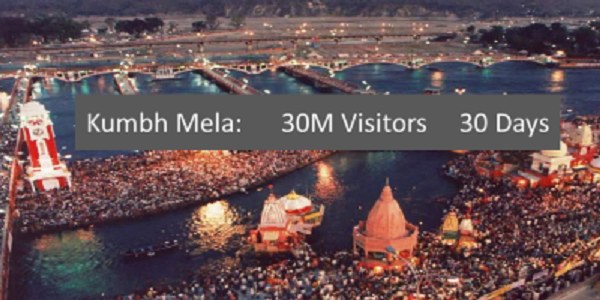
Kumbh Mela

For my own sake, and for the possible interest of blog-friend Pundita, let’s take a look at a video of Ramesh Raskar, head of MIT Media Lab’s Camera Culture research group and one of the authors of the Nature paper quoted above.

Here Dr Raskar is talking about that most fascinating of Hindu festivals — and largest of human gatherings? — the Kumbh Mela

Talk about wicked problems — and crowd-sourcing solutions — and genius — and the manifold intersections of the secular and the sacred!

Sunday surprise: peering digitally around corners 1: Holbein

Sunday, July 31st, 2016

[ by Charles Cameron — a saunter through London’s National Gallery with Holbein’s Ambassadors, a skull and a psalter ]
.

Let’s begin with Hans Holbein, The Ambassadors:

Holbein Ambassadors

**

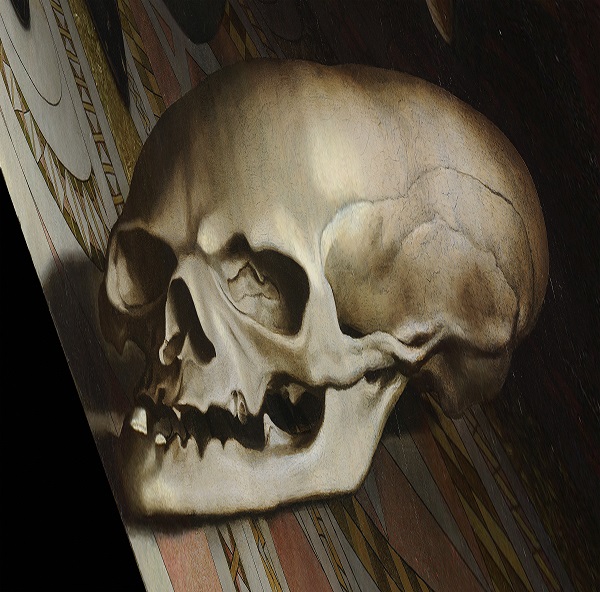
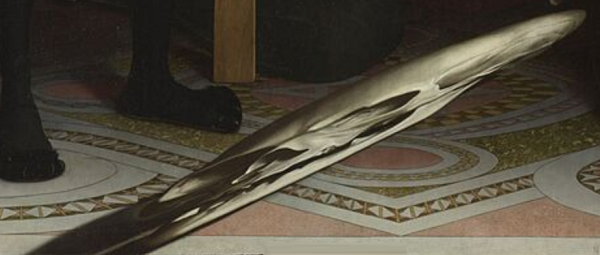
First up for consideration is this anamorphic skull detail:

Holbein detail anamorphic skull

The very oddly misshapen object in the foreground is in fact a skull, visible as such from the right position vis-a-vis the painting. It has puzzled countless people for ages, and no doubt considerably increased the painting’s fame in the process. The simplest explanation I’ve found is this one:

It has also been hypothesized that the painting is meant to hang in a stairwell, so that a person walking up the stairs from the painting’s right would be startled by the appearance of the skull. From such an angle, the skull appears in its correct aspect ratio.

Here’s the skull, resolved — to show it as it appears from the correct viewing angle — an angle from which the rest of the painting makes no sense, mark you:

Holbein_Skull

**

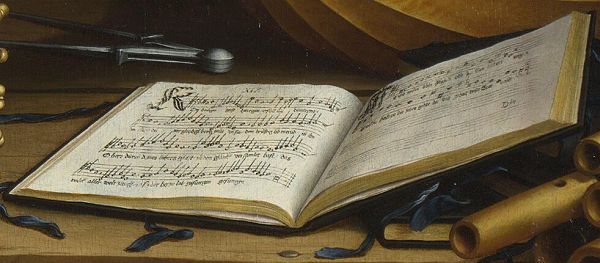
That’s the most striking detail in the painting, but also of interest is this Psalter detail:

Holbein psalter detail

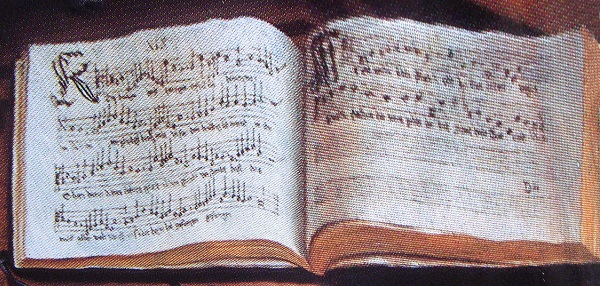
The psalter is depicted in the painting in the same perspective as the two figures, globe, carpet and so forth, but it’s at an angle to the viewer — and an enterprising fellow therefore decided to work computationnal magic and show us the psalter rectified, as we might see it if we were in the room, went over, and looked down at it:

Ambassadors_Lutherian_Psalms

**

All of this reminds me of another brilliant work of art, featuring an analogous shifting of viewpoint: Ridley Scott‘s Blade Runner, which I’ll explore in Part II of this two-part post.

A trumpet voice above Trump’s

Monday, July 25th, 2016

[ by Charles Cameron — for those wishing for discourse above the political fray ]
.

Yesterday, Sunday, I was going to post a “Sunday surprise” about a voice that transcends that of Donald Trump — the voice of Alison Balsom, trumpeter extraordinaire. But my thread linking Balsom and Trump was a slender one — Trump and trumpet — and I thought better of it, and deleted my reliminary notes for that post.

Today, though, I read Humera Afridi‘s Dance of Ecstasy: Bridging the Secular, Sacred, and Profane, and found therein:

Amjad Sabri, an eminent Pakistani qawwal -— a Sufi devotional musician in the tradition of world-renowned Nusrat Fateh Ali Khan, and son of the famous singer Ghulam Fareed Sabri of the Sabri Brothers — had been shot dead in his car in Karachi ten days earlier by the Pakistani Taliban. He’d been praising the Prophet Muhammad (pbuh) and his noble family a little too much for the Taliban’s liking. And so they had their way with him. In a nation inured to violence, Sabri’s death, nevertheless, struck at the communal soul of Pakistan. ..

Thousands of Pakistanis came out on the streets, united in grief, to protest Sabri’s death. Sabri was a child of Pakistan’s own soil. He belonged to a venerable, centuries-old musical dynasty. His spiritual attunement and the muscular faculty of his voice transported people to ecstasy, raising mere mortals above the denseness of an earthly, mired existence, above differences of class and wealth into a celebration of the Divine. Sabri’s music was a glorification. And it belonged to a distinct tradition of South Asian music, a legacy irrefutably inherent in the DNA of Pakistan, twinned to the devotional practice of Islam and its syncretic cultural roots in the region. Invoking a transcendent joy, Sabri’s qawwali created a milieu of harmony—completely antithetical to the Taliban’s backward, beclouded ideology of hate which thrives on sowing seeds of discord.

**

It’s that second paragraph I’m interested in, because it says so exactly what I was trying to get at in my deleted post about Alison Balsom: that “mere mortals” can be lifted, lofted “above the denseness of an earthly, mired existence, above differences of class and wealth into a celebration of the Divine”.

Here’s a taste of Amjad Sabri, for those who appreciate the Sufi tradition and the haunting ecstasies of the Qawwals:

**

And here’s Balsom, whose trumpet voice likewise lifts us, for those with ears more attuned to the western classical tradition:

*

— and best of all, though I’ve posted it here before:

Sunday surprise: Pokemon Go Go Go

Sunday, July 24th, 2016

[ by Charles Cameron — for Adam Elkus, John Robb & JM Berger among others ]
.

Three tweets:

*

*

**

I find that last one pretty interesting, and would like to juxtapose it with a para from Michael Moore‘s piece — almost certainly the only piece of his writings I’ve actually downloaded onto my hard drive — Five Reasons Why Donald Trump Will Win:

The fire alarm that should be going off [CC: for Hillary supporters] is that while the average Bernie backer will drag him/herself to the polls that day to somewhat reluctantly vote for Hillary, it will be what’s called a “depressed vote” – meaning the voter doesn’t bring five people to vote with her. He doesn’t volunteer 10 hours in the month leading up to the election. She never talks in an excited voice when asked why she’s voting for Hillary. A depressed voter. Because, when you’re young, you have zero tolerance for phonies and BS. Returning to the Clinton/Bush era for them is like suddenly having to pay for music, or using MySpace or carrying around one of those big-ass portable phones. They’re not going to vote for Trump; some will vote third party, but many will just stay home. Hillary Clinton is going to have to do something to give them a reason to support her — and picking a moderate, bland-o, middle of the road old white guy as her running mate is not the kind of edgy move that tells millenials that their vote is important to Hillary. Having two women on the ticket – that was an exciting idea. But then Hillary got scared and has decided to play it safe. This is just one example of how she is killing the youth vote.

Department of unintended consequences and black swans:

Who’d have thought a Japoanese telephone-based game might have an influence on the demographics of democracy in the US of A?

Sunday’s second surprise — the Van Gogh DoubleQuote

Sunday, July 17th, 2016

[ by Charles Cameron — Van Gogh, Rilke, El Greco, Von Kármán. Hokusai, Jakob — rich correspondences between singificant items in widely separate disciplines ]
.

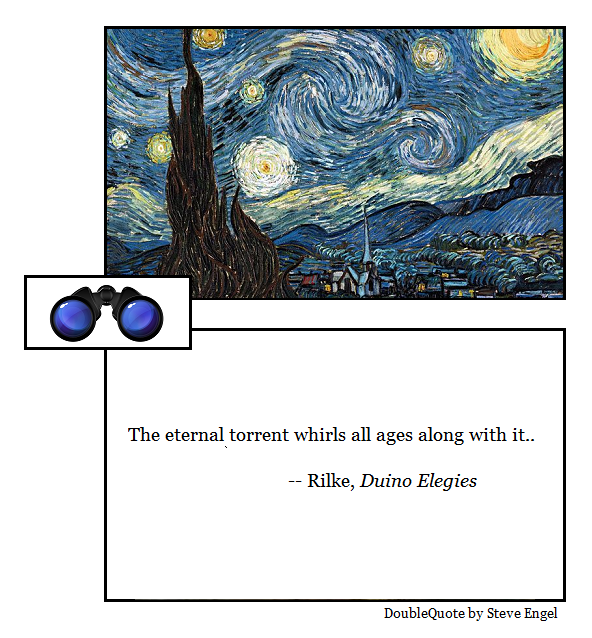
My friend Steve Engel suggested this variant on my personal favorite DoubleQuote — the one pairing Van Gogh with Von Kármán — and as a lover of Rainer Maria Rilke I very much appreciate his suggestion, which bridges painting and poetry as my original DQ brdges arts and sciences:

SPEC DQ Gogh Rilke Steve Engel

**

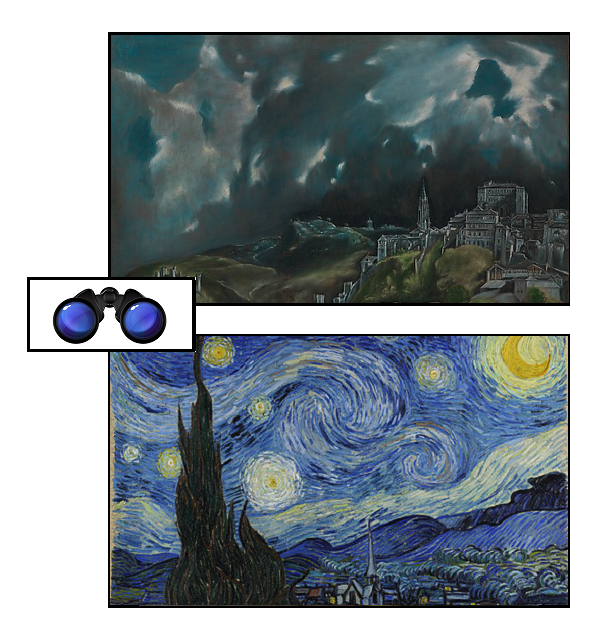
I’ve also featured that particular van Gogh painting in another DQ, this one showing the sky as painted by El Greco and Van Gogh:

SPEC DQ greco gogh

El Greco was first among my loves in painting, and I’ve long thought that the differences between how El Greco sees the sky and how Van Gogh sees it could stand in for the differences between religions — you don’t see Van Gokkites attacking El Grekkites in museums on account of the different visions of their preferred painters, and if we could view religions as visionary rather than prescriptive, taking from them what a poetic, metaphoric, non-literal, non-fundamentalist, non-reductionist reading would approve, we might be a little farther on our way towards interfaith harmony, and away from religiously-sanctionable violence.

I’m thinking here of St Francis‘ meeting with the Sultan Malik al-Kamil, and more recently Thomas Merton‘s meetings with Buddhist contemplatives, Sufis and the like..

**

Here’s the Von Kármán / Van Gogh DQ, which I value in light of Hermann Hesse‘s Glass Bead Game as a clear bridge between one of the crucial dualities of recent centuries — the needless and fruitless schism between the arts and sciences, which has given rise not only the rantings of Christopher Hitchens and his less elegant disciple Bill Maher, but to such other matters as the Papal condemnation and “forgiveness” 359 years later of Galileo Galilei, Charles Babbage‘s Ninth Bridgewater Treatise, Andrew White‘s A History of the Warfare of Science With Theology in ChristendomW, and CP Snow‘s The Two Cultures:

karman gogh

**

And finally, here’s an ugraded version of the other DQ of mine that seeks to bridge the arts and sciences — featuring Hokusai‘s celebrated woodblock print, The Great Wave off Kanagawa (upper panel, below) and Jakob aka nikozy92‘s fractal wave, which I’ve flipped horizontally to make its parallel with the Hokusai clearer (lower panel) — Jakob‘s is a much improved version of a fractal wave compared with the one I’d been using until today:

SPEC-DQ-Hokusai-fractal v 2.0 minikozy92


Switch to our mobile site