zenpundit.com » 2010 » September

Archive for September, 2010

Summer Series 2010: WAR by Sebastian Junger

Wednesday, September 8th, 2010

Summer Series 2010: Reviewing the Books! has begun. This review was originally posted in June, 2010 and is being re-posted as part of Summer Series:

WAR by Sebastian Junger

I just finished reading my courtesy review copy of WAR by journalist and author Sebastian Junger, on his firsthand observation of the war against the Taliban in the Korengal Valley, waged by the soldiers of the 2nd Platoon of Battle Company. I cannot say that I found WAR to be an enjoyable read – though Junger is a polished writer – a more accurate description is that WAR is powerful, thought-provoking, at times moving and, ultimately, a very disturbing account of the war in Afghanistan.

Junger, whose previous works include The Perfect Storm: A True Story of Men Against the Sea and Fire, was embedded along with photojournalist Tim Hetherington, with 2nd Platoon during their COIN campaign in Korengal, a mission that resulted in some of the bloodiest firefights and highest American casualties of the Afghan war and withdrawal from a rugged valley sometimes known as “Afghanistan’s Afghanistan”. The Korengalis, related to the people of Nuristan, are noted for their xenophobic hostility to outsiders, which was directed at times toward the Taliban as well as Americans. Junger reports that the US only succeeded in controling a quarter of Korengal and contesting roughly half of the six mile by six mile valley with the Taliban and local “accidental guerrillas”motivated by money, excitement, religious zeal or revenge to attack the Americans.

WAR is not an especially “political” or “policy” book discussing the war from some remove. Junger’s primary interest are the men of second platoon at Restrepo, an outpost dedicated to the memory of a valorous medic who had been killed. O’Byrne, Anderson, Stitcher (who has “INFIDEL” tattooed across his chest), Jones, Moreno, Bobby to name just a few soldiers Junger interviewed and witnessed how they lived in the moment. That moment could comprise the adrenaline high of combat, agonies of grief, anticipatory tension before the next ambush, the angst of boredome behind the wire and especially the iron bonds of brotherhood in a small unit tempered by fire.

What comes through in War, aside from the extremity of the terrain and the uncertainty of ever-present danger, men being shot without warning by the enemy, even in Restrepo, is how very few men are actually involved in combat. Battle Company is the vaunted “tip of the spear” but when only a few hundred men were taking a wildly disproportionate percentage of all combat contacts in a nation the size of Afghanistan ( Junger cites 20 %) the spear begins to look more like a tiny sewing needle connected to a Leviathan-like noncombatant-administrative tail, surreally outfitted with fast food courts.

There’s a peculairly granular quality to Junger’s WAR, the grittiness of the squalid conditions in which soldiers live, the depths of their physical sufferings and mental exhaustion, their primal fear of letting their comrades down in battle and being responsible for getting friends killed. There are also epiphanies of bravery and carrying the day against the odds, men living who but for chance would have died on some rock strewn hill and lusty celebration after the deaths of their enemies. The sort of politically incorrect, atavistic, jubilation that is culturally frowned upon by people who are comfortably safe and far away.

What disturbed me most about WAR was not just how few Americans are carrying the burden of the combat in Afghanistan but how disconnected these few soldiers and their sacrifices are from the rest of the military itself. Junger’s epilogue with O’Byrne, a fine soldier who is a major figure in the book, and his inability to readjust and shift from the battlefield to garrison or civilian life is deeply depressing. “The Army’s trying to kill me” O’Byrne declared, finding a momentary refuge in alcohol, but little help from the military bureaucracy.

Junger attempted to show the war in Korengal as seen from the perspective of the privates, NCO’s and junior officers of Battle Company who lived and died there, from his interviews and his own participation in their patrols as they came under fire or as they gingerly parleyed with Korengali elders in isolated villages. Eschewing theory or a historian’s search for causation, Junger attempts to let the soldiers words and actions drive the narrative.

Sebastian Junger’s WAR is raw and undecorated by sentiment.
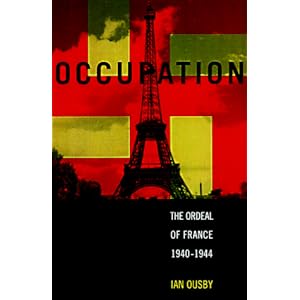
Summer Series 2010: OCCUPATION: The Ordeal of France 1940-1944

Tuesday, September 7th, 2010

Summer Series 2010: Reviewing the Books! has begun. First up is a book that was a gift from my regular guest-blogger, Charles Cameron:

Occupation: The Ordeal of France 1940-1944 by Ian Ousby

“France Fell because there was corruption without indignation”
                                                     – Romain Rolland

“‘Stalin let fly with some choice Russian curses and said that now Hitler was sure to beat our brains in.”
                                                     – Nikita Khrushchev, on the Fall of France.

 One of the mystifying events of twentieth century military history is the rapid collapse and defeat of France in 1940 under the tank treads of von Rundstedt’s and Guderian’s panzers. France, an ancient great power, possessed of a vast colonial empire and a well-equipped army, which had held out through four years of terrible trench warfare in the Great War, was brought to her knees in a mere six weeks despite having twice the number of guns and a third more tanks than the Wehrmacht, plus the aid of 300,000 Tommies of the British Expeditionary Force. Equally remarkable as their destruction in combat operations, was the bewildering speed with which the French, a people with centuries of martial glory and valorous performance on the battlefield, acquiesced to German occupation and quietly resigned themselves to vassalage in the Nazi New Order. It is this complex and depressing history that Ian Ousby seeks to explain in OCCUPATION: The Ordeal of France 1940-1944. 

Ousby, who made extensive use of French primary and secondary source material, peels away the hazy mist of postwar Gaullist revisionism to show a France grown weary democracy, of the bitter political divisions intrinsic to the Third Republic, suspicious of Jews, antifascist refugees and perfidious Albion, resentful of having to shoulder the burdens of war and all too eager to lay them down at the first opportunity. Ousby quotes an Army officer and later Resistance leader, Henri Frenay:

Then I saw our men, who had fought so well right up to the last moment, throw down their weapons, cast away their equipment and join together dancing on the road or in the clearings. Forgotten was the disaster, the surrender, self-respect, the dignity which the defeated should maintain in the presence of the victor. No, I was not wrong: in the looks of the young German soldiers who passed I read astonishment and contempt.

Compiègne in 1940 is not to be confused with Appomattox.

Ousby carefully parses distinctions, now long forgotten, between the various factions among the French who struggled to accept the reality of defeat: leftist intellectuals like Sartre and his circle, antiquarian reactionaries like Charles Maurras, the Vichy regime, Petainiste cultists, the Fascist ultra-Collabos of Paris and the brutal Miliciens, the Resistance, the Free French of General Charles DeGaulle and ordinary citizens scraping to get by under increasingly bleak conditions. What stands out as theme in Ousby’s work is how widely unrealistic illusions were embraced by the French in their acclamation of Marshal Petain’s assumption of power, illusions that the Germans were eager to humor and the deeply felt pain as self-deception gradually failed to hide bitter truth from the French. Ousby demolishes the idea that the Fall of France can be laid at the door of Weygand, Petain, Laval and a few deluded Fascists at Je Suis Partout.

Which is not to say that the Third Republic’s misguided politicians, the rulers of Vichy and their more extreme Fascist ultra-collabo rivals do not loom large OCCUPATION. The vainglorious ego and senile cunning of Marshal Henri Petain, as the national hero of Verdun postulates collaboration as the highest form of patriotism, is distrurbing. He used his moral authority to give benediction to a shabby, puppet regime based on the long-nursed grievances of the French far-right against liberalism, democracy, the Jews, secularism, urbanism, and all elements the Third Republic inherited from the French Revolution except a narrow, provincial, variant of nationalism.

If the cost of Petain’s papier-mache cult of personality was merely France’s dignity, the price of Pierre Laval’s exercise of power was Vichy France’s truckling subservience to Nazi Germany. Oily, opportunistic and corrupt, Laval had his grasping fingers in every sordid pie, from banal looting to collaborating in the Holocaust to sending Frenchmen into slave labor in German factories and mines. It was Laval who created the thuggish, Fascist gendarmerie, the Milice. Hitler could not stand him but found Laval useful enough that the German Ambassador, Otto Abetz, acted as Laval’s political godfather, as he did to a host of sinister and deranged French ultra-collabos and Parisian gangsters on the Nazi payroll. Unlike the aged Marshal Petain,  Laval would die before a firing squad as a traitor to France.

A weakness of OCCUPATION is that the sections on the aftermath of liberation, the settling of accounts by the Resistance and the restoration of the Republic are too short in light of the national trauma that Ousby details. While present in a series of chapters these facets are covered by Ousby with a lighter hand, mirroring, perhaps unintentionally, the desire of the French to put the Occupation and Vichy behind them as quickly as possible. They could easily have been extended by about half again their actual length, examining a period of postwar history that has been understudied.

OCCUPATION can be summed up perfectly in its’ subtitle – “the Ordeal of France”.

Rofer at Chicago Boyz

Saturday, September 4th, 2010

Left of center Blogfriend Cheryl Rofer cross-posts at conservative-libertarian Chicago Boyz to debate Lexington Green:

Others’ Shoes

Lexington Green is politically conservative, but he and others at Chicago Boyz have been willing to put up with me; I respect them, too, because they think out what they’re about. I think they actually listen to me, too, even as we disagree.

So when Green’s post was endorsed by Glenn Beck, I realized that this might be a way to get into his admirers’ minds. Green begins with a John Boyd hierarchy that I haven’t spent much time with; this is another of my departures from my friends at Chicago Boyz. But I suspect that that part can be skipped with little loss. He’s saying that Beck is taking a broad view, going up a couple of levels.

But I don’t feel like I get the rest of it. I can do a sentence-by-sentence exegesis, but that wouldn’t be quite right. I’m trying to get into Green’s and Beck’s heads, not dispute them. But there are barriers. Since I wrote that, Green has added another update, which makes some things clearer. I’ll get to the update later.

One is that so much of what Beck offers is factually flawed. Green is an intelligent person; how can he miss that? Perhaps because the bigger things he talks about in the post are more important to him. But those factual flaws are a barrier to me. A lack of fact is a poor foundation for anything to come after.

What Green likes is Beck’s creation of a large narrative.

Beck is building solidarity and cultural confidence in America, its Constitution, its military heritage, its freedom…

Beck is creating positive themes of unity and patriotism and freedom and independence which are above mere political or policy choices, but not irrelevant to them.

This sort of narrative is indeed attractive; I have wished for a vision that can unite Americans, that would provide a solidarity that we can rest on, a positive vision.

But there is a double-mindedness to Green’s analysis that is another barrier to me. I agree that we need unifying themes for us as Americans. Period. Unfortunately, it’s easy to unify around an enemy, and, while talking about solidarity and unity, Green develops an enemy, “the Overlords”, and a sense of aggrievedness. Since “the Overlords” are Americans too, that sense cannot be the basis for unity. But that duality is in Beck’s words too: he condemns President Obama for a cult of victimization, and then tells his followers how victimized they’ve been. And for him and for Palin, there are very definitely an “us” and a “them.” Apparently I am one of “them.”

Read the rest here or here.

Summer Series 2010: Reviewing the Books!

Saturday, September 4th, 2010

Every year I make an effort to increase my reading of books during the summer months. Inevitably, I fail at completing whatever overambitious reading list that I compose while somehow finding time to read other books that were never on the list. This year was no exception.

Starting this weekend, I am going to be reviewing all the books I did read from late May to early September. It was an eclectic collection and I hope to complete this series of posts by mid-September. A few reviews that have already appeared in this time period will be re-posted to make the series complete.

Readers are free to offer comments and recommendations about their own favorite summer books or their idiosyncratic reading habits as the series rolls along……

Lexington Green and the Glenn Beck Show

Friday, September 3rd, 2010

My fellow Chicago Boyz blogger and co-author, Lexington Green, has hit the big time – as a story on the nationally broadcast Glenn Beck Program . Having written an incisive post on the strategic Boydian aspect of Beck’s recent rally at The Lincoln Memorial, Lex today discovered that his analysis would be read on the air by Beck himself:

Glenn Beck: This guy gets it

GLENN: All right. So this guy, Lexington Green, I’m assuming that’s not his real name, writes in Chicagoboyz.net: I think I see what Glenn Beck is doing.

I think this is the only guy that really gets it. The Glenn Beck rally is confusing people. Why? He is aiming far beyond what most people consider to be the goalposts. Using Boyd’s continuum for war, which, you are all for that one, right, Pat?

PAT: Sure. Boyd’s continuum? How many times have we talked about Boyd’s continuum?

GLENN: Okay. Well, let’s make it once. Material, intellectual, and moral. He is using for political change elections, institutions and culture. Beck sees correctly that the conservative movement has only had limited success because it’s good at Level 1, the elections, for a while. Weak at Level 2, institutions. And barely touched Level 3, culture. Talk radio and the tea party are Level 3 phenomena, popular outbreaks which are blowing back into politics. Someone who asks what the rally has to do with the 2010 election is missing the point. Beck is building solidarity and cultural confidence listen to this. This is it.

PAT: A smart guy…..

Agreed. 

Read the rest of the transcript or listen to the audio here.

I have never watched Glenn Beck on TV, except a brief snippet of his interview with Sarah Palin, but as a major media personality, it was very gracious of him to reach out and acknowledge Lexington Green. That level of exposure is something that has been a long time coming for Lex, and IMHO, it is richly deserved.

Having gotten to know Lex in the last few years well enough to call him a friend, and having been a guest a number of times at his book-lined home, I can attest that Lex’s keen intellect and depth of knowledge gives his writing the cultural verve that deserves a larger audience than our humble corner of the mil/strategy blogosphere. He’s one of those small minority of bloggers toiling out there who has the right stuff to play at a much higher level.

Congrats Mr. Green!


Switch to our mobile site