zenpundit.com » 2011 » January

Archive for January, 2011

Narcos Over the Border

Friday, January 21st, 2011

Narcos Over the Border: Gangs, Cartels and Mercenaries by Dr. Robert J. Bunker (Ed.)

Just received a review copy courtesy of Dr. Bunker and James Driscoll of Taylor & Francis – could not have arrived at a better time given several research projects in which I am engaged.

The 237 page, heavily footnoted, book is organized into three sections: Organization and Technology Use by the narcos networks, Silver or Lead on their carrot and stick infiltration/intimidation of civil society and the state apparatus, and Response Strategies for the opponents of the cartels. Bunker’s co-authors Matt Begert, Pamela Bunker, Lisa Campbell, Paul Kan, Alberto Melis, Luz Nagle, John Sullivan, Graham Turbiville, Jr., Phil Wiliams and Sarah Womer bring an array of critical perspectives to the table from academia, law enforcement, intelligence, defense and security fields as researchers and practitioners.

Looks good – will get a full review here at a later date, but a work that will definitely of interest to those readers focusing on national security, COIN, 4GW, irregular or Hybrid war, terrorism, transnational organized crime and black globalization.

Best Books About Reagan

Thursday, January 20th, 2011


From my colleague, Lexington Green at Chicago Boyz:

Best Books About Reagan

ChicagoBoyz will be hosting a roundtable discussion to celebrate the centenary of the birth of President Reagan, the week of February 6th 2011.

In the meantime I would like to get the views of our contributors and readers on what are the best books about Reagan, the Reagan presidency, the Reagan era. Please leave comments with your favorites.

I note that President Obama was recently reading Lou Cannon’s book The Role of a Lifetime, which is supposed to be very good.

I have read and enjoyed several books about Mr. Reagan, his presidency and his era. I will restrict myself to one favorite. If I had to pick one, I would give the palm to Peggy Noonan’s book What I Saw at the Revolution. Used copies are available for a penny. This book captures the impact Mr. Reagan had on our national morale, which is not always captured in other writings about him. I say this despite still being mad at Ms. Noonan about her unforgivably uncritical response to Mr. Obama’s candidacy.

I am currently reading John O’Sullivan’s book, The President, the Pope, and the Prime Minister: Three Who Changed the World. I am about one third done with it and it is excellent.

As I said in the comments section at Chicago Boyz, I concur that Cannon’s The Role of A Lifetime and Noonan are the place to start.

There was a prolific outpouring of memoirs by former members of the Reagan administration in the years during and after his time as president. I think we can even divide the lit into books about (or by, at least nominally) Ronald Reagan and those about his administration.

Here are some of my recs….

On Ronald Reagan:

An American Life: The Autobiography

Reagan: In His Own Hand

The Reagan Diaries

I like starting a subject by looking closely at what they had to say for themselves. Reagan’s diaries and private correspondence put the lie to the “amiable dunce” smear made by Clark Clifford (a decidedly nasty-edged, lawyer-courtier of Democratic presidents who ended his own long public career exposed as a corrupt dotard, thus proving George C. Marshall’s ability to size up a man’s character was inerrant).

On the Reagan Administration:

Inside The National Security Council by Constantine Menges

Unfortunately, I believe this one is out of print. Dr. “Constant Menace” details the intrigue at the NSC and State by officials who were less than committed to Reagan’s foreign policy initiatives, in particular the Contras and SDI. Menges, the late brilliant, often insufferable, old-style neoconservative gets a thumbs up from me for his capacity to infuriate State Department officials and his geostrategically incompetent and socially inept boss, NSC Adviser Col. Bud McFarlane.

Casey by Joseph Persico

Liberal biographer Joe Persico paints a complicated but at times hagiographic picture of his close friend, CIA spymaster and Reagan political adviser, William Casey. Strong emphasis on Casey’s crusade against the USSR, his unprecedented role for a CIA chief in foreign policy and the ideological struggle over the control over Reagan’s foreign policy. I have a great deal of admiration for Bill Casey and wish someone like him were running the IC today. We’d all be a lot better off.

The Triumph of Politics: Why the Reagan Revolution Failed by David Stockman

The mendacious, arrogant and disloyal ex-Congressman David Stockman nevertheless manages to have an array of interesting, insightful, amusing, if unflattering, anecdotes and opinions about key domestic policy players in the early Reagan White House and in the Democratic leadership in Congress, whom Stockman called “the politburo of the welfare state”. While it was Stockman who failed Reagan rather than the reverse, this book is the most interesting memoir by far of the “dissenters” who left the administration under a cloud.

Turmoil & Triumph by George Schultz

This is not an interesting memoir. It is a ponderous, dull tome, which is surprising given Shultz’s critically acclaimed intellect and forceful persona. The reason for inclusion here is that Schultz obviously felt a duty to “set the record straight” about his battles over foreign policy with Cap Weinberger, Bill Casey and several NSC advisers and his memoir contains a wealth of minute detail about US foreign policy and national security. An invaluable resource.

What books on or about Ronald Reagan would you suggest?

Quantum COIN

Tuesday, January 18th, 2011


With quantum mechanics being used as a metaphor.

The New Physics: Key to Strengthening COIN by  A. Lawrence Chickering

….At the present time, most of what is being done for COIN is driven by old physics concepts, while many things we ought to be doing are understandable more in terms of the new physics.

One can see the difference between these two concepts in terms of the distinction between helping and empowering.3 The importance of this distinction is implicit in the widely quoted statement that T.E. Lawrence made in 1917 about the importance of empowering people and giving them ownership by letting them do things. -Do not try to do too much with your own hands,? Lawrence wrote.4 -Better the Arabs do it tolerably than that you do it perfectly. . . .?5 Helping is a powerful example of simple, Newtonian causation; it produces -concrete, measurable results,? which are the central concern of most philanthropy and donor programs. Unfortunately, the concrete results it produces are far weaker than the outcomes that result from empowerment and ownership.

Helping? is Newtonian and objective. You build a well, and the -measurable result? is a well. -Empowering? and -ownership? are post-Newtonian and subjective. You cannot -see? empowerment or ownership. These concepts have power when they are felt by people. Following Lawrence‘s statement, empowering and ownership are the key in COIN.

Empowering people, encouraging them to do things for themselves, shows the importance of non-local causation and results based only on probabilities. When a local community becomes empowered, there is no certainty what it will do. They will do things people care about-things they value. If you work in 100 communities, you cannot say what each village will do, but you can predict that some percentage will build wells, and some other percentage will build schools-and so on.

You know that empowering will not produce the -concrete, measurable results? you can get if the -helper? does the work, but when the helper does the work, there will be no community ownership and no sense of responsibility for security or maintenance of the -improvement?. With empowerment and ownership, people will protect a well or school and will maintain it. That explains why the well built by -an Arab? (Lawrence‘s phrase) is worth so much more than one built by -us? (the helpers).

The author has a solid point about top-down, outsider-controlled, hierarchically-organized aid activities cultivating an attitude of dependency, passivity or fatalism in populations that COIN forces are attempting to win over.

If we see symptoms of “welfare dependency” and disengagement from civil society in American neighborhoods with minimal levels of employment, high levels of violent crime and atomized social structures, as partly the product of intervention by social workers, police, state court systems and Federal programs, how much more so is this the case with third-country COIN? With bad people running around with RPG’s and AK-47’s? What would you, the impoverished and unarmed farmer of the village do? Stick out your neck? Or keep your head down?

Untangling two words

Monday, January 17th, 2011

[ by Charles Cameron ]

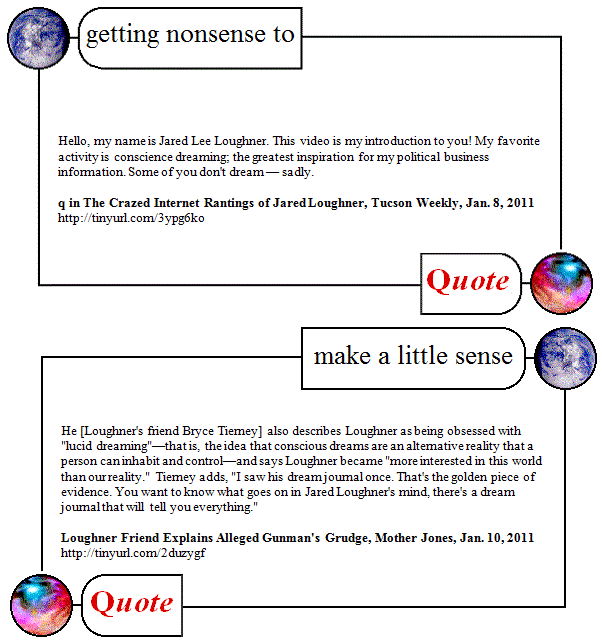
I’d like to take one small data-point and bring it into sharp focus with what lit critics would call a close reading of a two-word phrase from one of Loughner’s videos.

Maybe it’s because in French conscience means both what we’d call conscience and consciousness in English, when I read the weirdly stilted prose of Jared Loughner with its curious insistence on syllogism, the phrase “conscience dreaming” suggested “conscious dreaming” to me — and I wondered whether Loughner wasn’t perhaps thinking of the activity called “lucid dreaming” in which one knows while dreaming that one is dreaming, and begins to “direct” the dream in much the same way in which a film-maker directs a film.

The first quote in this DoubleQuote is from one of Loughner’s videos — the second, which confirms my hypothesis, quotes a friend of his.

I am not suggesting that “lucid dreaming” is responsible for Loughner’s actions — I’m not sure that anything or anyone is, including Loughner himself.

My point is that here as elsewhere, figuring out what the allusions in an unfamiliar rhetoric mean is an important step in understanding the mental processes that produce it.

Lucid dreaming is one clue in the tangled mess that was Loughner’s state of mind that day…

Announcement: The Ronald Reagan Roundtable at Chicago Boyz

Monday, January 17th, 2011

February 6th 2011 marks the centennial of the birth of America’s 40th president, Ronald Wilson Reagan and it is an appropriate time to reflect on the legacy of a man whose presidency altered the course of his party, his nation and the world. It is no exaggeration to say that events set in motion by the Reagan administration are still unfolding today and the ideas and values championed by Ronald Reagan continue to shape our public policies and frame our political discourse.

Therefore, to commemorate and debate this important legacy, The Ronald Reagan Roundtable, hosted at Chicago Boyz blog will begin February 6th and end on the 16th.

Past Chicago Boyz Roundtables have featured discussions about specific books – On War by Carl von Clausewitz, Science, Strategy and War by Col. Frans Osinga and The Anabasis of Cyrus by Xenophon. They were well-regarded and thought-provoking enterprises. This roundtable will be a little more like the last one on Afghanistan 2050, in that there is no set book to evaluate but a wide-open and free-wheeling discussion of Ronald Reagan, his administration and the historical record.

Contributors will be free to address the topic narrowly or broadly, from Left, Center or Right, in scholarly or polemical tone, with a focus on the present or the past, at whatever length or number of posts they feel is required. Book reviews of the burgeoning number of titles related to Ronald Reagan and his times are also very welcome.

Participants will be encouraged to comment upon one another’s posts and interact with the readers who leave comments but that is not obligatory, contributions can also stand on their own.

Those interested in in joining the Ronald Reagan Roundtable should contact me or Lexington Green and we will make the arrangements with a final “head count” to be announced on or about February 1st

Hope to see you there!

“Do they mean peace, or do they mean we just want to be left in peace? There can be no real peace while one American is dying some place in the world for the rest of us. We’re at war with the most dangerous enemy that has ever faced mankind in his long climb from the swamp to the stars, and it’s been said if we lose that war, and in so doing lose this way of freedom of ours, history will record with the greatest astonishment that those who had the most to lose did the least to prevent its happening. Well I think it’s time we ask ourselves if we still know the freedoms that were intended for us by the Founding Fathers.”
  – Ronald Reagan


Switch to our mobile site