zenpundit.com » 2011 » May

Archive for May, 2011

Gamification: al Awlaki loses big points

Friday, May 13th, 2011

[ by Charles Cameron ]

.

There’s been talk about “gamification of jihad” recently, the idea being that on the jihadist forums you get points and seniority for posting often, your posts getting thumbs up from others, etc — reputation, in a nutshell.

tweet-quilliam-on-obl-on-awlaki.png

Well, the guys at Quilliam include Senior Analyst Noman Benotman, one time leader of the Libyan Islamic Fighting Group (LIFG) and bin Laden comrade-in-arms, who later disbanded the former and criticized the latter in an open letter — if he’s getting the sense that al-Awlaki didn’t impress bin Laden, hopefully some jihadi wannabes will get rapidly less impressed, too…

Ugliness and holiness

Thursday, May 12th, 2011

[ by Charles Cameron ]

.
I’m taking a break from my usual Zenpundit fare this time around, and posting some poems about the ugliness and holiness I see most evenings.

*

When my capacity for writing about religious violence and apocalyptic fever has abated, and I want to set my mind on pause before I go to sleep, I often watch crime-thrillers: it’s a sort of meditation for me. And because it’s a sort of meditation, I find that odd things – single shots, often the ones film-makers call “establishing shots” – catch my eye and send me into poetry mode, where what I’ve seen triggers a clearer sense of what I intuit.

The secular sacred: i

In the relative darks of early darkness
a train crosses on a raised rail above the houses
where sleeping is beginning, its
windows and windows and windows lit up
with empty interiors, here and there
a person, but windows, mainly, and their
lights passing in sequence with a rhythm like
the rhythm of breathing, of the late train.

And how to get that in poetry, how to get
what the camera sees, the slightest of slightest
parts of the daily routine, entirely secular,
where plain people have transmuted
metal to transportation system? Tta-cha,
this passing of lights, lights, lights in the night.

It goes this way: the films show me something of the scope and range of human activity, and the scope – the sheer size of numerous cities – is so huge, and the range – from the heroic, the creative and even the saintly to the crazed, the dulled, the bereft and the vicious – is so great that my sense of how wide and deep the world is gets expanded way past its limits.

And the part of me that has experienced (and continues to experience) something that I can find no words for outside the religious vocabulary — “grace” and “radiance” – the part of me that is enormously thankful now and always for the privilege of human being, of sight, friends, speech, friends, books, friends, music, travel, the internet… that part of me, precious to me, somehow must come to grips with the gritty, the grimy, the “real”.

I have no theories about heaven, no belief or creed beyond a non-verbal assent, but it’s my sense that the condition of joy we call “heaven” – much like the condition of insight we call “poetry” – reaches “down” from whatever lofty spires or Himalayas we may suppose it abides in, into the dust beneath our wheels, beneath our feet… dust that my mind, at least, could easily sweep under the carpet.

And so, watching thrillers to put my mind on pause, I have to put the films on pause to write the poems…

The secular sacred: ii

How many gravestones can a camera’s eye
pass in a single sweep, and you think
God any less able to see? The sacrament
of cinema surpasses, pushes words
into admission of strange holiness way
past the tolerances of the religious,
way and away past any sense of what sacred
might mean except only the sacred itself,

felt fully in belly and brain of the city, the
splintered, splendored city. Nor, in
these needle-strewn streets, this broken
flesh and blood, is there mercy room
beyond pity of such pettiness, the
shattered dreams — so ugly, small, so holy.

After writing those two on successive nights, I made a note for some friends…

Those two, the “secular sacred” poems, are part of something I’m working towards by watching “gritty” films most nights, and triggered in particular by helicopter long-shots of freeways intercut with goings on at street level — giving me the feeling the world is far larger (and uglier) than (my) religious imagination usually reckons, with holiness in the discarded condoms.

So I’m trying to make room conceptually for a god or emergent world or mirroring pool wide and deep enough for gritty realism in these poems…

The secular sacred: iii

Now you think of it, someone must have
wanted him to walk down those steps from
the whore’s house round the corner
into the shadow and to his car, the street
laid out just the way it happens
in the film, someone put the camera
there or the street corner, setting
up a street corner is less effort than

growing a city from scratch and gives
greater freedom, so there was some intent,
some design to his coming down
those steps at that speed and time with
that look on his face, and directors
are not necessarily lacking in street smarts.

And I’m far from sure what sort of God, mirror or emergence will emerge from all this at the end, but it’s unlikely to have curls in a beard and be supremely nice, at least not just nice…

The secular sacred iv

The fact that there’s holiness in needles
glinting in the sun and discarded condoms in
the shade, and the fact there’s often
more shade than sun, and other facts I
might mention shouldn’t dissuade us from
the glint of clinics and the shade of
discarded habits, there’s holiness there
too, in the turning around of a life, and if

grass needs to break through asphalt to
prove a metaphysical point, you can be sure
some kind of holiness is reaching up
for sky and to get our attention, which,
too, is a locus of the sacred, humming in
time with the heartbeat of world and heaven.

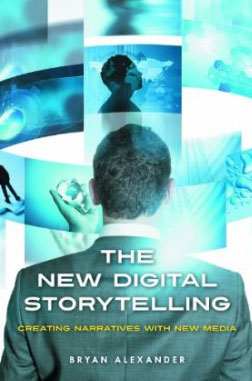
Guest Post: Shipman Reviews The New Digital Storytelling by Bryan Alexander

Thursday, May 12th, 2011


J. Scott Shipman, the owner of a boutique consulting firm in the Metro DC area that is putting Col. John Boyd’s ideas into action, is a longtime friend of this blog and an occasional guest-poster.

Book Review: The New Digital Storytelling

by J. Scott Shipman

Bryan Alexander’s  The New Digital Storytelling, Creating New Narratives With New Media is an excellent, highly readable, and comprehensive treatment of storytelling in our digital world. Dr. Alexander manages in 230 pages of text to capture the universe of available methods, processes, resources and tools available to storytellers, as of 2010. His 36 pages of notes and bibliography includes an exhaustive list of websites and sources used.

Dr. Alexander aimed his book at “creators and would-be practitioners,” storytellers looking for new digital ideas, to include teachers, marketers, and communications managers. Whatever your background, he assures in the introduction, “herein you will find examples to draw on, practical uses to learn from, principles to apply, and some creative inspiration.” I can’t speak for those in the target audience, but as one with but a casual interest in storytelling, I can say Dr. Alexander delivered! Over the course of the couple of days of reading, I came up with about a half-dozen ideas and discovered my MacBook Pro has a lot more under the hood than I ever appreciated or used.

That said, Dr. Alexander warns that his book is not a “hands-on manual” on the tech media discussed. In fact, he assumes the reader will not “be a technologist” and the material is presented accordingly. He says:

The New Digital Storytelling straddles the awkward yet practical divide between production and consumption, critique and project creation.”

The book is divided into four parts:

Part I Storytelling: A Tale of Two Generations

In Chapter 1 Dr. Alexander provides an unambiguous meaning to digital storytelling: “Simply put, it is telling stories with digital technologies.” The medium providing this review to you is my digital story about the book. But that is just the beginning; just about every digital device imaginable is being used to tell stories; blogs, social media, videos, and even in Twitter’s 140 character limit, storytelling genres are emerging [readers at zenpudit.com will recall Charles Cameron’s use of Twitter feeds following UBL’s death]. As Alexander points out, “no sooner do we invent a medium than do we try to tell stories with it.”

In Chapters 2 & 3, Dr. Alexander provides a history of digital storytelling in two parts; part one is what he calls “the first wave.” From foundations in the 70’s and 80’s (his reference to the 1983 movie War Games brought back memories) to the evolution and importance of hypertext. Alexander asks, “How do hypertexts work as digital stories? Users—reader—experience hypertext as an unusual storytelling platform. We navigate along lexia (“multiple readable chunks”) picking and choosing links to follow.” This point truly “clicked” for me; one of the pleasures of reading zenpundit.com is the ubiquity of supporting links and how sometimes these links lead to unexpected, but valuable adventures. Often I’ve landed in a place I would never have found if not for the first “story.” Alexander writes that Web 2.0 has allowed for “the ability to create content for zero software cost is historically significant, and now par for the course.” He points out with the ubiquity of hardware (both PCs and mobile devices) and the social element (social media, for example) a means of of delivery and an architecture are in place where potential storytellers have a low barrier to entry—to get their story out. Alexander includes gaming devices (mobile and console) in the review of the Web 2.0 phenomena.

Part II New Platforms for Tales and Telling

Chapter 4 is a comprehensive review of Web 2.0 storytelling and the fragility of systems existing today, but perhaps gone tomorrow. Dr. Alexander covers distinct types of blogs used in sharing stories; blogs are ubiquitous and the barriers to entry negligible. He covers epistolary novels and diary/journal-based stories and provides numerous examples. One example was News from 1930, which “posts selections from each day’s Wall Street Journal” during the early days of the Great Depression—in essence, a blog as a realtime history lesson. But as we know, the blogosphere is bigger than history, there also exists a market for various fictional stories which include reader interaction/collaboration. Also included are examples of character blogging (as Alexander notes: “Bloggers are characters”) where personalities are revealed over time in a serial nature. Twitter has developed into a unique format for storytelling, forcing the user to pack as much as possible in precious few words/characters. Wikis, social images and Facebook are also covered and explained in ways that made me think about “how” I use social media.

Chapter 5 covers in detail social media storytelling…and this is one of my favorite chapters. Alexander explains podcasts in a way that was accessible and in a way that made me want to “do” a podcast! A podcast is limited to audio, but a web video places a whole new spin on our ability to digitally tell our stories. Chapter 5 is rich in resources and insight.

In chapters 6 and 7 Alexander discusses gaming and storytelling. This may be the part of the book that was over my head (I’m dubious of the real utility of “gamification” in a meaningful/productive way). One sentence did jump off the page: “One key aspect of game-based storytelling is the immersion of the player in the story’s environment.” Indeed, “intimacy” is an enormous missing ingredient in more than storytelling and absolutely necessary in proficiency in just about any endeavor. One other sentence made a big impression: “Children also learn a deep secret about art, which is that the less detailed the representation of a character, the easier it is for us to identify with him or her.” I believe guys like the internet Oatmeal guy and the creator of Zen’s recent post  have figured out this phenomena isn’t limited to children.

Part III Combinatorial Storytelling; or, The Dawn of New Narrative Forms

Chapters 8 through 11 covers the networked book, mobile devices, and alternate reality games. The networked book resonated with me because of something from my distant career on submarines (early 80’s); we would write a story where periodically storytellers would add a sentence and half to an evolving text. The results were always amusing and never predictable. Networked books sound very similar to our collaborative efforts 30 years ago, but with the ubiquity of digital tools, opportunities abound. For example “transmedia storytelling,” where “story content is distributed across multiple sites and media; the movie trilogy, an anthology of animated films, comics, computer games, a massively multiplayer online game, Web content, and additional DVD content.” This dispersion of story content and the variety of venues allows users a more “immersive experience”—-the intimacy Alexander described earlier. Mobile devices are literally changing just about every aspect of our world from political meetings, classrooms, clinics “now that those present can hit the Web for fact checking or peer support.” An excellent recent example was the squashed attempt of the United States Naval Institute’s board to change the organization’s mission. Platforms like Twitter, Facebook, and LinkedIn were used to get the word out to members who took action. New tablet devices will continue to drive this phenomena. Alexander’s treatment of alternate reality games revealed “worlds” created with our world by game participants of such products as Second Life.

Part IV Building Your Story

In the final chapters, Dr. Alexander provides example of “how to” build a digital story, using the classic Center for Digital Storytelling workshop model. For me, this was the most thought-provoking section. The description of how a workshop is conducted, the questions used to prompt creative/insightful “story-able” thought is worth the price of the book. Alexander inventories the software available for audio, images, video editing, publication, concept mapping, and other production tools. This inventory of tools describes the appropriateness of each with respect to the level of experience of the storyteller. Digital storytelling in education is covered in Chapter 14 and is a rich resource for parents and educators who want to leverage the digital world.

The New Digital Storytelling should be the standard guide for anyone who wants to use all the new digital gadgets available to tell their story; this book is an excellent one-stop resource. I plan to use what I’ve learned in the expansion of my family tree history to an A/V platform and have already built a to-do list to get started.

One closing thought; the irony isn’t lost that this “book” about digital storytelling is made of paper, glue, and ink. I can only imagine what an adventure this would be if presented digitally where all the links were connected…a digital story on how to tell digital stories.

The New Digital Storytelling comes with my highest recommendation. Get this book, use those tools, and tell your stories.

Recommended reading — in stereo

Wednesday, May 11th, 2011

[ By Charles Cameron ]
.
quo-dark-side-of-force.jpg

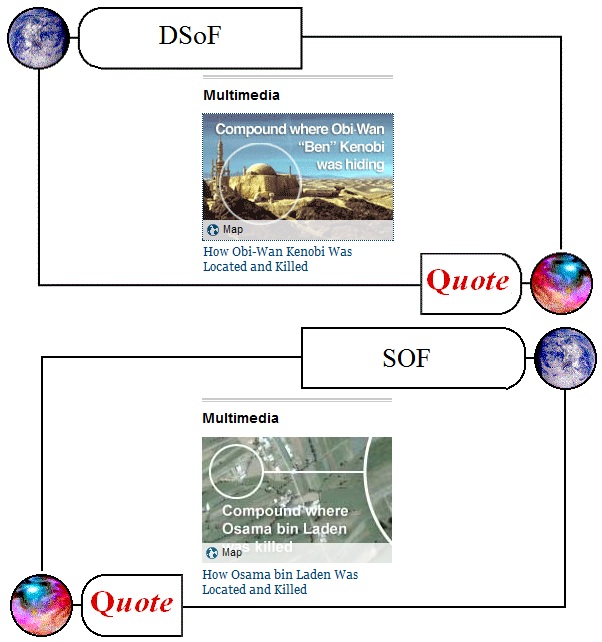
I’m always on about the power of polyphonic thinking, right? Okay, IMO, these two pieces are well worth reading in stereo:

http://www.galacticempiretimes.com/2011/05/09/galaxy/outer-rim/obi-wan-kenobi-is-killed.html
http://www.nytimes.com/2011/05/02/world/asia/osama-bin-laden-is-killed.html

h/t @abumuqawama

Grand Strategy Board II, UK Edition

Tuesday, May 10th, 2011


Aaron Ellis at Egremont, the blog of the Tory Reform Group, has taken a liking to my previous post, Time for a Grand Strategy Board? and decided that the time might be right for Britain:

Should the UK institutionalise its Wise Men?

Ever since the end of the Cold War, this country has found it hard to think strategically. A parliamentary report last year stated, “We have simply fallen out of the habit”. It has also befallen the United States and both our foreign policies have suffered from similar problems. The ‘Big Picture’ is being obscured as policies such as humanitarian intervention and promotion of democracy take the place of grand strategy.

Governments have also found it hard to implement their chosen policies because of the lack of proper strategy – the sort that links ends, ways and means. This has been the case for military action, as we are witnessing in Libya.

The lack of any overarching ideas about our role and our interests has led to an incoherent foreign policy, as competing departments pursue contradictory policies even within the same country.

The problem is partly institutional. Jim Scopes, a former director of strategy at HM Revenue & Customs, has written that current reward and promotion mechanisms in the Civil Service “favour reactive (problem-solving) behaviour rather than proactive (strategic) approaches.” The Public Administration Committee has found that “the ability of the military and the Civil Service to identify those people who are able to operate and think at the strategic level is poor.” As I wrote last month, the makeup of government institutions is not the only factor in making strategies but it is an important one. The world is so unstable right now that it is essential for policymakers to understand the global environment if they are to form a sensible foreign policy – yet the structure of governments influences how they see the world.

If governments are filled with officials more comfortable with solving immediate problems then foreign policy will be reactive and short-termist. We need people to take the longer view…

Read the rest here.

There’s an interesting symmetry here, in the effort to improve the strategic capacity of respectively the United States and the United Kingdom, that derive from the differences in their Constitutional arrangements and national security cultures.

Britain has operated for centuries with an unwritten Constitution and Cabinet government. While these phrases are much more historically complex than meets the eye, the power relationships of Monarch, Houses of Parliament, electorate, peerage, bureaucracy and Party having evolved considerably over time, we can simplify things by stating that the cardinal virtue of the British system was flexibility, to adapt to circumstances. In a crisis, power could rapidly flow to the minister best suited to deal with the trouble at hand and the lack of institutional structures helped ensure that once the crisis had ebbed, concentrated power would just as rapidly dissipate.

The United States, by contrast, has a written Constitution and a Federal government, which while also undergoing historical evolution, is characterized by restraint. Friction is engineered into the American system to thwart or deter concentrations of power and circumscribe it’s exercise within defined parameters . Except in rare instances of overwhelming national consensus, new activities by the US government require the Congress to establish formal institutions that will then fall within the natural gridlock of checks and balances that is the American system.

Ironically, in remediating the lack of strategic vision on both sides of the Atlantic, a Grand Strategy Board would represent an institutionalization of strategy by the British, whose flexible system is in need of a long term, disciplined, focus and a strategic advisory lobby for the Americans, whose more rigid political system periodically requires blue ribbon commissions, panels, study groups and boards to break our habitual political deadlocks.


Switch to our mobile site

