zenpundit.com » 2011 » November

Archive for November, 2011

Al-Awlaqi and the Rebbetzin?

Thursday, November 3rd, 2011

[ by Charles Cameron — tracking an al-Awlaqi quote through Jewish, Christian, Islamic and Hindu sources ]

.
awlaqi.jpg

.
I was reading JM Berger‘s CTC Sentinel piece about al-Awlaqi‘s Constants on the Path of Jihad, which is itself an expansion of al-Uyayri‘s original text, and found myself feeling vaguely uneasy about one of al-Awlaqi’s interpolations.

Berger’s example of how al-Awlaqi frequently “expanded al-‘Uyayri’s citations into living, breathing stories, often at significantly greater length, transforming the legalistic argument into an emotionally and politically loaded discourse” concerns the “People of the Ditch” motif found in the Qur’an and hadith:

In the story, a king is persecuting believers in Allah. He orders them to renounce their religion or be thrown into a flaming ditch or trench to die. All of the believers throw themselves in. One woman, carrying her baby, hesitates, and Allah inspires the baby to speak to her, saying “Oh Mother! You are following al-Haqq [the truth]! So be firm!” As a result, she carries him into the fire and succeeds in achieving martyrdom.

Al-Uyayri makes a brief mention of this story; Al-Awlaqi expands on it, transforming (in Berger’s words) “al-‘Uyayri’s perfunctory citation into an emotional journey that engages the listener and broadens the original point to emphasize the importance of taking even one step toward jihad.” He does this by commenting:

This woman, because she took the first step, and that is the willingness to jump in the trench, when she was about to retreat, Allah helped her. So if you take that first step towards Allah, Allah will make many steps towards you. If you walk towards Allah, Allah will run towards you.

*

So far so good. But isn’t al-Awlaqi quoting someone here?  I had an itch in the back of my head…

I thought I should check, and what I found frankly surprised me. I mean, was he really quoting the Rebbetzin Esther Jungreis?

We have a promise from HaShem that if we take just one step toward Him, He will take two steps toward us.

Not likely.

Perhaps it was a Christian source he had in mind…

A common saying in my church and in many Christian circles is the following: “Take One Step Toward God and He Takes Two Steps Toward You”

Nope.  Surely, it must have been a Hadith:

Allah (swt) says: “Take one step towards me, I will take ten steps towards you. Walk towards me, I will run towards you.”

After all, he can hardly have been quoting the Hare Krishna devotees, can he?

in 1972 In Denver, I remember hearing all the time from the temple devotees to encourage me as a new bhakta… “you take one step towards Krsna and He’ll take 10 steps towards you”.

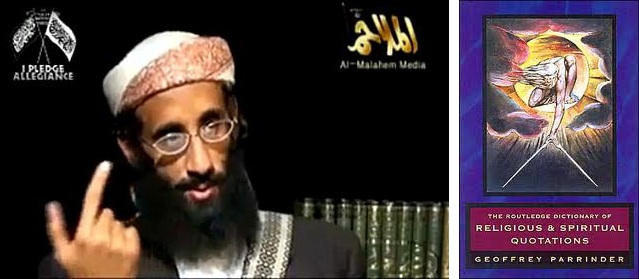
And no, that particular phrase doesn’t seem to be in the Routledge Dictionary of Religious and Spiritual Quotations — perhaps because it’s hard to know quite where to put it…

*

My own favorite among cross-religious commonalities of this sort, fwiw, is this one:

dyad_planting.jpg

*

BTW, nice to see both Berger and Chris Anzalone in the Sentinel — and the Flagg Miller cover-piece on early bin Laden tapes is interesting, too.

STRATFOR on Anonymous vs. The Zetas

Thursday, November 3rd, 2011

I don’t think of STRATFOR as a cyber shop, generally, but this is worth a look.

On War as an Unfinished Symphony

Thursday, November 3rd, 2011

cvcforming.jpg

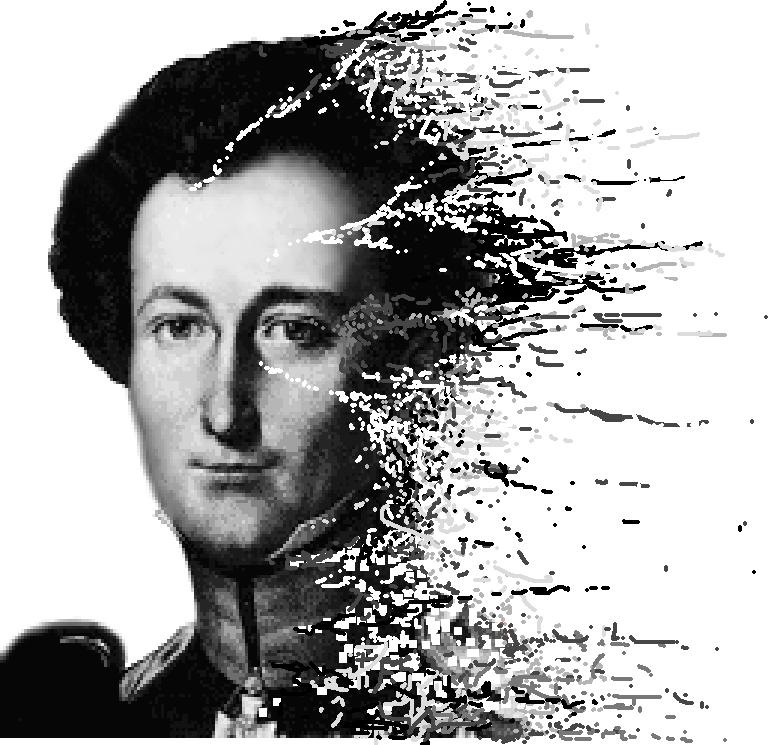
On War by Carl von Clausewitz has been the most influential book on strategy and war of all time.

We can say this because On War is the standard by which all other works of strategy are measured and only a few compared – notably Sun Tzu’s Art of War and The Peloponnesian War by Thucydides. The odd thing is that we can say this despite the fact that On War is more frequently shelved, cited or understood secondhand rather than read, even by military professionals. And furthermore, within the narrow demographic that reads Clausewitz seriously and critically, there can be heated dispute over what he meant, due to the difficulty of the text. Then there are the secondary effects, historical and military, of Clausewitz having been misunderstood, forgotten, ignored or at times, his strategic philosphy consciously rejected.

The shadow cast by On War is all the more remarkable given it’s circumstances of publication. Clausewitz died in 1831, at fifty-one, of cholera, having finally risen to a military post his talents merited. He had been writing On War since 1816 and it was far from completed or refined to his satisfaction and it is highly unlikely, in my view, that Clausewitz would have consented to it’s publication in the condition in which he left it. His determined and intellectually formidible widow, Marie von Clausewitz, further shaped the manuscript of On War, guided by her intimate knowledge of her husband’s ideas and was likely the best editor Clausewitz could have posthumously had.



Nevertheless, to my mind On War remains a magnificent unfinished symphony.

What would On War have looked like if Clausewitz had lived another twenty-five or thirty some years? Assuming continued good health, Clausewitz would have seen, perhaps commanded in, the First Schleswig War and at least studied the Crimean War from afar. He would have had another quarter-century of reading and mature reflection on his subject. Clausewitz, who had a keen understanding of history, would have also witnessed the grand European upheaval of liberal revolution in 1848 that rocked the Hohenzollern monarchy to it’s core. What new insights might Clausewitz have gleaned or expanded upon? Would his later chapters On War have evolved to equal the first?

Having outlived Marie (who died in 1836), would Clausewitz have become a deeply changed man?

What I find it difficult to believe is that Clausewitz, with his creatively driven and philosophically exacting mind,  would have been content to let the manuscript of On War rest where it stood in 1831. Or that we read today what Carl von Clausewitz ultimately intended.

Beware of Greeks Spurning Gifts…..

Wednesday, November 2nd, 2011


This has some possible geopolitical implications:

Greek government in chaos with debt deal in doubt

ATHENS, Greece (AP) – The Greek government teetered and stock markets around the world plummeted Tuesday after a hard-won European plan to save the Greek economy was suddenly thrown into doubt by the prospect of a public vote.

One day after Prime Minister George Papandreou stunned Europe by calling for a referendum, the ripples reached from Athens, where some of his own lawmakers rebelled against him, to Wall Street, where the Dow Jones industrial average plunged almost 300 points.

Papandreou convened his ministers Tuesday night, and a spokesman said the prime minister was sticking to his decision to hold the referendum, which would be the first since Greeks voted to abolish the monarchy in 1974. Papandreou has also called a vote of confidence in his government, to be held midnight Friday.

“The government is not falling,” said Angelos Tolkas, a deputy government spokesman.

….A Greek rejection of the second rescue package could cause bank failures in Europe and perhaps a new recession in Europe, the market for 20 percent of American exports. It could also cause Greece to leave the alliance of 17 nations that use the euro.

European leaders made no secret of their displeasure.

“This announcement surprised all of Europe,” said a clearly annoyed French President Nicolas Sarkozy, who has been scrambling to save face for Europe before he hosts leaders of the Group of 20 major world economies later this week.

“Giving the people a say is always legitimate, but the solidarity of all countries of the eurozone cannot work unless each one consents to the necessary efforts,” he said.

French lawmaker Christian Estrosi was even more direct. He told France-Info radio that the move was “totally irresponsible” and reflected “a wind of panic” blowing on Papandreou and his party.

“I want to tell the Greek government that when you are in a situation of crisis, and others want to help you, it is insulting to try to save your skin instead of assuming your responsibilities,” Estrosi said.

Sarkozy and German Chancellor Angela Merkel, who have been at the forefront of Europe’s efforts to contain national debt, talked by phone and agreed to convene emergency talks Wednesday in Cannes, France. Papandreou will also attend.

Merkel also spoke by telephone Tuesday with Papandreou, his office said.

The response was brutal in the international financial markets, especially in Europe. Greece’s general price index plunged to close down 6.92 percent, while in Germany the Dax index, the major stock market average, lost 5 percent – the equivalent of about 600 points on the Dow.

The French stock market closed down 5.4 percent, the Italian 6.7 percent and London 2.2 percent.

“Talk about your all-time bonehead moves,” said Benjamin Reitzes, an analyst at BMO Capital Markets….

While it is likely that the EU will muddle through this latest Greek crisis, I have to wonder if the EU will exist at all in five years? Or perhaps as a rump Northwest European confederation? This will not be the last debt crisis.

Our unlamented and departed Soviet adversaries used to talk about what they called “the contradictions of capitalism”. In the current crisis we are seeing the contradictions of technocratic governance as practiced by European elites. It seems that lacking the political ability to coerce Southern member states into genuinely accepting austerity programs, or alternatively spur their less developed economies to higher growth rates, the EU structure is both the raison d’etre and the obstacle to a solution.

An essentially undemocratic elite project, the EU is stymied by the residual democratic capacity of national citizenry to resist. Ordinary Greeks are not inclined to accept financial castor oil spooned by foreigners to please the international markets and I suspect the tolerance of German taxpayers for footing more than their share of the EU bills is wearing dangerously thin.

Either power will increasingly flow to the EU nations still writing the checks, making the EU even more unrepresentative, but more economically rational in political decision-making, or there will be a rush for the exit door.

ADDENDUM:

Greek Prime Minister abruptly sacks military chiefs


Switch to our mobile site