zenpundit.com » 2012

Archive for 2012

Look, I’m sorry to be so blunt — II: all you need is math

Thursday, July 19th, 2012

[ by Charles Cameron — global warming, global curriculum ]
.

you can turn an aircraft carrier pretty fast -- but the human population?

.

Bill McKibben has an article out in Rolling Stone, Global Warming’s Terrifying New Math, in which he says:

When we think about global warming at all, the arguments tend to be ideological, theological and economic. But to grasp the seriousness of our predicament, you just need to do a little math.

Well, no you don’t.

You need something closer to global understanding. Once you’ve gathered — via that “little math” — that we’re not on a sustainable track, you’ll need to understand a few other things. Like:

Look, I’m sorry to be so blunt, but… the problem isn’t understanding, it’s changing.

Psychology. Inwardness.

And I can’t speak for economy or ideology, but believe me — theology will have a role to play!

Look, I’m sorry to be so blunt — I: modeling ideas

Thursday, July 19th, 2012

[ by Charles Cameron — a stray thought, endlessly ricocheting — with a friendly wink to @khanserai ]
.

chessboard by Ji Lee

.
Back in 2006 the US National Strategy for Combating Terrorism suggested:

In the long run, winning the War on Terror means winning the battle of ideas. Ideas can transform the embittered and disillusioned either into murderers willing to kill innocents, or into free peoples living harmoniously in a diverse society.

So. More than five years have passed.

Look, I’m sorry to be so blunt… but how good are we now at modeling, simulating and / or gaming ideas?

Venkat on Positioning vs. Melee Moves

Thursday, July 19th, 2012

Blogfriend, Dr. Venkat Rao had an intriguing post at Tempo (his other blog) on which I want to make a few, relatively disjointed, observations:

Positioning Moves versus Melee Moves 

My general philosophy of decision-making de-emphasizes the planning/execution distinction. But I am not an agility purist. Nobody is. You can think of the Agility Purist archetype as a useful abstraction. This mythical kind of decision-maker believes that a mind and personality that is sufficiently prepared for a particular domain (say programming or war or biochemistry) needs no preparation for specific situations or contingencies. This magical being can jump into any active situation in that particular domain and immediately start acting effectively.

At the other extreme you have an equally mythical Planning Purist archetype who has thought through every possible contingency all the way through the end and can basically hit “Start” and reach a successful outcome without further thinking. In fiction, this is best represented by jewelry heist capers based on long, involved and improbably robust sequences of moves, as in Ocean’s Eleven or The Italian Job. A few token things go wrong, but overall, these narratives play out like Rube Goldberg machines. 

What is interesting to me is that if we look at historical figures who epitomize a “purist archetype” they can represent disaster as easily as they can triumph. Take the planner archetype,  for example. Two figures in the annals of warfare who are “purists” in this regard would be Moltke the Elder and Robert Strange McNamara.

Because the Vietnam War was such a terrible debacle and because McNamara’s role in the war was so significant the resulting opprobrium heaped upon McNamara (deservedly, IMHO) makes it too easy to forget that he had a brilliant mind, that he was not just a reckless bumbler or a hack as Secretary of Defense. A famous anecdote of McNamara’s intelligence and his ability to quickly grasp enormous reams of data is in The Best and the Brightestby David Halberstam.  As Halberstam related, Secretary McNamara was once over a thousand slides into  being briefed about the war when he abruptly ordered the briefer to stop because the current slide conflicted with the information on something like “slide 23”. They stopped and checked. McNamara was indeed right.

It was McNamara who introduced systems analysis and PPBS to the Department of Defense, created the DIA and the Defense Logistics Agency. Yet despite his methodical and mathematical analytical gifts, his understanding of the human element was a curious lacuna that led to his carefully calculated attrition strategy and escalation. There was no way way, in Robert Strange McNamara’s metrics, to quantify Hanoi’s will to fight, and without such comprehension, attrition would be (to use a popular phrase anachronistically) a “stratergy of tactics”.

Field Marshal Graf von Moltke’s careeer as a war planner and chief of the Prussian general staff was a happier one as the victor in three of Prussia’s wars and a co-founder, with Bismarck, of the German Empire. A devoted student of Clausewitz, von Moltke was at home in the contradiction of exquisite planning and the improvisation that was part and parcel of coup d’oeil in the midst of battle. Unlike McNamara, von Moltke’s planning encompassed the human factors and serendipity. As Antulio J. Echevarria put it:

….Like Clausewitz, Moltke emphasized flexibility in military planning and execution. He eschewed dogmatic thinking, whether tactical or strategic, accepted chance and uncertainty as inseparable from the nature of war, and recognized the often decisive (but incalculable) role that moral factors played in victory. He originally viewed the destruction of the enemy’s main fighting force as the proper aim of war, but gradually became less convinced of its genuine decisiveness after the French resorted to partisan warfare in 1870-71.[10] “We want to believe,” he later told the Reichstag, “that neither the Thirty Years’ nor the Seven Years’ War will recur, but when millions of individuals are engaged in a bitter struggle for national existence, we cannot expect that the matter will be decided with a few victorious battles.”

….By the early 1880s, this free-form approach to war had further established itself as part of the German military tradition, accruing still more Moltkean ideas: simplicity is the essential ingredient of an order; war plans do not endure beyond the first engagement; friction, chance, and uncertainty are inescapable elements of war; and strategy serves policy best when it strives for the highest aim, complete tactical victory.[32] The fact that military writers often accused each other of Schematismus–rigid, prescriptive thinking–in Germany’s turn-of-the-century military debates indicates that Moltke’s ideas had become paradigmatic within the officer corps. Ironically, an inherent contradiction developed in the German view of war at this time–namely, that while war possessed no absolute rules, the destruction of the enemy’s forces had to remain its ultimate aim.

Second, Moltke’s open, inductive approach to war also helped legitimize a decentralized style of warfighting called (perhaps wrongly) Auftragstaktik. Much confusion reigns concerning this concept and its “dubious” historical validity.[34] Military writers on either side of the Atlantic have somewhat abused the term Auftragstaktik in an effort to legitimize their own preferred style of command. In fact, Auftragstaktik and the meaning behind it surfaced decisively, albeit sparingly, in the debate over tactics that raged for years between the Imperial Army’s traditionalists and reformists. In its origins, the concept probably owes more to that leading figure of the Prussian Restoration, Gerhard von Scharnhorst, than to Moltke. But Moltke clearly advocated the decentralization of military effort. He reasoned that war, a product of opposing wills subject to a host of frictions, gives rise to rapidly changing situations that quickly render a commander’s decisions obsolete. Hence, subordinates had to think and act according to the situation, even without or in defiance of orders. While Moltke did indeed promote such a style of command, he did not condone willful disobedience. In fact, the Prussian, and later the German, army maintained strict codes of discipline. 

Back to Venkat:

….In sail warfare, there is a clear distinciton between moves designed to put you in an advantageous position with respect to relatively predictable environmental conditions (primarily the wind direction of course) and moves that are used once an engagement starts.  The latter culminate in a melee: ships next to each other, boarding actions and hand-to-hand combat. It is messy, chaotic and the very definition of the “Fog of War” phenomenon (in the case of sail warfare, cannon fire and the action of fire ships could create a literal blinding smokescreen over everything).

You can think of positioning moves as rich moves based on fertile variablesthat are likely to put you in command of many situations (“own the high ground” is the most famous one). They are high-potential-energy commitments in the space of probable paths. You can also think of them as leverage moves. A crucial feature is that positioning moves involve much less time pressure than melee moves and can be set up well before they are needed. So positioning moves are early, rich moves.

Melee moves on the other hand are, well, the other kind.

I am no naval expert, but the sea like the sky, being free of human clutter and topographic variation, brutally clarifies for commanders and strategists like Mahan or Wohlstetter the relative spatial relationship between adversaries and the limitations of their comparative resources and capabilities in light of distance and time.

If Russia had been a sea, Hitler would have thought twice about Operation Barbarossa.

Numbers by the numbers: four

Wednesday, July 18th, 2012

[ by Charles Cameron — importance of the ratio form (“this is to that as thus is to so”) as a bridge between domains and silos, creative leaps, the glass bead game, and finally, Chittick’s joke about camels, sex and translations from the Arabic ]
.
.

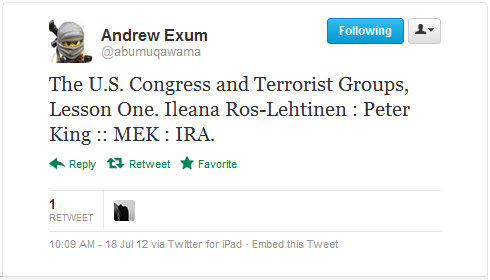
I retweeted this tweet of Andrew Exum‘s to my friend Paul Pilkington because I know he’s working on a project to find out what “this is to that” is to some other “this is to that” — across a wide swathe of human culture.

Note particularly that Exum is using this formal device to illuminate, to give insight, in an area of importance to analysts, strategic thinkers and decision makers.

I’m also retweeting Exum to Paul because I believe Paul’s simple experiment, based as it is on his reading of Hermann Hesse‘s Glass Bead Game, has the capacity to build an architecture of thought (a) crossing all disciplines and (b) spanning the trivial with the profound.

I’m doing something similar with Cath Styles in our Sembl games project — but this time I want to concentrate on Paul’s approach, and since there are four moving parts in an a is to be as c is to d configuration, I’m calling this post Numbers by the numbers: four — number three will just have to wait a while.

**

To get a sense of what Paul is up to, we can go to his Twitter Project page, which describes the fourth in a series of books he’s writing — and also follow him on Twitter, where he posts as Just Knecht.

Two of Paul’s recent tweets express his sense of the task pretty incisively:

The whole of language is the holding up of one unlike thing to compare, contrast and connect with another

Curating is a matter juxtaposition of work against work, artist against artist, place against place – A.Searle on Documenta 13, The Guardian

On his Twitter Project Page, he tells us:

Each tweet is an individual Glass Bead Game move, which is a comparison (metaphor, simile or analogy) across different areas, and may be either a statement or a question.

In question form, these are not unlike analogy questions from SAT tests with an additional dimension of general knowledge, cultural invention and intellectual playfulness. The basic challenge is to work out the relationship between two terms in one context, and apply it in another. Sometimes a tweet will extend an analogy further, which would be the beginning of forming a larger game from an individual move.

Some of the most interesting moves do not have right or wrong answers. Some have canonical or original answers, but they’re not necessarily right. In fact, very often I will post something I’ve picked up from elsewhere which I would love to see improved on, challenged, or at least better explained by others.

He then poses some of the sorts of questions that intrigue him:

Who is the J.H.Prynne of contemporary dance? Like Prynne in contemporary poetry they need to have been ‘out there’ right at the edge of theory and practice for some time, and also deeply steeped in tradition at the same time. Merce Cunningham? Suggestions welcome … And Heston Blumethal or Ferran Adrià might be the Prynne of cookery. But what about the Prynne of contemporary warfare?

What is the equivalent of sonata form in architecture? Goethe and Hegel both said ‘architecture is frozen music’ but neither really explained what they meant. If it is, then is there an architectural equivalent in Western architecture of the key structural form in Western art music? Suggestions welcome …

So, Zenpundit readers — who is the JH Prynne of contemporary warfare?

**

Not so long ago, in Numbers by the numbers: one, I posted a series of self-referential tweets that I’d collected over the last month or two — here I’d like to present some of Paul’s recent tweets:

Let’s start with one that’s a foreign policy insight, arguably as significant to day as it was when Vance first said it:

16 Jul @justknecht
“The Strait of Hormuz is the jugular vein of the West” (Cyrus Vance)

If these tweets can be timeless, they can also be timely:

4 Jul @justknecht
The Higgs boson is the quantum of the Higgs field, just as the photon is the quantum of the electromagnetic field

As they accumulate over time, they can build a conceptual “mesh” that engages an entire field — in this case, recent classical music — while linking it to a variety of other areas:

16 Jul @justknecht
“Boulez’ Derive 2 sounds like birthday cakes ought to” – Philip Clark, Gramophone

22 Jun @justknecht
Wagner was a beautiful sunset that was mistaken for a dawn – Claude Debussy, quoted by Geoffrey Norris in Gramophone

30 May @justknecht
Fauré’s Theme and Variations (no. 9) is like an evening star falling slowly from the sky – Bryce Morrison cites Alfred Cortot in Gramophone

11 May @justknecht
Kraftwerk is the Warhol of pop music – The New Yorker

There’s profundity here:

9 Jun @justknecht
“Space is to place as eternity is to time.” – Joseph Joubert

This could be, as Paul says, “the beginning of forming a larger game from an individual move” — that quote in itself could plausibly be the keystone of an architecture bridging science with religion…

There are historical parallels to consider:

31 May @justknecht
Robert Burton : Oxford :: Jeremy Prynne :: Cambridge

Catty remarks by Nobel laureates:

21 May @justknecht
“Thinking is to humans as swimming is to cats” (Nobel laureate Daniel Kahneman)

Near-tautologies:

21 May @justknecht
Macon Telegraph: Recipes are to food as blueprints are to buildings.

And, ooh, exotic forms of slander!

18 May @justknecht
“[Your daughter] has lovers as numerous as the striking of tablas on Palm Sunday” – Arabic satire by Abu Nawas, 756 – 813 AD

Once again, it’s form that generates insight, not content. Get used to form, play around with it, and content will leap out at you from the page, from the screen.

**

I’m no Arabist myself, but ah! that last quote reminds me irresistibly of the difficulties faced by translators from the Arabic, as recounted by William Chittick in The Self-disclosure of God: Principles of Ibn Al-‘Arabi’s Cosmology (SUNY Press, 1998, pp. xxxv-xxvi.)

An old joke among orientalists tells us that every Arabic word has four meanings: It means what it means, then it means the opposite of what it means, then it has something to do with sex, and finally it designates something to do with a camel …. The rational mind tends to push the meaning of a word away from experience to ‘what it means’ but the imaginal mind finds the self-disclosure of the Real in the sex and the camel … it is in the world’s concrete realities that God is found, not in its abstractions.

I’d been looking for an excuse to post that quote on Zenpundit — now I’ve found it!

Prophecy, Poetry and Prediction

Tuesday, July 17th, 2012

[ by Charles Cameron — personal preference, gangs, Chicago, insurgency, Afghanistan, and admitting the uncomfortable ]
.

Albrecht Durer, The Blessed Virgin enthroned on the crescent moon

**

Poetry, on the whole, has a liking for prophets. Thus Sylvia Plath writes:

By the roots of my hair some god got hold of me.
I sizzled in his blue volts like a desert prophet.

There’s an undeniable affinity there, the sense of giving voice to a lightning strike. Or as Randall Jarrell puts it:

A good poet is someone who manages, in a lifetime of standing out in thunderstorms, to be struck by lightning five or six times; a dozen or two dozen times and he is great.

**

Okay. I’m a poet, I think, partly because I have such a damnably literal mind that I need to break out in metaphor the way athletes break out in a sweat.

And the trouble with prophecy, from my point of view, is that it’s all too often read in damnably literal-minded ways, as though:

And there appeared a great wonder in heaven; a woman clothed with the sun, and the moon under her feet, and upon her head a crown of twelve stars

wasn’t clearly poetry. Let me clarify: it is.

And it is because prophecy (not “false prophecy”) is all too often read literally that the end of the world is so regularly promised, without once having come to pass thus far.

Even though the scriptures proclaim, But of that day and hour knoweth no man, no, not the angels of heaven

**

I suppose it goes along with being a poet rather than a statistician that I’m far more interested in qualitative than in quantitative approaches to modeling — or understanding, as we used to call it.

There are times, though, when it’s advisable to acknowledge the approaches most different from one’s own — for they too have their moments.

**

A Reporter’s Notebook entry yesterday on Fox News titled Chicago gang database intends to predict and prevent further violence tells us “One shooting sets the next shooting in motion.” That’s poignant even if a tad banal. But what comes next is interesting:

In an attempt to predict the next violent act, Chicago police are turning to technology. They have established a database that includes information on more than 100,000 known gang members. Even the lowest members of the gangs are entered as soon as police become aware of them. Their arrest records and affiliations are all entered and cross-referenced and available to the cop on the street. This is the kind of information a good beat cop would keep in his head; now it’s available to every cop on every beat. Sgt. Tom Ryan is in the gang unit on the South Side. “This is just a great way that we can look at all the information gathered because it is hard for the detectives to talk to all the different units. This is a good way of filtering down data through the departments to each other.

Probably of greatest use to the officers, when a guy gets shot, police see who his buddies are. “We can make predictions about where retaliations might be likely to happen,” says Commander Jonathan Lewin.

**

And I bring this to your attention because today I ran across an article in Wired’s Danger Room with the headline Study: WikiLeaked Data Can Predict Insurgent Attacks which resonated with yesterday’s Chicago gang report:

Insurgencies are amongst the hardest conflicts to predict. Insurgents can be loosely organized, split into factions, and strike from out of nowhere. But now researchers have demonstrated that with enough data, you might actually predict where insurgent violence will strike next. The results, though, don’t look good for the U.S.-led war.

And they’re also laden with irony. The data the researchers used was purloined by WikiLeaks, which the Pentagon has tried to suppress. And the Pentagon has struggled for years to develop its own prediction tools.

That data would be the “Afghan War Diary,” a record of 77,000 military logs dated between 2004 and 2009 that were spilled onto the internet two years ago by WikiLeaks. In a paper published Monday by the Proceedings of the National Academy of Sciences, a team of researchers used the leaked logs to (mostly) accurately predict violence levels in Afghanistan for the year 2010. (Behind a paywall, alas, but a summary is available for free in .pdf.)

**

I’m focused on minds and hearts, as the saying goes — but I’ll admit that mines and HK417s are also significant.

If the quant side of the house can reduce casualties, I’m all for that.


Switch to our mobile site