zenpundit.com » 2012

Archive for 2012

Congratulations!!

Tuesday, December 4th, 2012

To Lexington Green and James Bennett, for finishing their new book, America 3.0 – due out (I think) in 2013 published by Encounter Books.

A political vision for an era desperately short on imagination and needing statecraft of inspiration.

Recommended Reading & Viewing

Monday, December 3rd, 2012

SWJ Blog – The Generals… Readable but Flawed?


In his groundbreaking 1976 book The Face of Battle, eminent historian John Keegan argued that the history of battle should focus on more than the generals and their decisions.

Keegan had grown weary of military histories explaining the outcome of battles and wars singularly on what generals decided. Instead, Keegan emphasized the complexity of battle, its chaos, and most importantly the role contingent factors played in the outcome of battles and wars.

Keegan’s book helped popularize what would become known as the “new military history” that sought to explain and understand warfare not solely through the eyes of the general, but from myriad other military, social, cultural, and political factors.

Tom Ricks’s new book The Generals regresses from Keegan and takes us back to a less complicated form of military storytelling in which wars’ outcomes were determined solely by the performance of army commanders.

HistoryGuy99 –The Liberator: One Soldier’s 500-Day Odyssy across Nazi Europe 

A few months ago I learned that best selling author, Alex Kershaw, was about to publish a new book about World War II. Alex, had already gained a reputation for his accurate portrayal of war in three earlier best selling books. When his latest, The Liberator  arrived, it immediately went to the top of my growing must read pile. where within a fortnight; I settled down to read about one man’s 511 day and 2000 mile journey across the blood stained surface of Nazi held Europe. The story is more than one mans journey, but describes in moving detail, the men of the 3rd Battalion, 157th Regt. of the 45th Infantry Division, who fought from the beaches of Sicily, on to Salerno, and Anzio, then into the belly of Vichy France and into the deadly forests of Vosges; and finally ending inside the hell of Dachau, where to a man, they reached their breaking point.

The Glittering Eye – How Not to Negotiate 

….My understanding is that the president’s proposals rest on three legs:

  1. Raise taxes on the highest income earners while leaving the remainder of the “Bush tax cuts” intact.
  2. Leave Social Security and Medicare alone.
  3. Make raising the debt ceiling automatic.

I wasn’t entirely surprised at Senate Minority Leader Mitch McConnell’s reaction (he broke out laughing). My immediate reaction was that the president had opened with the insult price.

Milpub (Seydlitz89) –Fall 1942 – The Turning Point of the War in Europe 

….One gets the impression that the Russian Front was not seen as a single theater, but rather as five separate fronts: Finland, Army Group North facing Leningrad, Army Group Center facing Moscow, Army Group B at Stalingrad, and Army Group A in the Caucasus. Thus each individual front competed individually with those in the West and keeping Italy in the war was Hitler’s priority towards the end of 1942. This possible perspective regards only the operational decisions, not those involving logistics, production, genocides, and other matters that Hitler reserved for himself. That the situation with Army Group B was dangerous was recognized relatively early on with the 20 November order to establish Army Group Don from the staff of the 11th Army under the command of Field Marshall von Manstein to take command of Army Group B and other forces coming in. This headquarters was to be tasked with reestablishing the front on the Don/Volga. This distinction is important, it was not first to reestablish contact with Stalingrad, but to re-establish the front as it had existed prior to the Soviet offensive, it was assumed that those forces in Stalingrad would remain in place. A withdrawal from Stalingrad and the Volga was never seriously considered until it was too late. Manstein and his staff were at Vitebsk and due to the weather and rail conditions were unable to arrive in theater until 24 November.

The Committee of Public Safety –Entrails of deceit and Entrails of deceit (cont.)


….Whaley had written specialized studies of deception for the Central Intelligence Agency (later declassified and published as Codeword Barbarossa and Stratagem: Deception and Surprise in War) as well as books on magic (Encyclopedic Dictionary of MagicWho’s Who In Magic). Bell was a painter and art critic who’d started writing about terrorism during the 1960s, especially as practiced by the Provisional Irish Republican Army. Whaley and Bell had direct experience of fields where deception was the coin of the realm. They’d picked up more experience during their fruitless efforts to get academia and government to properly study deception.

As a side-effect of their experience as well as their target audience, Cheating and Deception discusses many of the manifestations deception can take on in everyday life. It includes specific explorations of the role of deception in magic, warfare, gambling, sports, business, science, and art. True to the spirit of their topic, Whaley and Bell even manage to sneak their more scholarly theory of deception into Chapter 2.

They claim their theory is the only general theory of deception ever devised.

Gene Expression –TreeMix: Who were the West Eurasian ancestors of Ethiopians?


Lions of Judah?

David Ronfeldt – Why the Republicans lost: excessive tribalism — a partial TIMN interpretation and Q’s & A’s about “TIMN in 20 minutes” (6th of 7): space-time-action (STA) orientations 

Thomas P.M. Barnett- Lesson in eBook marketing 

The Agonist (Kattenburg)-Writerly Reads

New York Times Review of BooksThe Jihadis of Yemen 

The American Conservative – On the Value of Old Educational Models and Revenge of the Reality-Based Community  

The Wilson QuarterlyBloody New World 

Scientific American– Why Is it Impossible to Stop Thinking, to Render the Mind a Complete Blank? 

RECOMMENDED VIEWING:

Doors within doors: Ibn Arabi, Henry Corbin and Tom Cheetham

Sunday, December 2nd, 2012

[ by Charles Cameron — a response to, and endorsement of, Tom Cheetham ]
.

Interior of the Touba mosque

**

If I only had one book to take with me, I’d pick Henry Corbin‘s Creative Imagination in the Sufism of Ibn Arabi, also available under the title Alone with the Alone. And I’d pick it, because — well, this poem of mine says it best:

No Place Special
.

I am baffled:
                 your muezzin calls me
with a call more resonant than any command
of sensible business, any
instrument, nay, of corporeal music,
to prayer in no place visible,
as if defining by example what
eyes in the back of the head might mean,
might see, ears on the inside
of the skull
mean, what
their music, not being
ears or eyes in the habitual sense at all.

Cliff.
        Not the sheer cliffs of fall
Of Hopkins’ poem, but cliffs sheer without any
word-hold by which to climb
celestialwards — as if
adamant, as if obsidian,
oblique to terrestrial gravity, this cliff
of hearing the call without seeing the mosque
,
without turning
around, inwards, some new way within.

I have ignored the lures, chased breath,
pressed my life into service, and —
as if a pressed life, even in service, were
death on display, a pinned butterfly —
withdrawn from pressing,
taken ease in the swell and ride
of life, loved much, seen
many to my great joy and felt richly
to my grief…
                  and the
muezzin yet calls, the baffle, the cliff
still between me and the attainment of garden,
tree and spring.

Corbin’s book is too high for me, but I feel the call. And Ibn Arabi — beyond my knowing.

**

Ibn Arabi is known as the Shaykh al-Akbar, the greatest shaykh, because his work towers higher and digs deeper into the soul than that of any other Islamic writer, saving only (perhaps) his contemporary the poet mystic Jalaluddin Rumi.

Stepping down from his heights, up from his profundities, we have in Henry Corbin an interpreter of great power — and since I find even Corbin requiring of me a depth of insight I can not yet grasp yet must read again and again across the decades, I am happy to have found his interpreter, Tom Cheetham.

And thus Tom Cheetham is a doorway for me into the doorway that Henry Corbin is to Ibn Arabi, himself a doorway into the profoundest mystery.

**

You can find Tom Cheetham’s four books here — I’d start with The World Turned Inside Out: Henry Corbin and Islamic Mysticism, and read them in the order of publication.

I have written this post to draw the attention of any who may be interested to Tom’s offer of an online seminar in Corbin’s work: The World of Henry Corbin – Online Learning.

I am considering the possibility of offering some kind of online learning program.
I would like to know:

(1) if there is interest,
(2) what topics people would be most interested in,
(3) what format or formats might be most useful, and
(4) whether people might be willing to pay a modest fee.

Any other comments or suggestions are welcome.

Contact me by commenting on this post or emailing me at
tcheetham@gmail.com
subject heading “Corbin Online Learning”

Very highly recommended.

The Antilibrary of the Living Dead

Friday, November 30th, 2012

From time to time we talk here about “the pile” of books waiting to be read, or the larger “Antilibrary” which briefly also became a blog, now defunct:

….The writer Umberto Eco belongs to that small class of scholars who are encyclopedic, insightful, and nondull. he is the owner of a large personal library ( containing thirty thousand books), and separates vistors into two categories: those who react with ‘Wow! Signore professore dottore Eco, what a library you have! How many of these books have you read?’ and others – a very small minority- who get the point that a private library is not an ego boosting appendage but a research tool. Read books are far less valuable than unread ones. The library should contain as much of what you do not know as your financial means, mortgage rates, and the currently tight real estate market allow you to put there. You wil accumulate more knowledge and more books as you grow older, and the growing number of unread books on the shelves will look at you menacingly. Indeed, the more you know, the larger the rows of unread books. Let us call the collection of unread books an antilibrary.

–    Nassim Nicholas Taleb 

It occurred to me the other day, that the Antilibrary contains some unread books that, while bought we the best of intentions, perhaps even an air of anticipation, yet were never read – and at the current rate of new book purchases, never will be. To get “living dead” status a book needs to have been sitting on a shelf for a minimum of five years (the archives of book collectors don’t count since they are buying to own or invest and not always to read) and ten is even better. Here are a few of mine:

Tecumseh: A Lifeby John Sugden

My only explanation is that this one was a gift by a well-meaning friend who knew in a vague sort of way that I am “into history”. I really don’t care very much about Tecumseh and still less about his brother the Prophet ( maybe if he had a better handle on the prophecy thing their confederation would have won).

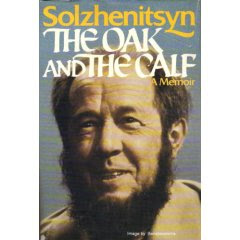
The Oak and the Calf by Aleksandr Solzhenitsyn

This has been sitting on my shelf for 20+ years. This is odd, because I’ve read The Gulag Archipelago twice, along with Cancer Ward,  The First Circle and August 1914.  Not sure if I burned out on Russian-Soviet studies at the time or if the collapse of Communism made it less relevant but it has never been cracked open.

Conquest by Hugh Thomas

Sweeping, magisterial, impressively detailed…..and decidedly unread for at least 15 years.

Nietzsche by Rudiger Safranski

As my Great-great Grandfather hailed from Germany, I now suspect the author may be a distant relation. That hasn’t helped me get started reading it.

Does America Need a Foreign Policy by Henry Kissinger

One of the more ironically-timed books ever written, coming out a mere six months before 9/11, I have had this one for 10 years + and I think I bought it in hardcover for $4 (you can it used on Amazon for one cent. Ouch!). I have read a fair amount of Kissinger, including his acromegalic, multi-volume memoirs, but I can’t muster the energy to read this one.

What are you not reading and why?

On the HipBone and Sembl games: update

Thursday, November 29th, 2012

[ brief intro by Charles Cameron, then shorter version of Dr. Cath Styles‘ presentation of Sembl at the National Digital Forum in New Zealand, 20 November 2012 ]
.

Charles writes:

I’ve been working for almost twenty years on the development of a playable variant on Hermann Hesse‘s concept of the Glass Bead Game.

It’s an astonishing idea, the GBG — that one could build an architecture of the greatest human ideas across all disciplinary boundaries and media — music, religion, mathematics, the sciences, anthropology, art, psychology, film, theater, literature, history all included — and it has engaged thinkers as subtle as Christopher Alexander, the author of A Pattern Language [See here, p. 74]. Manfred Eigen, Nobel laureate in Chemistry and author of Laws of the Game [see here], and John Holland, the father of genetic algorithms [see here].

Here’s Hesse’s own description of the game as a virtual music of ideas:

All the insights, noble thoughts, and works of art that the human race has produced in its creative eras, all that subsequent periods of scholarly study have reduced to concepts and converted into intellectual values the Glass Bead Game player plays like the organist on an organ. And this organ has attained an almost unimaginable perfection; its manuals and pedals range over the entire intellectual cosmos; its stops are almost beyond number.

My own HipBone Games were an attempt to make a variant of the game that would be simple enough that you could play it on a napkin in a cafe, and has in fact been played online — and more recently, my friend Cath Styles has adapted it for museum play, and introduced the basic concept and our future hopes in a presentation at the National Digital Forum 2012, New Zealand — which you can see very nicely recorded in Mediasite format.

Do take a look — Cath makes a first-rate presentation, and I love the Mediasite tech used to capture it.

Since the slides are shown in a small window concurrently with Cath’s presentation, I’ve edited her presentation for Zenpundit readers, and reproduced many of her slides full-size with some of her commentary below.

**
Sembl, the game of resemblance

Cath speaking:

In its first form, Sembl is an iPad game, called The Museum Game, at the National Museum of Australia. We’ve just released it in beta as a program for visiting groups.

Cath then talks about feedback from children and adults about their experience of playing the game. Some kids homed in on the principle of resemblance, others emphasised the social side of the game. She talks, too, about their teacher, and her observations about the ways the game engaged her kids.

She then shows us various Sembl gameboards for iPad:
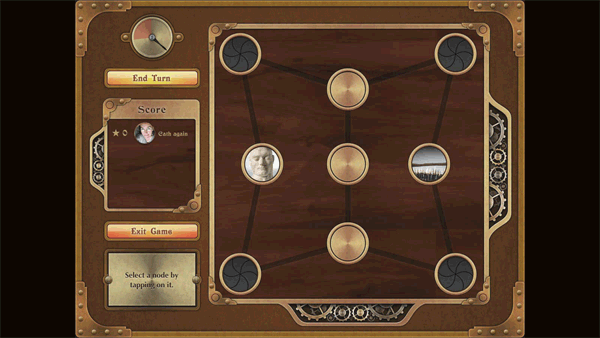
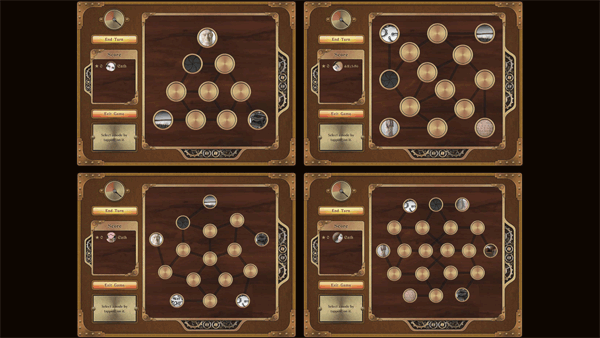
Sembl Museum gameboard for four teams of younger players

Four different Sembl Museum gameboards

Cath speaks:

But The Museum Game is just one form of Sembl. The Museum Game is played in real time, on site, and players take photos of physical objects to create nodes on the board.

The next step is to make a web-based form, that you could play at your own pace, and from your own place. Then, Sembl becomes a game-based social learning network, which amplifies the personal value of the game – it becomes social networking with cognitive benefits.

But it’s the bigger picture – of humans as a community – that I most want to explore: Sembl as an engine of networked ideas, or linked data.

Charles notes: I’m skipping the educational part — and the bit about my own role in the game’s development, to get to the core of her presentation as I see it: the cognitive facilitation it provides

Cath again:

Another way of saying this is that the Game provides a structure and impetus for dialogue, between the museum and visitors, between visitors and things, among visitors and between things. And this is not dialogue in the sense of an everyday conversation. It’s deeper than that. It’s a mutual experience of looking both ways, simultaneously.

Cath next quotes David Bohm, the eminent quantum physicist:
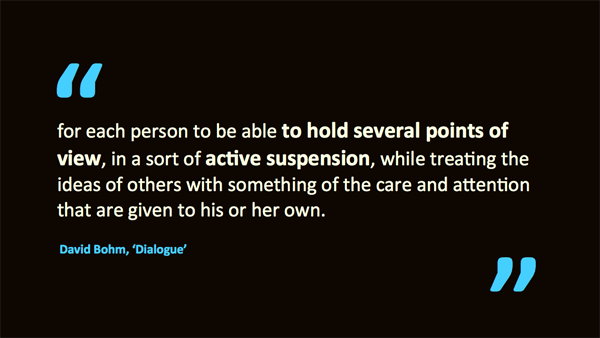
to hold several points of view in active suspension – quotation of David Bohm

Cath speaks:

For Bohm, dialogue means holding several points of view in active suspension. He regarded this kind of dialogue as critical in order to investigate the crises facing society. He saw it as a way to liberate creativity to find solutions.

Cath then drops in an important topic header:

Toward a game-based social learning network

Cath:

The concept of Sembl, in its deepest sense, is social learning – game-based social learning. In its first instantiation, it is game-based social learning in a museum and – if things turn out as I hope they will – from next year it will be playable at any other exhibiting venue that has the infrastructure and the will to host games – galleries, libraries, botanic gardens, zoos and so on.
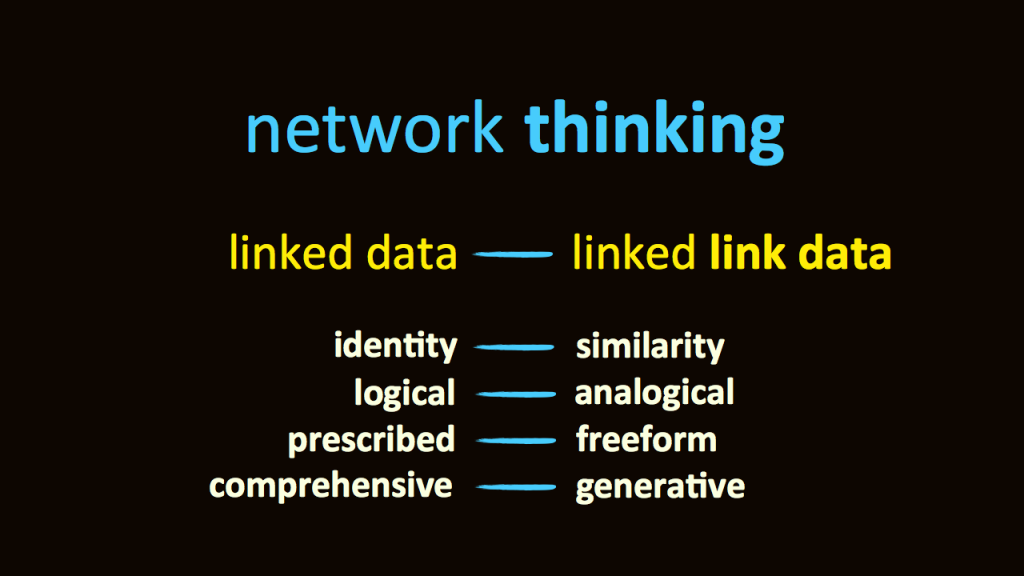
network thinking – how Sembl network links differ from traditional linked data links

A web-based form of Sembl can generate linked data with a difference. It’s linked link data, and quite different to normal linked data.

  • Instead of connections based on what a thing is – sculpture, or wooden, or red – Sembl generates connections based on a mutual resemblance between two things. Which, amazingly enough, is a great way of gaining a sense of what each thing is. And if your interest is to enable joyful journeying through cultural ideas, or serendipitous discovery, this approach just wins…
  • Instead of compiling logical links, Sembl cultivates the analogical.
  • Instead of building and deploying a structured, consistent set of relationships, Sembl revels in personal, imprecise, one-of-a-kind, free association, however crazy.
  • Instead of attempting to create a comprehensive and stable map of language and culture, Sembl links are perpetually generative, celebrating the organic, dynamic quirks of cognitive and natural processes.

But the most important way that Sembl is distinct from other systems of network links is that those who generate the links learn network thinking. Which is a critical faculty in this complex time between times, as many smart people will tell you.

Poets have always known the virtues of analogy as a path to the truth.
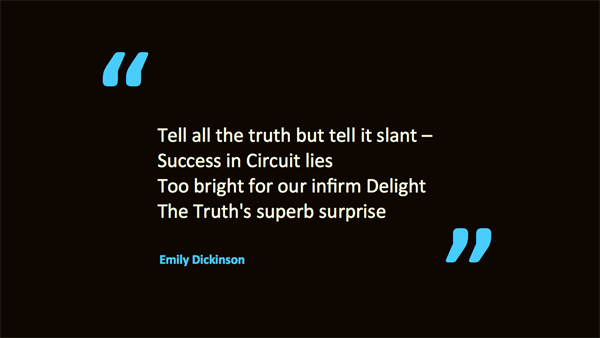
Tell all the truth but tell it slant – poem by Emily Dickinson

Sembl promotes dialogic, non-linear thinking, and new forms of coherence.
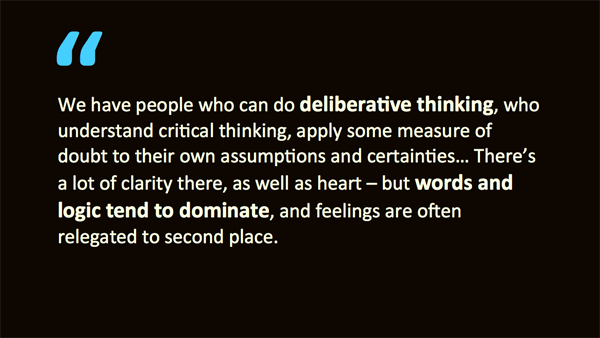
deliberative thinkers – quotation of Charles Cameron

It’s distinct from deliberative thinking, which is rational and causal and logical and linear.
eccentric thinkers – quotation of Charles Cameron

It’s another kind of thinking, which might be informed by rational thought, but its purpose is not singular.
bridge-builders – quotation of Charles Cameron

You might say its purpose is to create – and cohabit – a state of grace, from which ideas simply emerge.
every move you make is a creative leap

If playing Sembl gives us practice in polyphonic thinking, if it helps cultivate connectivity and our capacity to find solutions to local and global problems, it is good value. As Charles says, every move is a creative leap.

Cath concludes:

If you’re interested in working with us to supply content, develop strategy or raise capital, we’re keen to talk.

And I can’t tell you how much I’m anticipating being able to invite everyone to play.

thanks

**

Cath can be reached via Twitter at @cathstyles, and I’m at @hipbonegamer. The Sembl site is at Sembl.net.

Next up: what Sembl has to offer the IC.


Switch to our mobile site