zenpundit.com » 2012

Archive for 2012

Copywrong?

Friday, June 29th, 2012

[ by Charles Cameron — borrowing as the nature of creativity from lichen to origami, copyright ]
.
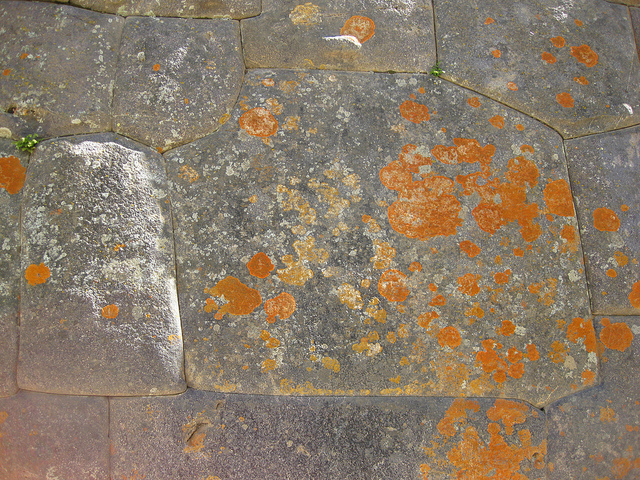
Lichen covered wall, Incan ruins of Ollantaytambo. Cusco, Peru

**

Leonardo in his Treatise on Painting came up with what he called “a new theoretical invention for knowledge’s sake … of great utility in bringing out the creativity in some of these inventions”:

This is the case if you cast your glance on any walls dirty with such stains or walls made up of rock formations of different types. If you have to invent some scenes, you will be able to discover them there in diverse forms, in diverse landscapes, adorned with mountains, rivers, rocks, trees, extensive plains, valleys, and hills. You can even see different battle scenes and movements made up of unusual figures, faces with strange expressions, and myriad things which you can transform into a complete and proper form constituting part of similar walls and rocks. These are like the sound of bells, in whose tolling, you hear names and words that your imagination conjures up.

Borrow, he says, from nature.

Michelangelo, you may recall, used to see statues in chunks of marble, then chip away the excess to reveal what had been there all along…

**

The stone-cutters whose marvelous ingenuity pieced together the stone wall in the Incan ruins of Ollantaytambo, Peru, depicted above in a photo by Teosaurio (under a CC BY-SA 2.0 license) borrowed stone from nature in somewhat the same manner, brilliantly.

Nature repaid the compliment, adding the colors of lichen to the sunlit and shadowed grey of stone.

**

In Paris, the artist Mademoiselle Maurice has been adding her own kind of lichen to the shadowed and sunlit walls of Paris, in an installation she calls spectrum – her lichen being composed entirely of small, colored origami folds, by way of honoring the origami peace cranes of Hiroshima artist Sadako Sasaki.

image: Mlle Maurice, abstract paper rainbow

**

Origami?

Origami is an exquisite art in its own right, demonstrating once again that mathematics belongs as much to the arts and humanities as it does to the sciences and technology.

[Consider this bleeding together of arts and sciences as something of a crusade of mine. Photography is art, and it does not became science just because the photograph is of stars rather than stones: photography is science, and it does not become art simply because the stars are beautiful.]

One genius of the artful mathematics of folding would be Robert Lang, who, as Kevin Kelly just told us, “helped NASA design satellite folding/unfolding solar panels” and “uses computers to devise folding patterns to create impossibly detailed 3D organisms from a single piece of paper…”

One can hardly deny that his work is quite lovely:

Butterfly image: Robert Lang, Origami Insects Vol 2, ed. Makoto Yamaguchi

**

One might wonder whether Lang is the genius, or mathematics? Does he borrow from God, from some principle immanent in universe?

His diagram depicted, left, below, “will, when folded by him, turn into a convincing Rhinoceros Beetle”

Of the Rhinosceros beetle or of the butterfly one might ask, as William Blake asked of the Tyger:

Did He smile His work to see?
Did He who made the lamb make thee?

Science, naturally, somewhat believes it has the answer…

**

Compare and contrast:

image: Kevin Kelly, from the Technium

**

Inappropriately appropriated? The very concepts battle each other into oxymoron fatigue.

The painter Susan Morris borrowed Robert Lang’s beautiful design, itself a WoA — useful bureaucratese devised by a friend of mine for filing Works of Art in a category of their own – to make the painting, also a WoA, depicted above, right.

Morris, it seems to me, takes Lang in a direction pioneered by Frank Stella:

image: Frank Stella, Harran II

**

It was Kevin Kelly who juxtaposed Lang and Morris in the image above — in what I’d have claimed was a WoA in my DoubleQuotes format if I’d done it myself — so as to discuss copyright.

Or more precisely, copy — right or wrong?

Nature copies, without apology, with beauty – and, in the case of certain poisonous spores, without remorse. And are we not nature?

Here’s Leonardo again:

Don’t underestimate this idea of mine, which calls to mind that it would not be too much of an effort to pause sometimes to look into these stains on walls, the ashes from the fire, the clouds, the mud, or other similar places. If these are well contemplated, you will find fantastic inventions that awaken the genius of the painter to new inventions, such as compositions of battles, animals, and men, as well as diverse composition of landscapes, and monstrous things, as devils and the like. These will do you well because they will awaken genius with this jumble of things.

To study, to copy, to derive: this awakens genius. Who am I to disagree?

“It’s Tablet!”….”No, it’s a Coffee Table!”

Friday, June 29th, 2012

Starbuck gets at hat tip for this cool mash-up of furniture with a giant next-generation tablet:

Get Ready for the Smart Coffee Table

Computers started out as discrete objects to be placed on top of furniture — a PC on the desk, a laptop on the dining room table. An iPad on the kitchen counter. But the destiny of computing devices is to be built into our furniture. The desk itself will become a PC. The dining room table will be usable like a laptop. And the kitchen counter will work a lot like an iPad.

In computer science, the concept of computers built into everything is called ubiquitous computing, pervasive computing, ambient intelligence or, my favorite label: everyware.

The transition to intelligent furniture will also involve a reconsideration of the hierarchy of furniture. For example, the tables throughout your house exist in a functional ranking system. Today the king of tables, of course, is the dining room table. You spend more money on it than other tables, such as bedroom nightstands, the coffee table, the patio table, the workbench in the garage, the desk in your home office and so on. Its quality, appearance and placement are far more important than that of lesser tables.

When the dust settles on the transition to intelligent furniture, however, it’s likely that the lowly coffee table will usurp the crown and become the most important (and expensive) table in your house. The reason is that the current location and purpose of a coffee table as a table are peripheral to what’s important about your family’s life. But the intelligent coffee table of the future may be the central computing device in your home.

This is sort of an evolutionary half-step toward the internet of things, as is Google’s Daemon –type glasses. The step beyond that is networking the internet of things with our own brains. Can our brains handle this additional order of magnitude of continuous information flow? Most likely, as we adapted from pastoral life to high-tech civilization without any major evolutionary changes but our culture will definitely evolve – perhaps more than with the advent of literacy or the printing press. Without a depth of connection to others we would be at risk of cultivating a culture of isolation and self-absorbtion (I was going to write “introspection” but, well…we know that is not going to happen). With too much connection there is not enough focus to recognize or develop insights.

SUR40 COFFEE TABLE

William Lind on the Taliban’s Operational Art

Friday, June 29th, 2012

Adam Elkus directed my attention today on Twitter to a new piece by William S. Lind, “the Father of 4th Generation Warfare” at The American Conservative:

Unfriendly Fire 

….The Soviet army focused its best talent on operational art. But in Afghanistan, it failed, just as we have failed. Like the Soviets, we can take and hold any piece of Afghan ground. And doing so brings us, like the Soviets, not one step closer to strategic victory. The Taliban, by contrast, have found an elegant way to connect strategy and tactics in decentralized modern warfare.

What passes for NATO’s strategy is to train sufficient Afghan forces to hold off the Taliban once we pull out. The Taliban’s response has been to have men in Afghan uniform— many of whom actually are Afghan government soldiers or police—turn their guns on their NATO advisers. That is a fatal blow against our strategy because it makes the training mission impossible. Behold operational art in Fourth Generation war.

According to a May 16 article by Matthew Rosenberg in the New York Times, 22 NATO soldiers have been killed so far this year by men in Afghan uniforms, compared to 35 in all of last year. The report went on to describe one incident in detail—detail NATO is anxious to suppress. There were three Afghan attackers, two of whom were Afghan army soldiers. Two Americans were killed. The battle—and it was a battle, not just a drive-by shooting—lasted almost an hour.

What is operationally meaningful was less the incident than its aftermath. The trust that existed between American soldiers and the Afghans they were supposed to train was shattered. Immediately after the episode, the Times reported, the Americans instituted new security procedures that alienated their native allies, and while some of these measure were later withdrawn,

Afghan soldiers still complain of being kept at a distance by the Americans, figuratively and literally. The Americans, for instance, have put up towering concrete barriers to separate their small, plywood command center from the outpost’s Afghan encampment.

Also still in place is a rule imposed by the Afghan Army after the attack requiring most of its soldiers to lock up their weapons when on base. The Afghan commanding officer keeps the keys….

Lind has lost none of his skill for zeroing in on which buttons to push that would most annoy the political generals among the brass.

However, I think Lind errs in ascribing too much credit to the Taliban here. A much simpler explanation is that the usually illiterate ANA soldier is a product of the same xenophobic cultural and religious environment that created the Taliban, the Haqqanis, vicious Islamist goons like Gulbuddin Hekmatyar or the Afghan tribesmen who slaughtered the retreating garrison of Lord Elphinstone in 1841.

While the Taliban have infiltrators, it remains that many of the “Green on Blue” killings are just as easily explained by personal grievances, zealous religious bigotry, indiscipline, mistreatment by American advisers or Afghan superiors and sudden jihad syndrome. While it is impolitic to emphasize it, Afghan betrayal and murder of foreign allies (generally seen as “occupiers”) is something of a longstanding historical pattern. The Taliban capitalize on it politically but they are not responsible for all of it.

Morsi and the Socratic gadfly wannabe

Thursday, June 28th, 2012

[ by Charles Cameron — comparing presidential candidates, here and there ]
.

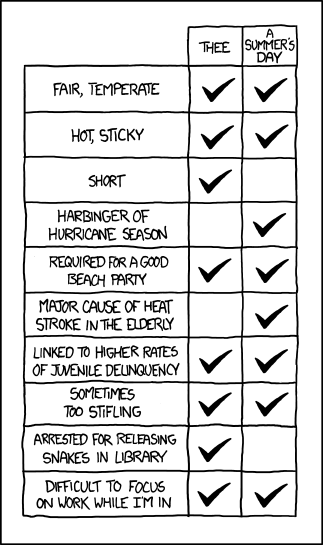
The ability to compare and contrast is an amazing business — you can get online tutorials in how to do it, and it even shows up in xkcd:

Compare and contrast is a basic human activity, in fact, closely allied with choice, and IMO can be crafted into a very powerful engine for understanding — if we first clear away the tangle of other thoughts with which we generally surround it, focus in on it, and use it to probe our assumptions and generate our creative insights…

**

In that spirit, then, let me pose my compare and contrast question for the day.

Compare and contrast:

The first quote presents one of Mr. Morsi‘s actual statements — hand-picked for scary — and there’s even a MEMRI video clip to prove it. The second is admittedly far more vague; it’s from a New York Times piece assessing and guessing at Mr. Romney’s likely foreign policy, which doesn’t actually quote him in any detail — instead, it lays out the basis for current speculation.

What I’m really trying to get at here, though, is how we read Mr. Morsi’s words — and my quote regarding Mr. Romney is in this instance mostly a foil, a way to suggest that at home, we don’t imagine what a candidate says is necessarily what he intends.

So my question, really, boils down to this: how ready would you be to agree that Mr. Morsi may have been making election promises in the full knowledge that he could not, would not, or might not even wish to keep them?

**

Different people will put different weights on Mr. Morsi’s campaign statements and those of Mr. Romney. There may be some interesting patterns to be found in the demographics of those differences.

I for one certainly don’t imagine that both Mr. Romney and Mr. Morsi would keep all their campaign promises to the letter if elected — but then neither do I imagine they would necessarily both deviate from their promises to the same extent under the pressures they, respectively, are under. And as I have indicated, I expect that different outside observers will bring different assumptions and expectations to their evaluations of the likely degree to which each of these men will / would if elected adhere to or deviate from their promises.

The pressures and constraints the two men find themselves under will differ — their respective most basic fears and ideals will very likely differ considerably, too.

And we ourselves, to the extent that we compare and contrast them, will do so from different angles — and come to different conclusions…

**

So: realistically and without prejudgment, how would we compare and contrast the element of what the NYT writer nicely called “political rhetoric” in these two cases?

How seriously should we take Mr. Morsi’s calls for shariah, for jihad, for “our most lofty aspiration” — death for the sake of Allah?

Religious & other weather forecasting

Thursday, June 28th, 2012

[ by Charles Cameron — forecasting, relihttp://zenpundit.com/?p=10194&preview=truegious and otherwise ]
.

As I write, there are fires still raging in the area of Colorado Springs, Colorado.

**

Years ago (in October, 1982?) I lived in a little place called El Nido, the Nest, about half way up Corral Canyon in Malibu, California. My papers were there, a decade’s worth of my thinking and writing, all highly flammable. I was in Santa Monica as it happened, watching a wildfire that had jumped the many lanes of the Ventura Freeway — eucalyptus bark carries flame nicely in a high wind — and was pouring down the dry scrub hills towards the coast, and I heard a police spokesman say the fire had been diverted into two mostly uninhabited canyons — Corral and Latigo — to avoid any risk of the fire reaching the prestigious Malibu Colony a little ways down the road.

That fire burned to within fifteen feet of our house.

The Colorado Springs fires are in the immediate vicinity of the US Air Force Academy, in and around the city the Guardian calls “the ‘evangelical Vatican'” and NPR “a Mecca for Evangelical Christians”.

**

When Hurricane Katrina flooded 80% of New Orleans in August 2005, Pastor John Hagee said:

All hurricanes are acts of God, because God controls the heavens. I believe that New Orleans had a level of sin that was offensive to God, and they are — were recipients of the judgment of God for that. … I believe that the Hurricane Katrina was, in fact, the judgment of God against the city of New Orleans.

When Haiti was hit by a 7.0 magnitude earthquake in 2010, killing 300,000 and rendering more than a million people homeless, one-time pastor Pat Robertson said:

Something happened a long time ago in Haiti and people might not want to talk about. … They were under the heel of the French, you know Napoleon the third and whatever. And they got together and swore a pact to the devil. They said ‘We will serve you if you will get us free from the prince.’ True story. And so the devil said, ‘Ok it’s a deal.’ And they kicked the French out. The Haitians revolted and got something themselves free. But ever since they have been cursed by one thing after another…

Now it’s the turn of Colorado Springs, the Evangelical Vatican or Mecca.

**

Here’s Joel Rosenberg blogging on the topic of the Colorado Springs fires:

Thousands of years ago, God told the Hebrew prophet Haggai to write down these words: “For thus says the Lord of hosts, ‘Once more in a little while, I am going to shake the heavens and the earth, the sea also and the dry land. I will shake all the nations. . . . I am going to shake the heavens and the earth. I will overthrow the thrones of kingdoms and destroy the power of the kingdoms of the nations’” (Haggai 2:6-7, 21-22). This is Bible prophecy. This is an intercept from the mind of the all-knowing, all-seeing God of the universe. It is a weather report from the future, if you will, a storm warning.

His headline?

**

Juan Cole has a different set of resources, a different worldview:

Over the coming decades, the American Southwest will become drier and warmer as a result of all the carbon dioxide and soot that the US, China and other industrial societies are dumping into the atmosphere.

[ … ]

Professor Max A. Moritz at the Department of Environmental Science, Policy, and Management, University of California, Berkeley and his colleagues find the long-term probability of increase of forest fires in the American southwest is high.

Texas and Arizona are among those states at risk — further evidence that the Red States that engage in active climate change denial are committing suicide. I suspect most Coloradans know exactly what is happening to them and why, and my heart goes out to them.

**

It appears that Boulder, too, may be under some degree of threat, and is preparing for possible evacuation.

Boulder, as very distinct from Colorado Springs, is where the Buddhists thrive — home of Naropa University and much more besides.

Best watch out, Boulder. Some Buddhists — as true to the Buddha’s teaching, perhaps, as Rev. Hagee is to those of Christ — hold views about Karma that seem remarkably similar to Rev. Hagee’s views about the wrath of God.

I’m thinking of Sharon Stone:

Stone, 50, who was speaking to reporters at the Cannes film festival, criticised the Chinese government’s actions in Tibet and directly linked them to the disaster: “I’ve been concerned about how should we deal with the Olympics, because they are not being nice to the Dalai Lama, who is a good friend of mine,” she said. “And then all this earthquake and all this stuff happened, and I thought, is that karma – when you’re not nice that the bad things happen to you?”

**

God, nature or karma — whatever it is, it appears to be an equal-opportunity creator and destroyer.

We’re human.

With our heads, we’d like to explain and blame. With our hearts we are terrified, concerned, meditate, pray, fear, love. And help.


Switch to our mobile site