zenpundit.com » 2013 » February

Archive for February, 2013

The Buddha, the Barbie, and Walter Benjamin

Sunday, February 17th, 2013

[ by Charles Cameron — iconoclasm, Iranian style ]
.

From AP today:

Iran confiscates Buddha statues from shops.

TEHRAN, Iran (AP) – An Iranian newspaper is reporting that government authorities are confiscating Buddha statues from shops in Tehran to stop the promotion of Buddhism in the country.

Sunday’s report by the independent Arman daily quotes Saeed Jaberi Ansari, an official for the protection of Iran’s cultural heritage, as saying that authorities will not permit a specific belief to be promoted through such statues.

Ansari called the Buddha statues symbols of “cultural invasion.”

He did not elaborate on how many have been confiscated so far, but said more would be seized from shops.

Iran has long fought against items, such as Barbie dolls and Simpsons cartoon characters, to defuse Western influence, but this appears to be the first time that Iranian authorities are showing an opposition to symbols from the East.

**

Walter Benjamin, very much apropos, in The Work of Art in the Age of Mechanical Reproduction:

The uniqueness of a work of art is inseparable from its being imbedded in the fabric of tradition. This tradition itself is thoroughly alive and extremely changeable. An ancient statue of Venus, for example, stood in a different traditional context with the Greeks, who made it an object of veneration, than with the clerics of the Middle Ages, who viewed it as an ominous idol. Both of them, however, were equally confronted with its uniqueness, that is, its aura. Originally the contextual integration of art in tradition found its expression in the cult. We know that the earliest art works originated in the service of a ritual – first the magical, then the religious kind. It is significant that the existence of the work of art with reference to its aura is never entirely separated from its ritual function. In other words, the unique value of the “authentic” work of art has its basis in ritual, the location of its original use value. This ritualistic basis, however remote, is still recognizable as secularized ritual even in the most profane forms of the cult of beauty. The secular cult of beauty, developed during the Renaissance and prevailing for three centuries, clearly showed that ritualistic basis in its decline and the first deep crisis which befell it.

**

Sources:

Barbie Sitting Acrylic Cut Out
Buddha, seated

Robb on the Networked Age

Saturday, February 16th, 2013

John is en fuego today:

Life in a Networked Age

.….In the last thirty years, we’ve seen a shift in the technological substrate.  This new susbstrate is increasingly a family of technologies related to information networks.

As this new substrate begins to take control, we’re going to need new management forms.  Both bureaucratic and market systems are proving insuffient solutions to the challenges of a networked age.  

In both cases, the emergence of a global network is eroding the efficacy of bureaucracy and markets as solutions.  How?  One reason is scale.  

A global network is too large and complex for a bureaucracy to manage.  It would be too slow, expensive, and inefficient to be of value.  Further, even if one could be built, it would be impossible to apply market dyanmics (via democratic elections) to selecting the leaders of that bureaucracy.  The diversity in the views of the 7 billion of us on this planet are too vast.  

In terms of markets, a global marketplace is too unstable.   Interlinked, and tightly coupled markets are prone to frequent and disasterous failures.  Additionally, a global marketplace is easy for insiders to corrupt and rig, as we saw with the 2008 financial melt-down.   Given instability and unmitigated corruption, markets will fail as a decision making mechanism.  

So, what’s going to replace bureaucracy and markets?

Read the rest here.

In very strong agreement with John. I like markets and think they produce efficient and optimized results for many things ( not all things) but free markets currently face massive (and sadly bipartisan) efforts to rig them by the oligarchy here at home, much less in autocratic states where the  practice of state socialism, kleptocracy and government by mafia or tribal/sectarian minority is the norm.  People will seek work-around structures to adapt, thrive and evade extortionate schemes by elites that have hijacked the state.

Hat tip to Lexington Green

Valentine — our first global saint?

Friday, February 15th, 2013

[ by Charles Cameron — a mixed reception for St Valentine and his Day ]
.

Above: Pakistan, 2103. Below: Saudi Arabia, 2013

**

Blog-friend Omar Ali has a piece up at the Brown Pundits blog, How easy is it to be accused of blasphemy in Pakistan? — which included the upper of the two images above, along with this comment and more…

The website of the Express Tribune (liberal by Pakistani standards) published a picture. its a modestly dressed woman posing next to an anti-valentine day billboard with a sign that says “let love be”. (It doesnt seem to be on the tribune site anymore… I am told it was there but has been removed … I just thought of taking THIS blog post off the net too, but since PKKH has their original post up, I doubt if we are materially adding to any possible legal case that may be concocted to bully the people involved).

[ … ]

It took only a few minutes for Paknationalists to notice and become outraged. See details here.

Of course no blasphemy was intended or committed. But the poor girls, and the editors and publishers of the Tribune, could still be in trouble.

**

I have noted the distaste some festivals which seem innocuous enough to many of us can stir in some others, and Valentine’s Day among them, mentioning both Hindu and Muslim reactions to the feast of hearts, roses, restaurants and beds along with Halloween in “Trick or Shirk” Indeed. Today, I’d like to raise the possibility that Valentine is may be the first saint of globalization, if Santa Claus hasn’t already won that honor — a saint, that is, of commerce, which tends to obliterate all boundaries of faith and nation.

Here’s an interesting indicator… This year, the Saudi Gazette reports Saudi religious police deny intent to close flower shops (see the lower image above):

The head of Saudi Arabia’s Commission for the Promotion of Virtue and Prevention of Vice (CPVPV) denied on Tuesday plans to close shops selling flowers during Valentine’s Day, Feb. 14.

Sheikh Abdullatif Al-Sheikh told the Saudi daily newspaper Al-Jazirah: “This is not our specialty. It is the specialty of other parties. We reject what violates the book (Qur’an) and the Sunnah (the Prophet’s teaching) and Saudi Arabia’s regulations.”

“We deal with issues on a case by case basis, and if there is a violation our role is to liaise with concerned government parties,” he added.

Al-Sheikh’s statements followed widely-circulated reports that the commission is planning to close all shops selling flowers on Valentine’s Day.

Previously, the commission banned the sale of red roses ahead of Valentine’s Day, forcing couples to think of new ways to show their love.

**

For a quick peek at St Valentine’s skull — and the heart of St Lawrence for that matter, see my post Of dust and breath, which dealt with their respective show-cased relics.

On Socrates and His Legacy, Part I.

Thursday, February 14th, 2013

Recently, I finished two books on the iconic ancient Athenian philosopher Socrates, both of which pointed me to a third. The books were of a very different character and quality, yet together raised an important dichotomy about a man who lived 2400 years ago, whose intellectual legacy contributed to the shaping of Western civilization. The Stoics and Cynics looked back to Socrates as their forerunner; Socrates’ greatest student Plato became the most influential philosopher of the written word of all time, rivaled only by his own protege, Aristotle. So definitive was the influence of Socrates and his inexhaustible store of questions that all the Greek philosophers who came before him are reckoned “the pre-Socratics“. Yet he was put to death by the Democracy that had proudly boasted of being the “the school of Hellas“.

Who then, was the historical Socrates?

Socrates shares, to a lesser degree, the enigmatic quality of Buddha, Jesus and his own near contemporary, Confucius; we know more about Socrates than we do the others, but as with the others, it is all secondhand. Having written nothing himself, we must rely on the apologia of his disciples, the barbs of his critics, some statuary relics and the commentary of philosophers and historians from later in antiquity who had access to sources now lost to tell us of Socrates.

Here are the books:
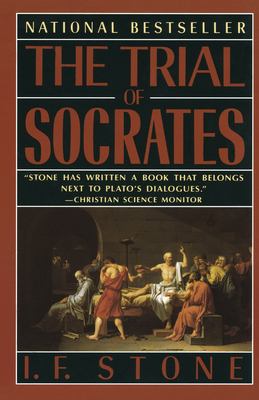
  

The Trial of Socrates by I.F. Stone

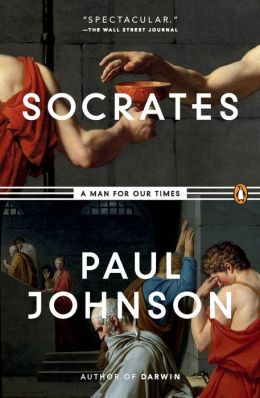
Socrates: A Man for Our Times by Paul Johnson  

Both authors were splendid prose writers, otherwise they are a study in contrasts. The late I.F. Stone was a famous radical, an antifascist, an investigative, “muckraking” journalist of the mid twentieth century and, for a time,  a Soviet agent during the “Red decade” of the Thirties. Stone, who was noted for his diligence with using government documents as a reporter, unearthing scoops everyone else had missed, became, in his retirement, a scholar of antiquity who read deeply in the classics in the original ancient Greek.

Paul Johnson began his career as a prolific writer and popular historian on the British Left with The New Statesman and over time shifted rightward to become a leading Anglo-Catholic conservative public intellectual, an adviser to Margaret Thatcher and an author of 40 books. Johnson is most known for his best-sellers that tackled panoramic and encompassing subjects – The Birth of the Modern, Intellectuals and The History of the Jews, often written from a highly idiosyncratic, as well as a conservative, perspective.

Of the two books, Stone’s  The Trial of Socrates is by far the most substantive. Stone relies heavily, though not exclusively, upon primary sources in the original Greek to build his argument, which is that Socrates was executed because of his militant, arch-reactionary, “antipolitical” opposition to self-government, especially in the form of the Democracy; and further, that Socrates’ actions at his trial were perversely designed to inflame the jury which might easily have acquitted him.  Socrates:A Man for our Times by Johnson is based on English translations of primary sources and secondary sources, is lighter in tone and much closer to being an essay. Johnson is evaluating the importance of Socrates in a broad, civilizational, context while Stone trying to tell what really happened while simultaneously judging Socrates culpability.

One point on which both authors have agreement is the mendacity and artistry with which Plato has made this task more difficult. I.F. Stone generally sees a “sneering” antidemocratic political continuity between Socrates and all of his disciples Plato, Xenophon, Charmides, Critias, Antisthenes and Alcibiades but even Stone cannot stomach Plato’s casual misuse (or abuse) of Socrates in his later dialogues to vent petty gripes and snobbish airs. Writing of an insulting passage in The Republic:

….Plato put this into the mouth of Socrates many years after the latter’s death. There is no evidence that the historical Socrates ever spoke so unkindly or pretentiously. Otherwise Socrates could not have had the lifelong affection of his oldest disciple, the “low-born” Antisthenes; his mother was a Thracian, hence he was twitted for not being of pure Attic blood (Diogenes Laertes, 6.1). Several scholars believe this was Plato’s slur against his fourth century rival – and Socrates’ old friend – Isocrates.[255]

Paul Johnson goes much further; attributing much that scholars regard as negative in Socrates’ reputation to the machinations of Plato using his late master as “a ventriloquist’s dummy”, a caricature Johnson calls “PlatSoc” to add authority to his own views and theories in which Socrates never believed or more likely, never even had heard:

….As an intellectual he [Plato] began to formulate his own ideas. As an academic he quickly merged them into a system. As a teacher he used Socrates to spread and perpetuate it. In his earlier writings Plato presented Socrates as a living breathing, thinking person, a real man. but as Plato’s ideas took shape, demanding propagation, poor Socrates whose actual death Plato had so lamented, was killed a second time, so that he became a mere wooden man, a ventriloquist’s doll, to voice not his own philosophy but Plato’s.

….So the act of transforming a living, historical thinker into a mindless, speaking doll – the murder and quasi-diabolical possession of a famous brain – became in Plato’s eyes a positive virtue. That is the only charitable way of describing one of the most unscrupulous acts in intellectual history. Thus Plato, with no doubt the best of intentions, created like Frankenstein, an artificial monster-philosopher [11]

There are other sources of information regarding Socrates than Plato, of course.  Xenophon, also wrote an apologia; Aristophanes and other comic poets satirized Socrates in their plays, the philosopher being a “public figure” in Athens as much as was Pericles or Cleon (Socrates apparently could take a joke much better than the litigious and bloodthirsty demagogue Cleon); Aristotle had informed speculations regarding Socrates based on his long (and one suspects trying) tutelage under Plato and there are Roman writers such as Cicero who had access to sources now lost, but Plato remains the most prolific.

This is important, because the central thesis in The Trial of Socrates is that Socrates is not merely an “antidemocratic” gadfly in Athens, but an arch-reactionary teacher of “antipolitical” doctrines. That is to say that Stone argued that Socrates and his followers rejected the concept of the self-governing “polis” itself, oligarchy as much as democracy, that men were a “herd” fit only for a shepherd, an absolute Homeric ruler defined by Socrates as “the One who Knows”. Stone argues, with accuracy, that Socrates disciples, despite differences in personality and philosophy, shared a common disdain for democratic politics and furthermore, that Socrates teaching repeatedly led to cohorts of aristocratic, pro-Spartan,”Socratified youth” who twice supported the overthrow of the Democracy. In short that Socrates was tried because his activities, his “examinations”, were ultimately politically subversive to the state in a time of danger and instigated civil strife.

This means, to judge Stone’s argument requires that we discern Socrates from Plato that in turn requires some expertise on Plato. This need to sift Platonic dialogues explains why both Johnson and Stone, despite Stone’s ability to work with the primary texts in the original Greek, turned to the scholarship of Gregory Vlastos for guidance. Vlastos was a seminal figure in the field of Platonist philosophy whose work is described by other scholars as “transformative” and having “a vast influence” who best parsed Socrates from his artfully prolix disciple. Because of Stone and Johnson, I have picked up what is regarded by many as “the best book on Socrates” – Socrates: Ironist and Moral Philosopher by Gregory Vlastos.

Vlastos, in this final book, ultimately came closer to Johnson’s position in the sense that some of what  moderns find disagreeable in Socrates and what Stone criticizes in particular – the harsh antidemocratic edge – is more a product of Plato’s literary handiwork than the philosophy of the historical Socrates. Vlastos writes:

I have been speaking of a “Socrates” in Plato. There are two of them. In different segments of Plato’s corpus two philosophers bear that name. The individual remains the same. But in different sets of dialogues he pursues philosophies so different that they could not have been depicted as cohabitating in the same brain throughout unless it had been the brain of a schizophrenic

The early Socrates of the Elenctic Dialogues is the most genuine in the view of Vlastos.

End Part I.

Book Mini-Review: Makers: the New Industrial Revolution by Chris Anderson

Wednesday, February 13th, 2013

Makers: The New Industrial Revolution by Chris Anderson 

This is a fun book  by the former editor-in-chief of WIRED , author of The Long Tail and the co-founder of 3D Robotics, Chris Anderson. Part pop culture, part tech-optimist futurism and all DIY business book, Anderson is preaching a revolution, one brought about by the intersection of 3D printing and open source “Maker movement” culture, that he believes will be bigger and more transformative to society than was the Web. One with the potential to change the “race to the bottom” economic logic of globalization by allowing manufacturing entrepreneurs to be smart, small, nimble and global by sharing bits and selling atoms.

Anderson writes:

Here’s the history of two decades of innovation in two sentences: The past ten years have been about discovering new ways to create, invent, and work together on the Web. The next ten years will be about applying those lessons to the real world.

This book is about the next ten years.

….Why? Because making things has gone digital: physical objects now begin as designs on screens, and those designs can be shared online as files…..once an industry goes digital in changes in profound ways, as we’ve seen in everything from retail to publishing. The biggest transformation, but in who’s doing it. Once things can be done on regular computers, they can be done by anyone. And that’s exactly what we’re seeing happening in manufacturing.

…..In short, the Maker Movement shares three characteristics,  all of which I’d argue are transformative:

1. People using digital desktop tools to create designs for new products and prototype them (“digital DIY”)

2. A cultural norm to share those designs and collaborate with others in online communities.

3. The use of common design file standards that allow anyone, if they desire, to send their designs to commercial manufacturing services to be produced in any number, just as easily as they can fabricate them on their desktop. This radically foreshortens the path from idea to entrepreneurship, just as the Web did in software, information, and content.

Nations whose entire strategy rests upon being the provider of cheapest labor per unit cost on all scales are going to be in jeopardy if local can innovate, customize and manufacture in near-real time response to customer demand. Creativity of designers and stigmergic /stochastic collaboration of communities rise in economic value relative to top-down, hierarchical production systems with long development lags and capital tied up betting on having large production runs.

Interesting, with potentially profound implications.


Switch to our mobile site