zenpundit.com » 2013 » April

Archive for April, 2013

Tamerlan Tsarnaev end times videos I: the Mahdist video, pt 1

Saturday, April 20th, 2013

[ by Charles Cameron — possibility of Mahdist belief or sympathies on the part of one of the Boston bombers surfaces, with some details of the relevant video ]
.

Source: https://twitter.com/gregorydjohnsen/status/325264215025782788
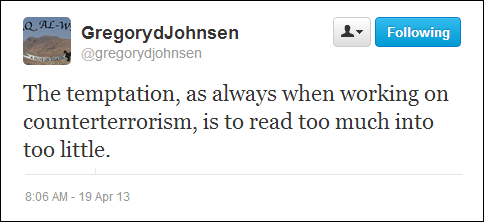
**

Having said that, here’s the explicitly Mahdist video that Tamerlan Tsarnaev liked on FaceBook — one of two “end times” videos as it happens, and worth viewing in context with the other.

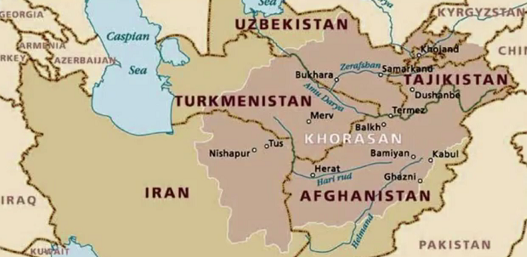
The theme here of the black banners of Khorasan is one I have been writing about for years now, as the editors at NRO kindly noted yesterday.

**

I’m not alone in noticing this video [1, 2, 3], but I may have more interest in it than many others, because I believe Mahdism — and “end times” excitement in general — is a volatile conceptual additive and should be handled with considerable caution.

In particular, I would note that the “black banners of Khorasan” ahadith, cited in the video, have been widely used in AQ recruitment as reported by ex-FBI agent Ali Soufan and Syed Saleem Shahzad in their respective books [1, 2], although the ahadith are of probable Abbasid origin as suggested by David Cook [Contemporary Muslim Apocalyptic Literature, Chapter 8, Apocalyptic Predictions concerning Afghanistan and the Taliban, pp. 172 ff.] — and indeed, I’d recently asked the tweeting American mujahid Abu Mansoor Al-Amriki (Omar Hammami):

to which he’d responded:
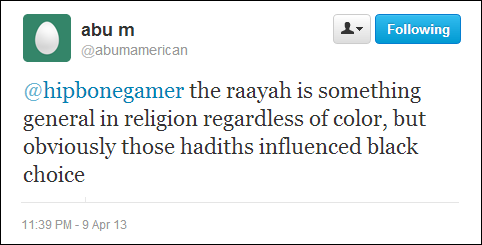
[ I started to tweet occasional theological questions to Abu M after he instructed his followers to read Zenpundit, here and more emphatically here — I believe the post he was specifically referring to was this one ]

**

Okay.

This account of the Mahdist video would make a long post, and if you can watch the video and make out most of what it is saying in the title cards (intertitles) that form, along with the occasional voice over, the through-line of the movie, you won’t need most of the rest — I’m mostly going to offer transcriptions of those portions that aren’t too fuzzy for me to read.

Three things you might find worth noting, however, are:

  • the quotes from Imran Nazar Hosein, whom I’ve discussed before eg: 1, 2, 3, 4], starting in this section
  • the section on the supposedly Jewish origins of the Afghan people [which I discussed in some detail here], in part 2 of this post, and
  • the short clip from Mel Gibson‘s The Passion of the Christ which has been slipped into the video with dramatic effect, in part 3.
  • **

    For those of you who feel like following along — and there’s plenty of detail of interest — I’ve broken the thing into parts, and my account of the video begins here…

    After the Bismillah:
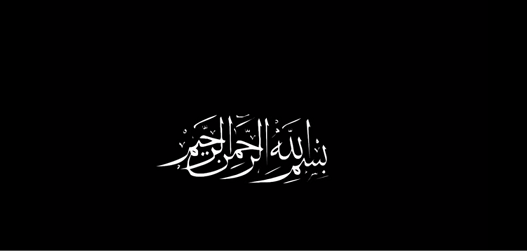
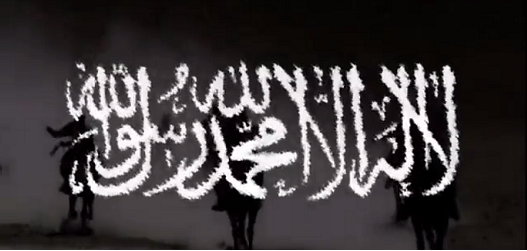
    … followed by a card proclaiming it to be the work of T.R.U.E.E. Productions [00.07], the video begins with the “black banner” itself [00.21], in this form:

    This serves as the opening title of the video, which is presented on YouTube and a minute into the video with the title “The Emergence of Prophecy: The Black Flags From Khorasan“. The banner fades slightly to show present-day horsemen, presumably from Afghanistan:
    There are others — I’m thinking of Chris Anzalone and Aaron Zelin — who could tell you the origins of the various video clips and anasheed that are used throughout the video, but I’ll confine myself to the text cards and voice overs.

    Over the last of the horsemen, the voice of Imran Nazar Hosein speaks [00.46]:

    The prophet said, “When you see the black flags coming from the direction of Khorasan, go and join that army.” That army has already started its [march). They know it. And that’s why they demonize as a terrorist anyone, anyone who supports that army. They know it. And that’s why they demonize as a terrorist anyone, anyone who supports that army.

    That’s the end of the Intro, after which the title in English appears [01.16]:
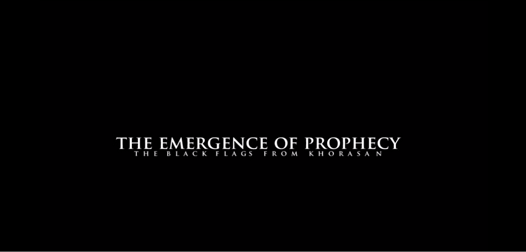
    For a bit of flash and excitement, there’s a count-down [01.23 – 01.32] — we’re approaching zero hour, I’m guessing — and the first major text card shows up [01.38]. It is the first of several “notes”:
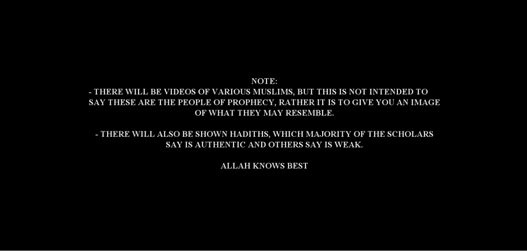
    The caution exhibited here is interesting — someone doesn’t want to be caught out in an error by theologically more sophisticated viewers, hence the admission that some scholars view the black banners of Khorasan ahadith as weak… and the always welcome admission:

    Allah knows best.

    At [01.56] a hadith is introduced over black and white visuals of war by night:

    I’ve magnified this one a little for easier reading [02.09]:

    The citation in red is hard to make out, but I believe it references “Sunan Ibn Majah Hadith 971 Volume 3”.

    The statement, “their weapon will be the weapon of Emaan (Faith)” is of interest, compare in the New Testament Ephesians 6.13-17 —

    Wherefore take unto you the whole armour of God, that ye may be able to withstand in the evil day, and having done all, to stand. Stand therefore, having your loins girt about with truth, and having on the breastplate of righteousness; And your feet shod with the preparation of the gospel of peace; Above all, taking the shield of faith, wherewith ye shall be able to quench all the fiery darts of the wicked. And take the helmet of salvation, and the sword of the Spirit, which is the word of God.

    as is the reference to the conquest of Constantinople “without materialistic weapons”. But all that’s fodder for another post on another day.

    At [02.36] we get:

    The text in red here — compare with the use of white and red print against a black background in the screen-grab by JM Berger from an As-Sahab Media video at the top of this post — reads fairly clearly:

    Saheeh Muslim Book Hadith 2896, page 1904, volume 3

    There’s a brief flash of the world map, then this map with its central text in small print and the word EAST quite large by comparison [02.54]:
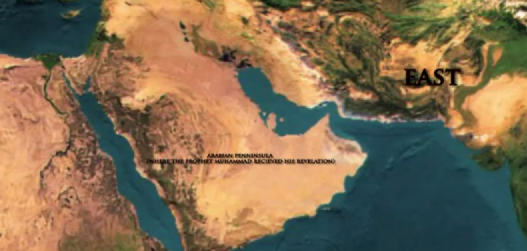
    That central text reads:

    Arabian Penninsula
    (Where the Prophet Muhammad received his Revelation)

    Next coes another hadith [02.59]:
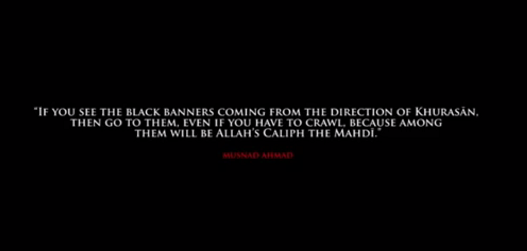
    Here the only reference is “Musnad Ahmad”.

    Then two maps identifying Khorasan [03.04 and 03.07]:
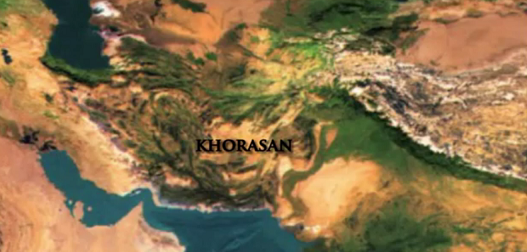
    So that’s the set-up.

    Things get pretty intriguing around here, as a question is posed as to the race or races of those who will follow the black banners, and the comments on Afghanistan and the Lost Tribes of Israel begin…

    **

    I’ll take a break here, and continue in Part II.

    Like a diamond, Boston

    Saturday, April 20th, 2013

    [ by Charles Cameron — two quick facets ]
    .

    Like a diamond, the Boston “event” has many facets — here are two of them to consider:

    There are many, many more, and I will be addressing one of them in detail shortly.

    Sources:

  • Pundita, at the Pundita blog
  • Rafia Zakaria, at Guernica
  • **

    Boston — the city composed of its people — has been a brilliant gem itself these last few days. I do not often salute a city, but today I salute Boston.

    A Boston DoubleQuote, via Jim Friedrich

    Saturday, April 20th, 2013

    [ by Charles Cameron — the subject of interest is in the details ]
    .

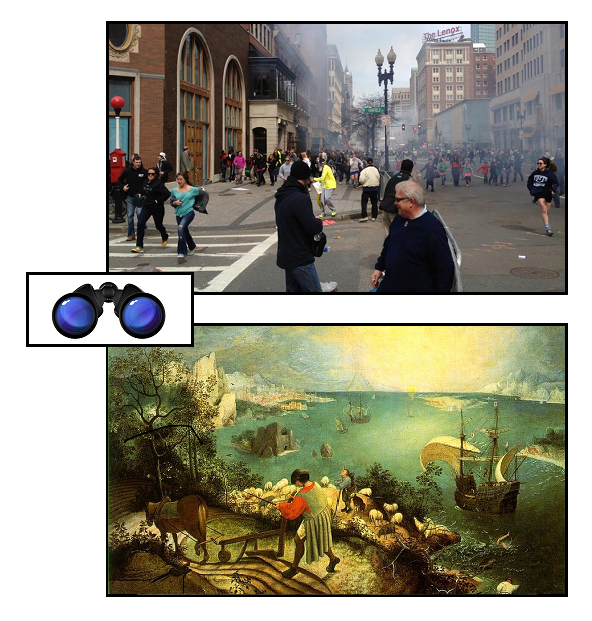
    My friend Jim Friedrich, an Episcopalian priest and artist, posted a thought-provoking juxtaposition of images on FaceBook yesterday, which I have resized and cropped to fit my own DoubleQuotes format:

    Fr Friedrich’s comment:

    This photo snapped Monday in Boston is like Brueghel’s “Fall of Icarus.” The critical subject in each is, from the viewer’s position, just a small detail practically lost in the totality of the scene. Very strange to look at, and to think about – ethically, existentially, theologically…

    **

    Also worth recalling in this context is WH Auden’s poem, Musee des Beaux Arts:

    About suffering they were never wrong,
    The old Masters: how well they understood
    Its human position: how it takes place
    While someone else is eating or opening a window or just walking dully along;
    How, when the aged are reverently, passionately waiting
    For the miraculous birth, there always must be
    Children who did not specially want it to happen, skating
    On a pond at the edge of the wood:
    They never forgot
    That even the dreadful martyrdom must run its course
    Anyhow in a corner, some untidy spot
    Where the dogs go on with their doggy life and the torturer’s horse
    Scratches its innocent behind on a tree.

    In Breughel’s Icarus, for instance: how everything turns away
    Quite leisurely from the disaster; the ploughman may
    Have heard the splash, the forsaken cry,
    But for him it was not an important failure; the sun shone
    As it had to on the white legs disappearing into the green
    Water, and the expensive delicate ship that must have seen
    Something amazing, a boy falling out of the sky,
    Had somewhere to get to and sailed calmly on.

    **

    I hope to post something tomorrow on the Mahdist video that Tamerlan Tsarnaev “liked” on FaceBook and added to his “Islam” folder. In its own way, that’s a minor — yet significant — detail, too.

    Aftermath: Caitlin Fitz Gerald

    Friday, April 19th, 2013

    [ Charles Cameron, introducing Caitlin Fitz Gerald ]
    .

    I was among those deeply moved by Caitlin Fitz Gerald‘s post, Boston’s Best Day, which I quoted from two days ago, and today she posted a series of tweets which again struck me. Knowing Caitlin’s love of visual expression, I invited her to take those tweets and make a guest post of them here, with an illustration should she so choose.

    Her post, both text and its illumination, follows:

    **
     
     
    Turns out I hate the theater of this. I don’t want to hear politicians talk about what happened, or about how strong we are, or anything. I just want the professionals to do what they do, find the people who did this, and along the way to keep us as informed as they can without compromising what they’re doing. I want people to grieve in their way, I don’t want this to be a political speech opportunity. Let our local religious leaders offer comfort and our community leaders direction. I’m sure others feel differently, and if it offers comfort to others, that’s wonderful, but I’ve been surprised how very much I don’t want to hear speeches from, e.g. the President on this. And if focus is on anyone, it should be on the medics and doctors and nurses and cops and firefighters and regular old people who helped each other. People keep calling them heroes, which is nice but almost undercuts the absolute gobsmacking amazingness of what they actually are: regular, good people whose instinct in a crisis was to help other people. Isn’t that more incredible than needing some superlative hero in a time like this? Isn’t it more amazing that what looks like heroism is really just what people are? How remarkable, that we all have that capacity in us. It’s not extraordinary, it’s miraculously ordinary.


    Caitlin Fitz Gerald, Aftermath

    Octavian Manea interviews MIT’s Roger D. Peterson

    Friday, April 19th, 2013

    Another installment of Octavian Manea’s excellent COIN interview series at SWJ. This one focuses on social science and varieties of insurgency:

    Breaking Down “Hearts and Minds”: The Power of Individual Causal Mechanisms in an Insurgency 

    ….OM: In your research you pointed out to a spectrum of conceivable individual roles in an insurgency. What is the methodology behind this typology?

    RDP: This methodology comes from my 2001 book (Resistance and Rebellion: Lessons from Eastern Europe) which focused on Lithuanian resistance to Soviets in the 1940’s. Insurgency is a complex phenomenon, especially in how violent organization and networks are created and sustained, and the methodology of that book involved breaking down this complexity into component parts and then building back up into a coherent whole. At the base of this process is the way individuals position themselves relative to the dramatic and violent events of insurgency. Most people may wish to remain neutral and just take care of their families but events push significant numbers of individuals into roles of unarmed support of insurgents, or local armed position of a militia, membership in a mobile non-local organization, or equivalent positions in support of the government.  Furthermore, individuals may move back and forth along this spectrum of roles. If one is skeptical of broad and vague theories at a high level of aggregation, as I am, then you need to get down and observe dynamics at a basic level. Observing movement along this spectrum of roles is one way to do that. 

    …..Is it FM 3-24 and the whole contemporary Western COIN discourse too narrow, too much focused on rational, cost/benefit models of decision-making? Is it too restrictive when making this inventory of driving motivations or causal mechanisms?

    RDP: I think there is a tendency in the Western academic analysis to focus on rational theories. Those theories are straightforward.  But they also might be too straightforward, too simple.  In Iraq, the coalition did not plan on the emotion of resentment stemming from a status reversal affecting Sunni calculations in the beginning stages of the conflict. We did not understand the revenge norms that exist in some of the places. We did not fully understand the social norms that helped to produce the tribal militias in Anbar province.  We did not understand the psychological mechanisms underlying the Sunni view of the new world they were living in. 

    The last part is a curious lacuna.

    The incompetence of the planning for the occupation of Iraq has been amply recorded – the high level disdain of General Tommy Franks and Secretary Rumsfeld for what befell the day after victory, the keeping of professional Arabists at arms length in preference for Beltway contractors and college kids with AEI connections, the haplessness of Jay Garner and the political obtuseness of Paul Bremer ad so on. This is not what I mean about lacuna.

    I mean something more fundamental, in terms of understanding human nature as the root of political behavior and therefore political violence. We are all familiar with the Clausewitzian trinity (or should be) but less attention is paid to the motivational factors that make men decide to stand, fight and die or stand aside. Thucydides also had a trinity that did not attempt to capture the nature of war but rather explain why wars happened and it seems to me to be of particular use for evaluating the decision in small wars to pick up a gun or not, to side with the government or join the rebellion:

    “Surely, Lacedaemonians, neither by the patriotism that we displayed at that crisis, nor by the wisdom of our counsels, do we merit our extreme unpopularity with the Hellenes, not at least unpopularity for our empire. That empire we acquired by no violent means, but because you were unwilling to prosecute to its conclusion the war against the barbarian, and because the allies attached themselves to us and spontaneously asked us to assume the command. And the nature of the case first compelled us to advance our empire to its present height; fear being our principal motive, though honour and interest afterwards came in. And at last, when almost all hated us, when some had already revolted and had been subdued, when you had ceased to be the friends that you once were, and had become objects of suspicion and dislike, it appeared no longer safe to give up our empire; especially as all who left us would fall to you. And no one can quarrel with a people for making, in matters of tremendous risk, the best provision that it can for its interest. 

    Fear, honor and interest are ever present in “calculation” both by men and by the political communities they compose and the factions that threaten to tear them apart. All the more so in a defeated and broken country divided by ethnicity and sect where all parties were uneasily eyeing the conqueror. No special knowledge of Arab culture should have been required to anticipate that Iraqi men, if made desperate by uncertainty and circumstance, might have at least seen it in their interest to achieve some measure of security with the gun and to enact policies of carrots and sticks a priori to discourage that, before the insurgency gained critical mass.

    Awareness of the universality of the Thucydidean trinity would not have in itself guaranteed success in Iraq but knowing it is a rudimentary minimum of political competence upon which you can at least build.


    Switch to our mobile site