zenpundit.com » 2013 » June

Archive for June, 2013

How to win souls and be worthy of emulation?

Tuesday, June 4th, 2013

[ by Charles Cameron — considering a rare attribute in two religious leaders ]
.

**

Christopher Anzalone tells a story about the Grand Ayatollah Sadiq al-Sadr (above, left), Moqtada‘s father, in his highly recommended podcast on Jihad & Martyrdom in Contemporary Muslim Militants with Karl Morand.

I’m very slow at transcription, but this story hit me with its insight into an aspect of religion that — as the story itself illustrates — is not always recognized, and i was able to find the same story told elsewhere, though not with the flair Chris brings to the telling. Here it is, as recounted by Patrick Cockburn in his book, Muqtada Al-Sadr and the Battle for the Future of Iraq:

One former disciple of Mohammed Sadiq tells an anecdote illustrating his master’s pragmatism. “One day, I was sitting with Mohammed Sadiq in his office, when a man came in to ask the price of tomatoes,” he says. “The question infuriated me: I thought he had come to mock us. But al-Sadr, wiser and smarter than I am, gave him a detailed answer, giving him the price of different kinds of tomatoes. He had understood what the question was about. I caught up with the man as he left the office and asked him why he had asked the question. He replied: ‘In selecting a marji’ [a religious figure to emulate and whose rulings he would accept], I choose the one who knows my suffering, who is close to the poor and the disinherited.'”

**

Pope Francis has a similar direct and simple approach, and from the very start of his pontificate it has been winning him admirers, both religious and secular. He refuses the limo, preferring to take the bus. He pays his own bill as he checks out at the hotel front desk (above, right). He telephones the guy in Buenos Aires whose newsstand supplied his daily newspaper, to thank him and cancel his subscription…

Person to person.

Half Price Books

Tuesday, June 4th, 2013

An old Border’s location near where I live was taken over by Half Price Books, the growing used book chain. So I took a drive with the kids to check it out, though my expectations were not high.  My Eldest also decided to sell a box of books dating back to her more childish years.

The atmosphere of the store was pleasant and the employees friendly and helpful, much of the space is (quite properly) devoted to maximizing the display of the stock of books instead of various kinds of retail nonsense. We browsed while the buyers evaluated my daughter’s books for resale. The store was very well stocked for a used book store catering to the general public and the prices were excellent. While the decor was “no frills” there were comfortable, well-used, chairs in which to sit toward the back of the store accompanied by end tables for the piling of books.  My son enjoyed going through the bins of of old comics, of which he bought a fistful for .50 cents each.

The most expensive book I bought was $9 (for two volumes) vice a new retail price of $40; most ran $4 – $6. One brand new copy was purchased for all of $2.

Here’s what I picked up:


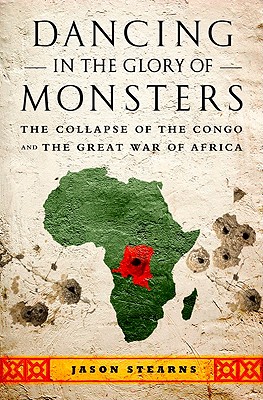
Dancing in the Glory of Monsters: The Collapse of the Congo and the Great War of Africa byJason Stearns 

This one was the subject of a book review by Scott Shipman which you can read in full here.

Clausewitz’s On War: A Biography by Sir Hew Strachan

I have been wanting to read this one ever since we had The Clausewitz Roundtable at Chicago Boyz. Strachan is one of the leading military historians and strategic thinkers and can be viewed lecturing on strategy and war here.

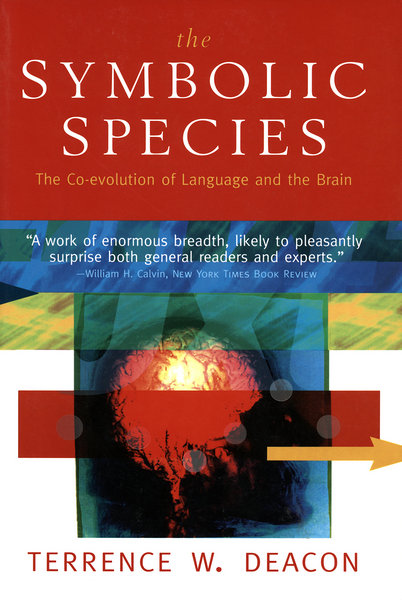
The Symbolic Species: The Co-evolution of Language and the Brain by Terrence Deacon

This was in mint condition – literally had never been opened (must have been a student’s copy LOL) – and was only $2 as a Half Price Books “SuperBuy”. Deacon is a biological anthropologist and was/is a professor at Harvard Medical School and Berkeley. On the one hand, some of the neuroscience might be dated, given the 1997 copyright, but as he is investigating 2 million years of human evolution, so how off could it be in just 16 years?

The Campaigns of Alexander by Arrian 

Arrian was cited frequently, but with significant reservations and commentary, by Paul Cartledge in his biography Alexander the Great, which I reviewed here.


War in the Shadows: The Guerrilla in History (vol. I & II) by Robert Asprey 

I am not very familiar with Asprey but I have deep sympathy for anyone who attempts this kind of epochal survey, they are very hard to pull off well ( and harder to get people to read all the way through  once they are written and published, see Arnold Toynbee and Will and Ariel Durant). Any comments here are welcome.

Mussolini by R. J. B. Bosworth 

A biography of il Duce by a leading expert on the period of Italian Fascism.

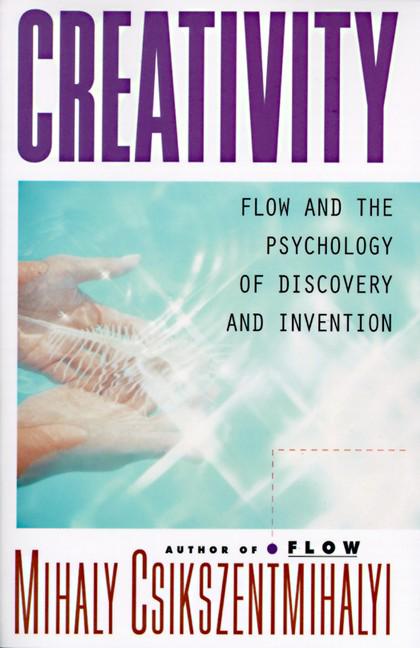
Creativity: Flow and the Psychology of Discovery and Invention by Mihaly Csikszentmihaly 

I’ve read this before, when it was first published, but did not have a copy. Bought it to have on hand as a reference.

My only complaint about the Half Price Books experience was the store was a trifle warm. My Eldest pocketed a cool $15 from selling her old books and decided to treat herself to a detective novel and a used Xbox game.

A good time was had by all.

I am not Kafka. But..

Tuesday, June 4th, 2013

[by Charles Cameron — a very preliminary salute to James Bennett and Michael Lotus’ new book, with blues harp to match ]
.


.

Okay, I’m a snapper-up of unconsidered trifles, a jackdaw, not the most consistent of readers — but I did stumble upon something…

I’ll admit, I cannot even see how “the actual time and materials cost of the hammer might be $60 a hammer” when its “functional equivalent might cost $20 in a hardware store” — but let’s overlook that 200% markup for a moment, and chew on the rest of this dazzling paragraph from James C. Bennett and Michael J. Lotus, America 3.0: Rebooting American Prosperity in the 21st Century — Why America’s Greatest Days Are Yet to Come, pp. 266-67:

The Department of Defense requires that the labor time and materials used in building defense items on a “time and materials” basis, which is the great majority of all such items, be documented in excruciating detail. The costs of doing this are themselves allowed as expenses, so that the government ultimately pays for the costs of this proof. Therefore, when lurid accounts of $600 hammers procured by the Pentagon surface in the press, what is actually happening is a hammer whose functional equivalent might cost $20 in a hardware store is purchased in the Pentagon system, the actual time and materials cost of the hammer might be $60, with an additional $540 in documentation costs to ensure that the government is not being over¬charged for the item.

I admit, I am not Kafka.

But if that isn’t a snake biting its own tail arrangement, I don’t know what is.

**

What can I say?

**

Interesting, btw — I’ll bet there’s a story behind the decision to switch book covers from the one proposed earlier (at the top of the post, left) to the one the book now carries (right)!

For the record: al-Raymi’s Message to the American People

Tuesday, June 4th, 2013

[ by Charles Cameron — a quick, minor note ]
.

You may of course already know this, but in case you don’t…

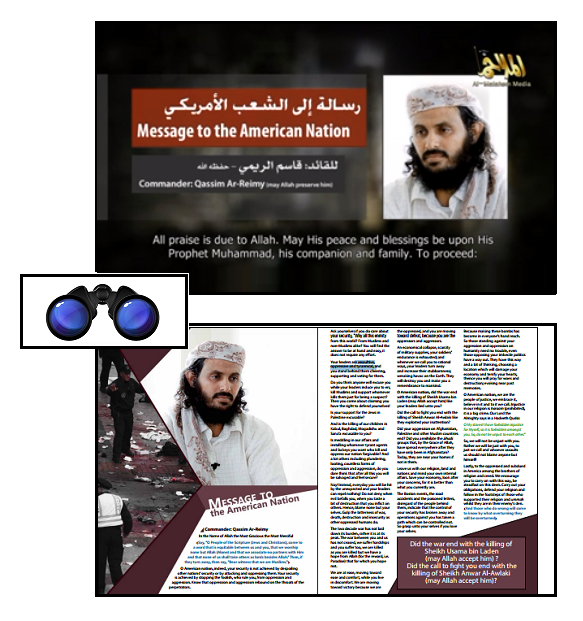
May eye was caught by the words “Your leaders are assaultive, oppressive and tyrannical” in the English subtitles to Qasim al-Raymi‘s “Message to the American People” video (upper panel, below)…

I guess it was the word “assaultive” that really caught my eye… I wasn’t looking forward to transcribing the entire video, so I went to the net to see if anyone else had done the job — which was when I realized I’d seen that same phrase before, in the latest issue, #11, of Inspire magazine (lower panel, above).

So this is just a quick note to say if you want to quote al-Raymi, there’s no need to transcribe the video, he says what he says in Inspire #11 pp. 8-9.

**

I suspect we could glean quite a bit if we listened with careful ears to the phrasings used by jihadist sources when writing or speaking in English or translating into it. There are some interesting characteristic turns of phrase — I haven’t been making notes as yet, but “to proceed” is one that is often used to end the scriptural prelims and turn to the message of the day… And there was that curious phrasing in the Khorasanist video Tamerlan Tsarnaev favorited, “The word Taliqan not just mentions the Taliqan region of today only, but…”

There are many interesting ways to read a text, and reading for tone and phrasing is one of them…

**

Sources, h/t to Aaron Zelin at Jihadology:

  • Al-Raymi, al-Malahim video
  • Al Raymi, al-Malahim Inspire magazine
  • A feast of form in my twitter-stream today

    Sunday, June 2nd, 2013

    [ by Charles Cameron — forms & patterns, pattern recognition & creative leaps, creative leaps & connecting dots, connecting dots & node-and-edge mapping — node-and-edge mapping, link charts and Sembl-HipBone games ]
    .
    .

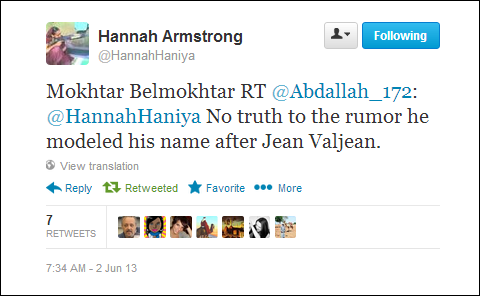
    There’s no “actionable intelligence” in that tweet, but it recognizes a pattern, it makes a fine creative leap. And given the chance, that’s something bright minds do naturally, and enjoy doing, and is away more important than we think.

    Yestedrday I was watching Manhunt pretty closely for an upcoming Zenpundit review, and noticed that some of the most significant quotes in the film were absent from CNN’s transcript. One gap I noticed had to do with the descriptions of the analytic process, and in particular some of the things Cindy Storer said. I’ll quote this one, which goes to the heart of the matter, but there’s plenty more left for me to chew over with you later. Here she goes:

    Even in the analytical community there’s a relatively smaller percentage of people who are really good at making sense of information that doesn’t appear to be connected. So that’s what we call pattern analysis, trying to figure out what things look like. And those people, you really need those people to work on an issue like terrorism, counternarcotic, international arms trafficking, because you’ve got bits and pieces of scattered information from all over the place, and you have to try to make some sense of it. … That takes this talent, which is also a skill, and people would refer to it as magic — not the analysts doing it, but other people who didn’t have that talent referred to it as magic.

    That’s a pretty exact description of what the Sembl game will eventually teach people, once it comes out of the museum prototype and onto the web — but let’s back it up with a quick quote from Wittgenstein:

    A surveyable representation produces precisely that kind of understanding which consists in ‘seeing connections’ [Zusammenhänge sehen]. Hence the importance of finding and inventing connecting links. Hence the importance of finding and inventing intermediate links.

    That’s from Philosophical Investigations, 122, and it’s a higher altitude / more abstract view — but it’s also the very heart of network thinking, seeing processes not just in terms of isolated nodes but of the connections between them.

    **

    Seeing connections — connecting the dots — happens in lines and leaps. That is to say, it can happen according to the usual linear way of thinking, the dogged 99% of perspiration that people talk about — or according to the far less common lateral move or creative leap, which moves by analogy, which is to say by pattern recognition, by the perception of similarities of form.

    That’s the 1% we call inspiration. That’s the magic.

    **

    So a whole lot of patterning was going on in my twitter-stream today, and I thought I’d show you.

    First, there was the parallel between the names Mokhtar Belmokhtar and Jean Valjean (above). If you’re hunting either fellow, the parallelism isn’t going to yield a useful clue — but the mode of recognition is what matters, and the reason its such a rare mode is precisely because it’s playful. It plays with forms — in this case, the forms of the two names — without regard for practicality.

    And yet this playful spirit is what brought us Weil‘s conjecture and Pierre Deligne‘s Abel Prize, and the Taniyama-Shimura conjecture and Wiles‘ proof of Fermat’s Last Theorem.

    Serious playfulness is key… to serious, magical breakthroughs. In any and all domains.

    *

    With that in mind, here are the rest of the patterns I recognized in todays feed.

    Let’s start with self-reference, which can hardly get more succinct than the hackers hacked:

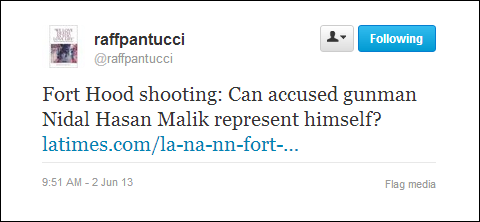
    There’s also a self-referential paradox at work in the question of a defendant appearing in his own defense — something that gives judges pause, because they see how tightly the serpent is chasing its own tail. Defendant defends self, From Raff Pantucci:
    The saddest self-reference of the morning’s tweets was this one, which could be encapsulated as storm-chaser chased by storm:
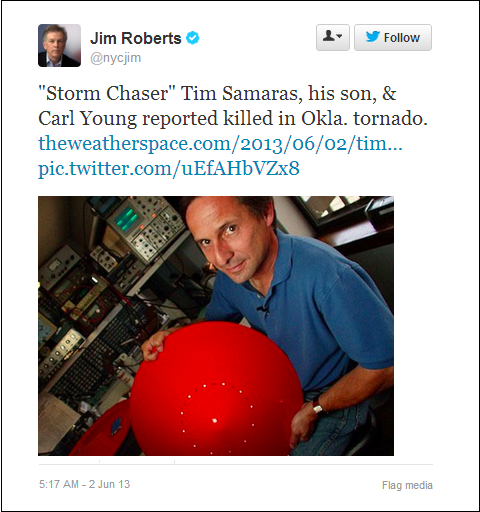
    Even tragedy can take self-referential form.

    **

    But lets move on to Turkey, which provided a rich dividend:

    There was this problem:
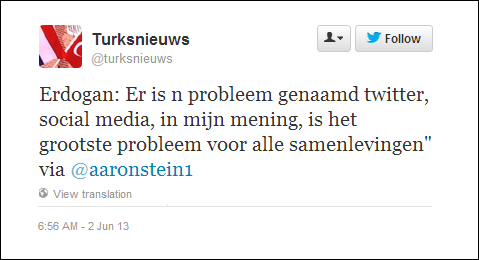
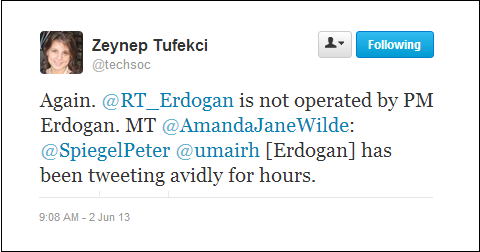
    Turkish I couldn’t read, Dutch I can more or less make out — but for an English tweet making the same point let’s go to Zeynep Tufekci, who has expertise in both matters Turkish and matters Internet, and tweets about Erdogan disapproving of tweeting:

    Tufekci again, this time catching an even neater self-reference which doesn’t quite pan out — because, as she says, PM Erdogan is not the same as @RT_Erdogan:
    **

    While we’re on Turkey, this tweet about Tienanmen, Tahrir and Taksim Squares gave us another example of a bright mind catching a hint of pattern…
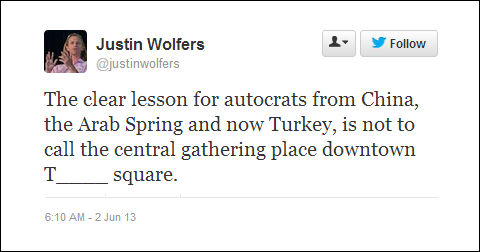
    And what a neat rejoinder!
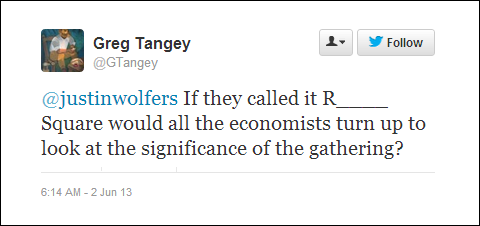
    All of the above is quite useless, entirely playful — and of deep interest if creativity and insight matter

    **

    Finally, I’d like to go someplace quiet and bathe in peace. This tweet, featuring a poem by a Korean zen master, does the trick nicely:
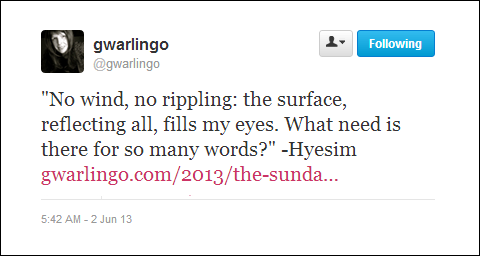
    AN appreciative bow to Gwarlingo for that one…


    Switch to our mobile site