zenpundit.com » 2015

Archive for 2015

Is the Islamic State Islamic? The Yes and No of the matter

Sunday, November 15th, 2015

[ by Charles Cameron — both answers are true in different contexts — IMO a significant point that previous discussion has tended to overlook ]
.

Were (are) the Khawarij Muslim? That’s the question I keep thinking of when discussion of whether IS (or AQ) is Islamic comes up. From a Muslim perspective, they were heretics. Joas Wagemakers identified the central distinctive opinion of the Khawarij thus:

The first of these is the Khawarij’s belief that revolt against Muslim rulers was allowed if they were deemed insufficiently pious. When ‘Ali accepted arbitration with Mu‘awiya, the people later known as Khawarij reportedly shouted ‘judgement is God’s alone’ (la hukm illa li-llah). In the context of that event, this referred to their belief that only God had the authority to arbitrate, not human beings, and that ‘Ali should not have accepted Mu‘awiya’s offer. The slogan later came to represent their broader view that all judgements and rulings should be left to God, thus applying Qur’anic rulings so strictly that they expelled Muslims guilty of major sins from their community and fought them. Because they believed sinful Muslims to be unbelievers (kuffar, singular: kafir), they directly applied passages from the Qur’an pertaining to jihad against non-Muslims to those of their co-religionists who were less than perfectly pious.

From the perspective of what I’m going to call “ongoing Islam” they were heretics — the very name Khawarij indicates those who have gone out, ie left the religion of Islam — and yet their heresy was that of “fundamentalizing” Islam, being, if you like, excessively Islamic.

Consider: according to a hadith reported in Abu Dawud:

The Messenger of Allah, peace and blessings be upon him, said, “There will be dissension and division in my nation and a people will come with beautiful words but evil deeds. They recite the Quran but it will not pass beyond their throats. They will leave the religion as an arrow leaves its target and they will not return until the arrow returns to its notch. They are the worst of the creation. Blessed are those who fight them and are killed by them. They call to the Book of Allah but they have nothing to do with it. Whoever fights them is better to Allah than them.”

As a student of religions might say, their use of the Qur’an marks them as clearly Islamic, and as a Muslim theologian might say, they have clearly departed the religion, in truth “they have nothing to do with it.”

Many contemporary Muslims would say of IS, its leader and members, that they “call to the Book of Allah but they have nothing to do with it” — and they have every right to say that. Those, however, who wish to understand what drives IS do well to understand the theology and eschatology involved, as well as the psychology of the passions they invoke — and also the Islamic context in which IS may well be viewed as having by the very nature of their excesses left the religion..

**

This post is copied wholesale from a fascinating conversation among friends (Mark Safranski, J Scott Shipman, Michael J. Lotus, Dan Tdaxp, Joshua Treviño, Lynn Rees and others) in response to Tanner Greer’s post Vox Will Never Understand Islam… Or Any Religion, Really, which is itself a response to a Vox piece by Max Fisher, The perfect response to people who blame Islam for ISIS.

Please share this post if you find it helpful.
On the events in Paris, Rod Dreher and the Benedict Option

Sunday, November 15th, 2015

[ by Charles Cameron — contrasting the ideal with “this pragmatical, preposterous pig of a world” ]
.

A few weeks back I read a piece by Rod Dreher around the concept of a Benedict Option recently, and liked it well enough that it sits in a special folder I have labeled 3 Major Papers, waiting for me to find the time to write it up in detail, offering my own suggested buttresses and side chapels to Dreher’s overall quasi-monastic structure. The Option itself derives from a paragraph in Alasdair MacIntyre‘s book, After Virtue:

What matters at this stage is the construction of local forms of community within which civility and the intellectual and moral life can be sustained through the new dark ages which are already upon us. And if the tradition of the virtues was able to survive the horrors of the last dark ages, we are not entirely without grounds for hope. This time however the barbarians are not waiting beyond the frontiers? they have already been governing us for quite some time. And it is our lack of consciousness of this that constitutes part of our predicament. We are waiting not for a Godot, but for another — doubtless very different — St Benedict.

**

Here’s my koan, as of yesterday, hearing the news of the multiple attacks in Paris and following Twitter to peer and pierce as best I could through the immediate fog towards the kernel of the matter. It takes the form of two tweets, the second in response to the first:

and:

**

My immediate reaction, dismayed at Dreher’s tweet, is to agree with Laura Seay‘s response. And I’m far from alone in this, as a glance at some other responses to Dreher easily confirms:

and:

**

So that’s the koan, the paradox — and that’s the way I lean on it.

Except that Dreher in a piece titled Refugees & the Paris Attacks, wrote again, today, and made some points that tip me towards the other side of the koan / coin:

Hesepe, a village of 2,500 that comprises one district of the small town of Bramsche in the state of Lower Saxony, is now hosting some 4,000 asylumseekers, making it a symbol of Germany’s refugee crisis. Locals are still showing a great willingness to help, but the sheer number of refugees is testing them. The German states have reported some 409,000 new arrivals between Sept. 5 and Oct. 15 — more than ever before in a comparable time period — though it remains unclear how many of those include people who have been registered twice.

Six weeks after Chancellor Angela Merkel’s historic decision to open Germany’s borders, there is a shortage of basic supplies in many places in this prosperous nation. Cots, portable housing containers and chemical toilets are largely sold out. There is a shortage of German teachers, social workers and administrative judges. Authorities in many towns are worried about the approaching winter, because thousands of asylum-seekers are still sleeping in tents.

The contrast between the ideal and the real couldn’t be greater: God’s in his heaven — and the devil is in the details.

**

As for that “pragmatical, preposterous pig of a world” — WB Yeats in his poem, Blood and the Moon is describing Bishop Berkeley:

                                                      that proved all things a dream,
That this pragmatical, preposterous pig of a world, its farrow that so solid seem,
Must vanish on the instant if the mind but change its theme…

It amuses me that when I look the phrase “pragmatical pig” up to make sure I quote it accurately, Google wants to correct it to “pragmatic pig” — doesn’t that massive AI know its Yeats well enough at least to have caught on to his marvelous catch-phrase?

**

More on Rod Dreher and the Benedict Option as time permits and place allows..

DoubleQuoting the French Revolution

Saturday, November 14th, 2015

[ by Charles Cameron — I was thinking of France yesterday, writing this in a happier mood before the evening’s news broke — up next, and tricky to write, a first response to the Paris outrage ]
.

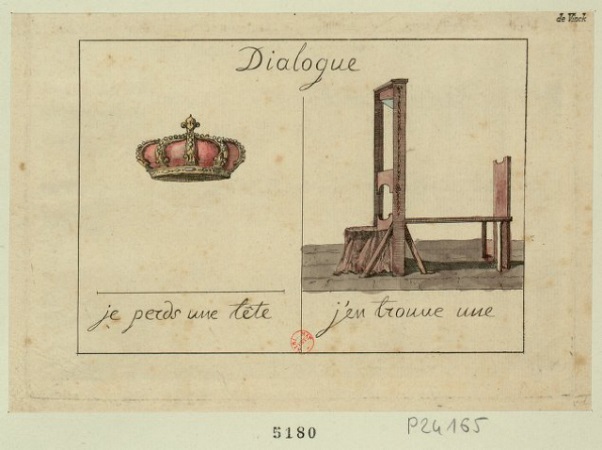
frenchrevolutionarchive15

**

One of the great pleasures of my work on DoubleQuotes and the HipBone and Sembl Games is the discovery of earlier analogues to what I’m doing. My purpose, after all, is to take a common human cognitive practice and formalize it, thus sharpening it from a somewhat haphazard activity into a tool, a practice.

We have all had the thought, “and that reminds me” — it crops up without any special prompting whenever something happening in current time calls up the memory of something similar experienced in the past, and our store of memories is pretty significant. On that last point, the great American poet Robert Frost once said:

Scholars and artists thrown together are often annoyed at the puzzle of where they differ. Both work from knowledge? but I suspect they differ most importantly in the way their knowledge is come by. Scholars get theirs with conscientious thoroughness along projected lines of logic? poets theirs cavalierly and as it happens in and out of books. They stick to nothing deliberately, but let what will stick to them like burrs where they walk in the fields.

Thyat’s from Frost’s essay, The Figure A Poem Makes, and it’s fascinating to me how much of that essay seems to apply not just to poems but equally to DoubleQuotes, HipBone and Sembl. Frost continues:

Knowledge of the second kind is much more available in the wild free ways of wit and art. A schoolboy may be defined as one who can tell you what he knows in the order in which he learned it. The artist must value himself as he snatches a thing from some previous order in time and space into a new order with not so much as a ligature clinging to it of the old place where it was organic.

I’d remembered Frost’s remark about knowledge sticking to people “like burrs where they walk in the fields” because it’s the most concise statement I know that explains the extraordinary amount of knowledge, in the sense of available-if-required-memory, that each and every human, not just the university-credentialed kind, acquires across a lifetime — some people know gang colors, tats, and graffiti, or sexual hanky code as others know Herodotus and Ibn Khaldun, or the different colored scarves of the Oxford colleges.

I don’t believe that I’d read Frost’s whole essay before today, although I may have — but you can see how closely his artist who “snatches a thing from some previous order in time and space into a new order” corresponds with my basic cognitive motion of DoubleQuotes as described it above, when “something happening in current time calls up the memory of something similar experienced in the past” and its qualifying remark, “without any special prompting”!

GMTA, or just GTA — thought, or theft? Who knows.

**

One other quote from Frost’s essay amplifies the unexpected nature of a single HipBone or DoubleQuotes play:
move

For me the initial delight is in the surprise of remembering something I didn’t know I knew.

The passage continues, extending Frost’s description of the poem from a single initial linkage to the sort of web of linkages that characterize HipBone and Sembl games:

There is a glad recognition of the long lost and the rest follows. Step by step the wonder of unexpected supply keeps growing. The impressions most useful to my purpose seem always those I was unaware of and so made no note of at the time when taken, and the conclusion is come to that like giants we are always hurling experience ahead of us to pave the future with against the day when we may Want to strike a line of purpose across it for somewhere.

**

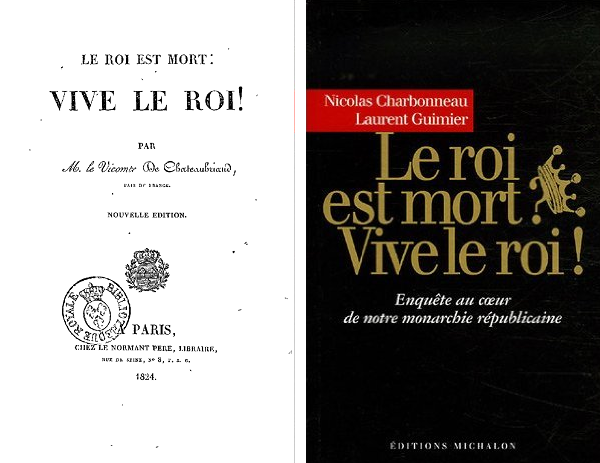
The natural response to the sequence from crown to guillotine at the head of this post is found in the motto “the king is dead; long live the king”. The sentiment is best known in French, as these two books attest:

chateaubriand monardhie republicaine

The Vicomte Chateaubriand was a monarchist. Charbonneau and Guimier speak of a “republican monarchy” — “plus ça change, plus c’est la même chose”, perhaps?

It is more important to have equations in your beauty..

Tuesday, November 10th, 2015

[ by Charles Cameron — musings on PAM Dirac and Hedy Lamarr ]
.

PAM Dirac once famously said, “it is more important to have beauty in one’s equations that to have them fit experiment.” I was reminded of that quotation while musing over this DoubleQuote in the Wild celebrating the birthday yesterday of Hedy Lamarr — stunningly symmetrical movie star and frequency-hopping inventor:

Hedy Lamarr DQ Wild

To the left, the beauty herself, and to the right, the equations in the beauty — if one may take the liberty of saying that thoughts are “in” their thinker’s body — shown here in the form of the patent application Lamarr and composer George Antheil submitted fora “a system for the radio control of airborne torpedoes”.

I put that last phrase in quotes because that’s the way a New York Times piece described their joint invention. Me, I haven’t the foggiest about their inner workings, whereas the outer face of Hedy Lamarr I can see with utmost clarity.

The Astounding Case of the Unequal Equals

Tuesday, November 10th, 2015

[ by Charles Cameron — how two ideas beget a third ]
.

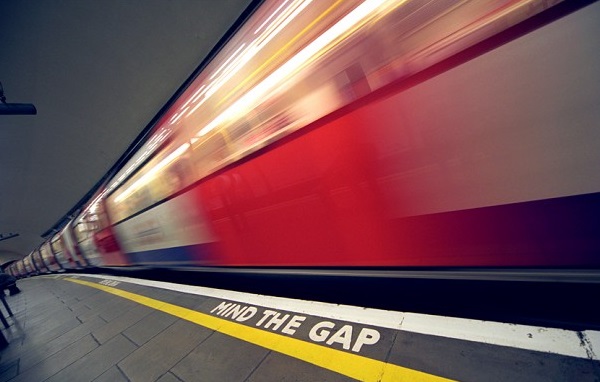
I’m a Brit, so the motto Mind the Gap is familiar to me — it warns people not to step between platform and train when entering or exiting the Tube

underground_2504657b mind the gap

— as is the London Underground symbol — and for that matter, the glyph for female, earlier the alchemical symbol of Venus.

**

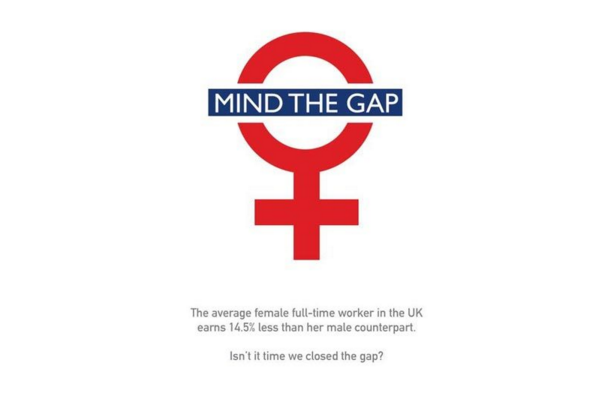
Today’s Telegraph contains a graphic that interests me a whole lot, under the title Equal Pay Day: 14 ways to visualise the gender pay gap:

telegraph mind the gap

**

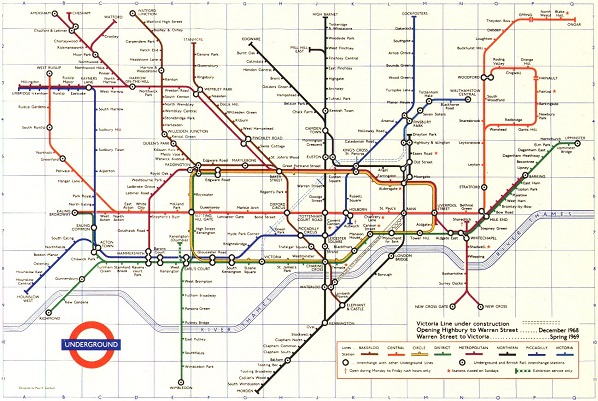
Does it interest me because I’m a fan of the London Underground? Not exactly. The Underground’s graphics, then? I’ll admit to an admiration for the Underground’s justifiably celebrated map

tube68

— which I’ve long thought would make a superb extended HipBone Game board, shown above in its 1968 incarnation. But that’s not it either. And although I don’t think gender should influence the pay a person receives for a given quantity or quality of work — Quant and Qualit again, one of the weirdst paradoxes my min d has ever encountered — it’s not the politics of the sign that interests and delights me.

**

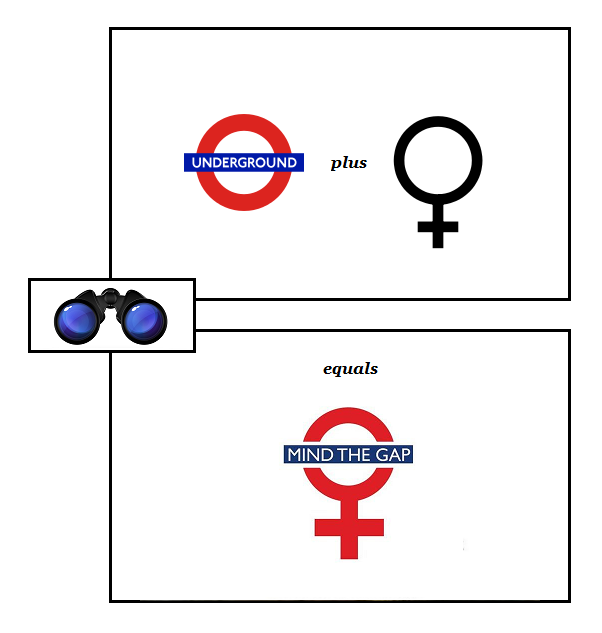
It’s the way two disparate elements — tube and gender graphics — are combined to create a remarkably powerful third:

SPEC DQ mind the gap

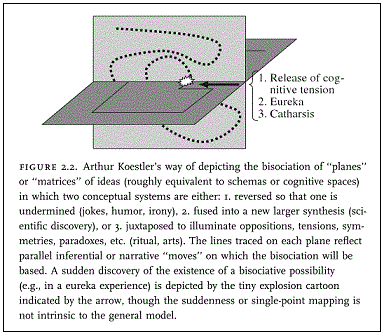
It’s a simple, elegant illustration of the intersection of two sets of ideas that Arthur Koestler talked about and that I’m constantly drawing on in my own work:

And yes, I’m aware that technically the equation I’m pointing to happened in two stages, with the substitution of the phrase “mind the gap” for the word “underground” in the blue bar of the tube logo — but the bar was also used, among other things, for the names of individual stations, so I don’t consider that much of a creative leap.

No, it’s the juxtaposition of underground logo with the gender sign by means of a conflation of their respective circles that’s impressive, coupled with the pun on the gender-specific and underground meanings of “mind the gap”.

That’s the very essence of the intersections Koestler was talking about, and illustrates as vividly as I know how, the power released by such an intersection.

**

Oh, and yes — fair play clearly requires fair pay.

And it’s Hedy Lamarr‘s birthday, dammit.


Switch to our mobile site