zenpundit.com » 2015 » October

Archive for October, 2015

EXTRA, EXTRA! See all about it!

Sunday, October 11th, 2015

[ by Charles Cameron — a second, off-the-cuff Sunday Surprise this week ]
.

Here’s your basic DoubleQuotes-formatted pair of images — Rembrandt‘s Nightwatch which you’re probably familiar with in the top panel, and Bill Benzon‘s Night Light Standing Guard which I believe he only posted today:

SPEC then and now

**

Consider the differences.. then, and now.

I wanted them in DoubleQuotes format to make the comparison clear — but here are larger versions of the two images, still in sizes this blog column can handle:

Rembrandt Nightwatch 602

and:

Benzon Night Light Standing Guard

**

But for a really detailed digital looksee, click on these two links, and then if you’d like, click again for maximum magnification, very possibly too large to fit a computer screen & requiring some scrolling to catch significant detail:

  • Rembrandt, The Night Watch
  • Benzon, Night Light Standing Guard
  • Even better, you could befriend and visit Benzon, and view the Rembrandt in the Rijksmuseum, Amsterdam. Either there, or by some other means, you and I and Benzon and Rembrandt should commune. As Emerson wrote:

    The world is young: the former great men call to us affectionately.

    Sunday surprise: House of Cards meets monks and sexy riot grrls

    Sunday, October 11th, 2015

    [ by Charles Cameron — wondering if the same mind (Beau Willimon?) suggested both? ]
    .

    Two very different modes of factual reality found their ways into the fictional world of House of Cards, Season 3, American version, and I found the two choices pretty interesting. I’ve recently found clips relating to both on YouTube, so here they are for your consideration:

    Pussy Riot:

    and

    Tibetan monks:

    Taking those two choices together is a bit like juxtaposing Gregorian chant and punk rock — which, come to think of it, is pretty close to what I was getting at in my first ever Riot Grrls post, Pussy Riot, Holy Foolishness and Monk Punk.

    **

    Contemplation and activism — poles apart, or one the mainspring for the other?

    DQs in the Wild and DQs @pmarca style

    Sunday, October 11th, 2015

    [ by Charles Cameron — a mini-historical recap on the two topics named in the title ]
    .

    Without exhaustive checking, I think I first started posting DoubleQuotes as such, on a site Garsett Larosse generously provided, on May 1st, 2004. I described them thus:

    DoubleQuotes consist of two quotes (or images), juxtaposed. They are intended to work in a way that I learned from haiku: as thoughts dropped into the mind-pond, not so much for their own sakes as for their concentric ripples and the interference patterns between them.

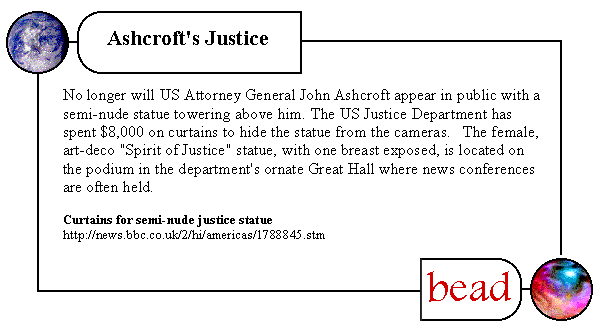
    It looks as though the first DQ I posted there was a couple of weeks later, on May 17th, and was titled Milk of Justice:

    DQ Mullah Ashcroftmullahs justice

    I keep hoping I’ll find a way to catch Kristof‘s attention and get him to tell me his source for the Iranian “breasts of justice” story.

    **

    DQs in the Wild:

    I think I introduced the idea that there were “DQs in the Wild” in this post with that title, in which I define the genre as that of “found objects as they call them in the art world, relating directly to my DoubleQuotes format”.

    Some examples:

  • A wildlife DoubleQuote in the Wild, hat-tip Dan Trombly
  • DoubleQuote in the Wild: Maurits Escher & Juan Cole
  • Brilliant use of “DoubleQuote in the Wild” images!
  • A DoubleQuote in the (Arctic) Wild
  • “Trust in Govt” DoubleQuote from John Robb
  • Black Banners in Sydney 1: a DoubleQuote in the Wild from Ardeet
  • Life imitates art: the eavesdropping TV
  • Via the keen eye of Caitlin Fitz Gerald
  • HM Govt goes DoubleQuote in the Wild
  • In which John Horgan presents a DoubleQuote
  • BTW, flags
  • A difficulty with DoubleQuotes
  • and:

  • Ceylan Ozbudak notes a discrepancy from PKK [updated]
  • I have to say spotting these examples, together with the various friendships most of them have sprung from, has been one of the delights of my on;line life these last few years.

    **

    DQs, Marc Andreessen and Adam Elkus:

    Here’s my post a while back responding to an exchange between Marc and Adam in which Adam mentioned my DoubleQuotes:

  • Some thoughts for Marc Andreessen & Adam Elkus
  • — along with some other, related posts:

  • Creating a web-based format for debate and deliberation: discuss?
  • DoubleQuoting Andreessen with Turing
  • Intriguing DoubleTweet variants & more
  • — those last two including DQs in which Andreessen is one of those quoted — and:

  • Simply so much.. 01
  • **

    And that concludes this series of posts. Until the thought-clock rolls around to the same time in a new day, and this stuff begins all over again.

    DoubleQuotes — origins

    Sunday, October 11th, 2015

    [ by Charles Cameron — IMO a really neat Zork-ish visualization game in one “passage”, albeit not in the least “twisty” ]
    .

    My first glimpse of the power of DoubleQuotes came to me after a visit to the Archives theological bookstore in Pasadena, where I had picked up a book by Haniel Long. I was reading it waiting for a bus to take me home, and ran across a paragraph that reminded me vividly of something else I had read. I had to get back to my bookshelves and find it. But which book?

    It turned out to be a book by Annie Dillard — like Haniel Long, a fine and under-appreciated American stylist — and she wasn’t quoting Long, she had a styory of her own to tell..

    **

    Not long afterwards, I made a “visualization game” out of the two paragraphs, which I posted to a hermetic studies mailing-list on November 14, 1994:

    Simply imagine this…

    You walk along a white corridor. There are two framed texts, one on each side of the corridor, at eye level.

    You stop and look at one of them, perhaps the one on the left, and read this quotation:

    My friend Jens Jensen, who is an ornithologist, tells me that when he was a boy in Denmark he caught a big carp embedded in which, across the spinal vertebrae, were the talons of an osprey. Apparently years before, the fish hawk had dived for its prey, but had misjudged its size. The carp was too heavy for it to lift up out of the water, and so after a struggle the bird of prey was pulled under and drowned. The fish then lived as best it could with the great bird clamped to it, till time disintegrated the carcass, and freed it, all but the bony structure of the talon.

    A note says this comes from the American writer Haniel Long’s book, Letter to Saint Augustine.

    What does the citation say to you? Do you like the sense that hawk and carp are gripped in a mutual embrace, like the two hands drawing each other in an M.C. Escher print?

    While you are reading this quote, your back is turned to the other. Do you turn round and read the second text?

    If so, you find a second quote, this time from Annie Dillard’s book, Teaching a Stone to Talk:

    And once, says Ernest Seton Thompson — once, a man shot an eagle out of the sky. He examined the eagle and found the dry skull of a weasel fixed by the jaws to his throat. The supposition is that the eagle had pounced on the weasel and the weasel swiveled and bit as instinct taught him, tooth to neck, and nearly won. I would like to have seen that eagle from the air a few weeks or months before he was shot: was the whole weasel still attached to his feathered throat, a fur pendant? Or did the eagle eat what he could reach, gutting the living weasel with his talons before his breast, bending his beak, cleaning the beautiful airborne bones?

    The two texts have the same weight: their images (osprey, carp, weasel, eagle) mirror one another, their language is similar, the quotes are roughly the same length, there is even a parallel between the framing of the first story in terms of Jens Jensen and the second in terms of Ernest Seton Thompson. They are twins.

    Standing between them can be like wearing stereophonic headphones.

    You walk on towards the open doorway at the end of the corridor, on the right…

    That post, with that pair of quotes from Long and Dillard, was the immediate precursor to my HipBone Games, providing me with an insight into what a single “move” in a Hesse-style Glass Bead Game might look like.

    DoubleQuotes, DQs in the Wild, DQs @pmarca style

    Sunday, October 11th, 2015

    [ by Charles Cameron — first post in a series, with brief intro to series on top ]
    .

    Okay, a three-post series coming up, of which this is post one. To help you navigate:

  • This post reports a conversation between Adam Elkus, Marc Andreessen (briefly) and Daniel Griffin about “@pmarca style” DoubleQuotes
  • DoubleQuotes — origins discusses the seeds of my own DoubleQuotes practice in the form of a visualization game from 1994
  • DQs in the Wild and DQs @pmarca style offers links to a number of examples of “prior art” relating to all of the above.
  • Some readers may be interested in all three, which would delight me — for myself, they’re an attempt to corral a dispersed set of matching ideas, mostly for the record.

    **

    So here’s the conversation, as far as I managed to track it. It opens with Adam quoting a paragraph from Jean-Marie Guéhenno‘s The Problem with Coalition Airstrikes in Syria, which he finds paradoxical, followed by his comment to that effect:

    **

    It was in fact Adam who first drew my attention Andreessen’s style of “double-tweeting”, as we’ll see in the final post in this series.

    Next up: DoubleQuotes — origins, or what the HipBone Games looked like, shortly before I first considered playing them on a board.


    Switch to our mobile site