zenpundit.com » 2016 » March

Archive for March, 2016

Small Wars and Big Thoughts

Saturday, March 19th, 2016

[by Mark Safranski / “zen“]


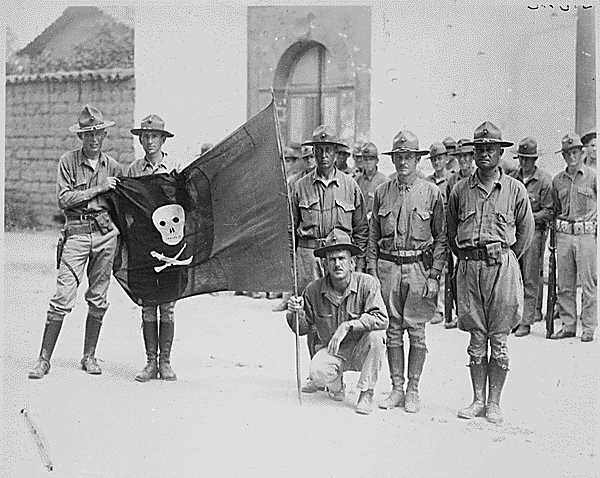
U.S. Marines display captured flag of Nicaraguan rebels led by Augusto Cesar Sandino

While pop-centric COIN may be dead, small wars and irregular warfare will always be with us. We might say they are in the fourth or fifth generation; are an open-source insurgency; or have become “hybrid“; or exist in some kind of mysteriousgray zone“. Whatever we call them, small wars are here to stay.

Two recent publications explore the topic.

The first is a taxonomic work from Robert Bunker at the Strategic Studies Institute:

Old and New Insurgency Forms

….Blood Cultist (Emergent). Strategic implications:  Limited to moderate. This insurgency form can be viewed as a mutation of either radical Islam and/or rampant criminality, as found in parts of Latin America and Africa, into dark spirituality based on cult-like behaviors and activities involving rituals and even human sacrifice. To respond to this insurgency form, either federal law enforcement or the military will be the designated lead depending on the specific international incident taking place. An all-of-government approach will be required to mitigate and defeat this insurgency form, which has terrorism (and narco-terrorism) elements that represent direct threats—especially concerning the Islamic State—to the U.S. homeland […]

I strongly agree with Bunker’s “dark spirituality” angle present in deviant religious-military movements. For example, ISIS, for all its protestations of ultra-orthodoxy in its Salafism exudes a spirit of protean paganism in its words and deeds.

The second is a book, Clausewitz on Small War by Christopher Daase and James W. Davis (Hat tip to Nick Prime). From a book review at the London School of Economics:

….The current generation’s trend in understanding Clausewitz is that of moving beyond On War – an analysis which Clausewitz himself considered incomplete and which was published posthumously. As part of this shift, 2015 alone saw the publication of a new account of his life, together with a biography of his wife and a comparison between Napoleon’s and Clausewitz’s ideas on war, to name a few.

Through Clausewitz on Small War, Christopher Daase and James W. Davis make a significant contribution to such efforts of contextualisation. Yet theirs is quite distinct from other works, in that they translate into English writings that were thus far accessible only to those with a reading knowledge of German. This is precisely where the value of the book lies, as well as being the editors’ primary aim: opening up Clausewitz through translating his own words, rather than in interpreting them. In doing so, they offer the tools through which future analyses can be better informed.

The editors nonetheless do set out a case in the introduction: Clausewitz’s writings on ‘Small War’ are testimony to his continuing relevance. To illustrate this, they offer four chronologically arranged texts – a journey of how his thinking on Small War evolved. Each text was written with a different frame of mind. The first is comprised of lecture notes on small-unit warfare that are informal and rather technical; the second and third are memoranda distributed to military reformers and through which Clausewitz passionately makes the case for militias; and the final is a chapter from On War, again on the arming of the people.

I would add that ZP contributor, Lynn Rees, also had a recent post on the role of Marie von Clausewitz in shaping “Clausewitz” and Clausewitzian thought.

That’s it.

Politics while in uniform: the No, Sir, and Yes of it

Saturday, March 19th, 2016

[ by Charles Cameron — trying out a new look for DoubleQuotes ]
.

I’m aware that testifying under oath when questioned on a specific topic by Congress is different from promoting a presidential candidate at a campaign rally — but even so, the contrast strikes me as interesting:

tablet trump & politics in uniform

As for the question of orders to torture which Joint Chiefs of Staff Chairman Gen. Joseph Dunford was addressing, I personally am with him. My point here, however, is not to play politics, but to raise the issue of “justice” — in this case, “fair play” might be a better phrase — “not only being done, but being seen to be done”..

**

Sources:

  • Military.com, Marine Rebuked for Performing at Donald Trump Rally in Uniform
  • Thehill.com, Joint Chiefs chairman: Trump orders would harm troop morale
  • Go googled, GBG still to go: 1

    Friday, March 18th, 2016

    [ by Charles Cameron — games, games, games — & prepping a challenge for AI, the analytic community & CNA ]
    .

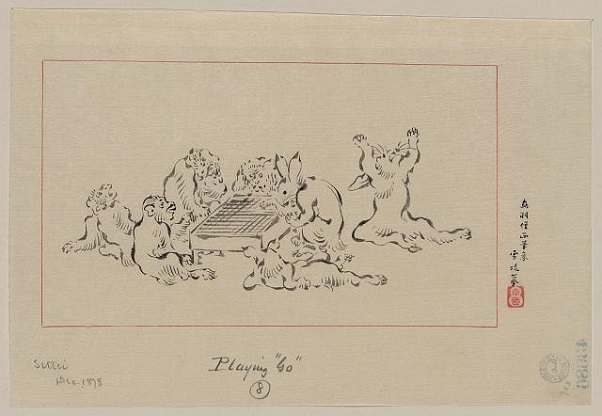
    playing go
    Playing go, Hasegawa, Settei, 1819-1882, Library of Congress

    **

    In the past, computers have won such games as Pong and Space Invaders:

    Google’s AI system, known as AlphaGo, was developed at DeepMind, the AI research house that Google acquired for $400 million in early 2014. DeepMind specializes in both deep learning and reinforcement learning, technologies that allow machines to learn largely on their own. Previously, founder Demis Hassabis and his team had used these techniques in building systems that could play classic Atari videos games like Pong, Breakout, and Space Invaders. In some cases, these system not only outperformed professional game players. They rendered the games ridiculous by playing them in ways no human ever would or could. Apparently, this is what prompted Google’s Larry Page to buy the company.

    Wired, Google’s Go Victory Is Just a Glimpse of How Powerful AI Will Be

    I can’t corral all the games they’ve played into a single, simple timeline here, because the most interesting discussion I’ve seen is this clip, which moves rapidly from Backgammon via Draughts and Chess to this last few days’ Go matches:

    Jeopardy should dfinitely be included somewhere in there, though:

    Facing certain defeat at the hands of a room-size I.B.M. computer on Wednesday evening, Ken Jennings, famous for winning 74 games in a row on the TV quiz show, acknowledged the obvious. “I, for one, welcome our new computer overlords,” he wrote on his video screen, borrowing a line from a “Simpsons” episode.

    NYT, Computer Wins on ‘Jeopardy!’: Trivial, It’s Not

    What’s up next? It seems that suggestions included Texas Hold’em Poker and the SAT:

    Artificial intelligence experts believe computers are now ready to take on more than board games. Some are putting AI through the ringer with two-player no-limit Texas Hold’ Em poker to see how a computer fairs when it plays against an opponent whose cards it can’t see. Others, like Oren Etzioni at the Allen Institute for Artificial Intelligence, are putting AI through standardized testing like the SATs to see if the computers can understand and answer less predictable questions.

    LA Times, AlphaGo beats human Go champ for the third straight time, wins best-of-5 contest

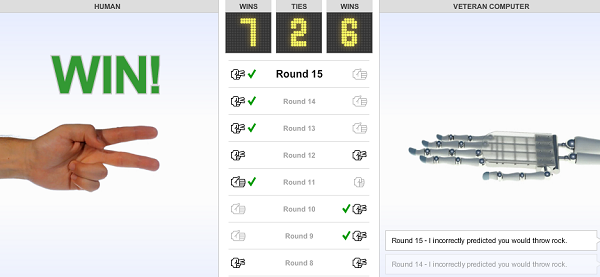
    And of course, there’s Rock, Paper, Scissors, which you can still play on the New York Times:

    Rock Paper Scissors

    **

    Now therefore:

    In a follow-up post I want to present what in my view is a much tougher game-challenge to AI than any of the above, namely Hermann Hesse‘s Glass Bead Game, which is a major though not entirely defined feature of his Nobel-winning novel, Das Glasperlenspiel, also known in English as The Glass Bead Game or Magister Ludi.

    I believe a game such as my own HipBone variant on Hesse’s would not only make a fine challenge for AI, but also be of use in broadening the skillset of the analytic community, and a suitable response also to the question recently raised on PaxSIMS: Which games would you suggest to the US Navy?

    As I say, though, this needs to be written up in detail as it applies to each of those three projects — work is in progress, see you soon.

    **

    Edited to add:

    And FWIW, this took my breath away. From The Sadness and Beauty of Watching Google’s AI Play Go:

    At first, Fan Hui thought the move was rather odd. But then he saw its beauty.

    “It’s not a human move. I’ve never seen a human play this move,” he says. “So beautiful.” It’s a word he keeps repeating. Beautiful. Beautiful. Beautiful.

    The move in question was the 37th in the second game of the historic Go match between Lee Sedol, one of the world’s top players, and AlphaGo, an artificially intelligent computing system built by researchers at Google.

    Now that’s remarkable, that gives me pause.

    Terror Is Glamour as War is Game

    Friday, March 18th, 2016

    [ by Charles Cameron — on the necessary simultaneity of temporal and eternal perspectives ]
    .

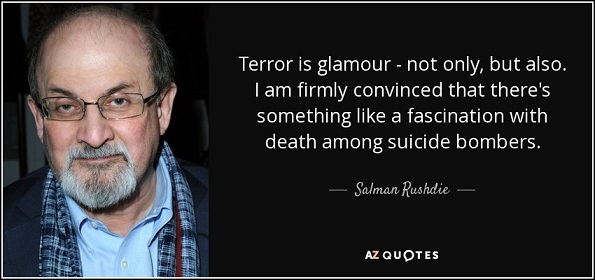
    quote-terror-is-glamour-salman-rushdie

    **

    First as to glamour -– it may help to reflect that glamour, our word, comes not from Vogue but from the same origins as grammar (referring to languages) and grimoire (a book of spells, spelling also being a matter of language), and means something along the lines of “luminous illusion”. If we say terror is glamour, then, we mean that it “casts a spell” — and thus creates an appealing, indeed compelling, mirage. It lies, then, in the realm of magic, image, imagination, so ably delineated by Ioan Couliano in his great book, Eros and Magic in the Renaissance.

    The best of contemporary advertising draws on precisely the same Renaissance principles of persuasion — principles of extraordinary power which we nowadays tend to dismiss as “magical thinking”.

    **

    Thus Virginia Postrel, in Terror Is Glamour:

    Glamour can sell religious devotion or military glory as surely as it can pitch lipstick or island vacations. All promise a way to transcend our everyday circumstances, to experience more and become better than ordinary life allows. All invite us to imagine escape and transformation.

    Postrel continues:

    From Achilles and Alexander to “national greatness,” the glamour of battle is remarkably persistent. So is the glamour of martyrdom, as any trip through a Western museum or perusal of a Lives of the Saints (or its Protestant equivalent) will demonstrate. Nor is martyrdom’s appeal to Christians merely historical, as Eliza Griswold reported in this 2007 TNR piece.

    Glamour appeals to our desires, whatever they may be, and Jihadi glamour offers something for everyone: from historical importance to union with God, not to mention riches and beautiful women.

    Postrel then quotes Egyptian cleric Hazem Sallah Abu Isma’il, indicating that the “beautiful women” in question are “black-eyed virgins” from a world conceptually above our own:

    If one of these virgins were to descend to this world, her light would extinguish the light of the sun and the moon. That’s how beautiful she is.

    Yet as Postrel comments, “glamour proves perishable”:

    As Rushdie suggests, of course, glamour always leaves something out, in this case the literally gory details of the act .. Either aspirations change, entropy and boredom set in, or the audience learns too much, destroying the mystery and grace on which glamour’s beautiful illusion depends.

    She concludes with a significant question and preliminary response:

    How do we puncture the glamour of Jihadi terrorism? The first step is recognizing that such glamour exists.

    That may seem like CVE 101, but the deeper our understanding of magic, imagination, image — and hence the power of glamour — the deeper our understanding of the deep problem that CVE presents will become.

    **

    Next we turn to Richard Fernandez, writing in A Bellyful of War, picking up the themes of war’s attraction, and the carnage its glamour omits from mention, and tying both to the notions of war as game and war as brutal reality:

    William Tecumseh Sherman understood what many modern theorists have forgotten: war can be attractive to young men for as long as long as it remains a game. War in small doses is supremely thrilling, even glamorous. It is peace which can be routine and boring.

    And so it goes until war stops being a game and the going gets really rough. “Its glory is all moonshine,” said Sherman. “It is only those who have never heard a shot, never heard the shriek and groans of the wounded and lacerated … that cry aloud for more blood, more vengeance, more desolation.” To Sherman a “bellyful of war” was ironically the psychological foundation of generational peace.

    Not only is that last sentence a profound statement worthy of the contemplation of all who love peace – it is also far more subtly convincing than the old Strategic Air Command motto, Peace is Our Profession, which sounds more like one of Rochefoucauld’s tributes that vice pays to virtue than anything, and yet is presumably intended to convey the same insight.

    **

    Finally we have Plotinus, for whom – in a manner richly echoed by Shakespeare — life itself is a dream, a play, a sport, a game:

    Murders, death in all its guises, the reduction and sacking of cities, all must be to us just such a spectacle as the changing scenes of a play; all is but the varied incident of a plot, costume on and off, acted grief and lament. For on earth, in all the succession of life, it is not the Soul within but the Shadow outside of the authentic man, that grieves and complains and acts out the plot on this world stage which men have dotted with stages of their own constructing. All this is the doing of man knowing no more than to live the lower and outer life, and never perceiving that, in his weeping and in his graver doings alike, he is but at play; to handle austere matters austerely is reserved for the thoughtful: the other kind of man is himself a futility. Those incapable of thinking gravely read gravity into frivolities which correspond to their own frivolous Nature. Anyone that joins in their trifling and so comes to look on life with their eyes must understand that by lending himself to such idleness he has laid aside his own character. If Socrates himself takes part in the trifling, he trifles in the outer Socrates.

    Plotinus is correct, I would suggest, sub specie aeternitatis, just as is Sherman sub specie incarnationis — and it is the role of the artist to hold both visions, trivial and eternal, as Koestler suggests.

    **

    I am again grateful to David Foster for his ChicagoBoyz post The Romance of Terrorism and War which triggered this exploration and the one on Getting Deeper into Koestler which preceded it.

    Getting deeper into Koestler

    Friday, March 18th, 2016

    [ by Charles Cameron — on creativity at the intersection of the fleeting and the eternal ]
    .

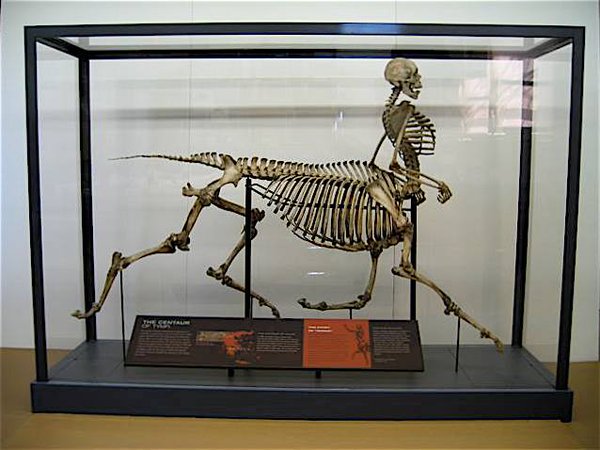
    centaur skeleton
    Centaur, displayed in the International Wildlife Museum, Tucson, AZ

    **

    You know Lao Tzu’s “uncarved wood” (pu) — and Spencer Brown’s “Mark” or “first distinction? It is hard to speak of “the one and the many” without language itself favoring the many, the one being “one” and the many “another”. The Greek phrase “Before Abraham was, I am” attributed to Christ may be as close as we get.

    The “uncarved wood” is not some definite -– named and thus defined -– “one” -– it is also “raw silk” (su), the simple -– the natural way or stream, from which things have not yet been separated out by naming.

    There is delight, however, both in one becoming two and thus many, in the making of distinctions and naming of names, and no less in two (or the many) becoming one, in the resolution of paradox, the release of tension, peace after strife. In human terms, there is joy in both solo and collaborative achievement.

    What better, then, than the perfect fit between disparate entities?

    I have written often enough about Arthur Koestler and the place where two disparate spheres of thought link up — the centaur links horse and man in an indissoluble unity — there’s no question here of dismounting after a ride, giving the horse a rub down and some feed, then retiring to the verandah for a whiskey…

    The mythological aha! we get from the centaur displayed in the museum hinges on the fit of horse and human skeletons, the perfection with which disparates are joined.

    **

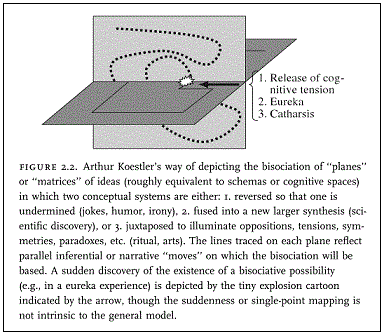
    Thus far, whenever I’ve discussed Koestler‘s notion of bisociation, I’ve focused on the sense that it liea at the heart of creativity. Koestler himself takes it deeper. Here’s Nicholas Vajifdar, in a review titled Summing Up Arthur Koestler’s Janus: A Summing Up:

    Koestler .. asserts that there are two planes of existence, the trivial and the tragic. The trivial plane is the stage for paying bills, shopping, working. Most of life takes place on the trivial plane. But sometimes we’re swept up into the tragic plane, usually due to some catastrophe, and everything becomes glazed with an awful significance. From the point of view of the tragic plane, the trivial plane is empty and frivolous; from the point of view of the trivial plane, the tragic plane is embarrassing and overwrought. Once we’ve moved from one plane to the other, we forget why we could have felt the way we used to.

    That’s not just any old distinction between two realms, that’s the one Koestler himself prioritizes. And following his basic principle that a creative spark is lit when two disparate “planes of ideas” intersect, we shouldn’t be too surprised to find Vajifdar continuing:

    “The highest form of human creativity,” Koestler writes, “is the endeavor to bridge the gap between the two planes. Both the artist and the scientist are gifted — or cursed — with the faculty of perceiving the trivial events of everyday experience sub specie aeternitatis, in the light of eternity…”

    William Blake made a similar observation in The Marriage of Heaven and Hell, writing:

    Eternity is in love with the productions of time.

    Finally, Vajifdar tells us why he finds Koestler’s definition of art maybe the best he’s ever read:

    What I value in this definition of creativity is its emphasis on the subjective being of those who experience the work of art or scientific theory, a surer gauge than cataloguing formal properties or whether it’s “interesting.” Art has always seemed like a kind of sober drunkenness, or drunken sobriety. Most people probably have wondered whether the feelings they felt while drunk were more or less real than their sober feelings. Koestlerian art joins these seemingly irreconcilable feelings together.

    Let’s just go one step further. In Promise and Fulfilment – Palestine 1917-1949, Koestler specifically singles out this intersection as an aspect of the experience of warfare:

    This intense and perverse peace, superimposed on scenes of flesh-tearing and eardrum-splitting violence, is an archetype of war-experience. Grass never smells sweeter than in a dug-out during a bombardment when one’s face is buried in the earth. What soldier has not seen that caterpillar crawling along a crack in the bark of the tree behind which he took cover, and pursuing its climb undisturbed by the spattering of his tommy-gun? This intersecting of the tragic and the trivial planes of existence has always obsessed me in the Spanish Civil War, during the collapse of France, in the London blitz.

    **

    I am grateful to David Foster for his ChicagoBoyz post The Romance of Terrorism and War which triggered this exploration, and that on the glamour of war which will follow it.


    Switch to our mobile site