zenpundit.com » 2016 » October

Archive for October, 2016

Visual for verbal, a perfect match

Wednesday, October 12th, 2016

[ by Charles Cameron — one picture is worth one paragraph, both perfect ]
.

I’ve paired the Annie Dillard paragraph in the upper panel below with an impressively similar paragraph from Haniel Long and a gorgeous slow motion video — now I’d like to pair it with a design in the style of native artwork from the Pacific Northwest, which as far as I can determine is the work of one Mark Gauti:

annie-dillard-art

The image is titled Eagle and Dog Salmon. It gives me pleasure to set these two (figuratively) side by side.

Twice lucky, or thrice? On dodging nuclear fireballs

Wednesday, October 12th, 2016

[ by Charles Cameron — two Russian secular saints — and an Australian ]
.

It seems we’ve been lucky twice —

saved-twice

Read their two stories, and weep.

**

27 October 1962

Thank you Vasili Arkhipov, the man who stopped nuclear war

If you were born before 27 October 1962, Vasili Alexandrovich Arkhipov saved your life. It was the most dangerous day in history. An American spy plane had been shot down over Cuba while another U2 had got lost and strayed into Soviet airspace. As these dramas ratcheted tensions beyond breaking point, an American destroyer, the USS Beale, began to drop depth charges on the B-59, a Soviet submarine armed with a nuclear weapon.

The captain of the B-59, Valentin Savitsky, had no way of knowing that the depth charges were non-lethal “practice” rounds intended as warning shots to force the B-59 to surface. The Beale was joined by other US destroyers who piled in to pummel the submerged B-59 with more explosives. The exhausted Savitsky assumed that his submarine was doomed and that world war three had broken out. He ordered the B-59’s ten kiloton nuclear torpedo to be prepared for firing. Its target was the USS Randolf, the giant aircraft carrier leading the task force.

If the B-59’s torpedo had vaporised the Randolf, the nuclear clouds would quickly have spread from sea to land. The first targets would have been Moscow, London, the airbases of East Anglia and troop concentrations in Germany. The next wave of bombs would have wiped out “economic targets”, a euphemism for civilian populations – more than half the UK population would have died. Meanwhile, the Pentagon’s SIOP, Single Integrated Operational Plan – a doomsday scenario that echoed Dr Strangelove’s orgiastic Götterdämmerung – would have hurled 5,500 nuclear weapons against a thousand targets, including ones in non-belligerent states such as Albania and China. [ .. ]

The decision not to start world war three was not taken in the Kremlin or the White House, but in the sweltering control room of a submarine. The launch of the B-59’s nuclear torpedo required the consent of all three senior officers aboard. Arkhipov was alone in refusing permission. It is certain that Arkhipov’s reputation was a key factor in the control room debate. The previous year the young officer had exposed himself to severe radiation in order to save a submarine with an overheating reactor.

**

September 26, 1983

The Man Who Saved the World by Doing Absolutely Nothing

It was September 26, 1983. Stanislav Petrov, a lieutenant colonel in the Soviet Air Defence Forces, was on duty at Serpukhov-15, a secret bunker outside Moscow. His job: to monitor Oko, the Soviet Union’s early-warning system for nuclear attack. And then to pass along any alerts to his superiors. It was just after midnight when the alarm bells began sounding. One of the system’s satellites had detected that the United States had launched five ballistic missiles. And they were heading toward the USSR. Electronic maps flashed; bells screamed; reports streamed in. A back-lit red screen flashed the word ‘LAUNCH.'”

That the U.S. would be lobbing missiles toward its Soviet counterpart would not, of course, have been out of the question at that particular point in human history. Three weeks earlier, Russians had shot down a South Korean airliner that had wandered into Soviet air space. NATO had responded with a show of military exercises. The Cold War, even in the early ’80s, continued apace; the threat of nuclear engagement still hovered over the stretch of land and sea that fell between Washington and Moscow.

Petrov, however, had a hunch — “a funny feeling in my gut,” he would later recall — that the alarm ringing through the bunker was a false one. It was an intuition that was based on common sense: The alarm indicated that only five missiles were headed toward the USSR. Had the U.S. actually been launching a nuclear attack, however, Petrov figured, it would be extensive — much more, certainly, than five. Soviet ground radar, meanwhile, had failed to pick up corroborative evidence of incoming missiles — even after several minutes had elapsed. The larger matter, however, was that Petrov didn’t fully trust the accuracy of the Soviet technology when it came to bomb-detection. He would later describe the alert system as “raw.”

But what would you do? You’re alone in a bunker, and alarms are screaming, and lights are flashing, and you have your training, and you have your intuition, and you have two choices: follow protocol or trust your gut. Either way, the world is counting on you to make the right call.

Petrov trusted himself. He reported the satellite’s detection to his superiors — but, crucially, as a false alarm. And then, as Wired puts it, “he hoped to hell he was right.”

He was, of course. The U.S. had not attacked the Soviets. It was a false alarm. One that, had it not been treated as such, may have prompted a retaliatory nuclear attack on the U.S. and its NATO allies. Which would have then prompted … well, you can guess what it would have prompted.

**

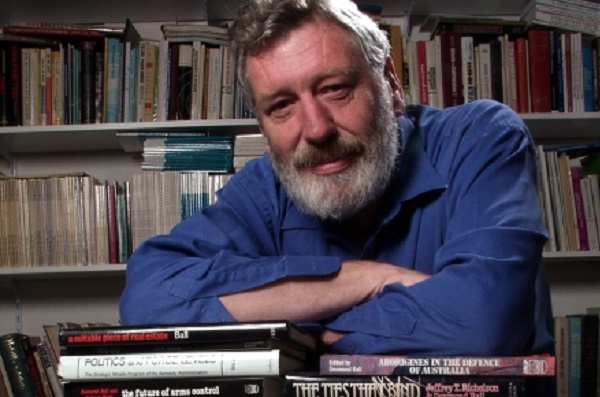
Oh, and the Australian. I came by this topic via an article about this man, Professor Des Bell:

des-ball

A strategist with books — he’s the sort of chap this blog thrives on! And he, too, seems to have saved us from a fiery furnace of our own devising:

Des Ball: the man who saved the world

THAT America could launch a limited nuclear strike against Russia was a fashionable belief in US strategic theory of the 1970s. Policymakers thought that if Cold War tensions boiled over, they could hit selected Soviet targets in a way that controlled further escalation and forced Moscow to back down.

It took the iconoclastic Australian security scholar Des Ball to point out that the theory was bunkum. In his influential essays of the early 1980s, Ball argued that reasoned strategic theory was likely to go out the window once the missiles started flying.

Among the first targets would be the other side’s command and control centres – its eyes and ears. Once blinded, a superpower – consisting of real people responding with human instincts – would not distinguish a ”controlled” strike from a full-scale attack and would retaliate with everything it had.

Thrice lucky? I prefer to call it grace.

Heart Line — a response to Bill Benzon

Wednesday, October 12th, 2016

[ by Charles Cameron — design fascination — including a Mimbres rabbit with a supernova at its feet ]
.

Bill Benzon has been blogging a remarkable series of posts on Jamie Bérubé‘s drawings as recorded in the online illustrations to Michael Bérubé‘s book, Life As Jamie Knows It: An Exceptional Child Grows Up.

**

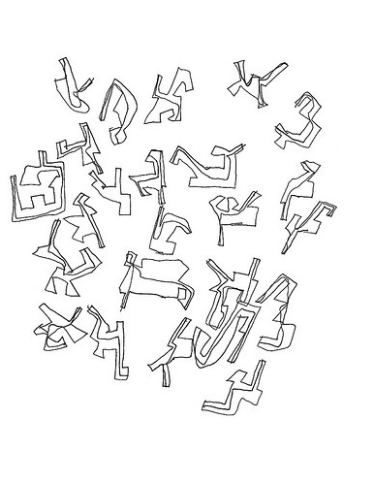
I wanted to respond to Bill’s latest, Jamie’s Investigations, Part 5: Biomorphs, Geometry and Topology, which included this illustration:

berube-benzon-5-biomorphs

and these comments, which I’ve edited lightly for clarity and simplicity:

I emailed Mark Changizi, a theoretical neuroscientist who has done work on letterforms. He has been making a general argument that culture re-purposes, harnesses (his term), perceptual capacities our ancestors developed for living in the natural world. One of his arguments is that the forms used in writing systems, whether Latinate or Chinese (for example), are those that happened to be useful in perceiving creatures in the natural world, such as plant and animal forms. I told him that Jamie’s forms looked like “tree branches and such.” He replied that they looked like people. His wife, an artist, thought so as well, and also: “This is like early human art.”

You’ll see why that-all interests me — letters and life forms — below.

And then:

Yes, each is a convex polygon; each has several ‘limbs’. And each has a single interior line that goes from one side, through the interior space, to another side. The line never goes outside the polygon .. Why those lines? I don’t know what’s on Jamie’s mind as he draws those lines, but I’m guessing that he’s interested in the fact that, given the relative complexity of these figures and the variety among them, in every case he can draw such a line.

**

Two thoughts cross my mind.

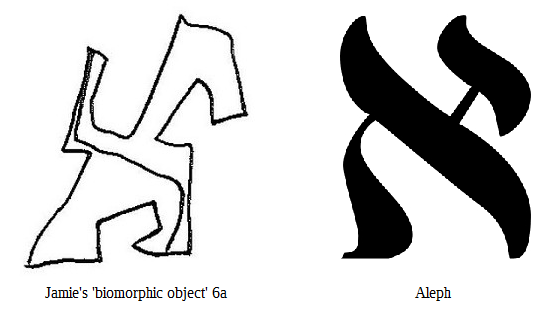
The first is that one of these forms, Benzon’s Biomorphic Objects 6a, bears a striking resemblance to the letter aleph, with which the Hebrew alphabet — or better, alephbeth — begins:

berube-benzon-5-biomorph-6a-aleph

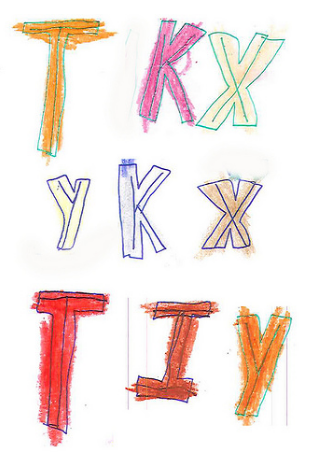
There may be some connection there, I’m not sure — though Jamie also has a keen interest in alphabetic forms, as illustrated here:

berube-benzon-5-letterforms

**

But it’s my second point that interests me more.

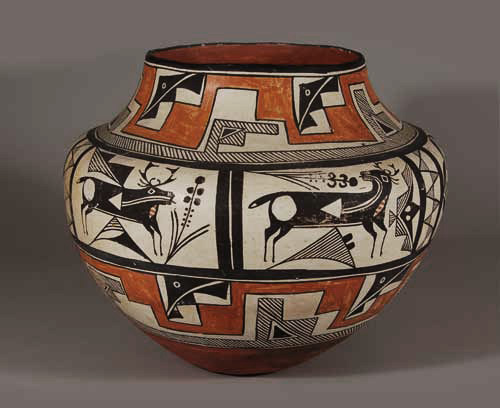
These “biomorphic objects” with “single interior line that goes from one side, through the interior space, to another side” remind me of nothing so much as the Native American style of representing animals with a “heart line” — best illustrated, perhaps, by this Acoma Pueblo Polychrome Olla with Heartline Deer:

The image comment notes:

One generally associates the use of heartline deer with pottery from Zuni Pueblo and that is most likely the origin. The fact that it appears on Acoma Pueblo pottery has been explained in a number of fashions by a number of contemporary Acoma potters. Deer designs have been documented on Acoma pottery as early as 1880, but those deer do not feature heartline elements. Some potters at Acoma have indicated that Lucy Lewis was the first Acoma potter to produce heartline deer on Acoma pottery. She did this around 1950 at the encouragement of Gallup, New Mexico Indian art dealer Katie Noe. Lewis did not use it until gaining permission from Zuni to do so. Other potters at Acoma have stated that the heartline deer is a traditional Acoma design; however, there is no documented example to prove this. Even if the heartline deer motif is not of Acoma origin, potters at Acoma have expressed that it does have meaning for them. It is said to represent life and it has a spiritual connection to deer and going hunting for deer.

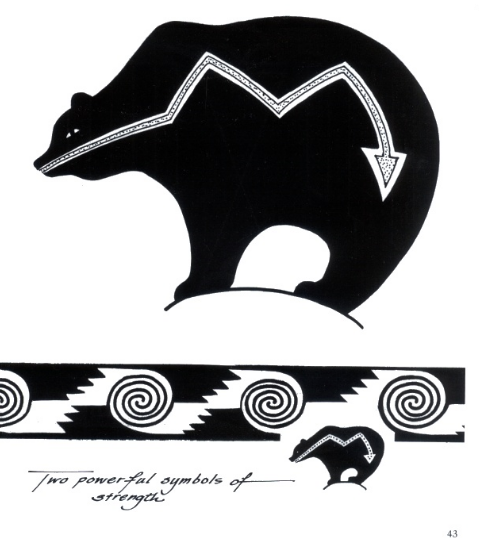
Here’s a “heartline bear” from David and Jean Villasenor‘s book, Indian Designs:

bear-heartline

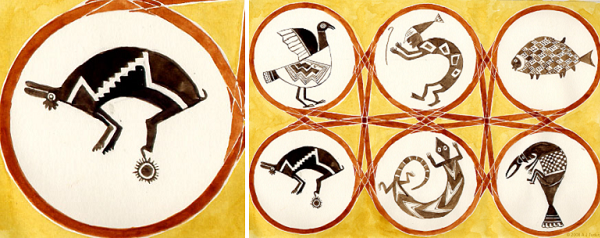
And here’s an equivalent Mimbres design for a rabbit with heartline, in which the line passes completely through the body from one side to the other, as in Jamie’s biomorphs:

mimbres-rabbit

Again, the comment is interesting — it cites a 1990 New York Times article, Star Explosion of 1054 Is Seen in Indian Bowl:

When the prehistoric Mimbres Indians of New Mexico looked at the moon, they saw in its surface shading not the “man in the moon” but a “rabbit in the moon.” For them, as for other early Meso-American people, the rabbit came to symbolize the moon in their religion and art.

On the morning of July 5, 1054, the Mimbres Indians arose to find a bright new object shining in the Eastern sky, close to the crescent moon. The object remained visible in daylight for many days. One observer recorded the strange apparition with a black and white painting of a rabbit curled into a crescent shape with a small sunburst at the tip of one foot.

And so the Indians of the Southwestern United States left what archeologists and astronomers call the most unambiguous evidence ever found that people in the Western Hemisphere observed with awe and some sophistication the exploding star, or supernova, that created the Crab nebula.

That would be the sunburst right at the rabbit’s feet!

**

Posts in Bill’s series thus far:

  • Jamie’s Investigations, Part 1: Emergence
  • Jamie’s Investigations, Part 2: On Discovering Jamie’s Principle
  • Jamie’s Investigations, Part 3: Towers of Color
  • Jamie’s Investigations, Part 4: Concentrics, Letters, and the Problem of Composition
  • Jamie’s Investigations, Part 5: Biomorphs, Geometry and Topology
  • My previous comment on #1 in the series:

  • On the felicities of graph-based game-board design: nine
  • The Thucydides Roundtable Oct 17: Meet our Panel!

    Wednesday, October 12th, 2016

    [Mark Safranski / “zen“]

    The long awaited Thucydides Roundtable is scheduled to begin Monday, October 17, 2016 and this seemed to be an appropriate time to introduce our participants.  My thanks to T. Greer, Lynn Rees, Michael Lotus and Charles Cameron for helping assemble this group.

    Our panelists are truly an impressive and outstanding group of thinkers, writers and scholars and I feel honored that they have agreed to be part of our roundtable and join us in wrestling with Thucydides to try to distill together an understanding from what the father of history deemed to be “a possession forever”.

    Accomplished as they may be, our panelists hail from all walks of life and experiences. We have active and retired military officers, philosophers and scientists, scholars of war, strategy, languages and culture here. Some practice law, others are journalists, policy wonks, poets and expatriates in distant lands. Some panelists have long and distinguished careers and others are starting out and are already making their bones. All share in common a respect for the life of the mind and a willingness to investigate profound books that raise life’s deepest questions. I thank all of them for the time and intellectual energy that they are devoting to this important project.

    A couple of brief notes: this list does not include a small number of special guest-posters who for various good reasons, will be entering the fray at a later date. They will be introduced with their post and the required biographical updates will be made here.

    Readers who wish to follow along with us or engage in the comment section are cordially invited to so — as a rule the comments at roundtables can be as lively as the posts. A reminder, we will be using The Landmark Thucydides as our official text. Our “Marching Orders” and Roundtable schedule are here.

    Without further delay – meet the panelists of the Thucydides Roundtable:

    Major Joe Byerly is an armor officer who frequently writes about leadership and leader development on his blog From the Green Notebook. He is a founding member of the Military Writers Guild.  He holds a B.S. from University of North Georgia and M.A. from the Naval War College. He currently serves as a Squadron Executive Officer in the 4th Infantry Division.

    Charles Cameron is the Managing Editor of zenpundit.com. Charles has also posted at Small Wars Journal, All Things Counterterrorism, for the Chicago Boyz Afghanistan 2050 roundtable, and elsewhere.  Charles read Theology at Christ Church, Oxford under A.E. Harvey, and was at one time a Principal Researcher with Boston University’s Center for Millennial Studies and the Senior Analyst with the Arlington Institute. Cameron is the designer of the HipBone Games, a three-time finalist at the Atlantic Council’s Brent Scowcroft Center on International Security’s Art of Future War contests, and a contributor to Robert Bunker‘s anthology Blood Sacrifices: Violent Non-State Actors and Dark Magico-Religious Activities (Terrorism Research Center, 2016).

    T. Greer is a writer and analyst currently based out of Beijing. His research focuses on the evolution of East Asian strategic thought from the time of Sunzi to today. He blogs at The Scholar’s Stage, and can be followed on Twitter at @Scholars_Stage.

    Dr. Pauline Shanks Kaurin holds a PhD in Philosophy from Temple University, Philadelphia and is a specialist in military ethics, just war theory, social and political philosophy, and applied ethics. She is Associate Professor of Philosophy at Pacific Lutheran University in Tacoma, WA and teaches courses in military ethics, warfare, business ethics, and history of philosophy. Recent publications include: When Less is not More: Expanding the Combatant/Non-Combatant Distinction, With Fear and Trembling: A Qualified Defense of Non-Lethal Weaponsand Achilles Goes Asymmetrical: The Warrior, Military Ethics and Contemporary Warfare (Ashgate, 2014)

    Sean Paul Kelley has a BA in History from the University of Houston, ’93, an MA in International Affairs from St. Mary’s University, San Antonio, ’02, and is pursuing another Master’s in History from the University of Texas, San Antonio. His work has appeared anywhere from the Los Angeles Times Travel Section, to the Alternet.org, the San Antonio Express-News, and was a staff writer for the San Antonio Current.

    Kelley’s focus is on the nexus of history and contemporary politics and where they meet internationally. He is a realist by training but an idealist on occasion. He studies power, above all, as it often touches the process, if it isn’t outright the entirety of the process. He spends his time between San Antonio, Texas and Diriá, Nicaragua, where he is completing his Master’s Thesis and beginning his first book on the continuity of history in Central Asia from the time of the Han to the current government of China’s “One Belt, One Road“. He can be reached at spkelley@gmail.com.

    Dr. Jim Lacey is the Professor of Strategy at the Marine Corps War College. Prior to that he was a widely published senior analyst at the Institute for Defense Analyses in Washington, DC. Lacey served over a dozen years on active duty as an infantry officer and recently retired from the Army Reserves. He also taught graduate level courses in Military History and Global Issues at Johns Hopkins and Georgetown Universities. Lacey was an embedded journalist with Time magazine during the invasion of Iraq, where he traveled with the 101st Airborne Division. He has written extensively for many other magazines and his opinion columns have been published in National Review, The Weekly Standard, the New York Post, the New York Sun, Foreign Affairs, and many other publications. Jim Lacey is also regularly published in Military History Magazine, Military History Quarterly, and the Journal of Military History.

    Lacey is the author of Moment of Battle (Bantam), The First Clash (Bantam), Takedown: the 3rd Infantry Division’s 21-Day Assault on Baghdad (Naval Institute Press), Pershing (Palgrave-Macmillan) The Making of Peace (Cambridge University Press), and The Making of Grand Strategy (Cambridge University Press) and Keep from all Thoughtful Men (USNI, 2010) He also has a trilogy of works on global terrorism, published early in 2008 (Naval Institute Press). His edited book Great Power Rivalries is forthcoming (2016), as are two other books: The Washington War, dealing with the relationship between FDR, the Joint Chiefs of Staff, and the War Cabinet during World War II; and, Gods of War, dealing with those times in history when great captains have fought each other.

    Michael J. Lotus is a lawyer in Chicago, a graduate of the University of Chicago and Indiana University School of Law.  He is the co-author with James C. Bennett of America 3.0: Rebooting American Prosperity in the 21st Century — Why America’s Greatest Days Are Yet to Come (2013), and the co-editor with Lynn C. Rees and Mark Safranski of The Clausewitz Roundtable (Ever Victorious Press, 2016).  He read The History of the Peloponnesian War twice in college and is happy to revisit it a third time.

    Dr. Steven Metz is Director of Research at the Strategic Studies Institute. He has been with SSI since 1993, previously serving as Henry L. Stimson Professor of Military Studies, Chairman of the Regional Strategy Department, research director for the Joint Strategic Landpower Task Force, and co-director of SSI’s Future of American Strategy Project.  Metz has also been on the faculty of the Air War College, the U.S. Army Command and General Staff College, and several universities. He has been an advisor to political campaigns and elements of the intelligence community; served on national security policy task forces; testified in both houses of Congress; and spoken on military and security issues around the world.

    Dr. Metz is a weekly columnist for World Politics Review and the author of Iraq and the Evolution of American Strategy and several hundred articles, essays, monographs, reports, and book chapters. His research has taken him to 30 countries, including Iraq immediately after the collapse of the Hussein regime. He is an Adjunct Scholar at the U.S. Military Academy’s Modern War Institute. He holds a Ph.D. from the Johns Hopkins University, and an MA and BA from the University of South Carolina.

    Marc Opper is a postdoctoral associate at Yale’s Council on East Asian Studies. His research focuses on the etiology, conduct, and outcome of internal conflicts with a focus on the micro-level interactions between civilians and armed groups. He specializes in the history, politics, and society of China, Malaya, and Vietnam.

    Lynn C. Rees is a software engineer and genealogist. He blogs at Zenpundit, Chicago Boyz, and the Committee of Public Safety. With Michael J. Lotus and Mark Safranski, he was co-editor of The Clausewitz Roundtable (Ever Victorious Press, 2016).

    Cheryl Rofer blogs at Nuclear Diner and contributes posts and op-eds to other web magazines, including the Globe and Mail, War On The Rocks, and Physics Today. She retired after 35 years at the Los Alamos National Laboratory. Her work included environmental projects in Estonia and Kazakhstan, managing cleanups at Los Alamos, and projects in fossil fuels, laser development, and the nuclear fuel cycle, all with implications for national policy. She has published papers in scientific and political science journals and edited a book. She holds an A.B. from Ripon College and an M.S. from the University of California at Berkeley. She tweets as @CherylRofer.

    Mark Safranski is a senior analyst at Wikistrat, LLC, an educator and writer; he holds an MA in diplomatic history from Northern Illinois University and a M.Ed in Curriculum and Leadership from Benedictine University. An occasional contributor to Pragati: The Indian National Interest, his writing has appeared in Small Wars Journal, War on the Rocks, The New Atlanticist, and other sites. Safranski was the editor of The John Boyd Roundtable: Debating Science, Strategy and War; with Michael J. Lotus and Lynn C. Rees, a co-editor of The Clausewitz Roundtable (Ever Victorious Press, 2016); and contributed chapters to a number of books including most recently Warlords, inc (North Atlantic Books, 2015 ) and Blood Sacrifices: Violent Non-State Actors and Dark Magico-Religious Activities (Terrorism Research Center, 2016).

    “Seydlitz89” is a former Marine Corps officer and US Army intelligence officer who served in a civilian capacity in Berlin during the last decade of the Cold War. He was involved as both an intelligence operations specialist and an operations officer in strategic overt humint collection. This experience sparked his serious interest in strategic theory. He is now involved in education. He participated in both the Clausewitz and Xenophon Roundtables at Chicago Boyz.

    Natalie Sambhi is a Research Fellow at the Perth USAsia Centre where she publishes on Indonesian foreign and defense policy as well as Southeast Asian security. She was previously an Analyst at the Australian Strategic Policy Institute (ASPI) from 2012 to 2016, and Managing Editor of ASPI’s blog, The Strategist. She has also worked at the Department of Defence and University of Canberra.

    Natalie holds a Bachelor of Arts (Asian Studies) (Hons) from the University of Western Australia and a Master of Arts (International Relations) and Master of Diplomacy from the Australian National University. Sambhi has been published in Security Challenges journal, The Asan Forum, The Diplomat, War On The Rocks, The Interpreter, and The Jakarta Post, among others, and most recently presented on Indonesia’s military modernization at CSIS’s Sixth Annual South China Sea conference in July 2016.

    In 2016 and 2014, Natalie was a Visiting Fellow at the Center for a New American Security (CNAS) in Washington, DC where she presented on Indonesian civil-military relations. Natalie has served as President of the Australian Institute of International Affairs ACT, having served as Vice President 2013–2015. She hosts Sea Control: Asia Pacific, a podcast series on Asia-Pacific security for the US-based Center for International Maritime Security (CIMSEC). Natalie also joined the team at Bloggingheads.tv as a host for their international relations segment, Foreign Entanglements.

    In 2010, Natalie founded the blog Security Scholar and tweets at @SecurityScholar. She speaks Indonesian and enjoys playing the cello.

    Electoral religion 2016

    Wednesday, October 12th, 2016

    [ by Charles Cameron — remembering the Ted Cruz Christ / Antichrist (and Obama ditto) rhetoric from an earlier post ]
    .

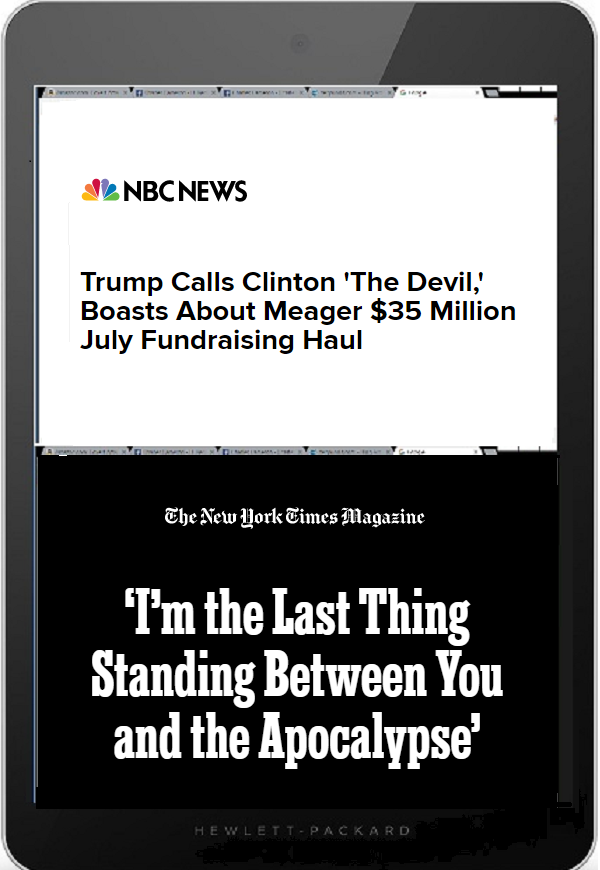
    Dismal, both of them:

    tablet-dq-electoral-religion

    Sources:

  • NBC News, Trump Calls Clinton ‘The Devil’
  • NYT Magazine, I’m the Last Thing Standing Between You and the Apocalypse
  • **

    I could be wrong, but I somehow doubt that either Trump or Clinton is using the terms “devil” or “apocalypse” (respectively) in their literal religious meanings here.

    For that I’m thankful.

    But then..

    In contrast to the two posts I’ve linked to above, these two below appear to me to be making overtly and deliberately religious appeals with respect to the current election.

  • Alex Jones, InfoWars, Hillary Clinton: Demonic Warmonger
  • Andy Crouch, Christianity Today, Speak Truth to Trump
  • I’ve included the InfoWars video clip because it makes it very clear that Alex Jones, at least, claims he is being “Biblical” — his own word — when he calls Hillary Clinton demonic — and the Christianity Today piece because it represents a distinguished Evangelical response to the general tendency of Evangelical Christians to support Donald Trump‘s candidacy.

    In somewhat related news, I am saddened to report that Christianity Today‘s literary magazine Books & Culture will close at the end of the year. John Wilson, the editor, is a long time and valued friend from Pasadena bookstore days — see his kind words about the late Bill Tunilla, the bookman who introduced us, in this Letter from the Editor.


    Switch to our mobile site