zenpundit.com » 2018 » July

Archive for July, 2018

GeoPol, the White House & Game Theory in the New Yorker

Wednesday, July 4th, 2018

[ by Charles Cameron — popularizing game theory as a means of understanding significant currents in world affairs ]
.

You may pick up a few details about the origins of game theory and Prisoners Dilemma, but apart from that, the basic outlines offered by two Bew Yorker articles won’t contain too many surprises. What’s interesting is the role the New Yorker plays as a disseminator of knowledge: game theory, if I may put it this way, is joining the wider conversation.

**

In May this year, the New Yorker carried John Cassidy‘s piece, How Game Theory Explains the Leaks in the Trump White House.

Here’s the game theoretical background:

In 1950, Albert Tucker, a mathematician at Princeton, gave a talk to a group of Stanford psychologists about the rapidly developing science known as game theory. To illustrate one of his arguments, he invented a story about two criminals who had been arrested for a crime they had committed jointly.

In the story, the police interrogate the two prisoners separately. The prisoners have no means of communicating with each other, but they both understand that, if they each deny the crime, they will be charged with a much less serious offense, which carries a short prison sentence (one year, say). If they both confess, they will get a heavier punishment (five years). If one confesses to the crime and the other insists that he is innocent, the one who confesses will be let off, and his accomplice will get an even heavier punishment (ten years). Tucker posed the question: Should the men confess or deny?

When first confronted with this story, many people think that both criminals should insist on their innocence and escape with a minor conviction. The problem is that mutual denial isn’t consistent with individual self-interest. Take the first prisoner. If he believes that his accomplice is going to deny the crime, he can confess and get off scot-free. If he believes that his accomplice is going to confess, he should certainly confess, too, or he will end up receiving the heaviest punishment of all. In the language of game theory, confessing is a “dominant strategy.” Regardless of which strategy the other players adopt, it is the most rational option to choose. But it ends up producing a bad outcome for both players: five years in prison. If they had both stuck to mutual denial, they would have got just one year.

Then, the political application:

What does all this have to do with the Trump White House? Quite a lot, it turns out.

The issue is White House leaks, and game theory can explain the why of them:

Ever since Trump became President, the White House has leaked like a sieve. “The leaks come in all shapes and sizes: small leaks, real-time leaks, weaponized leaks, historical leaks,” Jonathan Swan, Axios’s White House correspondent, wrote this week. “Sensitive Oval Office conversations have leaked, and so have talks in cabinet meetings and the Situation Room. You name it, they leak it.” Mike Allen, Swan’s colleague at Axios, says, “we learn more about what’s going on inside the Trump White House in a week than we did in a year of the George W. Bush presidency.”

That may well be true, and game theory provides one explanation. By deliberately creating a factionalized, dog-eat-dog culture inside the White House, one that mimics how he ran his business and the premise of his reality-television show, Trump has turned the people who work for him into White House versions of the prisoners in Tucker’s story. With this in mind, it is to be expected that so many White House staffers would take actions that are damaging to the Administration, such as leaking explosive information.

One description of the internal conflicts in the WHite House:

“You have to realize that working here is kind of like being in a never-ending ‘Mexican Standoff,’ ” a White House official explained to Swan. “Everyone has guns (leaks) pointed at each other and it’s only a matter of time before someone shoots. There’s rarely a peaceful conclusion so you might as well shoot first.”

The questionably named Mexican standoff, in which several bandits with guns confront each other at close quarters, is just another version of the prisoners’ dilemma. Imagine yourself in the unfortunate position of being a White House official. If you believe your rivals are about to leak some damaging information, getting it out first is a rational form of self-defense. But, even if you don’t think a rival leak is coming, there is an incentive to spread damaging information about your opponents. Just like confessing, leaking is a dominant strategy.

So, Mexican Standoff, Prisoners Dilemma. The impossible solution?

In terms of game theory, you need to alter the rewards and punishments that individual staffers perceive to be attached to their actions, so that coöperation, rather than backstabbing, emerges as an equilibrium strategy.

And Cassidy’s conclusiom:

The prisoners’ dilemma illustrates how the process works. But, in this case, it could be renamed the Trump dilemma. He created it.

**

Okay, the second New Yorker piece, by Adam Davidson, Is Michael Cohen Turning on Donald Trump? — dated July 2nd, which triggered this post:

Trump’s former attorney Michael Cohen appears to be playing out the Prisoner’s Dilemma with the President in the most public and consequential way possible.

The most famous game-theory formula was developed in 1950, by two mathematicians, Melvin Dresher and Merrill Flood. But it was only later that another mathematician gave it the catchy name that made it famous: the Prisoner’s Dilemma. The idea is simple: two accused criminals have been arrested and are being interrogated separately. If they both stay silent, they’ll both get a year in jail. But, if one rats out the other, he could get away scot-free while his accomplice would spend three years in jail. The optimal outcome, in terms of total time served, is for both to remain silent. But, as Drescher and Flood posited, there is enormous likelihood that each will rat out the other. There are endless variations of the formula, tweaking the costs and benefits of silence and confession, but the core insight remains: if two people whose interests are mutually dependent on the actions of the other don’t fully trust each other, and don’t have the opportunity to secretly coördinate, they will end up behaving in ways that hurt both of them.

President Donald Trump and his former attorney Michael Cohen are currently playing out the Prisoner’s Dilemma in the most public and consequential way possible

That’s enough to get you started.

**

And my motive for writing this post? As I said in On two, one, seven plus or minus, and ten – towards infinity:

When I worked as senior analyst in a tiny think-shop, my boss would often ask me for an early indicator of some trend. My brain couldn’t handle that — I always needed two data points to see a pattern, and so I coined the mantra for myself, two is the first number.

These twin New Yorker articles mark a tidal level in the dissemination of knowledge: political scientists andd strategists already know this stuff, but the New Yorker now feels that bright orchestral musicians, humanities teachers, and media mavens, charity workers and foreign affairs correspondents — a few quick guesses at their readership, which must be large and various — are ready and thirsty to add it to their cconceptual vocabulary. That’s a quietly interesting marker in itself.

**

Oh ah, the New Yorker on July 2 also had a piece titled Will North Korea Play Nuclear Hide-and-Seek with Trump?. I suppose I’d best be on the loookout for other hide-and-seek references. Irony, n’dst ce pas?.

Best graphic I’ve seen in a while

Wednesday, July 4th, 2018

[ by Charles Cameron — close cousin to the resurrection narrative ]
.

Boom!

**

The story is striking enough, regardless of whether you share my interest in religious symbolism; but for those who do, the religious parallelism leaps out at you.

Boom!

I’ll have to avoid using boom so much, soon: it’s easy to overdo it.

*

Deets:

  • Washington Post, A woman declared dead after a crash was put in a morgue freezer.
  • I’ll need to watch deets too.

    Happy Fourth of July to all ZP readers

    Wednesday, July 4th, 2018

    [ by Charles Cameron — from all of us at Zenpundit ]
    .

    From President Woodrow Wilson‘s Independence Day speech, July 4th, 1914:

    Mr. Chairman and Fellow-Citizens:

    We are assembled to celebrate the one hundred and thirty-eighth anniversary of the birth of the United States. I suppose that we can more vividly realize the circumstances of that birth standing on this historic spot than it would be possible to realize them anywhere else. The Declaration of Independence was written in Philadelphia; it was adopted in this historic building by which we stand. I have just had the privilege of sitting in the chair of the great man who presided over the deliberations of those who gave the declaration to the world. My hand rests at this moment upon the table upon which the declaration was signed. We can feel that we are almost in the visible and tangible presence of a great historic transaction.

    Have you ever read the Declaration of Independence or attended with close comprehension to the real character of it when you have heard it read? If you have, you will know that it is not a Fourth of July oration. The Declaration of Independence was a document preliminary to war. It was a vital piece of practical business, not a piece of rhetoric; and if you will pass beyond those preliminary passages which we are accustomed to quote about the rights of men and read into the heart of the document you will see that it is very express and detailed, that it consists of a series of definite specifications concerning actual public business of the day. Not the business of our day, for the matter with which it deals is past, but the business of that first revolution by which the Nation was set up, the business of 1776. Its general statements, its general declarations cannot mean anything to us unless we append to it a similar specific body of particulars as to what we consider the essential business of our own day.

    **

    If you’re a strategist or historian, these sentences may be of particular interest:

    Have you ever read the Declaration of Independence or attended with close comprehension to the real character of it when you have heard it read? If you have, you will know that it is not a Fourth of July oration. The Declaration of Independence was a document preliminary to war.

    Ahem, and if you’ll permit me my own reading, the key sentence here for my purposes is:

    We can feel that we are almost in the visible and tangible presence of a great historic transaction.

    WHile for factual purposes, 1776 and 1914 are separated by the intervening history, for the purposes of myth, dream, and psychological impact, that “almost” evaporates and the two moments merge, synchronous in a diachronic world.

    **

    Take whichever meaning you will, and accept it with our best wishes here at Zenpundit for a fireworked and festive Fourth!

    h/t War on the Rocks.

    My scope, first draft

    Monday, July 2nd, 2018

    [ by Charles Cameron — footprints on earth and moon — introducing callum flack — mapping the mississippi ]
    .

    Here’s a neat illustration of the extent of my interests, at least along one of my continua —

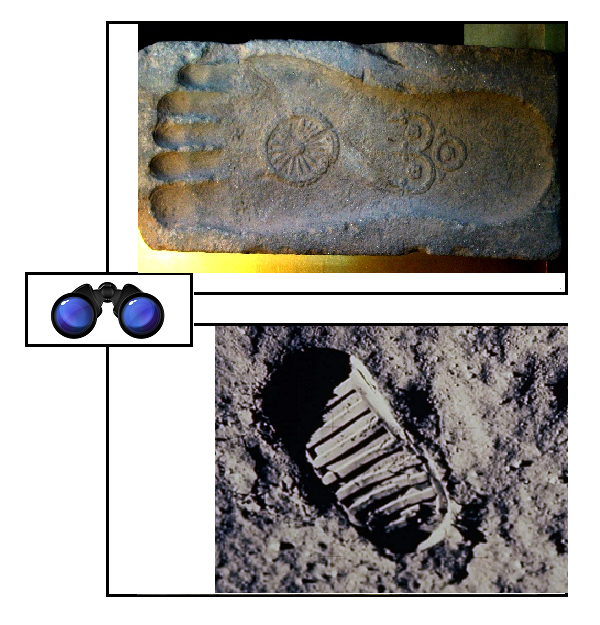
    The upper footprint above is that of Buddha. I have tweaked the image a bit, rotating, flipping it and resizing it to fit my DoubleQuotes format, and you can take thgat as analogous to the way we tweak the Buddha’s teachings to fit our expectations — and the lower footprint, a bootprint actually, is man’s mark on the moon, courtesy of NASA, whose comment is:

    These footprints on the moon will last forever, but the nature of who can be an astronaut is changing

    So, the oppositions:

  • ancient and modern
  • spiritual and technical
  • earth and moon
  • barefoot and booted
  • eternal and eternal
  • What have I missed?

    **

    So: why do I title this post My scope, first draft?

    Scope, to honor Callum Flack, friend of Cath Styles and Sembl, whose blog-post today, THE BRIEF, THE SCOPE AND THE DANCE I read, as I now read anytbing Callum writes.

    Callum and I have strongly overlapping interests, and The Brief, the Scope and the Dance is, amongst other things, a paean to flexibility in the context of planning a business website — flexibility and mutuality in planning. And in pursuit of that flexibility in both brief and scope, Callum uses one of my own favorite illustrations

    :

    — along with these comments:

    Objectives defined in the brief are quantifiable. But constraints, which are defined in the scope, are not. Constraints change, and opportunities are created when that happens.

    and:

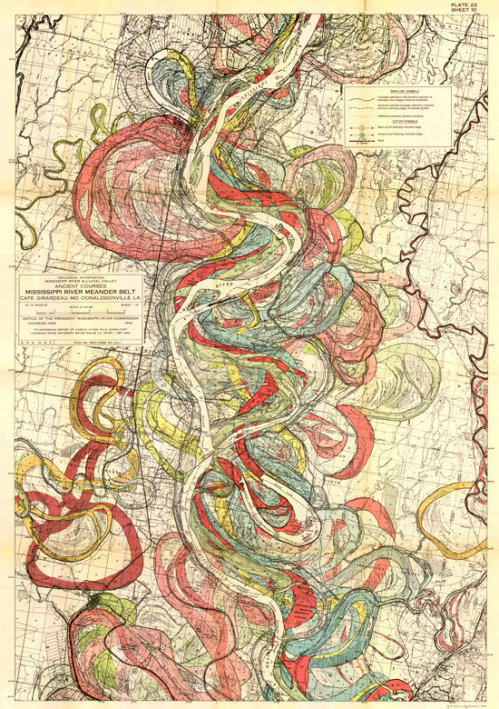
    We logically understand that the least surprising thing about scope is that what is documented as The Scope is not what will actually happen. Like a map, scope is a proxy for reality. The scope is like a river, and as the map of the Mississippi above shows, rivers change.. Anytime a project doesn’t expect the scope to change, it is unrealistic.

    And first draft, to honor that flexibikity in the riverine nature of things.

    **

    My idea and use of scope naturally differs from Callum’s, if for no other reason then because he’s thinking of the scope of a projected commercially effective web-page, while I’m taking the same word (Witty Wittgenstein, I’m saving this space for your chuckle here) to refer to the height, depth, breadth and other parameters of my life as it is currently taking its shape..

    No matter, Callum’s post prodded me, and I wanted to give Zenpundit readers a brief into to Callum’s work anyway — and his blog-post today as both an excellent introduction to and example of that work.

    And when Callum writes,”Objectives defined in the brief are quantifiable. But constraints, which are defined in the scope, are not” he’s showing his own scope (in my sense of the term) to reach across that (to me) all-important divide between quantity and quality, a divide that has at its heart a koan — the imponderable way in which a world can contain both qualit and quant, leaving us to ponder (!!) how to “value” one (quality) in terms of the other, and how to maximize that more elusive of the pair in a world seemingly dedicated to the more obvious and blatant (quantity) of the two.

    **

    Sources

  • Wikipedia, Buddha footprint
  • Washington Post, The unsung astronauts
  • **

    That Mississippi map, also, is a footprint.

    Their own private Farnboroughs

    Sunday, July 1st, 2018

    [ by Charles Cameron — one vivid memory, two breathtaking photos, one for war-watchers, one for poets ]
    .

    There are very few days in my life where I know where I was, but on 6 September 1952, I was at the Farnborough Air Show, when John Derry‘s De Havilland 110 fell apart at Mach 1, the body of the aircraft falling safely away from the crowd, but one jet ploughing into the hillside I was perched on — literally, on my dad’s shoulders — a few dozen yards behind us.

    **

    I was reminded of John Derry and his memorable death by this photo, captioned:

    Military aircraft enthusiasts watch as a United States Air Force F-15 fighter jet travels at low altitude through the “Mach Loop” series of valleys near Dolgellau, Wales, on June 26, 2018. The Mach Loop valleys are regularly used by the military for operational low-flying training, which can take place as low as 250 feet (76 meters) from the nearest terrain. Oli Scarff / AFP / Getty

    The aircraft, as shown above, is certainly striking — but no lesss striking at the tiny observers on the crest of the hillock, who no doubtt had an exhausting hike to get there, to see that remarkable aerial display. “Ooh, look!” These guys have their own private Farnboroughs — and thank God, nobody dies on this occasion.

    I’m posting this here because I think the urge to see, I suppose one might call it the voyeuristic urge, is close cousin ttom the urge to game play. And game play, in military affairs, is a significant matter , from kriegspiel to the rcecently aborted exercises in S Korea.

    Thoughts?

    **

    OMG —

    and I just can’t resist adding one more image from the same page where I found the one above — for its sheer drama:

    https://cdn.theatlantic.com/assets/media/img/photo/2018/06/photos-of-the-week-3/w02_984690316/main_900.jpg?1530296833

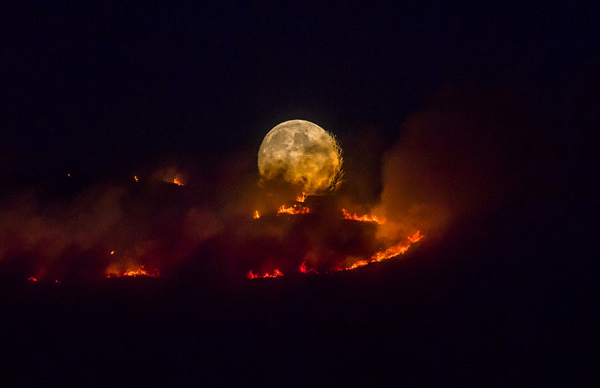
    The full moon rises behind burning moorland as a large wildfire sweeps across the moors between Dovestones and Buckton Vale in Stalybridge, Greater Manchester, on June 26, 2018, in Stalybridge, England. Anthony Devlin / Getty

    Er, Wow!


    Switch to our mobile site