zenpundit.com

Mandela’s Key

December 15th, 2013

[ by Charles Cameron — cross-posted from Shambhala SunSpace ]
.

While the world’s thoughts are turned to Nelson Mandela, I thought it might be useful to consider a statement in which Mandela diagnoses the human condition and prescribes for it. I found it in a paragraph from a letter he wrote from prison. I comment on it below, not so much to add anything to it as to allow the paragraph itself time to breathe.

**

Incidentally, you may find that the cell is an ideal place to learn to know yourself, to search realistically and regularly the process of your own mind and feelings.

Mandela is not alone in writing from prison. Martin Luther King, after all, wrote his celebrated Letter from Birmingham City Jail, Thoreau‘s Civil Disobedience was inspired by his own brief prison visit, and moving farther afield, CervantesDon Quixote was begun in prison, Malory‘s Morte D’Arthur too, and even that old reprobate Oscar Wilde arguably wrote his most profound work from the depths of Reading Jail. His very title, De Profundis, is a phrase from the Psalms meaning “from the depths” — it seems that experiencing the depths, stripped bare of comforts, is often a key to achieving the heights…

Realistically and regularly…

I suspect this whole paragraph, written perhaps unsurprisingly by a man in prison, has as much wisdom to impart to our times as anything written in the last hundred years.

In judging our progress as individuals we tend to concentrate on external factors such as one’s social position, influence and popularity, wealth and standard of education. These are, of course, important in measuring one’s success in material matters and it is perfectly understandable if many people exert themselves mainly to achieve all these.

A beautifully balanced statement: worldly success is no problem, and may even serve our purpose, just so long as it serves and does not rule us. Or as the Mighty I Ching might say, “no blame”. But…

But internal factors may be even more crucial in assessing one’s development as a human being.

Bingo. Mandela goes for the heart.

Honesty, sincerity, simplicity, humility, pure generosity, absence of vanity, readiness to serve others – qualities which are within easy reach of every soul – are the foundations of one’s spiritual life.

Here’s Mandela’s own tool-kit or skill-set, laid out on the workbench for all to see: … humility, pure generosity, absence of vanity, readiness to serve others… But these aren’t tools we can buy from a catalog, they are tools we shape and sharpen within ourselves. How do we do that?

Development in matters of this nature is inconceivable without serious introspection, without knowing yourself, your weaknesses and mistakes.

Mandela hits the mark again: we look within, and we don’t turn back along the path when we meet our own shadows.

At least if for nothing else, the cell gives you the opportunity to look daily into your entire conduct, to overcome the bad and develop whatever is good in you.

The problem with “not being in prison”, then, is not that the outside world is a bad place, nor are the “worldly things” that moralizing religion often preaches against so very terrible — it’s that we ourselves are so easily distracted.

And then it hits:

Regular meditation, say about 15 minutes a day before you turn in, can be very fruitful in this regard.

Meditate…

You may find it difficult at first to pinpoint the negative features in your life, but the 10th attempt may yield rich rewards.

And hello, by the seventh attempt you’ll be getting into the habit of meditation, by the tenth the rewards will already be rich — Mandela has given us our marching orders — roll on!

Never forget that a saint is a sinner who keeps on trying.

Oh, and he’s kind, too — kind enough to allow us our weaknesses, and encourage us to keep moving on.

I’m tempted to say this sentence decisively refutes and routs the oft-quoted teaching of Yoda: “Do… or do not. There is no try” — but maybe they’re two sides of a koan, coin — carrot and stick, the slow ascent and the nudge that gives sudden enlightenment?

Realistically and regularly…

I bow gassho to Nelson Mandela.

**

Here’s Mandela’s paragraph, flying solo — read it like repeated hammer blows, like rain quietly falling:

Incidentally, you may find that the cell is an ideal place to learn to know yourself, to search realistically and regularly the process of your own mind and feelings. In judging our progress as individuals we tend to concentrate on external factors such as one’s social position, influence and popularity, wealth and standard of education. These are, of course, important in measuring one’s success in material matters and it is perfectly understandable if many people exert themselves mainly to achieve all these. But internal factors may be even more crucial in assessing one’s development as a human being. Honesty, sincerity, simplicity, humility, pure generosity, absence of vanity, readiness to serve others – qualities which are within easy reach of every soul – are the foundations of one’s spiritual life. Development in matters of this nature is inconceivable without serious introspection, without knowing yourself, your weaknesses and mistakes. At least if for nothing else, the cell gives you the opportunity to look daily into your entire conduct, to overcome the bad and develop whatever is good in you. Regular meditation, say about 15 minutes a day before you turn in, can be very fruitful in this regard. You may find it difficult at first to pinpoint the negative features in your life, but the 10th attempt may yield rich rewards. Never forget that a saint is a sinner who keeps on trying.

Parable of the soft-touch chiropractor

December 15th, 2013

[raked by Lynn C. Rees]

Driving Mom around during her last years in this life, I sat in on one of her soft-touch chiropractic sessions. Her soft-touch chiropractor was out of the office so one of his disciples stood in.

As he worked, the sub-soft-touch chiropractor said, “Let me explain how this helps your mom.” As he’d done since the session started, he made a fist with his right hand and bent his arm back until the fist reached shoulder height. He flexed the muscles in his arm.

“First, I build up potential energy in my arm.”. The shake in his upper arm intensified.

“Then I concentrate the potential energy in my finger.” He whipped his arm forward and pointed. His arm and finger shook.

“Then I transfer that energy to your mom.”, he said, softly touching Mom’s shoulder. “It’s the perfect translation of potential energy to kinetic energy. Kinetic energy restores balance and balance restores health.”

“Hnn.”, I said.

Who can judge?

  1. Now these are the words which Jesus taught his disciples that they should say unto the people.
  2. Judge not unrighteously, that ye be not judged; but judge righteous judgment.
  3. For with what judgment ye judge, ye shall be judged: and with what measure ye mete, it shall be measured to you again.
  4. And again, ye shall say unto them, Why is it that thou beholdest the mote that is in thy brother’s eye, but considerest not the beam that is in thine own eye?
  5. Or how wilt thou say to thy brother, Let me pull out the mote out of thine eye; and canst not behold a beam in thine own eye?

— Matthew 7: 1-5  (JST)

For parables,  soft-touch chiropracty’s guilt or innocence is a noop: parablizing does not imply judgement, righteous or not. For show and tell purposes, mote or beam are equally useful. As the Thomas theorem claims:

If men define situations as real, they are real in their consequences.

This is true, though the outer limits on its truth are set by the Graham assertion:

In the short run, the market is a voting machine but in the long run it is a weighing machine.

If tactics is voting, strategy is weighing: strategy is the creation of asymmetry. To mangle Conrad C. Crane, there are two kinds of strategy: asymmetric and stupid: proper strategy puts a finger on the scale. It restores balance through weight of deliberate asymmetry and then balance restores health.

If the cycle of strategy is:

drive → reach → grip

Up the slope of:

certain → hazyuncertain

With the goal of summiting at:

certain → certain → certain

The parable of the soft-touch chiropractor demonstrates:

  1. There will be drive.
  2. Drive motivates a build up of strength. Fist clenching and muscle flexing, metaphoric or not, is involved.
  3. Strength creates potential reach.
  4. The ideal strength would banish uncertainty from reach and grip, making them indistinguishable from drive. This would be the perfect translation of potential reach to kinetic grip.
  5. The leap of faith is the frantic whipping between reach and grip. Pull my finger.
  6. Though potential reach will generally always fall short of translation into certain grip, sometimes the touch of its less than kinetic sway on its targets’ mind will compensate for its kinetic shortfall.


The sway of soft-touch chiropracty comforted as cancer spread. This is reach and soft power. Its force did nothing to hurt cancer. This is soft grip and hollow power. As reach exceeds grip, so cancer exceeds soft-touch chiropracty. Then comes the inevitable: no balance, no health.

In Search of Strategy(s), a Voice, a Narrative because, ‘Gentlemen, We Have Run Out Of Money; Now We Have to Think’

December 13th, 2013

[by J. Scott Shipman] [Warning: Maritime in flavor]

No matter how far humanity may go in seeking to foster the arts of civilization and the ideals of civic peace, there will come times when acts of war are required in order to defend world order and sustain the peace of civilized peoples. Charles Hill’s, Grand Strategies, Literature, Statecraft, and World Order, page 48

The lift quote in the title is attributed to Winston Churchill, and in this period of uncertainty with sequestration and deep cuts in defense commanding the attention of military leadership, one thing is becoming crystal clear: we have no cogent or explainable military strategy. Sure, we have “concepts” like Air-Sea/Air-Land Battle, A2/AD, and Off-Shore Control, but our most recent unclassified Navy strategy document A Cooperative Strategy for 21st Century Seapower was written in 2007 may be a bit dated.

This week I attended the U.S. Naval Institute’s annual Defense Forum, Shaping the Maritime Strategy and Navigating the Budget Gap Reality and given the title, there was a lot of talk about funding and in that light/context, strategy was that thing “we’re in the process of doing.” Several people I spoke with expressed concern about “telling the navy’s story,” “why we have a navy,” and one member of Congress encouraged us to build an engaged constituency to put pressure on Congress to knock-off the schizophrenic approach to appropriations, so that a bit of certainty will allow the development of a strategy. Since DoD hasn’t been successfully audited in a long, long time (if ever), I wouldn’t hold out hope for a grass-roots rescue. As Mr. Churchill wisely advises, “now we have to think.”

Strategy Defined

Since strategy is a hot topic, offered here are several definitions ranging from the classic to practitioners and academics, with the goal of framing the elegant simplicity of strategy as a theory, and challenge of defining in reality. As Colin Gray points out in his National Security Dilemmas: “The United States has shown a persisting strategy deficit.” (page 170) Dilemmas, written in 2009 before the budget axe fell in earnest he offers: “One would think that the following definition and explanation must defy even determined efforts of misunderstanding:” (he then quotes Clausewitz)

Strategy is the use of engagement for the purpose of war. The strategist must therefore define an aim for the entire operational side of the war that will be in accordance with its purpose. In other words, he will draft the plan of the war, and the aim will determine the series of actions intended to achieve it: he will, in fact, shape the individual campaigns and, within these, decide the individual engagements.” (On War, page 177)

The definition of strategy from the Department of Defense Dictionary of Military and Associated Terms, Joint Publication 1-02:

strategy — A prudent idea or set of ideas for employing the instruments of national power in a synchronized and integrated fashion to achieve theater, national, and/or multinational objectives. (JP 3-0)

Other definitions:

J.C. Wylie, RADM, USN, Ret., Military Strategy, page 14

“A plan of action designed in order to achieve some end; a purpose together with a system of measures for its accomplishment” 

Henry E. Eccles, RADM, USN, Ret., Military Concepts and Philosophy page 48:

Strategy is the art of comprehensive direction of power to control situations and areas in order to attain objectives. (emphasis in original)

Bernard Brodie, Sea Power in the Machine Age, page 78

“Tactics may be distinguished from strategy by the criterion proposed by Mahan—the fact of contact. “Tactics” refers to localized hostilities that occur where the adversaries are in contact; “strategy” refers to those basic dispositions in strength which comprise the entire conduct of a war.” 

General André Beaufre, Introduction á la stratégie, 1963, page 16. (note: I don’t read/speak French, I found the quote in Edward Luttwak’s Strategy, The Logic of War and Peace)

“…the art of the dialectics of wills that use force to resolve their conflict.” 

Paul Van Riper, LtGen, USMC, Ret, Infinity Journal, Volume 2, Issue 3, Summer 2012

“…strategy is specifically about linking military actions to a nation’s policy goals, and ensuring the selected military ways and means achieve the policy ends in the manner that leaders intend.”

From John Boyd’s Strategic Game of ?And?

What is strategy?

A mental tapestry of changing intentions for harmonizing and focusing our efforts as a basis for realizing some aim or purpose in an unfolding and often unforeseen world of many bewildering events and many contending interests.

What is the aim or purpose of strategy?

To improve our ability to shape and adapt to unfolding circumstances, so that we (as individuals or as groups or as a culture or as a nation?state) can survive on our own terms. (emphasis added)

Our own Lynn Rees

Politics is the division of strength. Strategy, its tool, squares drive, reach, and grip while striving for a certain division of strength.

Drive falls between too weak and too strong. Reach falls between too short and too far. Grip falls between too loose and too tight.

How strategy squares the three is open ended and ongoing. Outside friction, deliberate or not, always conspires with inside friction, intentional or not, to keep things interesting for strategy.

Drive is the certainty you want. Reach is the certainty you try. Grip is the certainty you get. Grip can be a little sway over certain minds. It can be big hurt carved in flesh and thing. Amid uncertainty, strategy strives for certain grip. The varying gulf between certain want, uncertain try, and not certain getting is the father of strategy.

Observations

Paradoxically, complexity is easy to design.  Colin S. Gray, The Strategy Bridge, page 25

All of these definitions have merit, and most coalesce around: power, conflicting wills, violence, and control. Lynn recently had a post on “Grip” where he offers a guide to physically grasp strategy (I do admire his imagery). Admiral Eccles also has a similar and complementary list:

A strategic concept is best expressed in explicit statements of

What to control,

What is the purpose of this control,

What is the nature of the control,

What degree of control is necessary,

When the control is to be initiated,

How long the control is to be maintained,

What general method or scheme of control is to be used. (page 48)

Both of these lists are unambiguous. (One of the biggest complaints about Air-Sea Battle and A2/AD is the ambiguity. Sam Tangredi wrote a book on the latter which I’ll review soon.) Bernard Brodie in A Layman’s Guide to Naval Strategy, page 14-15 (emphasis added), reminds us:

There is no need for a complicated terminology. However, to say that the basic principles of war are easy to understand is not to say that it is easy to comprehend the finer points, or what is more important, to determine upon a wise plan of strategy and then carry it out. The great commander must of course have a profound insight into all the ramifications of strategic principle, but that is only the first requirement of military leadership. He must thoroughly understand tactics, which with modern arms is bound to be exceedingly complex and require long training and experience. He must know how to solve problems of supply or “logistics,” he must know human nature, and he must have certain qualities of character and personality which transcend mere knowledge. He must be able to stick to his course despite a thousand distractions and yet be sufficiently elastic to recognize when a change in circumstances demands a change in plan. He must above all be able to make adjustments to the inevitable shocks and surprises of war.

Unfortunately, the very preoccupation of commanders with specific and inevitably complex problems sometimes tends to make them impatient with the age old verities. Long-tested doctrines which are utterly simple are rejected in part because of their very simplicity, and in part too because of the dogma of innovation so prevalent in our age. The French High Command in the summer of 1940 found out too late that the side which carries the ball makes the touchdowns, and that all the maxims of great military leaders of the past relative to the merits of initiative had not been outmoded by modern arms. We live in an age when basic theories of naval warfare are being rejected out of hand by responsible officials on the wholly unwarranted assumption that they do not fit modern conditions. One can say about theory what Mahan said about materiel: “It is possible to be too quick in discarding as well as too slow in adopting.”

There’s a lot to digest in those two paragraphs, but one take away is that whatever the Navy presents as a strategy should be easy to understand and explain. The strategy should also explain how it plans to maintain control or “command the seas.” And finally, as Wylie reminds the planner:

Wylie’s assumptions in a General Theory of War:

Despite whatever effort to prevent it, there will be war

The aim of war is some measure of control over the enemy

We cannot predict with certainty the pattern of the war for which we prepare ourselves

The ultimate determinate in war is the man on the scene with a gun

As we build our strategies and plans, these decidedly old-fashioned and many cases very simple guides can help us get it right.

An interesting pattern I’ll call Piggy in the Middle

December 12th, 2013

[ by Charles Cameron — on the travails of negotiators & peacemakers ]
.

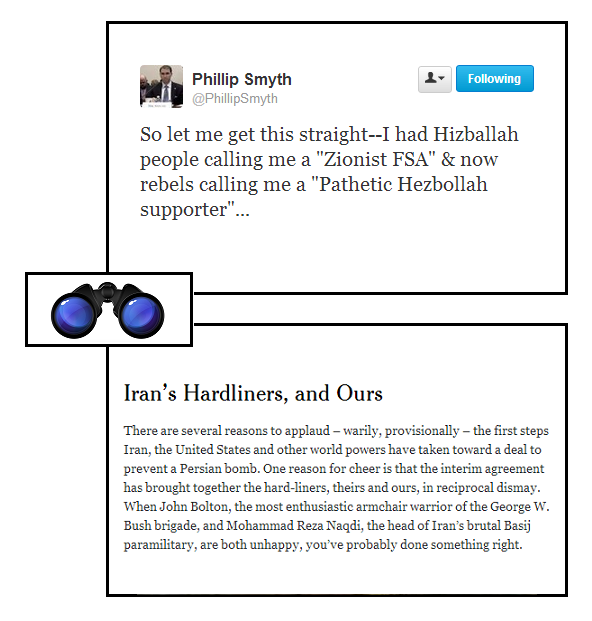
I’m thinking of the simple, three-player version of the children’s game called Piggy in the Middle. Two plays face each other and toss a ball back and forth, while a third player standing between them attempts to intercept the ball in passing. In the case below (upper panel), Phillip Smyth is “piggy in the middle”.

I’m suggesting there’s a pattern here that’s worth watching for. Bill Keller, opining in the NYT under the title Iran’s Hardliners, and Ours (lower panel, above), thinks that if you’re piggy in the middle, “you’ve probably done something right.”

That’s a thought that might have comforted my childhood, though I don’t think it’s true in an “always applicable” sense. I do think it suggests that both sides in a fierce argument may often have something to be said for them, and that a skillful negotiator will be one who can “hear the truth” in both sides and winnow them out of the turmoil as the basis for a rapprochement

And BTW, it’s clearly a lot more work being “piggy in the middle” that either of the two other players — for one thing, you’re constantly forced to spin around to catch a ball you just missed, as it whistles by in the opposite direction to the one it was going in when you just missed it. Blessed are the peacemakers.

**

Wikipedia’s entry on Piggy in the Middle is titled Keep Away. As of this writing, it contains what is undoubtedly my current favorite comment on any game in the entire literature of play up to this point in time:

The game has a worldwide use of playing; mostly in many countries.

That’s good to know, and or maybe not.

Leap Worlds: my 3QD attempt

December 11th, 2013

[ by Charles Cameron — another runup to the glass bead game ]
.

Below you can read my submission to the wonderful 3 Quarks Daily “web aggregator” site as a candidate to join their regular Monday blogging team — it didn’t even make their “close but no cigar” list, but I wrote it and I like it, so I’m posting it here.
.
___________________________________________________________________________________________________
.

They are both fine American authors, stylists of high repute yet little known, Annie Dillard and Haniel Long, but I hadn’t associated the two of them particularly closely until that day. I’d snarfed up a copy of Long’s Letter to Saint Augustine from the dollar box at Pasadena’s magnificent Archives theological bookstore, and on my way home to nearby Eagle Rock, stumbled on a passage that seemed hazily familiar.

My friend Jens Jensen, who is an ornithologist, tells me that when he was a boy in Denmark he caught a big carp embedded in which, across the spinal vertebrae, were the talons of an osprey. Apparently years before, the fish hawk had dived for its prey, but had misjudged its size. The carp was too heavy for it to lift up out of the water, and so after a struggle the bird of prey was pulled under and drowned. The fish then lived as best it could with the great bird clamped to it, till time disintegrated the carcass, and freed it, all but the bony structure of the talon.

By the time I arrived back at my books, I knew it was Annie Dillard I’d been reminded of, and a quick, no, excited but fumbling search turned up this passage from her Teaching a Stone to Talk:

And once, says Ernest Seton Thompson–once, a man shot an eagle out of the sky. He examined the eagle and found the dry skull of a weasel fixed by the jaws to his throat. The supposition is that the eagle had pounced on the weasel and the weasel swiveled and bit as instinct taught him, tooth to neck, and nearly won. I would like to have seen that eagle from the air a few weeks or months before he was shot: was the whole weasel still attached to his feathered throat, a fur pendant? Or did the eagle eat what he could reach, gutting the living weasel with his talons before his breast, bending his beak, cleaning the beautiful airborne bones?

They’re emblematic, those two quotes, the way I see them: emblematic in the sense that each could be the basis for a heraldic shield, the eagle stooping to carry off the weasel, air creature triumphant over creature of earth in the one, the fish dragging the bird down in the other — creature of water gathering the air creature into its own fatal realm.

Emblematic too, I see them, of the possibility of a rhyme between thoughts — and I have quoted them as such in previous essays, alongside rhymes of sound and rhymes of meaning, womb and tomb being the classic examples of choice, but also rhymes of image, the fan rotors and helicopter rotors in the opening sequences of Coppola‘s Apocalypse Now, rhymes of melody in counterpoint, in fugue… and rhymes, yes, in history, as when Sir Frederick Stanley Maude told the people of Baghdad in 1917, “Our armies do not come into your cities and lands as conquerors or enemies, but as liberators…” and Donald Rumsfeld chimed in, telling his own troops in that same weary city, almost a century later, “Unlike many armies in the world, you came not to conquer, not to occupy, but to liberate and the Iraqi people know this.”

Oh yeah?

**

The world is woven, Jung tells us in one of his most original and illuminating insights, of woof and warp, causaland acausal principles , it is at once at every point synchronic and diachronic.

Moving through time, we have the causal, diachronic principle, one things leads to another: let us sort and analyze the actions of one thing on another until psychology becomes sociology, sociology turns into evolutionary biology, biology into genetics, genetics a form of chemistry that is essentially physics — and physics, at the quark-level at last, a matter of statistics, mathematics unfettered even by the dualism of wave and particle.

Let me be clear about this. I do not begrudge Higgs his boson or his Nobel, nor Chandrasekhar his Nobel or his limit. But both men followed the warp, the causal, time-bound length-wise threads of discovery to their fraying edges. And the causal threading of events, time’s warp in our lived universe, is the mode best suited to quantity, to the determinable, and knows little of mystery unless magnitude alone — the infinities of astronomy, the infinitessimals of subatomics, alone will qualify.

Oh, scale is a marvel, true enough — but it is quality, not quantity, where the mystery and the greater meaning resides.

**

And so we come to the mind’s other faculty, the other manner in which the world is woven, the manner of rhyme and repetition, synchronicities and semblances, of patterns recognized within and across disciplines. The cross-weave.

This has been the step-child of cognition for too long — but with the rise of cybernetics, feedback loops, complexity theory, network thinking and multi-causality, we can no longer think only in linear progressions, but must also cultivate associative, lateral, sideways thinking — in short, creative leaps.

Creative leaps occur when we recognize commonalities across conceptual distances — theme and variations, as musicians would say, rhymes in the nature of things, multiple perspectives and voices in counterpoint. So the nature of our current world, in all its complexity and variegation, calls for what I would call a music of ideas.

I’m not the first to have this idea, Glenn Gould was pursuing it in his work for radio, blending the many voices and conversations in a train compartment, or at the different tables in a truck-stop café, to form an interwoven whole that comprehended all of its voices, all of its parts in a greater music. But it is Edward Said — another musicians, when he was not occupied with Israeli-Palestinian politics or literature — who observed in an essay in Power, Politics and Culture, p. 447:

When you think about it, when you think about Jew and Palestinian not separately, but as part of a symphony, there is something magnificently imposing about it. A very rich, also very tragic, also in many ways desperate history of extremes — opposites in the Hegelian sense — that is yet to receive its due. So what you are faced with is a kind of sublime grandeur of a series of tragedies, of losses, of sacrifices, of pain that would take the brain of a Bach to figure out. It would require the imagination of someone like Edmund Burke to fathom.

So that’s the symphonic scope of the thing, seeing the whole with all its fractures and dissonances as a music — a music that calls for harmonization, but remains in complex counterpoint.

**

Hermann Hesse was the first great proponent of the music of ideas, at least in modern western times, and his glass bead game — evoked but never defined in his Nobel-winning novel of that name — offers us a glimpse both of the nature of moves and of the possible grandeur of an implicit world-architecture, formed of resonances and semblances, rather than of causes and effects.

Hesse gives us an insight into how the game is played at the level of moves and themes when he says a given game might have explored “the rhythmic structure of Julius Caesar’s Latin and discovered the most striking congruences with the results of well-known studies of the intervals in Byzantine hymns” — but he could hardly have known, back in the 1940s, that in 1978 the University of Wisconsin Press would publish Jane-Marie Luecke OSB’s monograph, Measuring Old English Rhythm: an Application of the Principles of Gregorian Chant Rhythm to the Meter of Beowulf. Intentionally or unintentionally, his game is played by all whose minds play with meanings. And there’s a game move right there, in the conviviality between the fictional move of Hesse himself, and the monograph, years later, of a Benedictine nun.

Tiny, you say, a tiny move — but a move in what Hesse termed the “hundred-gated Cathedral of Mind.”

And the scope of that cathedral, in its gradual entirety, is vast — encompassing all the vast quantities of the sciences, with the qualitative depths and heights of the arts and humanities too:

The Glass Bead Game is thus a mode of playing with the total contents and values of our culture; it plays with them as, say, in the great age of the arts a painter might have played with the colors on his palette. All the insights, noble thoughts, and works of art that the human race has produced in its creative eras, all that subsequent periods of scholarly study have reduced to concepts and converted into intellectual values the Glass Bead Game player plays like the organist on an organ. And this organ has attained an almost unimaginable perfection; its manuals and pedals range over the entire intellectual cosmos; its stops are almost beyond number. Theoretically this instrument is capable of reproducing in the Game the entire intellectual content of the universe.

We are drawing close, in a humanly possible way and without making any predications of the being or non-being of such a supposed entity, to the very mind of god.

**

And with immediate real world application, as when Maxwell sees the commonality between electricity and magnetism, Kekulé the serpent-biting-it’s-tail like form of the benzene ring — or Taniyama‘s 1955 “surmise” as Barry Mazur puts it, that “every elliptic equation is associated with a modular form” — an insight that was to bear rich fruit forty years later, in Andrew Wiles‘ proof of Fermat’s Last Theorem.

Hesse’s vision of the game was lucid, elegant, intellectual — but lacked real world application. Viewed as a method of scoring the music of ideas, it offers illuminations from the most abstract and theoretical of mathematics to the most complex of opposed political intrangencies — from Tamiyama to Edward Said, and from Christopher Alexander‘s Pattern Language to John Holland‘s “genetic algorithms“. Alexander and Holland each indicate their debt to Hesse’s fictional game in their own respective works.

How, then, to notate this game, these moves that leap side-wise, pattern-wise, semblance-wise across boundaries and boxes, limitations and disciplines — for it is these leaps, as Arthur Koestler notes in his The Act of Creation, that give us the surprised aha! of discovery, the unexpected ha! of laughter, the gut-wrenching wail aiiyeee! when tragedy strikes.

My own inclinations favor play — solo or with a friend — at a coffee house, with pencil and paper napkin, with a small graph for a board, ideas played at its nodes, connections and resonances represented by its edges. I’m thinking of network mapping on a human scale, between seven and a dozen nodes, each one rich in meaning, anecdote, quote, statistic, image, snatch of song…

But the essence is the single move, the single resemblance. And for this I have a form which I would like to offer you, downloadable, for your own experiments:
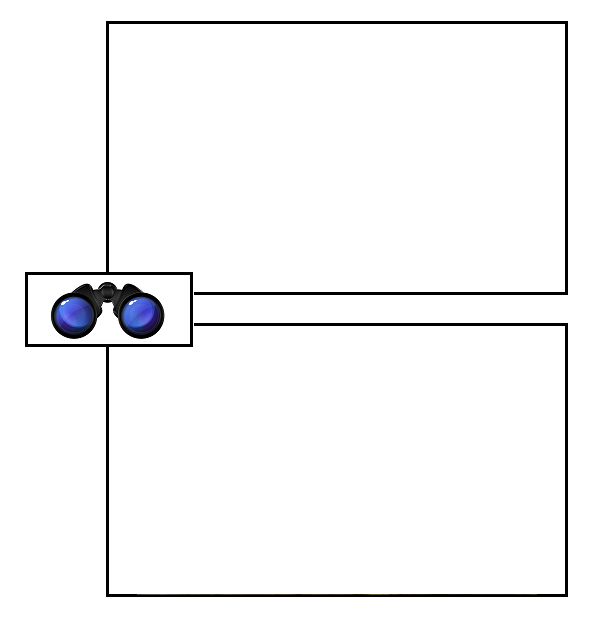
Download the image and fill the two spaces with what you will — whatever you can sketch, whistle, count out or scribble —

I think you’ll find the greatest reward comes when the two ideas, visuals, verbals, aurals you juxtapose are closely related yet drawn from distantly separated regions of thought.

At their best, such juxtapositions cross galaxies. My own most cherished example to date compares a night sky by Van Gogh with a von Kármán diagram of turbulent flow…

**

And where does this lead us? What becomes of CP Snow‘s famed Two Cultures?

Two great rows of pillars in Hesse’s hundred-gated cathedral, perhaps — best appreciated when one looks up, and sees the great vaulted roof, the magnificence of the arches between them.

In future Monday columns here on 3QD, I hope to bring you some further moves in the great game of correspondences, weaving together topics that have caught my attention in the preceding month — now in poetry, now on the morning news.

The leaps.

___________________________________________________________________________________________________
I’m happy to report that friend Bill Benzon made the 3 Quarks Daily cut and will be blogging there, and that friend Omar Ali is already one of their regulars.


Switch to our mobile site
