zenpundit.com

Raqqa, Syria: the Stations of the Cross

September 28th, 2013

[ by Charles Cameron — a small devotional exercise for our sometimes too-secular world ]
.

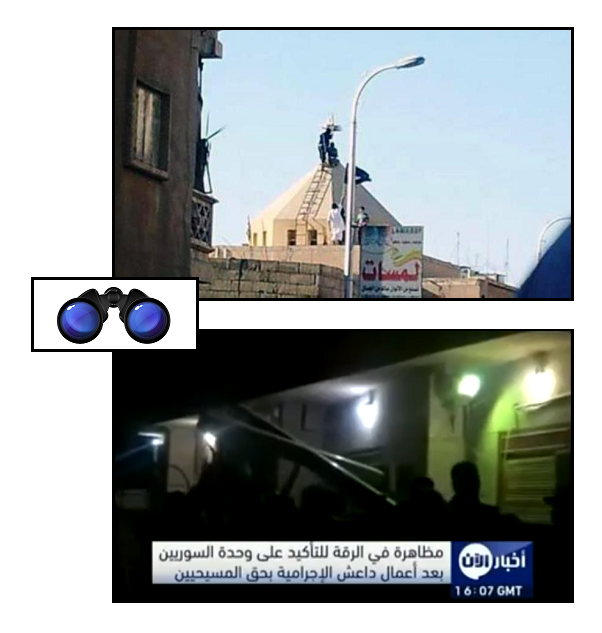
In the upper image of the pair above, a crowd in Raqqa, Syria, is protesting the desecration of a church by Islamist enthusiasts who had pulled down the cross atop a church. The people of Raqaa took to the streets in protest, chanting:

Syria belongs to Muslims & Christians.

The Roman Catholic devotion known as the Stations of the Cross involves a prayerful mini-pilgrimage around fourteen “stations” representing stages in the passion and crucifixion of Christ — each of which is traditionally marked with an image of the “station” in question. In the case illustrated in the lower panel above, the station is that of Simon of Cyrene, who was pressganged into bearing the weight of the cross on his shoulders for part of the way, to give the agonized Christ some relief.

The good people of Raqqa are thus enacting, informally, with courage and grace, the Station in which Simon of Cyrene is made to bear the cross. And there’s an echo here, too, of Christ’s injunction recorded at Luke 9.23:

And he said to them all, If any man will come after me, let him deny himself, and take up his cross daily, and follow me.

There’s a spontaneous beauty that crosses the lines between two world religions — and secularism — in all this.

**

But the cross itself also suffers its indignities, and thus the two images of the pair that follows can also be considered Stations of the Cross.

In the upper image (below), the cross is removed by State of Iraq and al-Sham militants from its proper station atop the church, to be replaced with their black banner one of their number is holding, while in the lower image we see another screen cap of the townspeople, who have retrieved the cross and are carrying it through the streets to safety:

The people are chanting:

Syria belongs to Muslims & Christians.

DoubleQuoting ReTweets

September 28th, 2013

[ by Charles Cameron — of tweets, and telephones, and terminal points with teletype equipment ]
.

The White House RTs Rouhani, Rouhani RTs State.

Is this a “sign of the times”?

Was any bookmaker offering odds on this happening?

**

Would I have been excited enough to want to write it up if I’d just found out, fifty years ago, that the White House had a “red telephone” that connected directly to the Kremlin?

I doubt it — but this article from the Smithsonian, There Never Was Such a Thing as a Red Phone in the White House informs us that it wasn’t a question of telephones either — it was…

two terminal points with teletype equipment, a full-time duplex wire telegraph circuit and a full-time radiotelegraph circuit.

Now — why am I feeling just a tad saddened by that tidbit of lifelong learning?

Teju Cole on Nairobi: death and birdsong, death and poetry

September 26th, 2013

[ by Charles Cameron — on the topic of Nairobi there’s the news — and then there’s Teju Cole ]
.

Teju Cole, left, Kofi Awoonor, right -- photo credits Teju Cole & Peace FM Online respectively

**

We’re interested in creativity as well as natsec issues here at Zenpundit, so i thought it might be appropriate to see what a fine writer had to say about the hideous attack and siege of the Westgate mall in Nairobi — and perhaps more importantly, how he chooses to say it.

Teju Cole is a writer (“award winning” and rightly so) whose insightful and skilfully deployed tweets caught my attention some while back, and have only increased my admiration for him over time. I followed his twitterstream along with others while the events in Nairobi were playing out, and today read his New Yorker blog post covering much the same ground in greater detail.

What is striking to me about Cole’s approach — the approach of a fine writer, in Nairobi at the time, a friend and admirer of the Ghanaian poet Kofi Awoonor who died at the mall — is the care he takes to balance death with birdsong, death with poetry. In treating matters this way — and we can be sure he is every bit as deliberate in his use of 140 characters as he is in longer-form writings — he both gives a world of context to the small world of the mall event itself, and offers us hope to balance our despair and disgust.

Cole is reading from his novel Open City at the National Museum at the time the attack on the mall begins:

During the reading, as word of the attack filtered in, people answered their phones and checked their messages, but, onstage and oblivious, I continued taking questions from the audience

**

Here, then, I have pulled together most of the tweets Cole posted in recent days for your consideration, in the order in which he posted them… Together, they offer us a very different way to encounter tragic events from those presented by journalists or analysts.

.
Nature has entered the picture: next up will be death — the death of his poet colleague and friend, described first obliquely in the poet’s own words:

.
Then comes the first of two tweets in which Cole judiciously balances the tragically human and blithely natural worlds, including in his tweet a short soundscape in which those voices are woven together in counterpoint:

.

This one is grim — suitable, or a bit overstated, with its echo of the Holocaust? — a question best left to individual taste, perhaps:

.
And then his second polyphonic melding of sounds natural and human-made, joyous and terrifying:

.
He returns to his friend’s death…

.
And then again to birdsong, to the natural world, to the world in which the events of the past days are framed…

**

There is something powerfully moving about Cole’s tweeted reflections, and I believe they take their impact from the precision with which Cole himself frames and balances the horror with beauty.

Just today, my friend Jessie Daniels posted a tweet that caught my eye:

Teju Cole has gone from a tweet to a blog post on the New Yorker site in a matter of days. Here’s just a brief taster:

The massacre did not end neatly. It became a siege. In my hotel room, about half a mile from the mall, I was woken in the mornings that followed by the sounds of gunfire, heavy artillery, attack helicopters, and military planes. In counterpoint to these frightening sounds were others: incessant birdsong outside my window, the laughter of children from the daycare next door. I read Awoonor’s poems, and watched a column of black smoke rise from the mall in the distance. The poems’ uncanny prophetic force became inescapable. A section of “Hymn to My Dumb Earth” reads:

What has not happened before?
An animal has caught me,
it has me in its claws
Someone, someone, save
Save me, someone,
for I die.

.
But you should really read the whole thing: Letter from Nairobi: “I will say it before death comes”.

Vlahos: Forty years of the Fighter Mafia

September 25th, 2013

[by Mark Safranski a.k.a “zen”]

Kelly Vlahos, the often sharp-penned defense columnist at The American Conservative, has written an excellent tribute to Colonel John Boyd and his Acolytes:

40 years of the Fighter Mafia

….Boyd and Christie started the group on a very small scale in Florida, fueled more by beer and frivolity than anything else. Things got serious when Boyd and later Christie were brought to work at the Pentagon. They met Pierre Sprey, a self-described “subversive” in the Office of the Secretary of Defense, then occupied by Robert McNamara. Sprey was one of the “whiz kids,” but he believed the Air Force was doing everything wrong in Vietnam. He was an early proponent of close air support, which led to the development of the A-10 Thunderbolt II “Warthog.”

“We were bureaucratic guerrilla warriors, fighting the system and deploying whatever underground means we could use,” including whistleblowing, leaking, and “suborning” members of Congress, Sprey says, half-joking.

“John Boyd came in as a maverick,” Sprey recalled. Initially, Boyd was brought to the Pentagon in the 1960s by a general who disliked Sprey’s ideas on close air support and was pulling together a group of eggheads to “disgrace” him. When the general left Boyd alone in the room with Sprey they “became fast friends, co-conspirators.” The rest is history.

By the time the group held its first Washington meeting in 1973, Sprey, Boyd, Christie, and test pilot Col. Everest Riccioni had designed the concept that was directly implemented as the F-15 and F-16 fighter programs—which have served as the core of American air power for the past 40 years. The group came to be known as the “Fighter Mafia” and expanded their circle to include other like-minded individuals with the same goals for reforming programs and building better weapons systems for the military.

“I’m proud of what we achieved, but it was only a drop in the bucket” relative to the massive size of the Pentagon’s budget and operations, says Sprey. “At least we got a few things done.”

Today, he adds, “we’re a network of subversives trying to cut the defense budget and campaigning against things that don’t work.”

Nice piece.  Read the rest here.

Addendum:

This would also be a good time to remind everyone that the Boyd & Beyond 2013 conference will be at Quantico on October 11th and 12th.  It’s free, but you must RSVP Scott Shipman or Colonel Stan Coerr. 

Serpent logics: simple incongruities

September 25th, 2013

[ by Charles Cameron — religious law enforcement, therapy incarcerated, and a quick blast of Johnny Cash ]
.

**

As you know, I collect instances of various patterns I see recurring in my twitterstream and elsewhere — here, I’d like to introduce a new pattern that I’ll simply call “simple incongruities”.

My first example, which I ran across several days ago, was this one from Saudi Arabia:

From the [Lebanese] Daily Star news report:

A Saudi motorist died and a passenger was injured on Tuesday when a religious police vehicle crashed into their car during a hot pursuit in Riyadh, a newspaper reported. A patrol of the notorious police, known unofficially as Mutawaa, chased two young men travelling in a sedan before crashing into their vehicle, forcing it off an overpass and onto a lower-level road, Al-Hayat daily said. The patrol vehicle fled the scene instantly, the daily said. “We pray to Allah to forgive the dead,” said Mohammed al-Shraimi, assistant spokesman of the Commission for the Promotion of Virtue and Prevention of Vice, the official name of the Mutawaa.

**

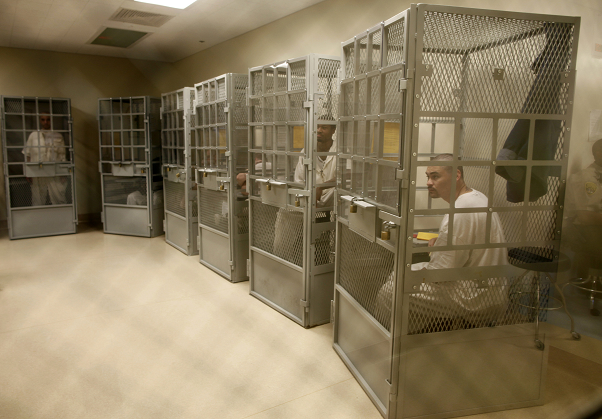
It’s my second example — from nearer home — which I only ran across today that inspired me to make a separate post about these incongruities. The image of caged prisoners in a group therapy session at San Quentin (see above) was just too remarkable for me to pass over. The tweet that brought it to my attention is below:

Here’s a comment from Johnny Cash — to give you added San Quentin context:


Switch to our mobile site