zenpundit.com

On eating one’s enemy

May 18th, 2013

[ by Charles Cameron — not good branding, not Islamic, dumbstruck? — not a whole lot else to say ]
.
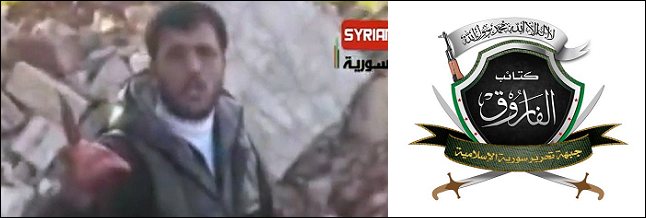
Commander Abu Sakkar / the Farouq Brigades logo


Let’s take the bald facts first:

Commander Abu Sakkar of the Farouq Brigades, Free Syrian Army, had himself videotaped this month cutting open and seeming to eat the flesh of a just-killed Syrian soldier loyal to President Assad — to send a message. According to a New York Times “Lede” blog-post, he preceded this act with the words:

I swear to God, soldiers of Bashar, you dogs — we will eat your heart and livers! … God is great! Oh, my heroes of Baba Amr, you slaughter the Alawites and take their hearts out to eat them!

His rhetoric as reported speaks of eating the heart: in the event, it is a portion of lungs that he eats, or mimics eating.

**

This has to be seen in many contexts — one of them, the branding of the Syrian rebels in general and the Farouq Brigades in particular.

This is taken from an article a couple of weeks ago on a WSJ blog titled For Some Syrian Rebels, It’s a Battle of the Brands:

Twelve activists in an office in Reyhanli, Turkey near the border run Farouk’s Facebook page, web site, and Twitter account. They’re working on the TV channel, which Mr. Awad says they’ve envisioned as a tool to resocialize fighters off the battlefield.

“The regime will fall one day,” he says. “We have 20,000 fighters–they all won’t stay fighters. They will put down their weapons, and need to integrate into the world. TV, radio, these things will help.”

The media office’s latest brand offering? A three-dimensional version of the Farouk logo, which will be used in videos and other online material.

“The guys complained the logo wasn’t nice enough,” Mr. Awad said, laughing. “They wanted a 3D one.”

**

Moralizing about someone eating the flesh of a deceased enemy is pretty easy to pull off — unless one still thinks it’s a potent way to acquire one’s enemy’s courage, which is now something of a curiosity in the anthropologist’s cabinet of concepts. Here, dug up from the section on Homeopathic Magic of a Flesh Diet in Sir JG Frazer‘s 1922 edition of The Golden Bough, now long out-dated, is the picture as it used to be seen:

When Basutos of the mountains have killed a very brave foe, they immediately cut out his heart and eat it, because this is supposed to give them his courage and strength in battle. When Sir Charles M’Carthy was killed by the Ashantees in 1824, it is said that his heart was devoured by the chiefs of the Ashantee army, who hoped by this means to imbibe his courage. His flesh was dried and parcelled out among the lower officers for the same purpose, and his bones were long kept at Coomassie as national fetishes. The Nauras Indians of New Granada ate the hearts of Spaniards when they had the opportunity, hoping thereby to make themselves as dauntless as the dreaded Castilian chivalry.

Even as a cannibal delicacy, the white man’s heart seemed to have special virtue! As I say, though — that’s all a little out of date.

**

Eating one’s enemy, however, is a distinctly un-Islamic behavior, whatever century we’re in. One early Islamic narrative concerns Hind bint ‘Utbah avenging deaths in her own family by eating the heart of a great Muslim warrior, dear to the Prophet — far from being an example of what is permitted in Islam, she’s an example of what Muhammad was up against by way of enemies in the early days of his preaching:

Hind Bint `Utbah, the wife of Abu Sufyaan, ordered Wahshiy to bring her Hamzah’s liver, and he responded to her savage desire. When he returned to her, he delivered the liver to her with his right hand, while taking the necklaces with the left as a reward for the accomplished task. Hind, whose father had been killed in the Battle of Badr and whose husband was the leader of the polytheist army, chewed Hamzah’s liver hoping to relieve her heart, but the liver was too tough for her teeth so she spat it out and stood up shouting her poem:

                    For Badr we’ve paid you better
                    In a war more flaring than the other.
                    I was not patient to revenge the murder of
                    `Utbah, my son, and my brother.
                    My vow’s fulfilled, my heart’s relieved forever.

Hind did eventually become a Muslim — but on account of this very event, was never fully included among “the Companions of the Prophet”.

**

I don’t want to moralize over Commander Abu Sakkar‘s act, not having been in his shoes — but it is vile under pretty much any moral standard you might choose. A problem arises, though, when one attempts to use it to justify one side or another, in a conflict in which brutality of one kind or another seems to be present on both sides. As Sakkar himself told a Time correspondent:

You are not seeing what we are seeing, and you are not living what we are living. Where are my brothers, my friends, the girls of my neighborhood who were raped?

**

Peter Bouckaert of Human Rights Watch is quoted giving another kind of context to the affair:

Abu Sakkar is just one man, and there are many other armed fighters in Syria who reject such sectarian actions and would be horrified by the mutilation and desecration of a corpse — let alone an act of cannibalism. But he is a commander in a decisive battle in Syria — hardly a marginal figure.

**

Not without reason did Kurtz whisper at the end of Joseph Conrad‘s Heart of Darkness, as in Francis Ford Coppola‘s Apocalypse Now:

The horror! The horror!

Are Insurgencies “Antifragile”?

May 16th, 2013

I have been reading Nassim Nicholas Taleb’s latest book,  Antifragile . It’s a highly intriguing book and I will give it a full review soon, but Taleb’s core concept of antifragility is important  and lends itself to wide application. Here’s Taleb on what constitutes “antifragility” – things that gain or improve with disorder – which he was careful to distinguish not just from “fragility” but also from “robustness” and “resilience”:

Almost all people answer that the opposite of “fragile” is “robust”, “resilient” , “solid”, or something of the sort. But the resilient, robust (and company) are items that neither break nor
improve, so you would not need to write anything on them – have you ever seen a package with
“robust” stamped on it? Logically, the exact opposite of a “fragile” parcel would be a package on which one has written “please mishandle” or “please handle carelessly”. It’s contents would not just be unbreakable, but would benefit from shocks and a wide array of trauma. The fragile is the package that would be at best unharmed, the robust would at best and at worst unharmed. And the opposite of fragile is therefore what is at worst unharmed. [31]

Italics in original.

Taleb uses a number of metaphors – the Phoenix, the Hydra – as well as examples to get across the point that an antifragile entity overcompensates in reaction to stress/damage/disorder by becoming better, growing stronger, more powerful, adaptively improving itself. Think of the effects of weight training in building muscle or a wildfire spurring bountiful growth in an ecosystem. There’s more to Antifragile than this but the gist is sufficient for now.

Which brings me to the question, “Are insurgencies antifragile?”

The study of insurgency, terrorism and revolution, while important and useful tend to suffer from several drawbacks. One is compartmentalization and academic specialization. As Robert Bunker pointed out in Narcos Over the Border,  a problem like “criminal-insurgency” attracts very different reactions from Law enforcement, intelligence analysts, the military, counter-terrorism officials and other experts (to say nothing of politicians) which makes consensus over a common analytic framework very difficult. Sometimes even defining the problem across domains is frustrating. As a result, many studies are too narrow and the few admirably ambitiously broad ones are deeply stamped in the political lens of the era in which they were researched and written – i.e. imperialist Small Wars, the Cold War, the War on Terror, Pop-centric COIN of Iraq and Afghanistan wars etc.  It is a subject that requires both more (and more intellectually creative) scholarship and a greater degree of synthesis.

In the meantime, I’d like to offer some speculation in an effort to answer the question:

  • The characteristics of “antifragility” in terms of at least some kinds of insurgency bears a striking resemblance to that of “wicked problems“, which has also been used to categorize some enduring irregular conflicts. Particularly in the sense of not having natural stopping points , manifesting complex interdependencies and resistance to simple, silver bullet solutions that could destroy it.
  • Moreover, most successful insurgencies are not, contrary to Maoist theory, autochthonous  – they draw many resources from external sources – black globalization, foreign patrons, legitimate trade, fundraising – and from the very state waging counterinsurgency warfare against them. The Afghan Taliban would be a much poorer military force without the vast amount of American aid passing through the hands of Pakistan and the Karzai regime
  • An insurgency’s claim to being “antifragile” may rest as much or more upon the general political and socioeconomic environment being relatively chaotic than on the nature of the insurgent organization itself.  The Chinese, Russian and Lebanese civil wars, Mexico’s narco-insurgency, West Africa and Afghanistan in the 1990’s, the Congo basinand Iraq in the 2000’s all had polycentric and disorderly environments that allowed  irregular groups to rapidly rise and fall on a local and regional basis. By contrast, “bilateral” insurgency vs. state dynamics can stabilize conflict for decades
  • An insurgent organization may lose antifragility as it restructures itself over time to become either more robust (ex. –Hezbollah) subnational entity or to accept greater fragility in order to acquire state-like hierarchical advantages ( political discipline and specialization). Note that “fragile” does not mean “weak”, it means “vulnerable”. States can be very strong and concentrating massive amounts of resources and coercive force, yet be strangely vulnerable to internal coups, popular uprisings, economic collapse, strategic myopia or even natural disasters. One of the great dangers today are complex systems that combine epic power with extreme fragility – small disruptions by irregulars yield huge ROIs.
  • States might be able to seek a strategic advantage over insurgencies by improving their robustness and smother the relatively ineffectual kinetic attacks of guerrillas or terrorists with inertia, refusing to “feed” the growth of an antifragile insurgent opponent, starving them of material resources and political oxygen. India has trucked along with something like seventeen ongoing insurgencies and episodic acts of major terrorism for decades without the Indian state remotely being in jeopardy of being overthrown by, say, the Naxalites, Sikh extremists or Kashmiri Islamists. Compare that with the rapid collapse or retreat of the state in places like Somalia, Yemen, Libya, Mali, Syria and so on.
  • The effects of globalization and information technology, the ability to have  John Robb’sopen source” decentralized, fast-evolving, insurgencies, give an an impetus to insurgencies becoming antifragile. At a minimum, it improves the odds.
Comments welcomed

Thinking outside the cocoon…

May 16th, 2013

[ by Charles Cameron — on caterpillars, butterflies, psyche and the alephs of Georg Cantor, with a glance at the vertiginous idea it might be “boxes all the way up and down”… ]
.

Let’s get the science — which is quite fascinating — taken care of first. Here’s our best current visualization of how a caterpillar, after crafting its cocoon, prepares to become a butterfly:

**

Words can sometimes tell us some things that images can’t — or explain things to parts of us that simply cannot comprehend them visually — so here for parallel processing is an account of part of the same business from Scientific American:

How does a caterpillar rearrange itself into a butterfly? What happens inside a chrysalis or cocoon?

First, the caterpillar digests itself, releasing enzymes to dissolve all of its tissues. If you were to cut open a cocoon or chrysalis at just the right time, caterpillar soup would ooze out. But the contents of the pupa are not entirely an amorphous mess. Certain highly organized groups of cells known as imaginal discs survive the digestive process. Before hatching, when a caterpillar is still developing inside its egg, it grows an imaginal disc for each of the adult body parts it will need as a mature butterfly or moth—discs for its eyes, for its wings, its legs and so on. In some species, these imaginal discs remain dormant throughout the caterpillar’s life; in other species, the discs begin to take the shape of adult body parts even before the caterpillar forms a chrysalis or cocoon. Some caterpillars walk around with tiny rudimentary wings tucked inside their bodies, though you would never know it by looking at them.

Once a caterpillar has disintegrated all of its tissues except for the imaginal discs, those discs use the protein-rich soup all around them to fuel the rapid cell division required to form the wings, antennae, legs, eyes, genitals and all the other features of an adult butterfly or moth.

**

It’s just possible that the bear’s ability to “die” in the winter and “be reborn” in spring gave use the original cirumpolar bear cult — and more generally, a propensity to believe that resurrection from the dead might be a physical, existential human possibility.

Humans watch animals pretty diligently — my old friend and mentor Wallace Black Elk once told me:

We watch the deer, and when they’re sick they know which plant is their aspirin: they eat that green medicine, and drink water. So we have deer medicine. We don’t need the mass-produced kind.

I don’t have the exact quote, but he also observed somewhat wryly that scouts from pharmaceutical companies used to watch him and see what medicines he used, in much the same way…

And if there’s any natural process that humans have watched with equivalent metaphysical interest to that which they may have shown in observing the bear’s pattern of hibernation and return, it would have been the process of metamorphosis in butterflies — whose name in Greek, psyche, is also the word for soul.

**

WB Yeats had a sense of the butterfly transcending both day-to-day human logic and death itself, when he wrote in his poem Tom O’Roughley:

‘Though logic choppers rule the town,
And every man and maid and boy
Has marked a distant object down,
An aimless joy is a pure joy,’
Or so did Tom O’Roughley say
That saw the surges running by,
‘And wisdom is a butterfly
And not a gloomy bird of prey.

adding just a few lines later:

What’s dying but a second wind?

**

What I’d like to do here is to take us from the plodding science of linear thought to which Yeats was (among other forms of linearity) objecting, towards the science — and poetry — of complexity, of nuance.

And I’d like to do it by skipping a couple of thoughts like a stone across water, inviting you to watch the ripples…

These are the leaps that connect the dots.. the creative leaps. And some leaps, it seems to me, are bigger and more demanding than others.

**

Is the leap from cocoon to butterfly in Hutching‘s quote really quite a huge leap? It certainly keeps some of our best scientists busy uncovering its hidden secrets. And the leap from butterfly to tornado, that Lorenz made? That would appear to me to be a larger leap, requiring a different mode of perception. And skipping from Hutchings to Lorenz, can we skim our stone of thought even further?

Putting two and two together is one thing: imagining “aleph null” for the first time, as Cantor did, that would be something else altogether. From two to four, I’m tempted to say, is a quantitative leap, while the imaginative leap from four, ten, or ten thousand to the alephs is qualitative.

How should we recognize and connect widely separated — yet deeply entangled — dots? What would prove to be the richest and most profound of creative leaps? Is there a move that will take us not just out of this box into the box it came in — but out of a whole matrioshka nest of boxes?

Those are the questions in my sandbox about now.

**

When we next meet, I’ll try to tie them in with this diagram that Adam Elkus recently pointed us to —

and with Hermann Hesse‘s Glass Bead Game for good measure.

Of Alice, Angels and Apsaras

May 15th, 2013

[ by Charles Cameron — squeezed between the space of astronomers and the paradise of the believers, is there yet room for the dancing play of poetry, music and imagination? ]
.

My first question for you today would be — do you believe in Alice?

And further to that, do you believe in the Red Queen?

**

Two things collided to cause me to write this post today. First, Emptywheel opened her blog post on Putin’s outing of an American spy today with a quote from Lewis Carroll:

‘I declare it’s marked out just like a large chessboard!’ Alice said at last. ‘There ought to be some men moving about somewhere–and so there are!’ she added in a tone of delight, and her heart began to beat quick with excitement as she went on. ‘It’s a great huge game of chess that’s being played–all over the world -– if this is the world at all, you know. Oh, what fun it is!’

I can’t really ignore Lewis Carroll when he crops up in my morning feed like that: he’s a Christ Church man and a poet, as I am, and it would be rude of me to ignore him. And besides, what he’s on about here is the world-as-game concept, which is never far from my mind — hence my inclusion of that question about the Red Queen.

**

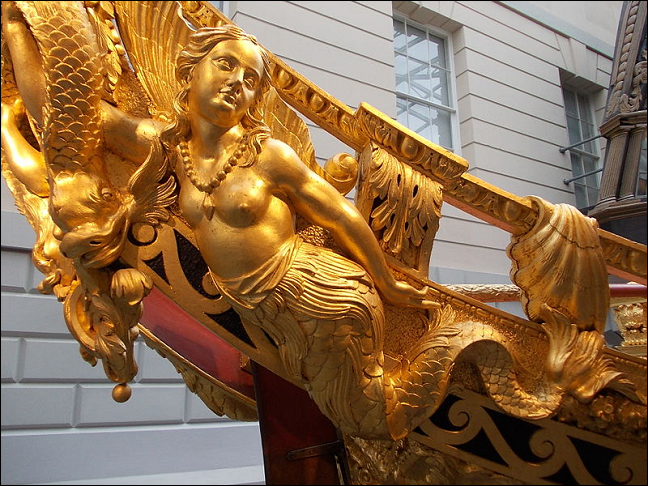
And second, mermaids.


.

It gets more interesting, you see. Because what collided with that first question was a conversation @khanserai aka Humera Khan was having with @mujaahid4life aka Abdallah via Twitter, in which the Harry Potter books were discussed and the topic of unimaginative clerical fatwas on games and works of fiction came up. At which point, Abdallah pointed us all to this now-archived fatwa regarding the permissibility of eating mermaid flesh:

Ruling on eating mermaids

A mermaid is a creature that lives in water and looks like a human. As to whether it really exists or it is a mythical being, that is subject to further discussion.

It says in a footnote in al-Mawsoo’ah al-Fiqhiyyah (5/129): From the modern academic resources that are available to us, it may be understood that the mermaid, which is called Sirène in French, is a mythical creature that is described in fairy tales as having an upper body like a woman and a lower half like a fish.

See the French Larousse encyclopédique on the word Sirène.

The encyclopaedia goes on to say: The widespread notion in ancient times was that the wonders and animals of the sea were more and greater than the wonders of dry land, and that there was no kind of animal in the sea that did not have a counterpart on land. This was confirmed by Prof. Muhammad Fareed Wajdi in his encyclopaedia, quoting from modern academic sources. See: Daa’irah Ma’aarif al-Qarn al-‘Ishreen: Bahr – Hayawiyan. End quote.

Al-Dumayri said in Hayaat al-Haywaan al-Kubra: Mermaid: it resembles a human but it has a tail. Al-Qazweeni said: Someone brought one of them in our time. End quote.

Many of the fuqaha’ mentioned mermaids and differed on the ruling concerning them. Some of them said that they are permissible (to eat) because of the general meaning of the evidence which says that whatever is in the sea is permissible. This is the view of the Shaafa’is and Hanbalis, and is the view of most of the Maalikis and of Ibn Hazm and others. And some of them regarded it as haraam because it is not a kind of fish. This is the view of the Hanafis and of al-Layth ibn Sa’d.

Ibn Hazm (may Allaah have mercy on him) said in al-Muhalla (6/50): As for that which lives in the water and cannot live anywhere else, it is all halaal no matter what state it is in, whether it is caught alive and then dies, or it dies in the water and then floats or does not float, whether it was killed by a sea creature or a land animal. It is all halaal to eat, whether it is the pig of the sea (i.e., a dolphin), a mermaid, or a dog of the sea (i.e., shark) and so on. It is halaal to eat, whether it was killed by an idol-worshipper, a Muslim, a kitaabi (Jew or Christian) or it was not killed by anyone.
What’s outside the box?

And it goes on… ending, mercifully:

And Allaah knows best.

Sometimes I think those might be my favorite words evvah!

**

Are mermaids real enough for religious scholarship to address them?

Is Alice?

John Daido Loori Roshi, late zen master and abbot of the Mountains and Rivers Order’s Mt Tremper abbey, once gave a teisho using a passage from Alice as his koan:

Many Zen koans contain references to myths and folktales of ancient India, China, and Japan. Since Westerners generally are not familiar with these stories, koan study without extensive background information is often a frustrating and exasperating process.

In this dharma discourse, Abbot John Daido Loori fashions a koan, complete with pointer and capping verse, from a classic of children’s literature, Lewis Carroll’s Alice in Wonderland. The koan revolves around Alice’s encounter with a caterpillar who explains the magical properties of a special two-sided mushroom that to Alice’s eyes appears perfectly round. Alice’s struggles with this dilemma make for a stimulating story that mirrors the conflicts and dualities we face in our everyday life.

You can read it here.

**

All of which brings me to the question of the place of deep imagination in a sometimes shallow world.

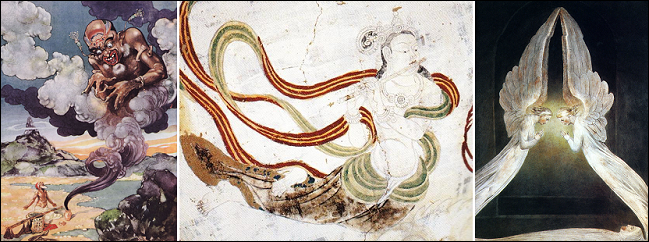
Alice, do you believe in her? Mermaids and Macbeth mean something to sailors and theater-folk, respetively. Angels? If angels, then the djinn, too? Christian scripture speaks for the existence of one, the Qur’an of both — is one more probable, more real, perhaps, than the other?

And what of the gandharvas and apsaras — middle panel — the celestial musicians and airy dancers who move to their music? Is there any poet who can claim never to have sensed them?

**

And thus we come to Robert Graves and the muse as he depicts her, in his book The White Goddess, and in many poems such as this:

In Dedication
.

Your broad, high brow is whiter than a leper’s,
Your eyes are flax-flower blue, blood-red your lips,
Your hair curls honey-colored to white hips.

All saints revile you, and all sober men
Ruled by the God Apollo’s golden mean;
Yet for me rises even in November
(Rawest of months) so cruelly new a vision,
Cerridwen, of your beatific love
I forget violence and long betrayal,
Careless of where the next bright bolt might fall.

**

But here the waters are getting deeper…

Boyd and Beyond 2013

May 14th, 2013

[by J. Scott Shipman]

Mark your calendars: Boyd and Beyond 2013 will be held at Quantico, Virginia, on 11 and 12 October 2013.

More details to follow.


Switch to our mobile site