zenpundit.com

Decapitation — Variations on a theme by Vollmann

September 24th, 2018

[ by Charles Cameron — preliminary to a rave review, i suspect, with Helena Bonham Carter as Red Queen thrown in ]
.

**

There’s an old English saying, presumably about the martyred King Charles I:

The King walked and talked half an hour after his head was cut off..

Young boys, getting acquainted with rules and grammar, and somewhat literal minded as a result, find this statement a paradox, which, however, can easily be resolved by the addition of a comma or perhaps better, a semicolon:

The King walked and talked; half an hour after his head was cut off..

Older boys quickly learn the (semicolon) reason of the riddle, and eagerly apply the first version to younger boys, the better to perplex and torment them. And thus both versions, the beauty of the paradox, the ease of its resolution, and the cruelty thus made available are transmitted across the generations..

**

I have written this because the beheading of a king clearly marked my young soul, as I was yesterday reminded by three passages from an Atlantic review of Vollmann‘s latest Opus — Magnum III at least [I, II, and let us not forget, gods I would love to read this, Kissing the Mask: Beauty, Understatement and Femininity in Japanese Noh Theater]..

Summits chopped off:

  • In West Virginia, mountains do not have their summits chopped off but are granted “removal of overburden.”
  • Decapitation:

  • His insatiable appetite for detail yields both irrelevant trivia (“Embarking on the Super Limited Hitachi Express, which was also known as the Super Hitachi 23 Limited Express”) and magisterial portraits of landscapes befouled by poking and prodding and, in the case of West Virginia’s mountains, decapitating.
  • Headless:

  • Vollmann breathes a cool wind “whose degree of particulate contamination was of course unknown,” hears on a silent street at night the grunting of a radioactive wild boar, and walks on broken glass through an abandoned clothing store advertising a 50 percent–off sale and peopled by headless mannequins.
  • Headless mannequins and radioactive wild boars — vivid metaphors, no? — we the humans have been brain-dead, and in all likelihood will continue so.

    **

    We’re all too familiar with images of ISIS executioners with their orange jump-suited prisoners, just prior to and after solo and group beheadings — as a corrective to the “it’s all Islam” narrative, here’s a para from an article titled Inside the Minds of Cartel Hitmen: Hannibal Lecters for Hire (which includes an interview with Robert Bunker that I will be taking a more extended look at now my review of JM Berger‘s new book. Extremism, is in):

    And the tactics employed in all that killing have become more and more gruesome over time. Maybe the rush felt by some murderers is like a drug itself, and they are junkies needing ever greater doses to get the same high. But how is it that ordinary people get hooked on activities like beheading, acid baths, and cannibalism?

    **

    Quoth the Red Queen: Off with their heads!

    JM Berger’s Extremism, from MIT Press. Brilliant.

    September 24th, 2018

    [ by Charles Cameron — my third JM Berger review, following reviews of Jihad Joe and ISIS: State of Terror ]
    .

    **

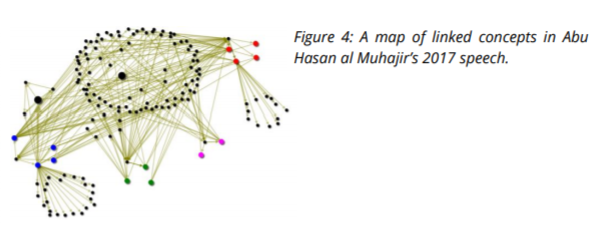
    I ordered a copy of JM Berger‘s Extremism months early from Amazon, having followed many of the posts in which he was formulating the insights that led to the book, and expecting a volume full of the very detailed diagrams and network analyses they contained:

    Image sources:

  • ICCT, Countering Islamic State Messaging Through “Linkage-Based” Analysis
  • Intelwire, EXTREMIST CONSTRUCTION OF IDENTITY
  • **

    These diagrams, and the research that underlies them — the work of JM and his colleague, Haroro J Ingram — attest to JM’s skill at the detailed drill-down level, the equivalent of rock-face drilling in a mine. The book couldn’t be further from my expectations: it attests to an entirely different set of skills, those of simplicity, grace, and a superb command of language.

    JM has the ability to communicate directly with a lay audience at their (our) level. He neither shies away from nuance nor adds needless complications — either of which would be a form of condescension to the reader.

    JM’s writing is direct and clean:

  • Terrorism is a tactic, whereas extremism is a belief system.
  • Extremism is a spectrum of beliefs, not necessarily a simple destination.
  • Group radicalization precedes individual radicalization
  • **

    Above are three of the pull-quotes, extracted from the book’s text, that state some of JM’s basic propositions on lucid, large-print, white on black pages, scattered as needed across the book’s 167 short pages (plus glossary, notes, bibliography, further reading, index)..

  • What extremism is, how extremist ideologies are constructed, and why extremism can escalate into violence
  • That’s the core proposition of the whole work, buttressed as it is with a wealth of detailed research and analysis. And radical…

    JM’s approach is already radical in its (his) refusal to treat only one ideological or religious frame for extremism. Studying both ISIS and home grown Identity groups, those who promote violence and those who arguably foreshadow it, led JM to see extremism itself as the most fruitful category to study — not terrorism, nor Islam, not the Citizen Sovereignty movement nor alt-right, but extremism tout court.

    That broadening of the frame allows Berger a set of analytic insights that were obscured by detail in earlier, more limited studies, and his book is the elegant formulation of those insights, simply, and with a forest of scholarship in support.

    **

    JM lists Impurity, Conspiracy, Dystopia, Existential threat, and Apocalypse as central “crisis narratives” utilized by in-groups as they view out-groups — but it is the in-group-out-group distinction which is central to his thinking, its wrongness characterized by the in-group’s paranoid conspiracist suspicions of the out-group’s impurity, dystopic being the nature of the world now ruled by the out-group, and to be abhorred or saved by the in-, with existential threat and apocalypse providing the sense of time-crunch, urgency.

    All this, I say, with a simplicity and elegance which belies the originality and scholarship that undergirds it.

    Above highly recommended.

    Sunday surprise — mourning, a global view

    September 23rd, 2018

    [ by Charles Cameron — starts with an anthro DoubleQuote inspired by this morning’s readings & a Steve Martin tweet — though in sensitive times it might be best not to chuckle, let alone guffaw, at strangers’ strange ways ]
    .

    One: The tearless eye of a NASA camera on the occasion of the Challenger blow-up:

    One of our reporters, who happened to be at a distant nasa base at the time, tells us that afterward a television monitor for nasa’s own internal satellite service kept on its screen a view from a camera on the beach at Cape Canaveral which had been following the spacecraft’s ascent. Now that camera simply stared searchingly out over the blue-gray sea to where it met the blue-gray sky, like a sailor’s widow gazing endlessly at the horizon. Twenty-eight years into the space age, the sea is as much a symbol of eternity as the sky. Both have swallowed up the Challenger and its crew, leaving behind a double emptiness of sea and space.

    Two: The professional Ghanaian substitute for tearless eyes:

    Here’s an account in the news:

    Ami Dokli is the leader of one of the several groups of professional mourners in Ghana. In a recent interview with BBC Africa, she said that some people cannot cry at their relatives’ funerals, so they rely on her and her team to do the wailing. Dokli and the other women in her team are all widows who, after their husbands died, decided to come together to help others give their loved-ones a proper send-off to the afterlife. But crying for strangers is not the easiest thing in the world, so professional mourners charge a fee for their services, the size of which is in direct relation to the size of the funeral. If it’s a big funeral, their tears cost more.

    And here’s an American FB version of the ad Steve Martin’s tweet captured:

    Do you want to boost your funeral? Hire me….the professional mourner to come and cry at the funeral. Below are the “Summer Special” prices:
    .
    1. Normal crying $50,
    2. Bahamian hollering $100,
    3. Crying and rolling on the ground $150,
    4. Crying and threatening to jump into the grave $200,
    5. Crying and actually jumping in the grave $1000

    That’s my DoubleQuote for the day.

    **

    A clutch of videos:

    Ghanaian Professional Wailing mourners:

    Promotional — funerala with a white lady mourner, extra:

    Ghanaian troupe of Dancing Pallbarers:

    Chinese professional mourning performer:

    N’Orleans Second Line:

    .. and including any and all interesting game language & stories ..

    September 19th, 2018

    [ by Charles Cameron — a 75-year old poker club in DC, more ]
    .

    It seems I’m moving from collecting only sport and game metaphors for politics, via sport and game metaphors more generally to sport and game language and stories — whatever catches my fancy. The paragraphs from William Finnegan, Off Diamond Head which I quoted in Storm special, surf’s up would have fit here nicely, and were my first signal, or perhaps one of my first, that my search interests might be widening.

    Lets start with A club of their own: The story of a secret poker society started by pioneering African Americans. It’s a great story of a poker club that’s been going 76 years now:

    In 1942, a group of university professors, doctors, lawyers and other black professionals in Washington wanted to get together on weekends and play poker. But they had a problem. Not only did segregation in the District bar them from joining country clubs or other social organizations where men could gather, but the president of Howard University, where many of them taught, was a religious man who did not approve of card-playing.

    So they started a monthly gathering in their homes and came up with a name to mask its true nature — the Brookland Literary and Hunting Club.

    The founding members of the club included a College president and consultant on Brown v. Board of Education, and the first black chief judge of DC’s federal court, and one of the the oldest current members at 96 — none of the founders are still with us — was a Tuskegee Airman. Over the last seventy-five years, these men have seen, and shaped, history. Their club is named the Brookland Literary and Hunting Club as code rather than abstract camouflage — “literary” because they’ve always discussed the topics of the day, from WWII via the Civil Rights movement to the present, and “hunting” because players are always hunting for a good hand when playing cards..

    Play..

    There were two tables — the big table, where hundreds of dollars exchanged hands over five-card stud, and the little table, whose participants played for coins or dollar bills and peppered the games with wild cards. Men would start at the little table and sometimes move up to the big one. As they got older and went on fixed incomes, some would move back to the little table.

    And the spirit of play:

    We’ve had great games and there’s never anybody who ran out of money, because somebody says: ‘Here, take some more. Just take it. Give it to me when you can,’

    **

    And it looks as though I can’t evade the sports and social parallelism business either. How can I resist What Serena Williams’s defeat tells us about the criminal-justice system? And how better to get at its essential than via another of today’s WaPo pieces, Yes, get consent. But be human, too.?

    After describing the two opinion camps around the kerfuffle between Serena Williams and chair umpire Carlos Ramos, the WaPo opinion writer Marc Howard, a professor of government and law at Georgetown, indicates the closeness of the parallel between tennis and social justice:

    This disagreement is about more than tennis, or even sports. It connects with a much deeper American divide about policing and criminal justice, with strong undertones connecting to race and racism.

    and later:

    Just like the criminal-justice system, tennis and many other sports depend on the subjective discretion of neutral arbiters to apply a set of supposedly objective “rules.”

    Ramos did indeed follow the code, and each of the three sanctions had some justification, thus satisfying the “rules” camp. But for two of the three violations (the racket smashing was unambiguous), he used his discretion to punish Williams for acts — coaching and heated exchanges with an umpire — that occur routinely in tennis but are seldom punished.

    So one “deeper .. divide” is about “policing and criminal justice” — but another deep divide exists between “rules” and what I’ll call “fairness” camps, following this paragraph:

    In all of these instances, one can always say, “Well, this person didn’t follow the rules,” and on an individual basis that may seem sufficient to justify the consequences. What gets lost, however, is that rules are rarely applied regularly, consistently or fairly..

    You’ll have to read the whole article to get many of the details, but the analogy between a sport and the judicial and penal systems is clear.

    How does this relate to the WaPo piece on consent in potential sexual aggression situations?

    The question there is whether, in the pithy words of a feminist writer quoted by WaPo:

    consent is just a hurdle you have to clear in order to Get The Sex

    Consent is the rulebook, and the missing ingredient when consent is the only consideration, is the human context, in the words of the same writer, the need to see our sexual partners:

    not simply as instrumental to our own pleasure but as co-equal collaborators, equally human and important, equally harmable, equally free and equally sovereign.

    I’m not sure that even that doesn’t smack a bit of the “rules” camp, but it’s certainly a strong step beyond the bare=bones “consent” rule towards an understanding of human circumstances. But the parallelism between that and the Serena Williams piece wouldn’t have struck me so forcefully without this exchange:

    “Yeah,” one, a junior, agreed. “The logic is sort of Cartesian.” (Oh, college!) “Do this, not that. Don’t break the rules ..

    That really nails it — as Lao Tzu would say:

    The rules can be codified in a rulebook aren’t the subtle rules of wisdom.

    That’s my Tao Te Ching translation #207 I know, but I think it’s apt for this occasion.

    Comments?

    Sunday surprise, the wind bloweth

    September 17th, 2018

    [ by Charles Cameron — when inspiration is in the air — Sister Rosetta and Kathleen Raine ]
    .

    Two very different artworks, each beginning with an attempt to express where inspiration comes from.

    My friend and sometime mentor Kathleen Raine‘s great poem, Invocation:

    Invocation:

    There is a poem on the way,
    There is a poem all round me,
    The poem is in the near future,
    The poem is in the upper air
    Above the foggy atmosphere
    It hovers, a spirit
    That I would make incarnate.
    Let my body sweat
    Let snakes torment my breast
    My eyes be blind, ears deaf, hands distraught
    Mouth parched, uterus cut out,
    Belly slashed, back lashed,
    Tongue slivered into thongs of leather
    Rain stones inserted in my breasts,
    Head severed,

    If only the lips may speak,
    If only the god will come.

    **

    Compare the early gospeller Sister Rosetta Tharpe‘s Music in the air:

    **

    Sister Rosetta sings, Up above my head / music in the air, and Kathleen Raine elaborates, “There is a poem all round me, / The poem is in the near future, / The poem is in the upper air”.. I could go on to describe how Kathleen’s prayer then builds, in rhythm, rhyme, and agony, her description of what she would offer in sacrifice if the divine wind should answer her prayer with a poem — the poem we are in fact reading — and there’s surely no need for me to express further the joy that Sister Rosetta’s song itself invokes and embodies

    But I would like to note that commonality between them — of the inspiration waiting, for Kathleen “in the upper air”, for Rosetta, “above my head” — and to say that “upper” and “above” here indicate a metaphorical rather than a physical dimension..

    **

    And “The wind bloweth where it listeth, and thou hearest the sound thereof, but canst not tell whence it cometh, and whither it goeth: so is every one that is born of the Spirit.”

    In this verse, the word for wind and spirit, pneuma, is also the word for breath — wind outside as part of the weather, inner wind as breath, and inspiration (literally, in-breathing) as what the inner wind carries with it — while the verb form, blow, is also related.

    Thus we may read the verse as meaning “wind blows where it wants, and nobody can tell where it comes from, or where it will go next” — or “breath breathes of its own accord, and no-one knows where it comes from or when it will cease” — or “inspiration cannot be forced, it touches down and takes off at its own pleasure, not at our command”..

    Like grace, it floats in possibility space, alighting at will, ever spontaneous, unmerited, never to be predicted.. Fortunate Sister Rosetta, fortunate Kathleen to have been visited.


    Switch to our mobile site