zenpundit.com » diplomacy

Archive for the ‘diplomacy’ Category

Announcements!

Tuesday, March 29th, 2011

A busy day for blogfriends and associates….want to draw your attention to a few highlights:

First, congratulations to Matt Armstrong of MountainRunner on his new appointment as Executive Director of the US Advisory Commission on Public Diplomacy. It’s hard to think of anyone better qualified than Matt!

There is a new Executive Director of the US Advisory Commission on Public Diplomacy

The U.S. Advisory Commission on Public Diplomacy is charged with appraising U.S. Government activities intended to understand, inform, and influence foreign publics. The Commission formulates and recommends to the President, the Secretary of State, and Members of Congress policies and programs to carry out the public diplomacy functions vested in the State Department, Broadcasting Board of Governors, and other government agencies, as well as appraising the effectiveness of the public diplomacy policies and programs carried out by government agencies.

There are seven members on the Commission, with “not more than four members may be from one political party.” In February, the White House sent to the Senate four nominations for the Commission.

Today, Matt Armstrong, author and publisher of MountainRunner.us, was sworn in as the Executive Director of the Advisory Commission. The immediate impact is the suspension of blogging, including the publishing of guest posts, at MountainRunner.us.
Secondly, Steven Pressfield has a new book out, titled Do The Work, in Kindle format and, for a limited time, it is free! One of the great things about Steve is that as an author, he gives back to his readership in myriad ways and isn’t afraid to break new ground:

A Publishing First: General Electric sponsorship for a Best Selling Author’s latest book

Never before done in the history of the publishing industry has this been done before (as far as we know, and we’ve checked) and we are so proud to be offering this phenomenal opportunity to our readership and the world.

General Electric has become our “Launch a Book” sponsor for  Do the Work, our latest release from The Domino Project.

What this means for you, the reader, is that you have access to the digital edition of this book for FREE. It won’t be free forever, so you should act now to grab your free copy. Order it here and it will be automatically delivered on pub date. You can read it on a Kindle, an iPad, an iPhone a PC and more. (If you already ordered your copy, your payment will be credited back to you…

Dr. Thomas P.M. Barnett threw some props my way for the Wikistrat futurist simulation on Turkey and managed to find a few sentences from my section that were non-abstruse and jargon-free 🙂 . The nice thing about the analytical process at Wikistrat is that people can grasp the part of the scenario where their strengths are emphasized ( I looked at possible external strategic options and impacts and left Turkish internals to those who could better drill-down):

Turkey – Re-Rise of the Ottoman Empire?

One of the most interesting things we do in Wikistrat is Scenario Planning. Through the use of live collaborative simulations, our analysts and subscribers alike engage in the mapping of scenarios, country interests and policy options on a given issue. We ran such drills on Egypt (The Egypt War Room) and on the “Sudden death of Kim Jong Il“.

Our current Simulation is on Turkey, and deals with its political and economic rise in the Middle East, its implications and potential pathways. So far several interesting scenarios were mapped, as well as interests and policy objectives for major regional and global powers affected by Turkey’s Rise.

Essentially we ask – Will Turkey’s rise continue? Will its relations with the West deteriorate given its “Shift eastward”? And- How should the US, the EU, Israel, Iran and the KSA react? [….]

Join Wikistrat

Metz on Libya

Tuesday, March 22nd, 2011

We may have to go “All Libya, All the time” here this week. We won’t, but it is tempting.

Dr. Steve Metz of SSI has a featured op-ed in The New Republic:

Libya’s Coming Insurgency 

….History offers a number of sign posts that an insurgency will occur. Unfortunately Libya has almost all of them. At this point the political objectives of the government and anti-government forces are irreconcilable. Each side wants total victory-either Qaddafi will retain total power or he will be gone. Both sides are intensely devoted to their cause; passions are high. Both have thousands of men with military training, all imbued with a traditional warrior ethos which Qaddafi himself has stoked. The country is awash with arms. Libya has extensive hinterlands with little or no government control that could serve as insurgent bases. Neighboring states are likely to provide insurgent sanctuary whether deliberately-as an act of policy-or inadvertently because a government is unable to control its territory. North Africa has a long history of insurgency, from the anti-colonial wars of the nineteenth and twentieth centuries to more recent conflicts in Chad, Algeria, and Western Sahara. Where insurgency occurred in the past, it is more likely to occur in the future. All this means that there is no place on earth more likely to experience an insurgency in the next few years than Libya.

What is not clear is whether the coming insurgency will involve Qaddafi loyalists fighting against a new regime or anti-Qaddafi forces fighting to remove the old dictator and his patrons. In either case, a Libyan insurgency would be destructive. Because they take place within the population, insurgencies always fuel refugee problems and humanitarian crises. They provide an opportunity for extremists to hijack one or both sides. And insurgency in Libya would destabilize a region undergoing challenging political transitions

Read the rest here.

Book Review: Grand Strategies by Charles Hill

Monday, March 21st, 2011

Grand Strategies by Charles Hill

Charles Hill, senior Cold War diplomat, Hoover Institution fellow and a co-founder of Yale’s popular Grand Strategy Program that amounts to a crash course in the kind of classical liberal education that universities once imparted to undergraduates but today pride themselves in doing so no longer. The popularity of Hill’s program,  therefore, is with the students moreso than campus activists or the faculty:

…Despite whispers of words like “elitist,” “conservative,” and “cult”-words considered synonyms by many at Yale-The Grand Strategy seminar, only a few years old, has become one of the university’s marquee classes. Grand Strategy, like Professor Hill, has its own myth. The liberals on campus call the class Grand Fascism. They are kidding, but only in part. Many Yale students and faculty are suspicious of the program. Students awed or repelled by Grand Strategy are the same ones who are awed or repelled by Professor Hill, and for the same reasons: the aura of power, the whiff of elitism, the promise of an answer to life’s messiest questions.

If the Grand strategy Course at Yale is a distillation of classical liberal education, Grand Strategies: Literature, Statecraft and World Order is Hill’s reification of the course as an education for the reader on how the evolution of the Western civilizational worldview makes possible grand strategy. The book is an intellectual tour de force by Hill, at some times an idiosyncratic one and at all times an interesting one. I have read many, though very far from all, of the classic texts that Hill critiques and uses to shape his argument but having a large library under your belt is not a prerequisite from understanding Grand Strategies. Far from it, one suspects Hill wrote the book with his seminar students in mind.

Hill examines the protean and mythopoetic relationship between cultural foundations and expressions of power and political wills in conflict represented by diplomacy and war, both navigated by grand strategy constructed from cultural vision. A recurring theme in Grand Strategies is the heroic structure of the epic tale, with the descent into the Underworld and revelation of the heroic destiny by the shades and an ascent (not always successful or as ideally envisioned) to a creative, transformative new order. The reader meets Achilles in many guises, marches upcountry with Xenophon, is cast out of Heaven by Milton, confronts Hobbes‘ Leviathan, defies Rosseau’s general will and exorcises the evil represented in Dostoyevskii’s The Possessed. And this only is a tenth of the narrative.

While I frequently found myself in agreement with Hill’s discernments of the texts, some of them struck me as strained or highly debatable, such as Hill’s reading of Plato as a wry ironist ( Hill borrows from Leo Strauss here but goes further, if I recall correctly, than Strauss did), something that Carroll Quigley, Karl Popper or many classicists would have disputed. Hill’s final chapter, “The Writer and the State” is entertaining and contains a laudatory anecdote about Hill’s former boss, the impressive SECSTATE George Schultz , but it lacked some of the gravity of earlier chapters.

Erudite and visionary, Grand Strategies is a grand synthesis by Charles Hill with lessons to learn on every page.

(Special hat tip to J. Scott Shipman who pushed me to read and review this book)

When Dictators Go Mad – Gaddafi Sentences Libya to Death

Tuesday, February 22nd, 2011

“Any Libyan who lifts an arm shall be punished with death….Any Libyan who undermines the sovereign state will be punished with death.” “Those who commit crimes against the army shall be punished with death. Anybody who works for a foreign company that undermines the country will be punished with death.”

Twitter is absolutely amazing on reporting events on Libya the last few days. What they lose in passing on rumors the make up for by being hours or days ahead of MSM and USG reaction.

Col. Gaddafi, who looks these days like a cross between a has-been rock star in Celebrity Rehab and Ethel Merman in her dotage, is desperately trying to cling to power and has unleashed artillery, naval bombardment, warplanes, helicopter gunships and African mercs on his own people. No word if the honorable member of the UN Human Rights Panel has employed poison gas yet, but the Libyans appear to be holding their own in fierce fighting in Libya’s largest cities.

The USG response has been muted on Libya. This sober restraint may reflect the vulnerability of American oil industry workers trapped in the fighting as well as the discomfort of anticipation of the details of recent deals between Western corporations and former government officials and the Libyan regime coming to light if Gaddafi falls. Or alternatively, Gaddafi tearing lucrative agreements up if he remains in power.

Egypt: the Muslim Brotherhood as Rorschach test

Wednesday, February 9th, 2011

[ by Charles Cameron ]

quoikhwan.gif

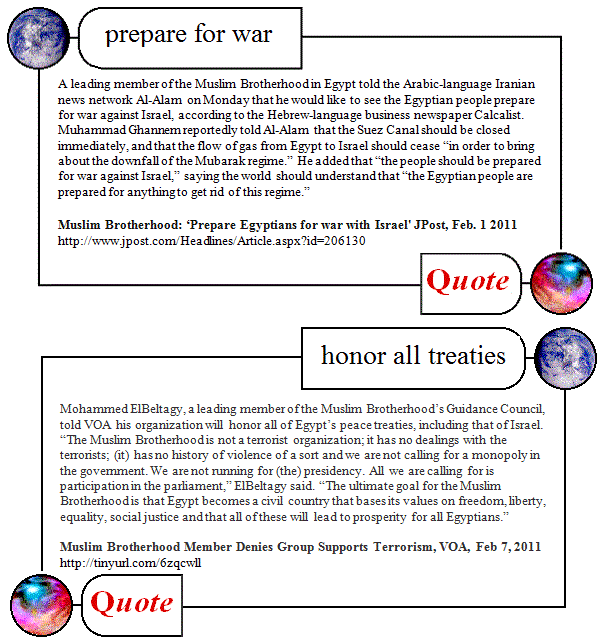
As far as I can tell from a quick search on Google, ElBeltagy is a Muslim Brotherhood MP, while Muhammad Ghanem is the Muslim Brotherhood’s representative in London.

Some will see in this DoubleQuote, further evidence of “taqiyya” — I think that’s quite a stretch. Some will see evidence of a struggle in which two opinions use media access as part of the process of jockeying for position — that seems a lot more plausible. Or it may be as simple as the left hand not knowing what the right hand is doing.

Here’s one analytic overview that came highly recommended by my more expert friends:

Hossam Tammam, Islamists and the Egyptian revolution


Switch to our mobile site
