zenpundit.com » IS

Archive for the ‘IS’ Category

Cole Bunzel captures the Dabiq moment

Friday, October 14th, 2016

[ by Charles Cameron — ISIS and Dabiq, with Stephen O’Leary on the Millerites in parallel ]
.

I have a longish post in the works about the battle for Dabiq which will soon be upon us, in which I’ll give some preliminary indications about the ways in which groups spin things when prophecies on which they’ve depended don’t occur as prophesied and planned. It’s a wonderfully complex business, and one with direct bearing on the current situation.

Meanwhile, Colw Bunzel fills us in on the ISIS strategy this time around, in a tweet today which I’m posting while still working on my longer ZP piece:

**

Postponement.

This is reminiscent of the Millerites, whose prophet William Miller predicted , “I am fully convinced that sometime between March 21st, 1843, and March 21st, 1844, according to the Jewish mode of computation of time, Christ will come.” Stephen O’Leary, in his magisterial Arguing the Apocalypse: A Theory of Millennial Rhetoric, comments:

When the End failed to materialize by March 22, the movement’s first crisis of confidence occurred. Various attempts to recalculate the chronology were made. The puzzling failure of the Lord to return was interpreted as the “tarrying time” of the biblical parable of the wise and foolish virgins (Mt. 25:1—12), a key text for the Millerites. Attempts were also made to justify the failure of prophecy on the grounds that the Lord was testing the believers’ faith.

O’Leary’s chapters 4, Millerism as a Rhetorical Movement, and 5, Millerite Argumentation, are definitive, and Festinger‘s When Prophecy Fails is the classic psychological exploration of prophetic failures, and subsequent work by scholars of apocalyptic and new religious movements have refined and expanded our understanding of such processes. But more of all that in my pending post here, My latest for Lapido: on the fall of Dabiq & failure of prophecy.

AQ < ISIS < Boko Haram

Monday, October 10th, 2016

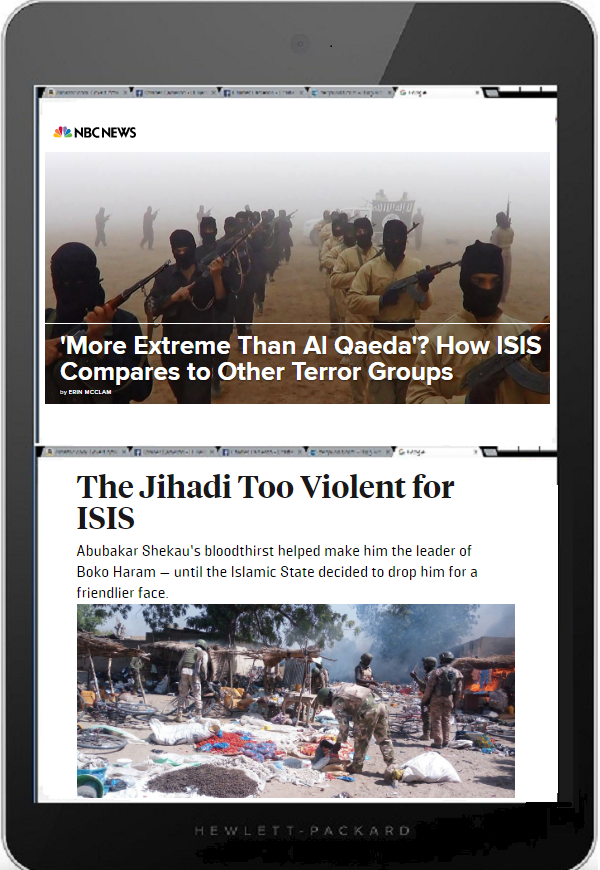
[ by Charles Cameron — a ladder of escalation? a question of quality vs quantity? — it’s hard to judge ]
.

tablet-dq-600-comparative-violence-aq-is-bh

**

  • In single event death toll, al-Qaida has set 9/11 as the high water mark.
  • In terms of territory captured (and enslaved) ISIS had conjoint swathes of Iraq and Syria.
  • In terms of repudiation, Boko Haram has been repudiated for excessive violence by ISIS.
  • Note also that depending on whether your definition of terrorist includes state-sponsored groups, insurgents in occupied lands, etc or not, the list of “most violent” may also include the Quds Force, Haqqani Network, and Kataib Hezbollah

    And one 2014 list of The Most Violent Terrorist Groups in the World Right Now listed Al-Qaeda, Ansar al-Sharia, Hamas, Lashkar-e Taiba, Palestine Islamic Jihad, Kurdistan Workers’ Party, Abu Sayyaf Group, Revolutionary People’s Liberation Party, Hezbollah, Taliban, FARC, and Boko Haram — though the inclusion of FARC illustrates just how tricky formulating (and updating!) such lists can be..

    On the felicities of graph-based game-board design: nine

    Sunday, October 9th, 2016

    [ by Charles Cameron — if the territory is graphical, so’s the map ]
    .

    Terrain, with its named places and transportation links between them, is graphical, as illustrated in this map:

    It makes me wonder how often graph theory (of the sort that gives us the Königsberg Bridge Problem, see the first post in this series) is applied to troop movements — as it often is to public transportation (see the upcoming tenth post).

    **

    My next example of the use of a node-and-edge graphical design both puzzles and intrigues me:

    It puzzles me, because I can’t quitec grasp what Raza Rumi — a very bright fellow — is up to in choosing this particular illustration. And it intrigues me, because once on a vision quest I glimpsed an outstretched eagle’s or hawk’s wing, with a similar graphical overlay of its structural essence. It’s a sight I’ve never forgotten, an exquisite linking of the real and abstract worlds, and one that I’m sadly ill-equipped to reproduce visually myself. Words don’t do it justice.

    **

    My third example, as you can see, is taken from a learned paper describing the use of graphs to illustrate musical compositions according to a strictly defined protocol:

    What interests me here — aside from the fact that any of these digrams could be used as a board in a sufficiently complex HipBone or Sembl game — is that I ran across this particular paper within 24 hours of reading m’friend Bill Benzon‘s account of his friend Michael Bérubé and his son Jamie, introduced in this tweet:

    Bill’s post Jamie’s Investigations, Part 1: Emergence to which his tweet refers us — is illustrated thus:

    benzon-jamie-berube-01

    Michael Bérubé, we read, has recently published a book about Jamie, who has Down’s, Life as Jamie Knows It: An Exceptional Child Grows Up, and it contains a series of Jamie’s drawings, of which this is one example.

    Bill, who is himself the author of Beethoven’s Anvil: Music in Mind and Culture, notes “Jamie loves music, and his dad is a rock-and-roll drummer, so’s his older brother Nick, I believe.” And here’s the clincher — he then asks:

    In what way are these drawings like drum beats?

    So that’s two examples of novel visual representations of musical pattern in just two days, earlier this week.

    **

    Enough for now — onwards to On the felicities of graph-based game-board design: ten — a long, fascinating post IMO, long enough that I’m glad this is a Sunday.

    Earlier in this series:

  • On the felicities of graph-based game-board design: preliminaries
  • On the felicities of graph-based game-board design: two dazzlers
  • On the felicities of graph-based game-board design: three
  • On the felicities of graph-based game-board design: four
  • On the felicities of graph-based game-board design: five
  • On the felicities of graph-based game-board design: six
  • On the felicities of graph-based game-board design: seven
  • On the felicities of graph-based game-board design: eight
  • Cartels & ISIS, Mexico & France

    Friday, October 7th, 2016

    [ by Charles Cameron — terror and anti-clericalism — a double parallel? ]
    .

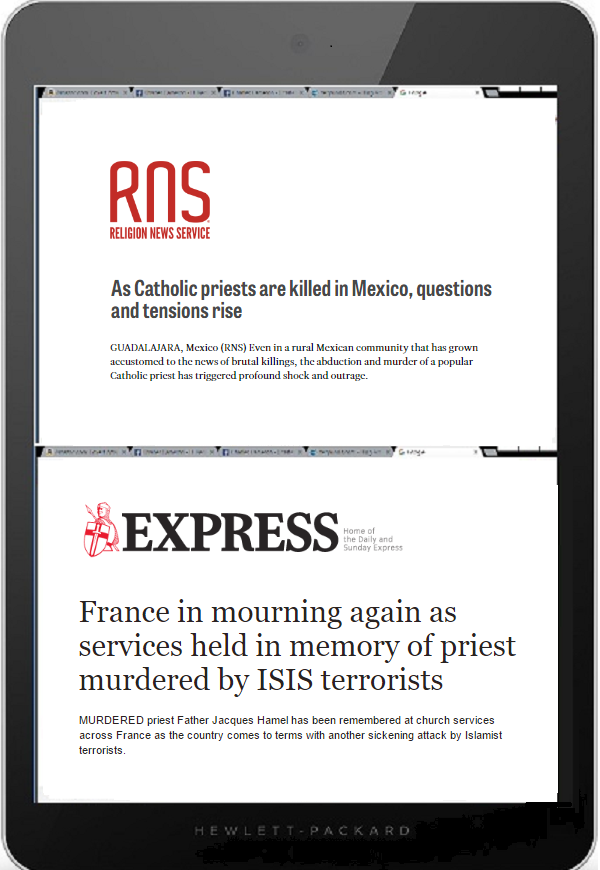
    Imagine how Catholic Mexico feels at the murder of Fr. Jose Lopez Guillen, a priest, if even secular France is shocked by the killing of another priest, Fr Jacques Hamel.

    tablet-dq-600-mexico-france-priests-killed

    **

    From the RNS report:

    Lopez was kidnapped on Sept. 19, the same day authorities discovered the bodies of two slain priests in the eastern state of Veracruz; that makes at least 15 priests slain over the past four years. [ .. ]

    Mexico is the country with the second-largest Catholic population in the world, with nearly 100 million people, or more than 80 percent of the population, identifying as Catholic. But the country has a long history of anti-clericalism and in the past century the government officially and often violently suppressed the church. [ .. ]

    Motives have not been established for the latest killings, but the Catholic Multimedia Center notes that violence against the clergy occurs disproportionately in states with high levels of organized crime, such as Veracruz and Michoacan.

    The organization records 31 killings of priests in Mexico since 2006, the year then-President Felipe Calderon deployed troops to Michoacan in an effort to stamp out the drug cartels.

    A decade on, the war across Mexico has claimed more than 150,000 lives, while Michoacan remains a hotbed of crime and civil unrest.

    Note that France, like Mexico, has a history of anti-clericalism — dating back in the French case to the time of the French Revolution — see my LapidoMedia post, When laïcité destroys egalité and fraternité

    Concerning the Future — black swans & white

    Sunday, September 25th, 2016

    [ by Charles Cameron — in concern, yes — and hope ]
    .

    timeline-with-swans-sm

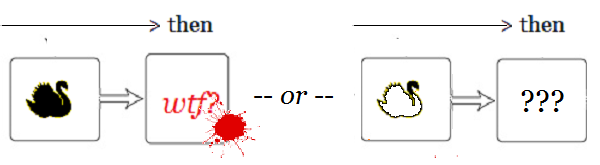
    I know which I’d choose — but I can’t speak for the powers that be (Ephesians 6.12 included).

    **

    Here’s a paragraph from David Barno and Nora Bensahel, The Future of the Army: Today, Tomorrow, and the Day After Tomorrow:

    Some future developments can be predicted, but others will be unexpected and unforeseen. “Black swans” —- unpredictable events with very serious consequences — will be as inevitable then as they have been in the past.105 In 2000, for example, no analyst could have possibly foreseen all of today’s disparate security challenges—the 9/11 attacks, the rise of al-Qaeda and ISIS, a resurgent Russia annexing Crimea and threatening neighbors with force, and China building artificial islands in the South China Sea from which to project power, among others. Unpredicted and unpredictable events will indubitably disrupt sober defense planning and could shift US defense priorities in an instant — especially if there were a nuclear exchange overseas or if a weapon of mass destruction were used against the homeland.

    **

    I’m somewhat sceptical of the polling methodology used by the Lincoln Leadership Initiative to generate these conclusions reported by The Hill:

    Among those who say they will vote for Trump, 48 percent say he’ll create a database to track Muslims? 36 percent say there will be race riots? 33 percent say the government would default on its debt? and 32 percent say Trump would punish his political opponents and authorize internment camps for illegal immigrants.

    Only 22 percent of Trump supporters believe he will start a nuclear war.

    Whatever the reliability of the poll — and I’ve asked — it seems clear that at least some potential voters believe Donald Trump, if elected president, might use nuclear weapons, perhaps in the fight against ISIS.

    I’d call the database, the race riots and the debt default that Barno and Bensahel mentiom black cygnets at best, but the prospect of nuclear war almost qualifies IMO as a full-on black swan — and I’d refer you back to the final sentence of the Barno-Bensahel quote above:

    Unpredicted and unpredictable events will indubitably disrupt sober defense planning and could shift US defense priorities in an instant — especially if there were a nuclear exchange overseas or if a weapon of mass destruction were used against the homeland.

    **

    Barno-Bensahel sat they would consider a nuclear exchange a black swan in their chapter on 2020-2035, whereas Trump’s first term, if he were to be elected president, would barely touch the beginning o0f that range — so that particular black swan, if it is one, might conceivably occur quite soon.

    But note that word “conceivable” — a true black swan, to my way of thinking, would be something that hadn’t even occurred as a possibility to forward thinking folks like David Barno — indeed not even, with all due respect, to John Robb.

    And Barno-Bensahel predict out to 2040.

    **

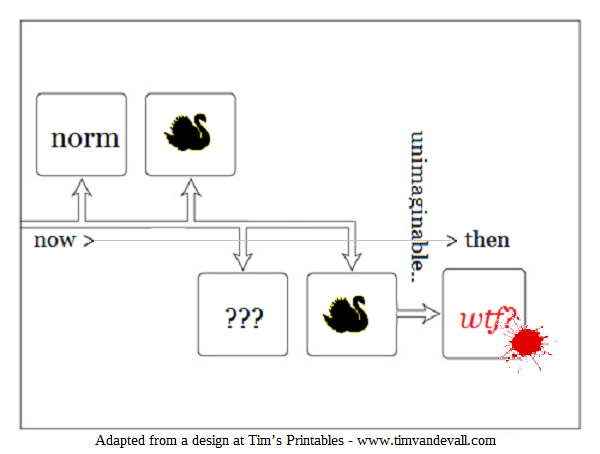
    My own predictive vision as a student of wisdom literature and propecies of various kinds shows me the following timeline:

    timeline-with-swans

    It goes without saying that I could be wrong — a whiter shade of swan might make all the difference.


    Switch to our mobile site