zenpundit.com » historians

Archive for the ‘historians’ Category

“No one is really listening, they are just pretending.” – Madhu

Wednesday, May 2nd, 2012

[by J. Scott Shipman]

As mentioned recently, I’m reading Inventing Grand Strategy and Teaching Command, by Jon Tetsuro Sumida. Chapter 2 is complete, however Sumida included one sentence at the end of the Introduction that has been nagging me. Professor Sumida said, speaking of Alfred Thayer Mahan:

“It remains to be seen whether readers exist with the mind and will to accept his guidance on what necessarily is an arduous intellectual and moral voyage into the realm of war and politics.” (emphasis added)

The phrase “whether readers exist with the mind and will” jumped off the page. Over the last few days I’ve seen several articles of warning of the West’s decline, and while many shed light on symptoms that would indicate decline, most are tired old bromides masquerading as “new thought.” For instance, a few days ago, a friend on Twitter (an Army officer) shared a Tweet from The New Atlanticist of an article called, “Why We Need a Smart NATO.” He tweeted, “Call me a cynic, but haven’t we ALWAYS needed a smart NATO?” Good question. In my estimation, “smart NATO” is yet another venture into sloganeering. While it may call into question my judgement, my first thought on reading “smart NATO,” was a line from the cult movie Idiocracy (if you haven’t seen it, get it) and one scene where the time traveling protagonist is attempting to explain the importance of water to plants to people of the future who use a sports drink instead. Here is the clip:

but it’s got electrolytes…

We’re living in a world of unprecedented availability of information, yet our meta-culture seems indifferent to anything that takes more than a few minutes to consume. Among too many military colleagues I know, it is not uncommon to hear the phrase, “I’ve not read Clausewitz through….nobody does…” And I respond, “But if not you, then who will?” If the practitioners of a profession as serious as the profession of arms don’t read and think deeply, who will? And what will become of the timeless principles learned and recorded at the cost of blood and treasure and how those principles translate into how we fight? I have an abiding fear our military, not out of malice but neglect, is cutting the intellectual cord with the past by making it culturally acceptable to be intellectually indifferent and incurious, to sloganeer instead of think, allowing slogans and PowerPoint as woefully inadequate substitutes. There is no app for intellectual development.

We can’t afford to allow the profession of arms to be anything but intellectually robust and challenging. Zen wrote an excellent summation of the recent posts on disruptive thinkers (which may for some have the ring of sloganeering). However these posts are evidence a lot of the young guys “get it” and want more. Good news, but recognition of the problem is not enough; action is required. Action that may damage a career.

I’m a member of the US Naval Institute, and an on-going concern of the Institute is relevance to the young folks. Yep, relevance. Relevance with a mission statement like this:

“To provide an independent forum for those who dare to read, think, speak, and write in order to advance the professional, literary, and scientific understanding of sea power and other issues critical to national defense.”

Reading, thinking, speaking, and writing requires what Sumida referred to as “mind and will.” Leaders create this condition and desire by example, unambiguous expectations, and by listening, adapting, and sharing their knowledge with subordinates and encouraging them to push their intellect. Good leaders will create a space where deep thinking is expected, where curiosity isn’t the exception, but the rule. Many of our folks in uniform compete in the physical fitness arena and do the hard work necessary to be the best physically, but we need more intellectually rigorous competition in both formal schools and at the unit level. Leaders create this environment, for the best leaders want their people to think. Robert Leonhard in his excellent book, The Principles of War for the Information Age said it best:

“The greatest legacy that a leader can leave behind is a subordinate who is not afraid to think for himself.”

While we can’t pretend to be in good condition or physically fit, some may be tempted to pretend on the intellectual front. Which brings me back to Madhu’s quote: “No one is really listening, they are just pretending.” Doc Madhu, a blog friend and frequent commenter at zenpundit, was commenting on an excellent essay by Mike Few at Carl Prine’s Line of Departure. The essay was titled Finding Niebuhr, and Mike reminds us of Niebuhr’s famous Serenity Prayer:

“Lord, grant me the serenity to accept the things that I cannot change, the courage to change the things that I can, and the wisdom to know the difference.”

Courage and wisdom are virtues enabled by a well-developed, well-rounded, curious intellect. “Pretending” in the profession of arms can have deadly consequences, and more often than not, the pretenders are trying to “be someone” instead of “doing something.” More often than not, this is a group effort, enabled by a crippled culture dominated by groupthink.

Boyd’s challenge continues to ring true:

“To be somebody or to do something. In life there is often a roll call. That’s when you will have to make a decision. To be or to do. Which way will you go?”

This is cross-posted at To Be or To Do.
History Will Judge Only if We Ask the Right Questions

Wednesday, April 18th, 2012

Thomas Ricks of CNAS recently had a historically-minded post at his Best Defense blog at Foreign Policy.com:

What Tom would like to read in a history of the American war in Afghanistan 

I think I’ve mentioned that I can’t find a good operational history of the Afghan war so far that covers it from 2001 to the present. (I actually recently sat on the floor of a military library and basically went through everything in its stacks about Afghanistan that I hadn’t yet read.)

Here are some of the questions I would like to see answered:

–What was American force posture each year of the war? How and why did it change?

–Likewise, how did strategy change? What was the goal after al Qaeda was more or less pushed in Pakistan in 2001-02?

–Were some of the top American commanders more effective than others? Why?

–We did we have 10 of those top commanders in 10 years? That doesn’t make sense to me. 

–What was the effect of the war in Iraq on the conduct of the war in Afghanistan?

–What was the significance of the Pech Valley battles? Were they key or just an interesting sidelight?

–More broadly, what is the history of the fight in the east? How has it gone? What the most significant points in the campaign there?

–Likewise, why did we focus on the Helmand Valley so much? Wouldn’t it have been better to focus on Kandahar and then cutting off and isolating Oruzgan and troublesome parts of the Helmand area?

–When did we stop having troops on the ground in Pakistan? (I know we had them back in late 2001.) Speaking of that, why didn’t we use them as a blocking force when hundreds of al Qaeda fighters, including Osama bin Laden, were escaping into Pakistan in December 2001?

–Speaking of Pakistan, did it really turn against the American presence in Afghanistan in 2005? Why then? Did its rulers conclude that we were fatally distracted by Iraq, or was it some other reason? How did the Pakistani switch affect the war? Violence began to spike in late 2005, if I recall correctly — how direct was the connection?

–How does the war in the north fit into this?

–Why has Herat, the biggest city in the west, been so quiet? I am surprised because one would think that tensions between the U.S. and Iran would be reflected at least somewhat in the state of security in western Afghanistan? Is it not because Ismail Khan is such a stud, and has managed to maintain good relations with both the Revolutionary Guard and the CIA? That’s quite a feat. 

Ricks of course, is a prize winning journalist and author of best selling books on the war in Iraq, including Fiasco and he blogs primarily about military affairs, of which Ricks has a long professional interest and much experience.  Ricks today is a think tanker, which means his hat has changed from reporter to part analyst, part advocate of policy. That’s fine, my interest here are in his questions or rather in how Ricks has approached the subject.

First, while there probably ought to be a good “operational history” written about the Afghan War – there’s a boatload of dissertations waiting to be born – I think that in terms of history, this is the wrong level at which to begin asking questions. Too much like starting a story in the middle and recounting the action without the context of the plot, it skews the reader’s perception away from motivation and causation.

I am not knocking Tom Ricks. Some of his queries are important – “What was the effect of the war in Iraq on the conduct of the war in Afghanistan?”  – rises to the strategic level due to it’s impact and the light it sheds on national security decision making during the Bush II administration, which I suspect, will not look noble when it is revealed in detail because it almost never is, unless you are standing beside Abraham Lincoln as he signs the Emancipation Proclamation.  Stress, confusion, anger and human frailty are on display. If you don’t believe me, delve into primary sources for the Cuban Missile crisis sometime.  Or the transcripts of LBJ and NIxon. Exercise of power in the moment is uncertain and raw.

But most of the questions asked by Ricks were “operational” – interesting, somewhat important, but not fundamental. To understand the history of our times, different questions will have to be asked in regard to the Afghan War. Here are mine for the far off day when documents are declassified:

What was the evolution of the threat assessment posed by Islamist fundamentalism to American national security by the IC from the Iranian revolution in 1979 to September 11, 2001?  Who dissented from the consensus? What political objections or pressures shaped threat assessment?

What did American intelligence, military and political officials during the Clinton, Bush II and Obama administrations know of the relationship between the ISI and al Qaida and when did they know it?

What did American intelligence, military and political officials during the Clinton, Bush II and Obama administrations know of the relationship between Saudi intelligence, the House of Saud and al Qaida and when did they know it?

What did American intelligence, military and political officials during the Clinton, Bush II and Obama administrations know of the relationship between the Taliban and al Qaida and when did they know it?

In the aftermath of 9-11, how did Saudi leverage over global oil markets effect American strategic decision making?

In the aftermath of 9-11, how did Pakistani nuclear weapons effect American strategic decision making?

In the aftermath of 9-11, how did the “Iraq problem”  effect American strategic decision making?

In the aftermath of 9-11, how did nuclear terrorism threat assessments effect American strategic decision making?  Did intelligence reports correlate with or justify the policy steps taken?

Who made the call on tolerating Pakistani sanctuaries for al Qaida and the Taliban and why?

Was there a net assessment of the economic effects of a protracted war in Afghanistan or Iraq made and presented to the POTUS? If not, why not?

Why was a ten year war prosecuted with a peacetime military and a formal declaration of war eschewed?

How did the ideological convictions of political appointees in the Clinton, Bush II and Obama impact the collection and analysis of intelligence and execution of war policy?

Who made the call for tolerating – actually financially subsidizing – active Pakistani support for the Taliban’s insurgency against ISAF and the Government of Afghanistan and why?

What counterintelligence and counterterrorism threat assessments were made regarding domestic Muslim populations in the United States and Europe and how did these impact strategic decisions or policy?

What intelligence briefs or other influences caused the incoming Obama administration to radically shift positions on War on Terror policy taken during the 2008 campaign to harmonize with those of the Bush II administration?

What discussions took place at the NSC level regarding the establishment of a surveillance state in the “Homeland”, their effect on our political system and did any predate September 11, 2001 ?

What were the origins of the Bush administration’s  judicial no-man’s land policy regarding “illegal combatants” and “indefinite detention”, the recourse to torture but de facto prohibition on speedy war crimes trials or capital punishment?

The answers may be a bitter harvest.

The Strategic Dilemma of Bitter-Enders

Sunday, April 8th, 2012

Berlin 1945

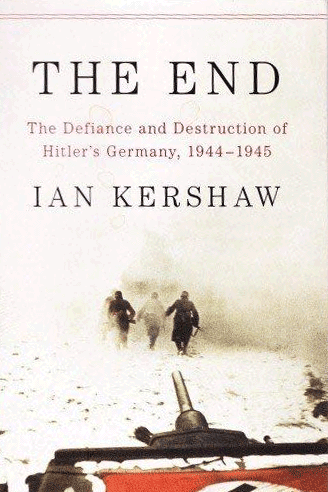
I have been reading The End by Ian Kershaw and it struck me that the story therein of Hitler’s Reich going down to total destruction is really a recurrent phenomena.

It is interesting that Kershaw, who began his earlier 2 volume biography of Adolf Hitler with the hypothesis that the Fuhrer was more the opportunistic vehicle of grand historical forces, in this study of the Nazi Gotterdammerung has accepted that the pull of Hitler’s inexorable authority over  Nazi and traditional German elites was charismatic, personalized and beyond challenge, even when Hitler was encircled by Soviet forces in his subterranean bunker and hours from suicide. Kershaw details how Hitler and his die-hard Gauleiter apparatchiks repeatedly demanded not only the militarily impossible, but the nonsensically insane, from the Wehrmacht, the Waffen-SS and the German people themselves. Virtually everyone struggled to comply.

This story is far from unique.

The Imperial Japanese, it must be said, surpassed even their Nazi allies in stubborn refusal to accept empirical reality and determination to fight to uttermost ruin. After the destruction of their Navy, loss of 100,000 men in Okinawa (their entire army there, minus a handful, fought to the death), the ruin of their cities, approaching famine, exhaustion of aviation fuel and gasoline stocks, the declaration of war on Japan by the Soviet Union and the atomic bombing of Hiroshima – Imperial Japan’s war cabinet deadlocked on a vote to surrender. The Kamikaze enthusiasts among the flag officers proposed a battle plan for their home islands to the war cabinet picturesquely titled “Honorable Death of 100 Million”, with gruesome implications for Japan’s civilian population.

Emperor Hirohito inspects Hiroshima after the atomic bombing

Many years later, Prime Minister Nakasone, who had been conscripted as a mere boy to meet invading American soldiers and Marines on the beach with a sharpened bamboo stake, credited the two atomic bombs with having saved his life. Without them, Japan’s warlords, with the tacit approval of their Emperor, would have coerced the Japanese nation into a gloriously genocidal defeat. A policy that while irrational,  faithfully followed the cultural spirit of Bushido and Japan’s mythic 47 Ronin.

Then there was the ancient example of Masada, the defiance of Titus by the Jewish Sicarii in 73 AD, as described by Josephus:

…. Miserable men indeed were they, whose distress forced them to slay their own wives and children with their own hands, as the lightest of those evils that were before them.  So they being not able to bear the grief they were under for what they had done any longer, and esteeming it an injury to those they had slain to live even the shortest space of time after them,-they presently laid all they had in a heap, and set fire to it.  They then chose ten men by lot out of them, to slay all the rest; every one of whom laid himself down by his wife and children on the ground, and threw his arms about them, and they offered their necks to the stroke of those who by lot executed that melancholy office;  and when these ten had, without fear, slain them all, they made the same rule for casting lots for themselves, that he whose lot it was should first kill the other nine, and after all, should kill himself. Accordingly, all these had courage sufficient to be no way behind one another in doing or suffering;  so, for a conclusion, the nine offered their necks to the executioner, and he who was the last of all took a view of all the other bodies, lest perchance some or other among so many that were slain should want his assistance to be quite dispatched; and when he perceived that they were all slain, he set fire to the palace, and with the great force of his hands ran his sword entirely through himself, and fell down dead near to his own relations. So these people died with this intention, that they would leave not so much as one soul among them all alive to be subject to the Romans.

….Now for the Romans, they expected that they should be fought in the morning, when accordingly they put on their armor, and laid bridges of planks upon their ladders from their banks, to make an assault upon the fortress, which they did,  but saw nobody as an enemy, but a terrible solitude on every side, with a fire within the place as well as a perfect silence So they were at a loss to guess at what had happened. At length they made a shout, as if it had been at a blow given by the battering-ram, to try whether they could bring anyone out that was within;  the women heard this noise, and came out of their underground cavern, and informed the Romans what had been done, as it was done, and the second of them clearly described all both what was said and what was done, and the manner of it:  yet they did not easily give their attention to such a desperate undertaking, and did not believe it could be as they said; they also attempted to put the fire out, and quickly cutting themselves a way through it, they came within the palace,  and so met with the multitude of the slain, but could take no pleasure in the fact, though it were done to their enemies. Nor could they do other than wonder at the courage of their resolution and the immovable contempt of death, which so great a number of them had shown, when they went through with such an action as that was.

What does the phenomenon of bitter-end political leadership mean in terms of strategy?

To the extent that war is a contest of wills or a form of bargaining between two political communities, the fanaticism of bitter-enders simplifies strategy while often complicating the warfare necessary to execute it.  Strategy is simplified because, to borrow a term from labor relations, the “last, best offer” has been refused. No bargaining is taking place – one or more sides refuses peace at any price short of total victory (“unconditional surrender”) or complete defeat. This represents movement away from a limited war for limited ends closer toward Clausewitz ‘s theoretical “Absolute War” by becoming, for the losing party, an existential conflict. The implicit threat to fight to the bitter end in any war – assuming the resources and will to make good on the threat exist – is really a primitive form of psychological deterrence; most states seeking limited objectives will avoid getting trapped in this dynamic.

This means the strategic calculus is altered by such a stance. The war itself and the driving need to wage it to it’s ultimate conclusion may have come to outweigh the value of the original “End” over which the conflict began; perhaps a policy concession or bit of territory or admission by a state’s rulers of a subordinate place in the diplomatic pecking order. While adopting a “bitter-end” position logically seems disadvantageous to the weaker party, it presents the enemy with a new set of problems. The “Means” or costs required to wage a war of conquest and lengthy occupation may be economically or attritionally prohibitive, or even physically impossible. Israel has a fine military and nuclear weapons but the Jewish state is too small to subdue and rule over the Arab states; Imperial Japan, for all it’s martial ferocity and cruelty, could not swallow the vastness of China, divided by civil war and fighting without allies, even before Pearl Harbor. Reach can exceed grasp.

Likewise, the moral burden and diplomatic friction of waging war not only against the opposing army, but the enemy population as well – of bombing or blockading into starvation women, children and the elderly – may be more than a political community or it’s leadership are able to bear and remain unified. As callous and narcissistic leaders of great countries usually are, few of them (fortunately) aspire to follow in the footsteps of Hitler, Stalin or Mao and openly spill an ocean of blood.  The impressive firepower of the bombing campaigns of Lyndon Johnson and Richard Nixon did not break Hanoi’s will to fight the Vietnam War, they broke the Eastern Establishment’s will to pursue anticommunist Containment by force in Vietnam or elsewhere. The brutal counterinsurgency tactics of the French Army in the Algerian War destroyed the Algerian rebels militarily, but it shattered the Fourth Republic politically.

Insurgency, the “war of the weak”, is powerful because it inherently contains elements of bitter-endism. To rise up against one’s own society usually is an act of politically burning your boats and wearing, so far as the state is concerned, the mantle of treason and all that it entails. A desperate act by desperate men and conversely,  many of the leaders of states, being tyrants, are in no better position. Tyrants are widely despised; the Gaddafis or Mussolinis know that their power is their only guarantee of safety and their fate, if they fall into the hands of their people, would be terrible, so any rebellion must be crushed immediately, lest it gain traction. The Shah by contrast, was a congenital coward but a realist. He knew what might happen if he and his family fell into the hands of his political opponents, so the Pahlavi dynasty preemptively fled at the first sign of trouble (twice).

Finally, a word must be said about the position of a people under the leadership of  bitter-ender rulers in a war. Caught between a rock and a hard place, they essentially have three choices, none of them attractive:

1. Make a supreme effort to win the war.

2. Make a supreme effort to overthrow the government and sue for peace.

3.  Desert the cause as quietly as they can on an individual basis and hope for the best.

The best almost never happens. Kershaw’s history of the fate of the Germans in 1945 would have been well understood by Thucydides, even if the Melians were as blameless as the Germans were deserving of their fate:

….About the same time the Melians again took another part of the Athenian lines which were but feebly garrisoned. Reinforcements afterwards arriving from Athens in consequence, under the command of Philocrates, son of Demeas, the siege was now pressed vigorously; and some treachery taking place inside, the Melians surrendered at discretion to the Athenians, who put to death all the grown men whom they took, and sold the women and children for slaves, and subsequently sent out five hundred colonists and inhabited the place themselves.

If you want the bitter end, be prepared to drink the last drop.

The End and Ends

Tuesday, March 13th, 2012

The End by Sir Ian Kershaw

I am currently reading The End, about the last year of the Third Reich and the Nazi death spiral toward Germany’s absolute destruction. It is a fascinating, mass suicidal, political dynamic that was mirrored to an even greater degree of fanaticism by Nazi Germany’s Axis partner, the Imperial Japanese. Facing the prospect of certain defeat, the Germans with very few exceptions, collectively refused every opportunity to shorten the agony or lighten the consequences of defeat and stubbornly followed their Fuhrer to the uttermost doom. It made no sense then and still does not now, seven decades later.

Adolf Hitler’s personal authority over the life and death of every soul in Germany did not end until his last breath. When surrounded by Soviet armies, trapped in his Fuhrerbunker in the ruin of Berlin, all it took for Hitler to depose his most powerful paladins, Hermann Goering and Heinrich Himmler was a word. They still commanded vast military and paramilitary security forces – Himmler had been put in charge of the Home Army as well as the SS, Gestapo and German police – but when Hitler withdrew his support and condemned them, their power crumbled. Goering, the glittering Nazi Reichsmarchal and second man in the state, was ignominiously arrested.

Even in Gotterdammerung, the Germans remained spellbound, like a man in a trance placing a noose around his own neck.

Currently, the chattering classes of the United States are uneasily working their way toward a possible war with Iran, or at least a confrontation with Teheran over their illegal nuclear weapons program (some people will object that, technically, we are not certain that Iran has a weapons program. This is true. It is also irrelevant to the diplomatic dynamic created by Iran’s nuclear activities which the regime uses to signal regularly to all observers that they could have one).  There is much debate over the rationality of Iran’s rulers and the likely consequences if Iran is permitted to become a nuclear weapons state. There is danger and risk in any potential course of action and predictions are being made, in my humble opinion, far too breezily.

In the run-up to war or negotiation, in dealing with the Iranians and making our strategic calculations, it might be useful to recall the behavior of the Germans.

A Wound That Does Not Cease to Bleed: The War in Vietnam

Wednesday, February 29th, 2012

Amigo of ZP blog, West Point military historian Colonel Gian Gentile, throws down the gauntlet in his review of Lewis Sorley’s new biography, Westmoreland: The General Who Lost Vietnam, in The National Interest:

The Better War That Never Was

DID GENERAL Westmoreland lose Vietnam? The answer is no. But he did lose the war over the memory of the Vietnam War. He lost it to military historian Lewis Sorley, among others. In his recent biography of William C. Westmoreland, Sorley posits what might be called “the better-war thesis”—that a better war leading to American victory was available to the United States if only the right general had been in charge. The problem, however, is that this so-called better war exists mostly in the minds of misguided historians and agenda-driven pundits.

In the battle over the memory of the Vietnam War, Sorley annihilates Westmoreland and leaves his character and reputation in smoldering ruins. Yet Sorley’s victory in the fight for the memory of Vietnam has not brought us a balanced historical biography of Westmoreland.  

 ….The better-war thesis argues that if only the U.S. Army had concentrated from the start on building up the South Vietnamese armed forces and winning the hearts and minds of the South Vietnamese people through limited applications of military force, we would have won the war. But the question remains: Precisely how could tactical adjustments early in the war have overpowered the political constraints placed on the army by the Johnson administration, which kept it from taking the fight to the North Vietnamese? Or the dysfunctional nature of the South Vietnamese government and military that precluded them from standing on their own? Or the declining popular support and political will in the United States as the war dragged on without a decent end in sight? Or, perhaps most importantly, how could tactical adjustments toward better methods of counterinsurgency have overpowered a communist enemy that fought the war totally while the United States fought it with limited means? In his Westmoreland biography, Sorley essentially ignores these questions.

Could the United States have prevailed in Vietnam? Yes, but it would have had to commit to staying there for generations, not a mere handful of years. The Vietnam War was an attempt at armed nation building for South Vietnam. Nations and their societies, however, are not built overnight, especially when they are violently contested by internal and external enemies. Thus, to prevail in Vietnam, the United States would have needed the collective will that it mustered to win World War II and would have had to be able to maintain it for generations. That kind of will—or staying power—was never a real possibility.

In war, political and societal will are calculations of strategy, and strategists in Vietnam should have discerned early on that the war was simply unwinnable based on what the American people were willing to pay. Once the war started and it became clear that to prevail meant staying for an unacceptable amount of time, American strategy should have moved to withdraw much earlier than it did. Ending wars fought under botched strategy and policy can be every bit as damaging as the wars themselves.

Well worth the read, not least for Gian’s model of how one historian carefully dismantles the thesis of another.

We are a mere three years from the fiftieth anniversary of Lyndon Johnson’s escalation of the Vietnam War, less than two years from the fiftieth anniversary of the assassination of John F. Kennedy that brought LBJ into power and a year from the fiftieth anniversary of the infamous coup d’etat against American client, President Ngo Dinh Diem, that JFK had approved. Finally,  fifty years ago, Kennedy drastically increased the American military advisory mission to South Vietnam to just under 10,000 men and signed off on clandestine operations against North Vietnam.

All those fiftieth anniversaries amount to a golden jubilee of rancor.

The bitterness sown by the lost war in Vietnam still burns in American politics like red hot coals. Less bright perhaps than the open flame of 1968, but if you scratch the surface, you will find with no less heat. The war spawned division and polarization that twisted our politics and poisoned public debate to this day, echoing now as farce as much as tragedy.

During the 1980’s, Vietnam historiography was virtually a cottage industry. It was the subject that ate the profession as a generation of academics who cut their academic teeth during the era of antiwar protest on campus acquired tenure, middle-aged paunches and lost hair while nursing their political grievances in their scholarship. I personally recall, as an  undergraduate, the war being referenced (usually along with vitriolic abuse of Ronald Reagan) in every humanities class, no matter how remote the course, with some professors being known for the quality of their off-topic rants.

While Westmoreland bears heavy responsibility for his part in a losing a war, even as theater commander in Saigon he was only an executor, not a maker, of strategy, much less national policy. Westmoreland did not lose Vietnam in a stunning battlefield capitulation, so Gentile is right to defend “Westy” from being scapegoated for the poor strategic reasoning hatched in the Oval Office. Where Westmoreland was at fault was in his inability to either intellectually comprehend the bigger strategic picture in which he found himself struggling (most likely) or if he did, to effectively articulate the strategic environment in Southeast Asia to a domineering President who was stubbornly determined to brook no contrary advice (possible). Had Westmoreland tried, he likely would have failed (Brute Krulak’s effort in this regard got him physically ejected from the Oval Office by the seat of his pants by Johnson himself. I am dubious that LBJ would have been any happier with contradiction of policy from Westmoreland).

Gentile, much like my professors of yore, is deeply interested in the congruence between events in his own time with those of the Vietnam era., in particular, the salience of counterinsurgency doctrine in the wars of Iraq and Afghanistan. There is, of course, some continuity between the Vietnam era and today present, a historical thread seized by the COINdinistas themselves in their veneration of Galula and slurping knife-blade portions of soup, but the continuity has limits. I suspect a Millennial generation vet of Kandahar or Fallujah, should they venture to become a historian, will frame and seek to explain their wars without much reference to the societal touchstone that is Vietnam.

Perhaps by then, for American society, Vietnam will have finally ceased to bleed.


Switch to our mobile site